

Expert Tips: How to Choose a Powder Flowability Tester
Getting your powder flow right is the secret to a factory that runs like a well-oiled machine. When your ingredients slide perfectly every time, you’re looking at flawless batches, zero downtime, and a production line that hits its targets without breaking a sweat.
But with so many gadgets on the shelf, how do you go about picking out the right bit of kit for your specific setup? This guide breaks down exactly what to look for to keep your quality checks satisfyingly spot on and your output at an all-time high.
Key Takeaways
- Catching clumping issues early stops expensive production jams and protects your profit margins.
- You absolutely have to match your testing equipment to your specific materials, whether you are dealing with free-flowing granules or sticky, static-heavy dust.
- A reliable machine needs to track classic industry metrics like the Angle of Repose and Carr's Index.
- Do not settle for flimsy hardware. You need pinpoint accuracy, a heavy-duty frame, and a setup that is actually easy for your floor team to use.
- Getting the paperwork right is mandatory, so make sure your tester follows strict pharmacopeial guidelines.
The Financial Impact of Powder Behavior (ROI)
Before we get into the nuts and bolts of the machinery, we need to talk about why this actually matters for your profit. From where we’re sitting, pretending your powder flow isn't a problem isn't just a small mistake; it’s a direct hit to your bank account.
Think about a completely preventable disaster: a jammed hopper on a Friday afternoon totally ruining a $50,000 batch of active pharmaceutical ingredients simply because the flow wasn't tested beforehand. When your ingredients get sticky, you end up tossing whole batches in the bin and dealing with machines that are stuck and shivering because of a clogged hopper.
We’re firm believers that getting a high-quality machine to test this stuff pays for itself in a heartbeat. By figuring out exactly how that dust is going to behave, you stop wasting expensive raw materials and keep your heavy-duty mixers from wearing out too fast. In our book, a tester isn't just another bill to pay; it’s the bodyguard for your profit margins.
Industrial Sectors Where Flow Consistency is Mandatory
Every industry has its own flavor of headaches, and we’ve noticed the need for being dead-on accurate is higher than ever. A versatile machine like the Powder Flowability Tester EFT-01 is a total lifesaver in spots like these:
- Pharmaceuticals: We’re convinced this is the big one. You’ve got to make sure your active ingredients are spread perfectly even while you’re cranking out pills at lightning speed.
- Food & Beverage: Nobody wants a clumpy protein shake. You need that powder to flow fast and stay dry in everything from spicy taco mixes to cake flour.
- Makeup & Cosmetics: Think about it; nobody is going to buy a face powder or eyeshadow that goes on in weird, patchy clumps. You need that stuff to slide on silky smooth every single time.
- Farming & Chemicals: If you're pumping out fertilizers or weed killers, that dust has to spread perfectly across a massive field. If it jams up the spreader, you’ve got a massive headache on your hands.
- Construction & Cement: When you're dealing with giant silos of cement or drywall dust, a bad clump isn't just a minor annoyance; it's a massive, day-ruining blockage that takes heavy machinery to clear out.
- Battery Manufacturing: Believe it or not, the guts of modern batteries (like the ones in your electric car) start out as super-fine dust. If that powder doesn't flow right when they're coating the parts, the whole battery ends up as scrap.
- Additive Manufacturing (3D Printing): As this tech gets bigger, we’re seeing a massive need for metal or plastic dust that flows without a single hiccup. In these cases, dynamic measurements are critical because flow under spreading conditions can make or break the part.
Essential Metrics for Evaluating Material Performance
To really get what’s going on inside your drums, we think your new machine has to be able to track the classic industry numbers.
However, we also believe that no single method tells the whole story. For a truly reliable picture, researchers suggest combining different tests, like shear cell measurements with angle of repose and compressibility indices. You want to make sure the unit is dead-accurate when it checks:
- Angle of Repose: The old-school, tried-and-true way to see how much friction is holding your powder back. Think of it this way: if your powder piles up into a steep mountain instead of settling out relatively flat, you can bet your bottom dollar it’s going to bridge and block your capsule-filling machines later on the line.
- Carr's Index & Hausner Ratio: We see these as the "must-haves." They tell you how much your powder squishes down, which is a huge hint for how it’ll act in a big machine.
- Flow Rate Analysis via Discharge Orifice: This measures how much stuff drops out in a certain amount of time. It’s the perfect way to see if your hoppers are going to get jammed up during a shift.
Related article: Solve Powder Clogs: Angle of Repose vs Shear Cell Testing
Key Features of Powder Flowability Tester Equipment
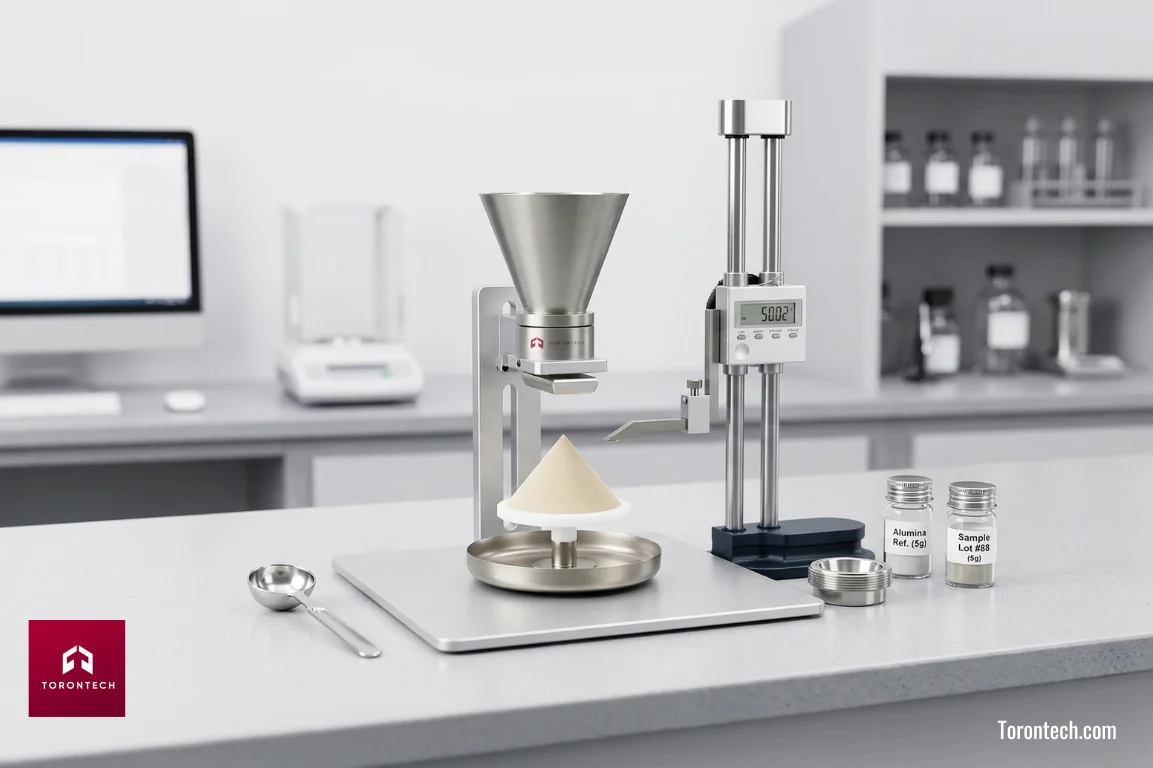
To make sure your numbers are the same every single time you run a test, you’ve got to look at the guts of the machine. Here are the key features of powder flowability tester units that we always put at the top of the list:
Spot-on Accuracy
The whole point of the machine is to give you the real story on your powder. We’re convinced that top-tier sensors and precision components are a requirement if you want to stop guessing and start knowing.
When you're dealing with wildly expensive active ingredients, a machine that rounds up or down because of cheap internal parts is just going to bleed money. You need pinpoint, dead-on data every single time.
Handling Minimal Samples
In the early stages of a product, you might only have a tiny bit of powder to work with. We believe a top-tier tester must be able to pull useful data from very small sample sizes. This allows you to spot flow issues before you commit to a massive production run.
Easy-to-Use Setups
We’re of the opinion that testing equipment shouldn't feel like a puzzle. If it takes a week to learn how to set it up, your team is going to make mistakes. Go for the ones with a straightforward design that just makes sense.
Think about your operators out on the floor. They're likely wearing thick safety gloves and working in a dusty room. If the powder flowability testing process is too complicated or requires pecking at tiny menus just to run a basic hopper test, your entire schedule is going to drag.
Heavy-Duty Framing
Factories are rough places. You need something that can take a literal beating and keep on ticking without getting cross-contaminated by the last batch. Look for high-grade stainless steel that refuses to rust, scratch, or hold onto leftover residue.
If the housing feels flimsy, walk away. You want a heavy piece of equipment that handles abrasive metal grits or sticky food starches all day long without flinching.
Consistency
A great machine has to give you the same answer twice, regardless of whether you're testing free-flowing granules or stubborn, cohesive dust. We absolutely prefer setups that lock out human error completely through standardized parts.
If you are looking at digital models, look for features that log the data automatically and spit out clear, clean reports, so nobody is left squinting at a clipboard trying to guess what the last guy scribbled down.
How to Choose a Powder Flowability Tester
Now that you’re up to speed on the metrics and the shiny bits, getting a solid handle on the basics (like how the grains feel or if they’re carrying a static charge) is the first move before you spend a dime on new gear.
Choosing the right device really comes down to matching the machine’s measurement principles to your powder's physical traits and your specific industrial use. Consider these final factors to ensure you make the right investment:
Compliance with International Quality Standards
Make sure the tester plays nice with the big international rules, such as USP or ASTM, that your quality team cares about.
When the auditors show up with their clipboards, they don't want to hear that your machine is "pretty close" to the official testing methods. You need to prove that your equipment pulls data in exact accordance with strict pharmacopeial guidelines. It’s the reason we made sure the Torontech EFT-01 gets the paperwork right before you even think about putting it on the floor.
Will it Work with Your Materials?
The machine has to be able to handle whatever you throw at it, from fluffy medicine dust to heavy industrial grit. There is a massive difference between handling standard granulated table salt, which moves like absolute water, and dealing with an ultra-fine whey protein isolate or a static-heavy API that sticks together like wet sand.
Consider a notoriously difficult material like a highly static cosmetic pigment. That kind of dust will coat the inside of standard machinery like literal spray paint if you aren't prepared for it. Ask the hard questions about whether the tester has the right attachments and coatings to handle your most annoying ingredients. Different testers, like shear cell units or powder rheometers, vary in how they respond to cohesiveness and particle shape.
Fitting Into Your Lab
We often tell folks to think about how much desk space they’ve actually got. You want something that slides into your daily routine without causing a massive headache. But physical footprint isn't the only thing to check. You also have to think about clean-up times and workflows. If the machine takes a full hour to pull apart and scrub clean between batches, your team will hate using it. Make sure the equipment is simple to dismantle, clean, and reset for the next run.
Improve Your QC with the Torontech EFT-01
Grasping the nuances of material testing is what gets us out of bed in the morning. The Torontech Powder Flowability Tester EFT-01 was built to give you those dead-on evaluations, making it a breeze to get ready for making pills or filling up capsules.
It’s built to last and it’s satisfyingly simple to run. We’re calling it: the Powder Flowability Tester EFT-01 is the perfect partner to help you keep every batch looking the same and stop those annoying production jams before they even start.
Strengthening Your Production Workflow with Torontech
Sorting out clumping problems shouldn't be a nightmare. When you know exactly how to choose a powder flowability tester and keep an eye out for the right key features of powder flowability tester units, your product quality will go through the roof without emptying your savings account.
Check out the Torontech EFT-01 now and get your factory running like a dream.
References:
- Tay, J., Liew, C., & Heng, P. (2016). Powder Flow Testing: Judicious Choice of Test Methods. AAPS PharmSciTech, 18, 1843 - 1854.
- Salehi, H., Barletta, D., & Poletto, M. (2017). A comparison between powder flow property testers. Particuology, 32, 10-20.
- Deng, T., Garg, V., Diaz, P., Markl, D., Brown, C., Florence, A., & Bradley, M. (2022). Comparative Studies of Powder Flow Predictions Using Milligrams of Powder for Identifying Powder Flow Issues. International journal of pharmaceutics, 122309.
- Zegzulka, J., Gelnar, D., Jezerská, L., Prokeš, R., & Rozbroj, J. (2020). Characterization and flowability methods for metal powders. Scientific Reports, 10.
- Tharanon, W., Guo, Y., Peerapattana, J., & Sun, C. (2024). A systematic comparison of four pharmacopoeial methods for measuring powder flowability. International journal of pharmaceutics, 124454.
- Marchetti, L., & Hulme-Smith, C. (2021). Flowability of steel and tool steel powders: A comparison between testing methods. Powder Technology, 384, 402-413.
- Tan, Y., Zhang, J., Xiang, L., Xu, Y., & Wu, C. (2021). Comprehensive evaluation of powder flowability for additive manufacturing using principal component analysis. Powder Technology, 393, 154-164.
