

Solve Powder Clogs: Angle of Repose vs Shear Cell Testing
We’re just going to say it: if your powder isn't sliding like it should, you’re basically watching your operational budget vanish.
Moving massive piles of grit and dust is the heart of the business, and when things get stuck, you're facing a massive, pricey headache. To keep the facility running smooth, you need to pick the right way to check your materials: angle of repose vs shear cell testing.
We’re here to help you figure out which one keeps your facility from turning into a total logjam.
Key Takeaways
- Flowability is the backbone of production efficiency and directly impacts your bottom line.
- The angle of repose is a fast and simple check for materials that already flow well.
- Shear cell testing is the professional standard for cohesive or moisture sensitive powders.
- Most industrial silos and hoppers require the high pressure data provided by shear testing.
- Following strict rules like ASTM D6128 and USP <1174> ensures your results are legal and accurate.
- Choosing the right powder flowability tester helps you avoid expensive clogs and unplanned downtime.
Comparative Analysis: Methodology Overview
For those in charge of quality who are running around with zero time to spare, here is the lowdown on how these two ways of powder flowability testing actually stack up. We think that while both have their moments, your choice should depend on how much of a headache your specific material is to handle.
| Angle of Repose | Shear Cell Testing | |
|---|---|---|
| Main Job | Quick-and-dirty flow check | Sorting out sticky bins and tough powders |
| What You Get | One lonely number (the angle) | A full map of how it squishes and slides |
| Material State | Fluffy and loose | Squeezed hard and packed down |
| The Rulebook | USP <1174> | ASTM D6128 |
| Best For | Dry stuff that slides like silk | Gunk that stays put or hates water |
Material Performance Matrix
To make things even clearer right out of the gate, let's look at a few specific everyday industrial materials and decide exactly which test they need:
- Dry Table Salt: Angle of Repose. It is highly uniform, completely dry, and flows freely. A basic check is plenty.
- Wet Coal Dust: Shear Cell Testing. This stuff is heavy, sticky, and packs down into a solid brick under its own weight.
- Whey Protein Isolate: Shear Cell Testing. It is notoriously fluffy, prone to absorbing moisture, and loves to cling to the sides of a hopper.
- Plastic Resin Pellets: Angle of Repose. Smooth, round, and predictable. They slide past each other without putting up a fight.
- Titanium Dioxide: Shear Cell Testing. A highly cohesive pigment that easily bridges and ratholes in large bins. You need the high-pressure data to handle it safely.
Primary Assessment: Angle of Repose (AoR)
The angle of repose is basically the grandparent of powder checks. It’s been around for decades. All you do is pour your stuff through a funnel into a heap and see how steep that little mountain gets before it starts slumping over.
It’s still a big deal for following certain official rules, like USP <1174> for those making medicine, which gives you a standardized way to do this basic measurement.
- Low Angle (under 30°): This stuff is silky smooth and slides right out of the bag.
- High Angle (over 45°): This stuff is clingy, grumpy, and hates to move.
To give you a clear picture, the materials that usually pass this basic check with flying colors are things like completely dry silica sand or perfectly uniform plastic pellets. They are simple, predictable, and don't clump.
The Good and The Bad of Angle of Repose
The best thing about this is it’s straightforward. You don’t need a specialized degree to do it, and it gives you a super-fast look at how your material acts when it’s just sitting there loose.
But, being that simple is also why it can let you down. We see people lean way too hard on this number for giant storage bins, and honestly, that’s a massive gamble. Angle of repose doesn't care about the heavy weight of tons of powder sitting on top of each other in a huge metal silo.
Since it only looks at loose stuff, it usually misses the signs that your bin is about to get a "rathole" or a giant clog when the pressure gets turned up. In fact, research shows that while it works for coarse materials, this method struggles with fine or highly cohesive powders because of clumping and particle shape issues.
Advanced Characterization: Shear Cell Testing
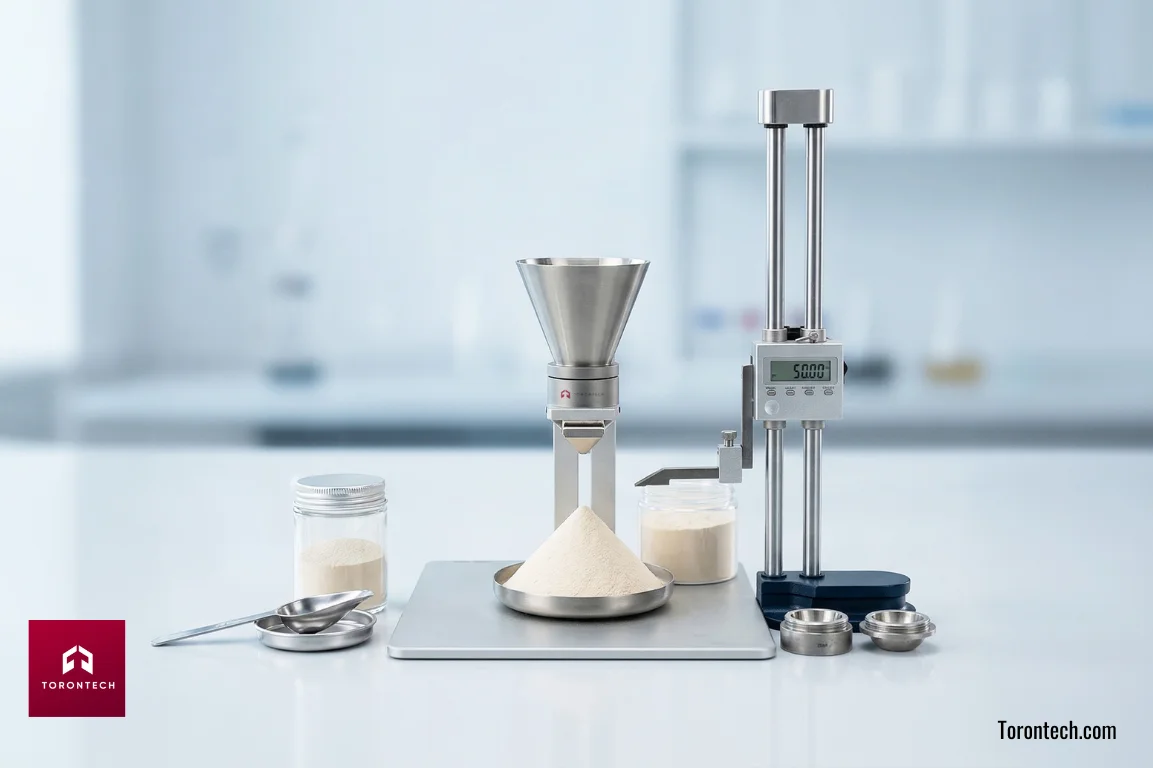
When the simple stuff isn't enough, smart folks turn to shear cell testing. This way of doing things measures how much force you need to make a packed layer of powder actually move under different amounts of heavy pressure.
This is the big one for sticking to serious industrial rules like ASTM D6128, which makes sure your results are spot-on every single time you run the test. We think this is the only way to go if you’re trying to build something that actually works.
When you do a shear cell testing vs angle of repose comparison, you see that the shear test puts the powder in a special box and piles on the weight to mimic what it’s like at the very bottom of a massive bin. Then, it pushes sideways until the powder finally gives up and slides.
For a realistic perspective, think about testing damp cement powder, sticky titanium dioxide, or fine cohesive flour. These materials are notorious for jamming machinery, making high-pressure shear cell testing absolutely essential to figure out their exact breaking points.
Why Shear Cell Testing is Better
In our view, shear cell testing is the clear choice for any job that isn't a walk in the park. It gives you the full story. You get to see how the powder behaves when it’s packed tight, how much it sticks to itself, and its inner friction.
Studies back this up, showing that shear cell methods provide detailed measurements of powder shear strength and cohesion under controlled stress, making them far more reliable for industrial design. This is the "secret sauce" for building bins that actually empty out without you having to hit them with a hammer.
In the past, people thought this gear was too pricey or too odd to use. But looking at the tools out there now, like our Powder Flowability Tester EFT-01, the new machines do the heavy lifting for you. We think they’ve become a total necessity for any lab that wants to get things right.
Regulatory Compliance and Industrial Standards
Having the right gear on the floor is really only half the battle. Sticking to the strict industry guidelines, like the rulebooks from ASTM and USP, is what keeps the auditors smiling and your production fully legal. Let's get specific. If you are checking powder for medicine, USP <1174> tells you exactly how to measure that pile so your results aren't just a wild guess.
For heavy-duty shear tests, ASTM D6128 demands exact weights, specific cell sizes, and precise pulling speeds. If your machine can't hit those exact numbers every single time, your data belongs in the trash. When you use specialized testing equipment, such as the Powder Flowability Tester EFT-01, it comes pre-loaded to handle these strict requirements right out of the box.
You remove the guesswork, you lock in your batch consistency, and you prove your quality to anyone who asks, from internal quality controllers to tough outside inspectors.
Industrial Case Studies and Operational Impact
To see why this matters, look at how these flow issues actually hit the bottom line on the shop floor. We’ve noticed the most successful operations focus on the financial impact of these tests:
Pills and Medicine
When dealing with sticky ingredients that go into tablets, like fine ibuprofen powder, the angle of repose usually strikes out.
We think shear cell testing is a must-have here to stop your tablet press from clogging up, which ruins expensive batches and causes massive headaches for quality control. Experts agree that combining these methods gives you the most complete picture for pharmaceutical powders.
Rocks and Dirt
Heavy materials push down with tons of weight. We believe that just looking at a little pile is a one-way ticket to a blocked silo. You need real-world shear testing to build a storage bin that won't fail and shut down your entire supply chain.
Food and Snacks
For plain dry ingredients, a quick angle of repose check might be fine for a morning check. But if the air gets muggy, we suggest shear cell testing, because damp powder turns into a solid brick faster than you can blink, ruining massive production runs.
3D Printing with Metal
Tiny dust has to spread out perfectly flat. While basic checks give you a rough idea, we see shear cell testing as the real key to making sure the powder lays down flawlessly, preventing microscopic flaws in high-dollar parts.
Chemicals and Plastics
Keeping things moving is the name of the game. We suggest using shear cell testing to help your team predict how stuff will act when it’s buried under a mountain of material, ensuring your mix ratios stay spot-on and pass final inspection.
Torontech: Final Recommendation
Picking your way of checking things is all about what your powder is like and how you’re storing it. We think if you’re working with stuff that is super dry, always the same, and slides like a dream in small tubs, the angle of repose might be enough of a quick check to get by.
But if you’re building big bins, dealing with gunk that hates to move, or materials that go weird when they get damp, we believe that basic checks are just leaving way too much to chance. To stop your line from grinding to a halt and keep your quality from dipping, stepping up to advanced shear cell testing is the way to go for any shop that wants to stay in the game.
Overall, shear testing is the clear winner when you need precise flow behavior under stress, whereas the angle of repose serves as a useful quick check for less sticky materials.
And getting your lab into top shape shouldn't mean you have to empty your pockets. At Torontech, we’re all about giving you gear that hits the mark every time without the eye-watering price tag. We make machines that are a breeze to use and easy on the budget, all to keep your factory floor running like a well-oiled machine.
Take a look at our Powder Flowability Tester EFT-01 today. We’d love to help you find the perfect setup that fits your shop like a glove.
References:
- Fukui, M., Shimada, Y., & Tahara, K. (2024). Analysis of Powder Properties of Pharmaceutical Excipients Using a Constant-Volume Shear Tester. Chemical & pharmaceutical bulletin, 72 11, 1024-1033.
- Lanzerstorfer, C. (2017). Dusts from dry off-gas cleaning: comparison of flowability determined by angle of repose and with shear cells. Granular Matter, 19, 1-7.
- Macho, O., Demková, K., Gabrišová, L., Čierny, M., Mužíková, J., Galbavá, P., Nižnanská, Ž., Blaško, J., Peciar, P., Fekete, R., & Peciar, M. (2020). ANALYSIS OF STATIC ANGLE OF REPOSE WITH RESPECT TO POWDER MATERIAL PROPERTIES. Acta Polytechnica.
- Poddar, R., Saluja, G., Mallick, S., & Kundan, L. (2023). An investigation into static angle of repose using pharmaceutical powders. Particulate Science and Technology, 42, 344 - 353.
- Tay, J., Liew, C., & Heng, P. (2016). Powder Flow Testing: Judicious Choice of Test Methods. AAPS PharmSciTech, 18, 1843 - 1854.
- Tharanon, W., Guo, Y., Peerapattana, J., & Sun, C. (2024). A systematic comparison of four pharmacopoeial methods for measuring powder flowability. International journal of pharmaceutics, 124454.
- Vyas, Z., Sen, A., Shetty, A., Callegari, G., Muzzio, F., & Razavi, S. (2025). Exploring pharmaceutical powder cohesion through the Warren Spring cohesion test. Advanced Powder Technology.
- Zegzulka, J., Gelnar, D., Jezerská, L., Prokeš, R., & Rozbroj, J. (2020). Characterization and flowability methods for metal powders. Scientific Reports, 10.
