Guide to BOCLE Lubricity Test & ASTM D5001 Standards
Is your jet fuel losing its "slickness"? As global refining standards strip away natural lubricants, the risk of metal-on-metal grinding and engine failure has never been higher.
At Torontech, we have seen that the margin for error in testing is now incredibly thin. Protecting your expensive aerospace hardware starts with a firm grip on the ASTM D5001 BOCLE test.
This guide breaks down the essential method for keeping your fuel certifications accurate and your aircraft safely in the air.
Key Takeaways
- Heavily processed aviation fuels lose their natural lubrication, increasing the risk of severe metal-on-metal friction inside aircraft engines.
- The ASTM D5001 standard provides a strictly regulated method to measure exactly how well a specific fuel prevents hardware wear.
- Relying on older manual equipment often leads to inaccurate humidity and temperature readings, which can cause false passes and catastrophic component breakdowns.
- Upgrading to self-regulating systems with automated PLC controls ensures pinpoint accuracy, saves dozens of operator hours, and drastically lowers long-term operational costs.
What is the ASTM D5001 Standard?
Think of ASTM D5001 as the definitive rulebook for verifying the lubricating quality of aviation fuel. Established by the experts at ASTM, this guide specifies the exact environmental parameters and hardware required to determine if a fuel can prevent mechanical components from wearing themselves down.
Research confirms that BOCLE emerged as the most significant test for aviation turbine fuel lubricity, specifically relied upon to detect low-lubricity fuels and the effect of additives or polar species.
For instance, when dealing with standard commercial Jet A or Jet A-1 fuels that have undergone severe hydroprocessing to remove sulfur, those liquids lose their natural boundary lubrication. That is exactly why specialized chemical treatments, like Corrosion Inhibitor/Lubricity Improvers (CI/LI), are added back into the mix. This test confirms whether those chemical additions are doing their job correctly before the fuel ever reaches the runway.
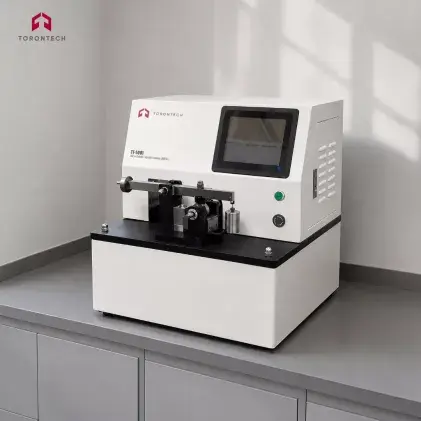
By employing advanced hardware like our Ball-on-Cylinder Lubricity Evaluator (BOCLE) TT-5001, technical teams can accurately simulate the friction and wear that occur within a jet engine. From our perspective, the data points generated here serve as the final safety net.
They indicate whether a fuel batch is ready for distribution or if it needs a precise dose of additives to ensure it is slick enough for heavy-duty use.
BOCLE Test Methodology and Procedure
The BOCLE test method is a remarkably clever setup that yields exceptionally sharp results. Instead of a messy manual process, the procedure breaks down into precise, measurable steps:
- Sample Preparation: Exactly 50±1.0 ml of the fuel sample is poured into a specialized test reservoir. The liquid then undergoes a strict fluid pretreatment process, flowing at a rate of 0.5 L/min directly through the fluid and 3.3 L/min over the surface for 15 minutes.
- Environmental Control: It is vital to keep the conditioned air within that testing chamber perfectly regulated. You must maintain a steady relative humidity of 10%±0.2% at exactly 25±1°C, with zero room for fluctuation. Studies emphasize that standardizing variables like humidity control and the reference fluid is absolutely essential for batch-to-batch consistency.
- Mechanical Simulation: A polished steel ball held firmly in a vertical chuck is pressed against a steel ring. This action utilizes a heavy, calibrated applied load of 1000 g (using a 500 g weight accurate to ±1 g), establishing a maximum test force of 10 N.
- Dynamic Friction: As that ring rotates, capable of hitting a cylinder rotational speed from 0 up to 240 rpm, it dips into the fuel reservoir, carrying a fresh film of liquid directly to the point where the ball and ring meet.
After running for exactly 30±0.1 minutes, that friction leaves a small scuffed mark, known as a wear scar, on the stationary ball. Measuring the exact dimensions of that scar is the entire objective of the BOCLE lubricity test. If the mark is remarkably small, your fuel provides excellent protection.
If it is large and irregular, you have a friction issue to address. We believe that achieving a spot-on measurement here is the most critical factor, as a tiny fraction of a millimeter is often what separates a "pass" from a "fail."
Furthermore, research highlights that the repeatability and reproducibility of BOCLE wear data can sometimes be limited, meaning careful execution and multiple replicates are needed to avoid mis-ranking lubricity.
Critical Risks of Inaccurate Lubricity Evaluation
Inaccurate lubricity assessments can lead to serious operational failures, such as expensive engine hardware turning into scrap metal long before its time. Extensive testing shows that standard BOCLE and scuffing variants correlate strongly with actual pump wear, unit injector wear, and engine rig tests .
Consider a hypothetical situation where a fuel batch with inadequate lubricity slips past a lab's quality checks. The negative outcomes snowball rapidly:
- Severe Hardware Friction: Once that fuel is loaded into an aircraft, the high-pressure fuel pump, a critical piece of hardware relying entirely on the liquid itself for lubrication, begins to experience intense metal-on-metal wear.
- Catastrophic Component Breakdown: The metal surfaces scuff and degrade at an alarming rate, which can lead to complete pump failure mid-operation.
- Astronomical Financial Hits: An event like this grounds entire fleets and results in massive repair bills, simply because a tiny wear scar measurement was slightly off in the lab.
We have seen that the primary struggle for modern labs is removing the "human factor" that leads to inconsistent results. Specifically, labs face major hurdles such as:
- Environmental Inconsistencies: Attempting to manually maintain that strict 10% humidity and perfect 25°C temperature is a massive, error-prone challenge.
- Manual Oversight Risks: Relying on human observation is no longer sufficient for the rigorous demands of jet fuel certification.
Moving to automated systems is quite simply the most logical path forward.
Key Advantages of Modern BOCLE Systems
While the standard ASTM D5001 BOCLE is excellent at detecting additive-induced wear reduction, the industry also relies on variants like the Scuffing BOCLE (SLBOCLE) to measure specific scuffing loads. However, lubricity rankings depend heavily on contact conditions, meaning no single bench test can uniquely define lubricity for every component.
For aviation fuels with new synthetic components, BOCLE is often best used alongside complementary tests like HFRR test or BOTD to fully represent reciprocating contacts.
Related article: BOCLE vs HFRR: Guide to Fuel Lubricity Testing
Regardless of the specific variant used, the most advanced BOCLE machines available today have evolved significantly to make laboratory workflows much smoother. We advocate for the inclusion of smart features that make staying compliant a much easier task.
Automated PLC Integration
We have found that units equipped with a dedicated PLC control system and clear touch screen operation take a significant burden off the operator by managing the entire test cycle effortlessly.
Advanced Temperature Regulation
Premium hardware relies on advanced semiconductor technology for heating and cooling processes. In our experience, this is the absolute best way to ensure quick cycle times and keep your sample locked at that mandatory 25°C fluid temperature.
Precision Humidity Management
Utilizing a high-precision gas mass flow controller adjusts the air humidity in real-time, offering rapid adjustment and minimal drift so you never stray from that 10% target.
Integrated Analytical Tools
Top-tier systems feature a microscope and camera system equipped with coaxial light illumination technology, providing binocular observation with a clear, bright field of view. Our setup includes a long focal length objective lens that facilitates easy handling of the steel balls, while an electronic micrometer accurately and swiftly measures the size of the wear spots directly on the machine.
Optimizing Total Cost of Ownership (TCO)
For decision-makers managing a budget, the initial price on the invoice is only part of the equation. The long-term drain on company resources is what truly impacts the bottom line.
We have always maintained that for a machine to be a genuine bargain, it must be easy to keep in top shape and simple to verify for accuracy over many years of service.
To put this into perspective, think about a high-volume testing facility processing fifty fuel samples a week. If operators are constantly fighting with manual humidity controls or waiting on slow temperature adjustments, they lose dozens of productive hours every month.
By upgrading to a self-regulating unit, that facility reclaims those lost hours and significantly reduces annual service fees, proving that operational efficiency drives serious financial savings.
Hardware like our TT-5001 is built to be exceptionally durable. By utilizing standard assembly components, the unit enhances test accuracy and simplifies routine calibration. In our professional opinion, a smart system that stays operational and reliable is worth far more than a cheap alternative that spends half its life waiting for repairs.
Choose Torontech for Accurate ASTM D5001 Testing
Staying compliant with strict aviation regulations requires highly accurate hardware that respects your laboratory budget. With over 20 years of North American presence, Torontech delivers the cost-effective solutions and innovative technologies the petrochemical sector demands.
Ready to phase out outdated hardware? The Torontech BOCLE TT-5001 pairs intuitive touch screen controls with superior semiconductor temperature regulation to ensure your fuel is ready for departure every time.
Contact our expert team or request a quote for the TT-5001 to give your lab a serious competitive edge.
Click to view full list of references
- Biddle, T., Meehan, R., & Warner, P. (1987). Standardization of Lubricity Test.
- Black, B., Hardy, D., & W. (1990). The lubricity properties of jet fuel as measured by the ball-on-cylinder lubricity evaluator.
- Black, B., & Hardy, D. (1989). The lubricity properties of jet fuel as a function of composition. Part 1. Method development.
- Blau, P. (2016). Lessons learned from the test-to-test variability of different types of wear data. Wear, 376, 1830 - 1840.
- Dukek, W. (1988). Ball-on-Cylinder Testing for Aviation Fuel Lubricity.
- Frame, E., & Alvarez, R. (2003). Synthetic Fuel Lubricity Evaluations.
- Jenkins, S., Landells, R., & Hadley, J. (1993). Diesel Fuel Lubricity Development of a Constant Load Scuffing Test Using the Ball on Cylinder Lubricity Evaluator (BOCLE).
- Kaźmierczak, U., Kulczycki, A., & Ozimina, D. (2021). THE INFLUENCE OF SYNTHETIC HYDROCARBON ON LUBRICATING PROPERTIES OF FUELS FOR TURBINE ENGINES. Tribologia.
- Lacey, P. (1993). Wear with low-lubricity fuels II. Correlation between wear maps and pump components. Wear, 160, 333-343.
- Nikanjam, M., & Burk, E. (1994). Diesel fuel lubricity additive study. SAE transactions, 103, 1600-1610.
- Ozimina, D. (2017). Carbon nanostructures for energy storage applications.
- Stavinoha, L., Mckay, B., Villahermosa, L., & Muzzell, P. (2004). Evaluation of Ball on Three Disks as Lubricity Evaluator for CI/LI in Synthetic JP-5.
- Wang, J., & Reynolds, D. (1994). The Lubricity Requirement of Low Sulfur Diesel Fuels. SAE transactions, 103, 1611-1616.
- Wojtyniak, M. (2005). Development of laboratory tests for diesel fuel lubricity evaluation. Journal of KONES, 375-382.