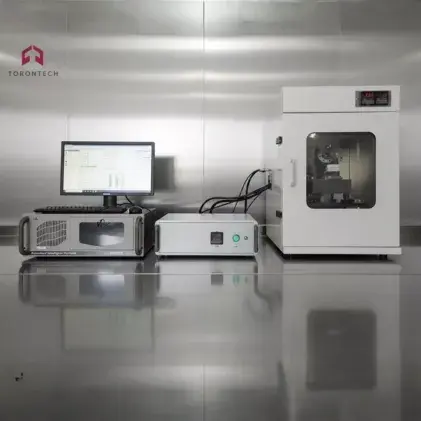
HFRR Lubricity Test: ASTM D6079 & ISO 12156-1
Ultra-Low Sulfur Diesel is a bit of a mechanical gamble. While it is wonderful for the air we breathe, the heavy-handed chemical scrubbing that removes sulfur also yanks out the naturally oily bits that keep fuel pumps from grinding into metallic dust.
In our view, HFRR testing isn’t merely an administrative checkbox. It is the only way to guarantee your fuel is satisfyingly slick and engine-safe. Let’s look at why the HFRR lubricity test is the absolute backbone of top-tier fuel quality.
Key Takeaways
- The ULSD Tradeoff: Chemical scrubbing removes naturally oily compounds, making precise lubricity testing absolutely vital for preventing severe fuel pump damage.
- WSD is the Ultimate Truth Teller: The HFRR lubricity test calculates the exact Wear Scar Diameter to guarantee your liquid batch is satisfyingly slick and completely engine-safe.
- Strict Global Rulebooks: Following ASTM D6079 lubricity and ISO 12156-1 guidelines is the verified way to prove international regulatory compliance.
- Smarter Operational Efficiency: Highly automated testing hardware completely eliminates sticky moisture interference and human error while massively protecting your bottom line.
HFRR Lubricity Testing and the Significance of WSD
Think of the High-Frequency Reciprocating Rig (HFRR) as a high-speed ball-on-disc sliding stress test. It explicitly checks if your fuel has that thick, protective liquid layer heavy engines absolutely crave.
To measure if a fluid can effectively stop metallic components from violently rubbing each other raw, this highly intelligent, computer-operated setup follows a remarkably specific procedure:
- The Physical Setup: A thoroughly standardized 6mm ANSIE-52100 test ball gets pressed onto a flat metallic plate with a highly specific 200±1 g applied load. The whole contact area is completely dunked in the fuel sample.
- The High-Speed Friction: An incredibly stable electromagnetic actuator shakes that spherical piece back and forth in a blur-of-motion quickness. It hits an exact 50±1 Hz reciprocating frequency with a precisely measured 1.0±0.02 mm displacement stroke length.
- The Final Calculation: Once the timer hits zero, we look at the nasty little scuff mark left behind using a 100 times magnification Wear Scar Measuring System. This calculates the Wear Scar Diameter (WSD), frequently reported as the corrected WS1.4 primary lubricity metric, with a staggering accuracy of 1μm.
We should also point out that while technicians typically measure the wear on the ball, disc scars also correlate beautifully and can sometimes be significantly easier to read. In our book, the WS1.4 result is the ultimate truth-teller. Consider a hypothetical 600-micron scrape mark, for instance.
Inside a heavy-duty motor, that oversized blemish translates to nasty metallic shavings jamming up the spray nozzles and completely destroying the highly sensitive injection system. On the flip side, a 400-micron result is sheer perfection. Getting that numerical measurement exactly right is the only way to avoid a total mechanical meltdown.
Related article: BOCLE vs HFRR: Guide to Fuel Lubricity Testing
Regulatory Compliance: ASTM D6079 and ISO 12156-1 Standards
In this highly regulated business, you absolutely cannot just wing it. We see these officially written rules as the universal operating language that keeps every single supplier entirely on the exact same page.
ASTM D6079 Testing Parameters
This is the big North American playbook. It strictly demands the testing procedure runs at exactly 60±2 ℃ for a full, uninterrupted 75 minutes. Interestingly, this guideline uniquely permits testing low-lubricity or volatile liquids at lower temperatures, such as 25 °C, if the situation requires it.
We believe following these rigorous instructions to the absolute letter requires incredibly dependable hardware. A seriously tough PTC ceramic chip heater is vital here because it delivers totally uniform heating and never needs replacing throughout its long service life.
ISO 12156-1 Global Compliance
This is the broadly accepted international version of the exact same evaluation game.
Whether you are cooking up wildly inventive additives or refining a massive fresh batch of diesel, hitting this target is like holding a verified, platinum-level stamp of approval that works anywhere on the globe. It ensures that regardless of where your fuel is sold, the lubricity meets the expectations of global engine manufacturers.
Industry Applications for HFRR Testing
If a massive liquid batch completely fails to meet the mark, it results in a totally nightmarish logistical headache that costs an absolute mountain of cash. We have noticed a few key groups that simply cannot function without these results.
Quality Control for Fuel Refineries
Refineries utilize this as a final, critical checkpoint to guarantee their "clean" diesel has plenty of slippery chemical additives mixed in before it hits the delivery vehicles. Picture a major processing plant completely dodging a ridiculously expensive product recall just by catching a dry, under-lubricated batch early.
Performance Validation for Additive Manufacturers
These groups spend their entire day inventing completely new ways to protect heavy engines.
Think about a chemical research lab demonstrating that their insanely clever synthetic formula works beautifully because their machine’s integrated software instantly and automatically records the precise coefficient of friction (μ) and the protective oil film signal. Hard, perfectly recorded objective data makes that possible.
Optimization for Biodiesel and Renewable Fuels
HFRR is heavily utilized to broadly characterize biodiesel blends, alcohol fuels, and marine liquids.
Since "green" fuel like B20 is naturally quite oily, many facility operators use these machines to figure out the absolute perfect blending ratio. Look at a biofuel facility getting their chemical mixtures satisfyingly spot on, saving absolute heaps of cash because they aren't dumping extra grease into a liquid that already has loads of natural slippery goodness.
Operational Efficiency and Total Cost of Ownership (TCO)
In the old days, getting a perfectly solid HFRR lubricity test result was an incredibly frustrating, totally miserable chore. We have always felt that entirely manual testing leaves way too much room for terribly costly human error to sneak in.
Consider a standard laboratory situation where a technician tries to run a highly sensitive friction check on an insanely damp, rainy afternoon without an Automatic Constant Temperature and Humidity System securely locking the room conditions strictly between 23–30℃ and 40–70% moisture. That sticky moisture routinely causes a wildly inaccurate failing score. This then tricks the factory management into throwing away thousands of dollars on extra additives for a fuel batch that was actually sheer perfection to begin with.
Plus, let’s talk about the actual financial reality. We frequently tell our partners to heavily scrutinize the "long-haul price tag" of their laboratory gear. Some setups are delightfully cheap to buy but cost an absolute fortune to fix because of terribly shaky internal parts.
We are massive fans of a far more sensible approach: finding hardware constructed with a heavy-duty steel pedestal mounting to completely eliminate internal extra vibration. This should be paired with a highly specific push rod design that totally stops lateral interference and delivers phenomenally straight reciprocating motion.
That keeps everything well within a reasonably affordable operating budget.
Better HFRR Lubricity Testing with Torontech
Staying compliant with ASTM D6079 lubricity and ISO 12156-1 shouldn't be a budget-draining chore. At Torontech, we focus on providing brilliantly engineered tools without the notoriously high price tags often found in this industry.
If you are exhausted by expensive guesswork, investigate our Diesel Lubricating High Frequency Reciprocating Testing Machine (HFRR) TT-6079. We built this piece of hardware for simple, single-click operation that automates data storage straight to your computer, making your workflow pleasantly straightforward.
Ready to swap those daily headaches for an exact way to check your fuel? Visit our product page to see what the HFRR TT-6079 can accomplish or reach out to the Torontech team.
Click to view full list of references
- Chuepeng, S., Klinkaew, N., Thumanu, K., Theinnoi, K., Sukjit, E., & Dearn, K. (2025). Effects of castor oil as lubricity enhancer on friction and wear characteristics of piston engine running on diesohol. International Journal of Engine Research, 26, 1305 - 1318.
- Chybowski, L., Wójcik, W., & Szczepanek, M. (2025). Evaluation of Rheological and Lubrication Properties of Selected Alcohol Fuels. Energies.
- Chybowski, L., Kowalak, P., & Dąbrowski, P. (2023). Assessment of the Impact of Lubricating Oil Contamination by Biodiesel on Trunk Piston Engine Reliability. Energies.
- Fathurrahman, N., Auzani, A., Zaelani, R., Anggarani, R., Aisyah, L., Maymuchar, M., & Wibowo, C. (2021). Lubricating Properties of Diesel Fuel and Hydrogenated Vegetable Oil with Palm Oil Biodiesel Blends Using HFRR Method. SSRN Electronic Journal.
- Fathurrahman, N., Auzani, A., Zaelani, R., Anggarani, R., Aisyah, L., M., & Wibowo, C. (2023). Lubricity Properties of Palm Oil Biodiesel Blends with Petroleum Diesel and Hydrogenated Vegetable Oil. Lubricants.
- Fazal, M., Sundus, F., Masjuki, H., Rubaiee, S., & Quazi, M. (2021). Tribological assessment of additive doped B30 biodiesel-diesel blend by using high frequency reciprocating rig test. Sustainable Energy Technologies and Assessments.
- Gevorgyan, G., Paukner, R., Erichsen, J., Weisse, M., & Dawah, P. (2017). HFRR test method with stainless steel specimens for gasoline fuels.
- Hai-Cang, W. (2008). Study of the Lubricity of Diesel Fuel samples by Using the High-frequency Reciprocating Rig. Journal of Gansu Lianhe University.
- Knothe, G. (2007). Evaluation of ball and disc wear scar data in the HFRR lubricity test. Lubrication Science, 20.
- Maru, M., Trommer, R., Cavalcanti, K., Figueiredo, E., Silva, R., & Achete, C. (2014). The Stribeck curve as a suitable characterization method of the lubricity of biodiesel and diesel blends. Energy, 69, 673-681.
- Sugiyama, K., Kajiwara, M., Fukumoto, M., Mori, M., Goto, S., & Watanabe, T. (2004). Lubricity of Liquefied Gas Assessment of Multi-Pressure/Temperature High-Frequency Reciprocating Rig (MPT-HFRR) -DME Fuel for Diesel. SAE transactions, 113, 866-876.
- Sugiyama, K., Mori, M., Kajiwara, M., Fukumoto, M., & Goto, S. (2003). Lubricity of Liquefied Gas - Assessment of the Various Pressure and Temperature High-Frequency Reciprocating Rig (VPT-HFRR) - LPG Blended Fuel for Diesel Engine.
- Sugiyama, K., Kajiwara, M., Fukumoto, M., Mori, M., Goto, S., & Watanabe, T. (2005). Assessment of the Lubricity of Liquefied Gas with a DME-Fuel Additive Using a Multi-pressure/Temperature High-Frequency Reciprocating Rig (MPT-HFRR). Transactions of the Japan Society of Mechanical Engineers. B, 71, 2784-2791.
- Thobejane, T., & De Vaal, P. (2023). The Effect of Temperature and Asphaltene Content on the Lubricating Properties of Fuel Oils. Lubricants.
- Tyrovola, T., & Zannikos, F. (2022). Tribological Assessment of Marine Distillate Fuels under a Variant HFRR Method. Tribologie und Schmierungstechnik.
- Xu, Y., Wang, Q., Hu, X., Li, C., & Zhu, X. (2009). Characterization of the lubricity of bio-oil/diesel fuel blends by high frequency reciprocating test rig. Energy, 35, 283-287.