Choosing a Handheld vs Benchtop Colorimeter
Color consistency shouldn't be a headache. Whether you are painting car parts or weaving textiles, a mismatched batch hurts your bottom line and kills buyer trust.
When you are looking to grab new gear, the big question is usually handheld vs benchtop colorimeter. We’re here to compare accuracy of portable vs benchtop colorimeters and give you our straight take on the benchtop vs portable colorimeter debate to help you pick the right fit for your operation.
Key Takeaways
- Workflow Match: Choose handhelds for active factory floors and large solid items. Opt for benchtops in climate-controlled labs handling liquids or master standards.
- Closing the Accuracy Gap: Modern portable devices provide exceptional precision for daily pass/fail checks, though benchtop units remain the absolute standard for strict laboratory baselines.
- Smart Investments: Handheld units deliver quick ROI through massive time savings on the line. Benchtops require a higher initial budget but pay off by eliminating early formulation errors.
Portable Colorimeter Overview
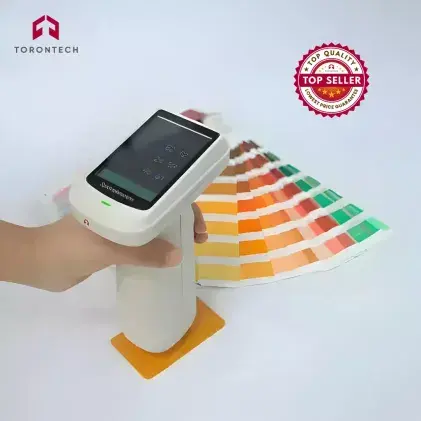
Think of the handheld colorimeter as your versatile, on-site workhorse. These compact, easy-to-grip units bring the laboratory straight to the factory floor, the storage room, or even right out into the field.
Practical Advantages:
- Total Freedom of Movement: These portable units let you check the color on massive, awkward, or immovable items (like a car door or a giant roll of coated metal) without having to cut off a sample to bring back to the lab.
- Fast and Responsive: They are perfect for quick "looks good" checks while you are actually in the middle of a production run, so you can spot a weird color shift before it ruins a whole batch.
- Simple for Anyone to Use: Modern portables have screen setups that feel very much like using a smartphone, so your team can get a reading without needing a specialized technical degree.
Our Take: We believe the greatest strength of a handheld is how it lets everyone stay on top of quality. By moving the check-point from a far-off room to the middle of the action, we see businesses save a significant amount of cash by catching mistakes before they turn into a pile of scrap. Research shows that handheld devices offer significant advantages for onsite, remote, and field measurements due to their portability and ability to function under varying environmental conditions.
A Quick Example: Let's say a factory team is piecing together heavy farm machinery. Instead of hauling a giant, freshly painted metal hood all the way to a distant testing room, a worker simply grabs a portable unit like our ToronSpec™ 700D, steps right up to the conveyor belt, and verifies the paint job in a matter of seconds.
Benchtop Colorimeter Overview
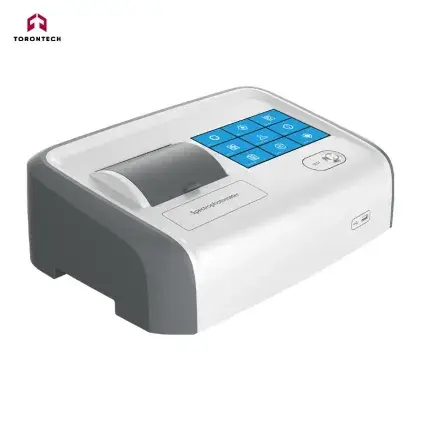
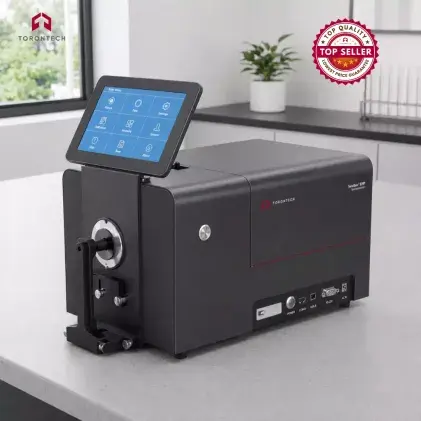
A benchtop colorimeter is the heavy-hitting cornerstone of the laboratory. It stays put on a desk and serves as the top-tier pick for deep research, strict quality checks, and figuring out the secret formula for brand-new colors.
Practical Advantages:
- Top-Tier Precision: These desk units usually have much larger light-catching components and more advanced lens setups inside.
- Handles Any Material: They are experts at checking all sorts of samples—liquids, powders, thick pastes, or solid blocks—using both "bounce-off" and "see-through" light methods.
- Steady and Repeatable: By staying in a quiet, stable lab, these units don't have to worry about weird shadows or changing light from the windows messing up the numbers.
Our Take: While the portables are incredibly handy, we see the benchtop unit as the "anchor" for any business that is dead serious about color management. If you are the one setting the rules that all your other vendors have to follow, we think a benchtop is an essential part of your setup. Even as smartphone-based colorimetric platforms emerge as low-cost alternatives, benchtop instruments remain the standard for absolute laboratory accuracy.
A Quick Example: Think about a massive beverage company getting ready to launch a brand-new cherry soda. To get that signature red liquid perfectly see-through and utterly consistent, the lab technicians rely on a specialized benchtop unit—such as our Liquid Color Spectrophotometer ToronSpec™ TT-LC2—to nail down the exact recipe before a single bottle ever reaches a grocery store shelf.
Related article: Colorimeter vs Spectrophotometer: Key Technical Insight
Comparing Accuracy: Portable vs. Benchtop Models
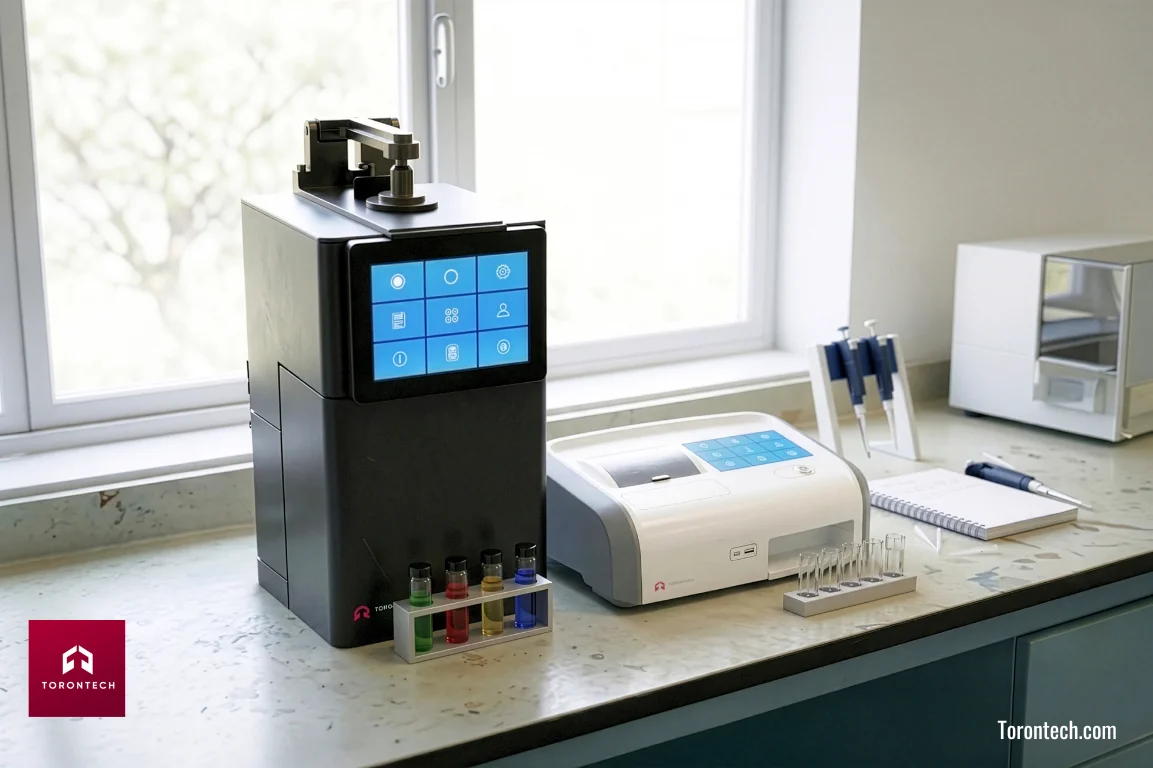
When you’re weighing up a benchtop vs portable colorimeter, the one thing that keeps quality managers awake at night is the question of accuracy.
In the past, the desk units were far ahead. Because they sit in a perfect lab environment and use much larger internal parts, they give you the kind of rock-solid numbers that stay exactly the same every single time.
However, recent case studies have shown high agreement (over 93%) between handheld devices and benchtop standards, even in challenging environments like high-temperature food processing.
Our Perspective: We find that the "accuracy gap" is often more about the messy factory environment than the actual sensor. A handheld used correctly in a stable spot can give you numbers that look nearly identical to a benchtop's. That said, benchtop colorimeters generally provide higher repeatability and precision over time compared to more basic mobile solutions. For almost all everyday production checks, the portable gear is plenty good enough to get the job done.
Quick Reference: Portable vs. Benchtop
To make your choice a little easier, we put together this side-by-side breakdown of where each device truly shines:
| Feature | Portable (Handheld) Colorimeter | Benchtop Colorimeter |
|---|---|---|
| Primary Workspace | Factory floor, loading docks, in the field | Climate-controlled testing laboratories |
| Sample Types | Large, immovable solids (car doors, metal coils) | Liquids, loose powders, thick pastes, small solids |
| Level of Precision | Very high; perfect for daily pass/fail checks | Absolute highest; required for master standards |
| Mobility | Complete freedom of movement | Stationary, fixed-position unit |
| Initial Investment | Highly budget-friendly | Higher upfront cost |
| Data Transfer | Instant Bluetooth/Mobile app sync | Deep computer integration for extensive reports |
Industry-Specific Applications
To figure out which one fits your daily grind, here’s how we see different sectors putting this gear to work:
Automotive & Aerospace
Handhelds are the winners here. We’ve seen that being able to check the curvy bits of a car body or a plane wing right there on the line without taking anything apart is a massive operational win.
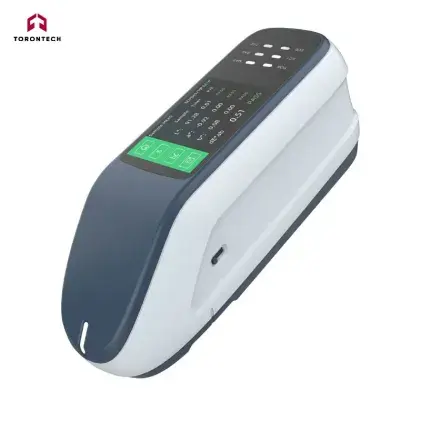
For instance, inspectors using a high-precision device like the ToronSpec™ 23/25/26D Series can easily confirm the exact color match on a metallic car door without ever hitting the pause button on the assembly line.
Food & Beverage
Benchtop units are a must for checking the color and clarity of liquids like juices or oils. In our view, the tricky nature of liquid samples almost always means you need the steady hand of a benchtop system.
Think of a massive ketchup facility; they rely heavily on a benchtop to guarantee that deep, signature tomato red looks absolutely identical in every single glass bottle that rolls out the door.
Textiles & Apparel
Most companies use both. Benchtops live in the lab to get the initial dye colors right, while the portables make sure the actual fabric coming off the machines hasn't drifted away from the original plan.
A global clothing brand might use the benchtop to establish the "official" shade of blue for a winter jacket, and then hand out portables to the factory workers to guarantee the actual fabric rolls hit that exact target.
Data and Software Integration
In a modern factory, getting the number is only half the job; you have to do something useful with it.
New handheld colorimeters come with Bluetooth and USB connectivity, which is great for people out in the field who need to instantly beam "pass or fail" info to a mobile app. Modern systems can even combine sensor responses with modeling approaches to quantitatively measure analytes independent of ambient lighting.
On the other hand, benchtop colorimeters are great at digging deep into the data. They usually plug straight into heavy-duty computer programs that help with color matching and printing out long compliance reports for the bosses.
Total Cost of Ownership (TCO)
Budget matters for every business. Usually, a benchtop unit costs more to start with because the parts inside are so intricate. However, its ROI is realized by making sure your "master" colors are perfect from day one.
Handheld units are much easier on the wallet to acquire. We believe their value comes from the time they save and their ability to stop flawed products from ever leaving your loading dock. Because we use some very smart, innovative tech, we ensure you get a lot of value for your money no matter which path you take.
Key Selection Criteria
Picking the best colorimeter comes down to how your team operates:
1. Operational Environment
If you’re on a fast-moving production line where parts are too heavy to move, go for a handheld. These devices are built to handle the constant movement and rough conditions of an active factory floor. If you’re in a quiet, controlled lab where you can bring the samples directly to a dedicated station, a benchtop is the way to go.
For example: A loud, active loading dock with shifting sunlight demands a tough portable device that blocks out external glare. A spotless, climate-controlled research facility requires a stationary benchtop setup.
2. Sample Material Requirements
If it’s a liquid, a loose powder, or a thick paste, a benchtop is usually better because it comes with specialized sample holders and completely seals off the material from outside light. If it’s a flat or curved solid surface that is already attached to a larger finished product, a handheld is the undisputed star.
For example: A giant vat of cloudy apple juice requires the transmission capabilities and secure cuvettes of a benchtop like our ToronSpec™ 820P. A stack of dry, painted wooden planks or an assembled car bumper is the perfect target for a quick handheld scan using the ToronSpec™ 700D.
3. Tolerance and Compliance Standards
For setting the absolute "gold standard" for a global brand that other suppliers will rely on, go benchtop. Its unmatched consistency is exactly what you need to establish absolute baseline metrics. For checking everyday production batches to ensure they haven't drifted from that baseline, a handheld is a powerhouse.
For example: If you are writing the official rulebook for a brand's trademarked logo color that print shops around the world will use, you need the benchtop. If you are just doing a routine check to guarantee that today's plastic cups match yesterday's cups, the handheld does the trick perfectly and saves you valuable time.
Torontech: Your Partner for Reliable Color Precision
Choosing between a handheld and a benchtop is simple when you focus on your specific workspace and materials. While benchtop instruments remain the standard for absolute laboratory precision, ongoing advances are rapidly narrowing the gap.
At Torontech, we provide cost-effective solutions designed to solve your daily quality control headaches without breaking the bank. From snappy, Bluetooth-ready handhelds to ultra-precise lab systems, our gear uses innovative technology to give you numbers you can actually trust.
Ready to fix your color checks? Explore our Color, Paint & Coating Test Equipment today and find the perfect, budget-friendly tool to keep your colors looking like absolute perfection.
References:
- Abels, K., Salvo-Halloran, E., White, D., Ali, M., Agarwal, N., Leung, V., Ali, M., Sidawi, M., Capretta, A., Brennan, J., Nease, J., & Filipe, C. (2021). Quantitative Point-of-Care Colorimetric Assay Modeling Using a Handheld Colorimeter. ACS Omega, 6, 22439 - 22446.
- Dang, A., Belles, D., Gonzalez, M., Aponte-Wesson, R., & Paravina, R. (2024). Repeatability of different mobile phone applications for color measurement in dentistry. Journal of Prosthodontics.
- Manurung, R., Telaumbanua, J., Lim, R., Astuti, W., Mada, D., & Andreani, A. (2025). Smartphone-Based Colorimetric Platform with RGB-CIELAB Multivariate Regression and 3D-Printed Illumination for Portable Multi-Analyte Detection. Jurnal Elektronika dan Telekomunikasi.
- Wang, Y., Lee, K., Yen, Y., Wu, C., Wang, C., Chang, C., Chieh, J., & Tsai, M. (2024). A Handheld Colorimeter for Remote and Onsite Recognition of Baking Levels at High Temperature — Pork Floss as a Case Study. Food Analytical Methods, 18, 606 - 620.
- Wei, X., Lam, S., Bohrer, B., Uttaro, B., López-Campos, Ó., Prieto, N., Larsen, I., & Juárez, M. (2021). A Comparison of Fresh Pork Colour Measurements by Using Four Commercial Handheld Devices. Foods, 10.