

Calibration of Friability Test Apparatus As Per USP
Nobody wants to open a medicine bottle and find a dusty pile of sadness. You want robust tablets, not a crumbly mess that looks like it lost a fight with the packaging machine.
That’s why nailing the calibration of friability test apparatus is important.
At Torontech, we believe accurate data shouldn't be a headache. We’re here to ensure your equipment tells the truth and your friability tester calibration is cleaner than a fresh lab coat. Here is how our innovative, cost-effective technology makes compliance a breeze.
Why You Cannot Afford to Neglect Friability Tester Calibration
So what does a friability test accomplish? In simple terms, you weigh tablets, let them tumble in a rotating drum, and then weigh them again to measure any material loss. If your apparatus's rotation speed is inaccurate, or if the internal drop height doesn't meet the standard, the entire test is invalid.
Related article: Friability Test in The Pharmaceutical Industry
The consequences of getting friability tester calibration wrong can be severe. You could unknowingly release substandard batches (creating a future recall scenario) or discard perfectly good product based on faulty data. Both outcomes are a significant drain on your resources.
Research into mechanical testing emphasizes that calibration is essential to reduce measurement uncertainty and improve repeatability (Scholtes & Meer, 1997; Liu, 2022). Proper calibration ensures that friability test results are valid and comparable over time, which is essential for product quality assurance and regulatory compliance.
To put this in perspective, consider a hypothetical production run involving a high-cost active ingredient. If your apparatus has silently drifted to 27 RPM due to a lack of calibration, the increased kinetic energy destroys tablets that are actually within specification. You end up rejecting a perfectly viable batch based on phantom data. That is a financial loss no production manager wants to explain to finance.
A proper calibration of friability test apparatus confirms the accuracy of three main parameters:
- Rotation Speed (RPM): This ensures every batch is subjected to consistent mechanical stress.
- Test Duration: This guarantees the tablets undergo the precise number of rotations.
- Apparatus Design: This verifies the drum and its internal scoop meet the required physical dimensions.
Calibration of Friability Test Apparatus as per USP: The Official Standard
When it comes to this procedure, the USP chapter <1216> "Tablet Friability" sets the definitive standard. These guidelines are not suggestions; they are the benchmark for validated testing in the lab. When you’re performing a calibration of friability test apparatus as per USP, these are the specifications that matter:
Rotation Speed
The drum must turn at 25 RPM, plus or minus 1. Why this specific pace? It generates the exact amount of gravitational force needed to stress the tablet without turning it into dust instantly. Anything outside this narrow band fails to simulate the correct testing conditions, rendering your kinetic data useless.
Drum Dimensions
The drum's internal diameter must be between 283 and 291 mm, with a depth between 36 and 40 mm. These tolerances are not flexible. Additionally, the USP insists on polished internal surfaces to minimize friction. If your drum is made of cheap, static-prone plastic, your tablets won't slide. They will stick to the walls, and your attrition rates will be artificially low.
Drop Height
Tablets have to fall a distance of 156 mm, plus or minus 2. We consider this the most vital detail because this drop generates the mechanical shock that mimics real-world conditions. This isn't just about height; it relies on a curved projection (baffle) with an internal radius of between 75.5 mm and 85.5 mm. If that curve is off, the tumble becomes a gentle slide, and the test loses its bite.
Tilt Function
For irregularly shaped tablets that may slide instead of tumble, the apparatus needs a 10° tilt capability to ensure a valid test. Without this specific angle, large or oblong pills tend to jam or "bridge" at the bottom of the drum, surviving the test simply because they never actually fell.
A Straightforward Checklist for Friability Tester Calibration
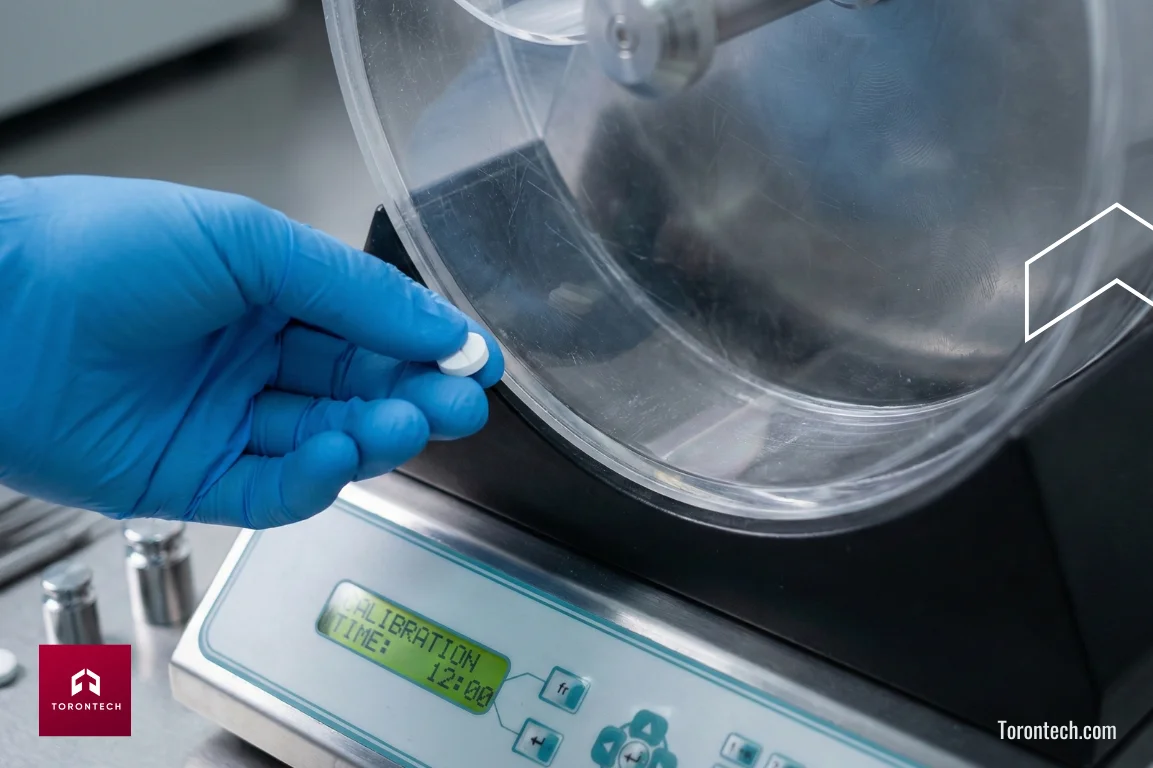
How do you confirm your machine is giving you accurate readings? Here is the direct checklist we advise our clients to follow when approaching the calibration of friability test apparatus:
- Visual Check: Inspect the drum. Are there any cracks, deep scratches, or residue? A compromised drum surface is an often-overlooked detail that can alter test results.
- Speed Verification: Use a calibrated tachometer to measure the drum's rotation speed. You need to see a consistent reading between 24 and 26 RPM.
- Timer Verification: Set the apparatus to run for 100 rotations and time it with a calibrated stopwatch. At 25 RPM, this process should take exactly four minutes.
- Documentation: Log all of these measurements. The moment your machine operates outside these limits, it requires either service or replacement.
How Often Should Friability Tester Calibration Be Done?
The frequency of calibration depends on usage intensity and regulatory requirements, but it is generally recommended to perform calibration at regular intervals. While your internal quality protocols will dictate the official timeline, we advocate for a sensible maintenance cadence to keep your data defensible.
In our view, a quick optical check of the test vessel should happen daily. This should be followed by a formal RPM verification using a tachometer on a monthly or quarterly basis. For long-term reliability, we suggest scheduling a complete calibration of friability test apparatus as per USP standards annually, specifically to certify the physical dimensions of the drum.
Furthermore, should you ever repair a motor or replace a housing, an immediate validation sequence is mandatory to ensure the equipment hasn't shifted from its baseline.
Troubleshooting Common Calibration Failures
So your machine is failing its calibration. Before scheduling a service call, check these frequent issues. We've seen them cause countless validation headaches:
- Belt Tension Issues: In older, belt-driven machines, an improperly tensioned belt is a primary cause of inconsistent RPM. (We found this so problematic that we build our newer systems with direct-drive motors to eliminate this point of failure).
- Drum Surface Degradation: A drum interior that has become scratched or worn will create more friction, causing tablets to lose more mass than they should.
- An Unlevel Surface: If the apparatus is not perfectly level on the benchtop, the effective drop height is altered. Always confirm the unit is level before a test.
A More Effective Way to Maintain Compliance Torontech
Performing these checks manually is standard practice, but we believe labs can operate more efficiently.
This is where Torontech's design philosophy makes a difference. We got tired of seeing labs contend with temperamental, outdated equipment, so we engineered our Friability Testers for the modern lab.
There are no signs of inconsistent speed, and the build quality is immediately apparent.
- Dependable Speed: Our ToronFRITUS™ model uses a stepper motor that maintains an incredibly consistent RPM. You can put an end to the speed variations that invalidate tests.
- Streamlined Operation: Select models include features like automatic sample discharge and biometric logins to help you meet 21 CFR Part 11 data security standards.
- Dual-Batch Efficiency: Our ToronFRI-2L models have two drums, allowing you to process twice the workload without investing in a second machine.
- Purpose-Built Design: The 10° tilt function is integrated and simple to use, so you can test a variety of tablet forms without difficulty.
Keeping your friability tester calibration up to date is essential for confirming your tablets have the required durability. But in our view, maintaining compliance shouldn't strain your budget or your daily operations. At Torontech, we create innovative, North American-designed lab equipment that performs reliably and is priced sensibly.
Ready to improve your quality control workflow? Explore our range of cost-effective Friability Testers and see how our technology can protect your budget and your operational uptime. Contact us to request a quote today.
References
- Liu, L. (2022). Research on Repeatability Calibration of Friction Coefficient of Transverse Force. Journal of Physics: Conference Series, 2381.
- Scholtes, J., & Meer, B. (1997). The Construction of the Friability Test at TNO-PML.
