Air Jet Sieve Machine: A Guide to Precise Powder Sizing
Are you tired of clumpy powders turning your particle analysis into a guessing game? We’ve seen how standard rattling setups often fail when grains get ultra-fine, leading to clogged screens and wasted hours.
We believe air-driven sieving is the precise fix your facility needs for consistent results. This guide explains exactly how that logic works and why it beats a standard shaker every time.
Key Takeaways
- We find that traditional vibrating setups frequently fail with ultra-fine powders because the material sticks together and blocks the mesh.
- Air jet sieves eliminate this problem by using a controlled vacuum draft to float the powder. This separates particles without applying rough mechanical stress.
- Upgrading to an air-driven system cuts testing time drastically. A process that takes 25 minutes on a standard shaker often finishes in under three minutes with air fluidization.
- We consider regulatory compliance a mechanical necessity. Proper air jet units must perfectly fit standard ASTM or ISO frames to maintain a flawless, airtight vacuum seal.
Core Principles of Air Jet Sieving
Consider an air jet sieving machine as a highly accurate piece of lab kit that figures out exactly how big your dry, dusty bits actually are. From where we sit, the most impressive thing about this machine is that it completely ditches brute force. Instead of just rattling, shaking, or banging on a frame, it uses a controlled blast of air as a separating "fluid" to get the job done.
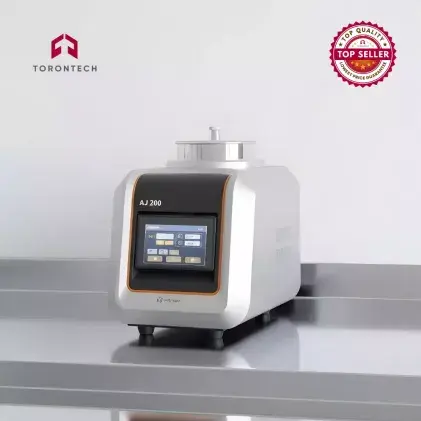
We’ve found that this air-based logic fixes that recurring headache where powders turn into clumpy messes that clog up your mesh. When we fire up a unit like the Air Jet Sieving Machine AJ200, we find it easily processes a measuring range from an incredibly tiny 5 µm all the way up to a chunky 5mm.
You can load it up with a max loading of anywhere from 0.3g to 100g. By creating a dynamic relationship between the powder bed and the air jet, the material circulates opposite to the incoming air. This enables a size-based separation of microscopic particles that we find nearly impossible to achieve any other way.
Related article: Sieve Analysis & Particle Size Distribution Test
Mechanical Process and Technology
The reason an air jet sieve works so well is all in the clever way it moves air. If you look at the technical details, the whole process is basically a masterclass in being efficient:
- Vacuum Connection: The machine gets plugged into a heavy-duty vacuum, which creates a low-pressure environment inside the testing chamber.
- Specialized Rotating Nozzle: Fresh air gets sucked in through a spinning nozzle with tiny slits, sitting right under the sieve.
- Breaking Up the Clumps: We really want to highlight this part because it is the most important bit. The air blasts through the mesh at high speed, pushing the powder around. This breaks up those clustered bits without using the kind of rough shaking that might crush your fragile samples.
- Sorting the Material: As the air jet spins, the powder continuously recirculates. Fine particles are carried through or out of the classification zone by the air flow. These get caught in the vacuum filter, leaving the bigger pieces behind so you can weigh them without any guesswork.
Key Advantages for Laboratory Analysis
In our professional opinion, switching to an air jet setup brings some massive perks that can really change how your lab manages its budget:
1. Improved Process Efficiency
We believe the time you save is one of the biggest reasons to make this investment. Research has shown that air-jet analysis time is notably shorter than mechanical alternatives.
Let’s say a facility needs to check a 50-gram batch of sticky cement dust. Running that through a standard rattling stack might consume a full 25 minutes of waiting. Switch that over to an air jet system, and the whole batch is perfectly sorted in less than three minutes.
2. Accurate Data and Sample Integrity
We’re big believers that being accurate shouldn’t mean you have to beat up your samples. In studies evaluating pharmaceutical powders, air-jet sieving provided simple, reproducible, and accurate results that aligned closely with manufacturer specifications.
Since this uses air instead of intense rattling, your delicate particles keep their original shape. Air fluidization keeps those delicate little spheres perfectly intact.
3. Long-Term Operational Reliability
We’re always going to cheer for gear that is as easy to take care of as it is to run. These modern air jet units are built for the person using them.
They are quiet, hardly a peep out of them, and have almost zero moving parts to wear out. Honestly, not having to fix broken gears or motors makes these a much smarter choice for the long haul.
Primary Industry Applications
Even though it works for many materials, we’ve seen this air jet method become the absolute "gold standard" for several specific industries.
Pharmaceuticals
In this field, making sure the ingredients in your medicine are the exact right size is vital so they actually work as intended. For example, sorting ultra-fine active pharmaceutical ingredients (APIs) that tend to stick to everything they touch is much easier with air.
Research confirms that air-jet sieving is highly effective for problematic, electrostatically charged powders. Although, for precision analysis where the powder is cooperative and doesn't instantly clump, we regularly see pharmaceutical labs lean heavily on our Sieve Shaker – Electromagnetic Type.
Chemicals & Plastics
Sorting out synthetic dust and printer toner is a task where even a tiny mistake is a big problem. A great example is verifying the incredibly fine, staticky dust in copier toner. You have to make sure it doesn't exceed strict size limits, which is where air-driven sieving shines.
Food Processing
This is often the only way to go for powdered milk, spices, and protein powders. Think about sifting through sticky cocoa powder or moisture-absorbing whey protein that turns into stubborn clumps on a normal mesh. Air keeps everything moving freely.
Construction & Minerals
In our view, this is the most solid way to check cement, gypsum, and fine limestone. We see this used for guaranteeing that fly ash or pulverized limestone falls into the exact micron range needed for high-strength concrete mixes.
Ceramics
Checking raw clay powders is essential because even a tiny bit of off-sized grain can ruin a whole batch of product. Early air-jet particle-size air analyzers were applied to ceramic powders with significant advantages for microscopic-size particles.
For instance, sifting super-fine aluminum oxide ensures a batch of advanced technical ceramics doesn't end up with structural flaws.
Vibratory Shakers vs. Air Jet Sieves
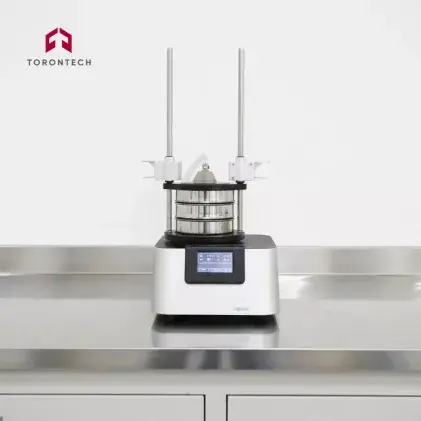
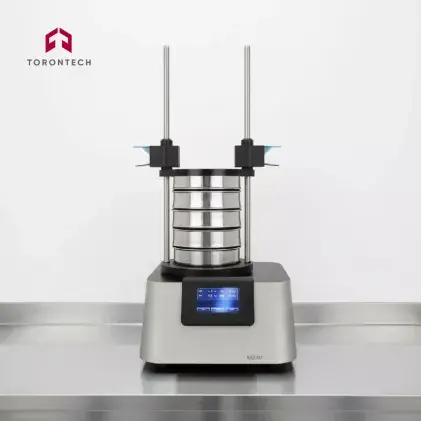
Picking the right gear usually means looking at a vibratory sieve shaker vs. air jet sieve. While we have plenty of laboratory sieve shakers, including incredibly sturdy options like the Vibratory Sieve Shaker SS2000 for solid materials, it is vital to know where one wins and the other loses.
Mechanical shakers rely on reciprocating or vibratory motion to drive particles through stacked sieves. Their efficiency depends heavily on amplitude, frequency, and sieve number.
| Feature | Air Jet Sieve Machines | Vibratory Sieve Shakers |
|---|---|---|
| Mechanism | High-velocity airflow & vacuum | 3D motion or vibration |
| Ideal Materials | Tiny, sticky powders | Chunky grains and rocks |
| Clumping Risk | Almost zero (Air breaks 'em up) | Moderate to high for fine stuff |
| Sieve Count | One sieve per cycle | Multiple stacked sieves |
| Size Range | Best for < 20 µm | Best for larger grains |
A Realistic Comparative Scenario:
Put a batch of titanium dioxide onto a standard vibrating shaker. Even if you are running a heavy-duty mechanical model with a massive 20μm-25mm measuring range and a precise 01~99min time setting just like the SS2000, within minutes, that titanium dioxide forms thick, solid clumps that totally blind the mesh.
This is a common limitation, as shaker type and motion pattern significantly affect separation efficiency. Toss that same sticky pigment into an air jet sieve, and the vacuum-driven draft instantly breaks up those clusters.
For fine grades like acetaminophen, air-jet sieving has been shown to give results much closer to specifications than electromagnetic shakers, which often return results that are far coarser than reality.
Technical Procurement Considerations
If you’re shopping for one of these right now, we suggest keeping an eye on these bits to make sure you get your money's worth:
- Intuitive Digital Controls: You want digital buttons that let you tweak the vacuum and timing exactly how you want.
- SOP Protocol Management: We think being able to save your "recipe" is a must-have so every person in the lab gets the exact same result.
- Standard Sieve Compatibility: Make sure it fits the regular 200mm (8-inch) sieves so you don't get stuck buying expensive, proprietary frames.
Regulatory Compliance (ASTM/ISO)
For major industrial players, following the rules is about more than just passing an audit.
We believe any top-tier air jet unit must integrate perfectly with sieves meeting strict ASTM E11 or ISO 3310-1 standards. The reason is purely mechanical: the entire air-draft system relies on a flawless, airtight seal around the frame. If you use non-compliant, poorly sized frames, your vacuum pressure drops, the internal vortex weakens, and your test fails completely.
This is exactly why we ensure our equipment, from the precise Air Jet Sieving Machine AJ200 to the heavy-duty Vibratory Sieve Shaker SS2000, easily accommodates these standardized test frames. In our view, utilizing strictly compliant gear across your entire facility is the only way to guarantee your sorting data holds up when the inspectors arrive.
Torontech: A Trusted Partner in Advanced Sieve Analysis
At Torontech, we believe in giving you more than just a box of parts; we provide the exactness your business needs. We’ve got a full selection of sample-prep gear that is built to last and stays accurate for years.
Check out our full selection of Laboratory Sieve Shakers, featuring these clever Air Jet machines and the sturdy Vibratory models built for whatever your industry throws at them. Get in touch with our team today and we’ll get a quote sorted for you.
References (Click to expand)
- Allen, T. (1965). Particle Size Measurement. Nature, 208, 529-529.
- Dishman, K. (2006). Sieving in Particle Size Analysis.
- Hidaka, J., & Miwa, S. (1979). Fractionation and particle size analysis of fine powders by micro sieve. Powder Technology, 24, 159-166.
- Iyasara, A., Nduka, J., & Irogbele, G. (2023). Design and Fabrication of Mechanical Sieve Shaker for Particle Size Analysis of Ceramics. Journal of Engineering Research and Reports.
- Kalivoda, J., Jones, C., & Stark, C. (2017). Impact of varying analytical methodologies on grain particle size determination. Journal of Animal Science, 95(1), 113-119.
- Kononoff, P., Heinrichs, A., & Buckmaster, D. (2003). Modification of the Penn State forage and total mixed ration particle separator and the effects of moisture content on its measurements. Journal of Dairy Science, 86(5), 1858-63.
- Masih, S., Shukla, J., & Rajagopalan, K. (1979). A Comparative Evaluation of Air-Jet Sieve for Particle Size Analysis of Pharmaceutical Powders. Drug Development and Industrial Pharmacy, 5, 387-405.
- Poullet, P., et al. (2019). Influence of Different Sieving Methods on Estimation of Sand Size Parameters. Water.
- Putri, R. (2025). Differential and Cumulative Particle Size Distribution Analysis using Home Made Sieving Equipment. Journal of Energy, Material, and Instrumentation Technology.
- Roller, P. (1937). Size Distribution of Ceramic Powders as Determined by a Particle-Size Air Analyzer. Journal of the American Ceramic Society, 20, 167-174.
- Swineford, A., & Swineford, F. (1946). A Comparison of Three Sieve Shakers. Journal of Sedimentary Research, 16, 3-13.