High Speed Centrifuge
Six benchtop models reaching 21,000 rpm and 30,642 x g, with rotors for microtubes through 750 mL buckets.
High speed centrifuges separate samples by spinning them at speeds that generate thousands of times the force of gravity. Laboratories use them to pellet cells, recover precipitates, clarify lysates, and separate blood components. This Torontech range covers six models. Capacities span single microtubes through four 750 mL buckets, and top speeds reach 21,000 rpm and 30,642 x g.
Rotor choice decides what each instrument delivers. Fixed angle rotors give the highest g-force and the fastest pelleting, while swing rotors trade speed for volume and leave a flat pellet with a clean supernatant boundary. Specialist rotors handle PCR strips, hematocrit capillaries, and 96-well plates. Every model here is a benchtop unit rather than a floor-standing frame.
Why Choose Torontech for Your High Speed Centrifuge
Torontech supplies testing and measurement equipment to laboratories and manufacturers worldwide, backed by responsive technical support and calibration service. The High Speed Centrifuge range is built for reliable, standards-driven results, so you can standardize on one supplier as your testing needs grow. Our team helps you match the right configuration to your samples, applicable standards, and throughput, then supports you through installation and beyond.
Request a Quote
Tell us your sample volume, tube format, and the g-force your protocols call for, and we will point you to the right model and rotor set. Contact the Torontech team for pricing, lead times, and rotor availability.
Applications
High speed centrifugation supports sample preparation across life science, clinical, and industrial laboratories.
- Cell Culture and Bioprocessing: harvests mammalian and bacterial cells from culture media, then pellets washed cells for downstream use.
- Clinical and Diagnostic Testing: separates serum, plasma, and buffy coat, and determines packed cell volume on capillary tubes.
- Molecular Biology and Genomics: drives silica membrane spin columns through binding, wash, and elution steps for DNA and RNA extraction.
- Protein Purification and Biochemistry: recovers precipitates and clarifies lysates at the tens of thousands of x g that fine fractions require.
- Pharmaceutical Quality Control: clarifies formulations and prepares samples ahead of chromatographic or spectroscopic analysis.
- Food and Beverage Analysis: separates fat, solids, and aqueous phases in dairy, juice, and beverage samples.
- Environmental and Water Testing: concentrates suspended solids, sediment, and microbial biomass before analysis.
- Materials Science: settles suspensions and separates particle fractions during sample preparation.
High Speed Centrifuge Range
The six models differ mainly by capacity, top speed, and how much automation the control system carries. Use the table to narrow by sample volume first, then by the g-force your protocols call for.
| Model | Max Speed / RCF | Max Capacity | Description |
|---|---|---|---|
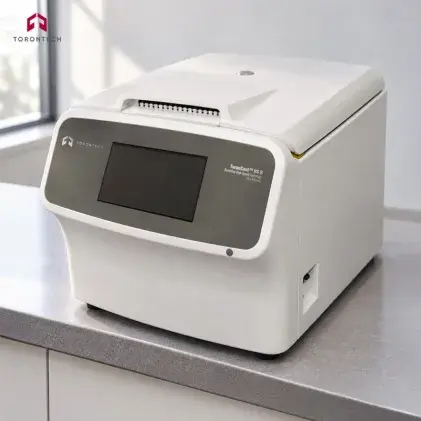
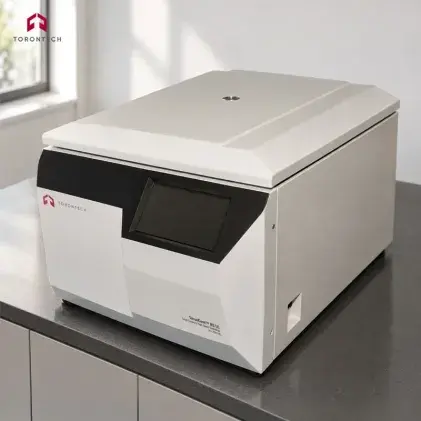
| ToronCent™ HS LC | 21,000 rpm / 30,642 x g | 4 x 750 mL | The largest unit in the range, processing 3 liters per cycle in swing buckets while its microtube rotors reach the top speed. Aerosol-tight buckets and autoclavable rotors suit blood banking and biocontainment work. |
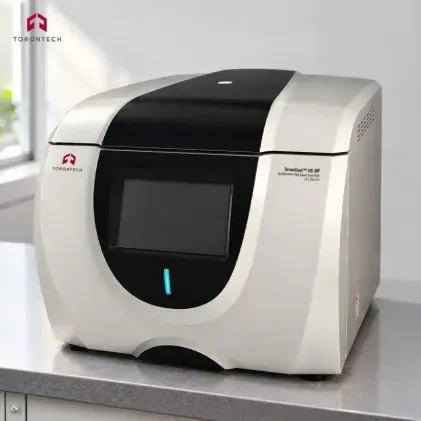
| ToronCent™ HS MP | 19,000 rpm / 25,100 x g | 4 x 250 mL | A general purpose platform with 15 rotors and five-step programmable centrifugation, covering microtubes, bottles, and 96-well plates on one drive. Suits shared labs replacing two instruments with one. |
| ToronCent™ HS B | 18,500 rpm / 23,797 x g | 4 x 100 mL | Fifteen magnetically identified rotors in a 380 mm footprint, including a dedicated hematocrit rotor and a PCR tube rotor. A wind deflector and damping system keep runs cool and steady. |
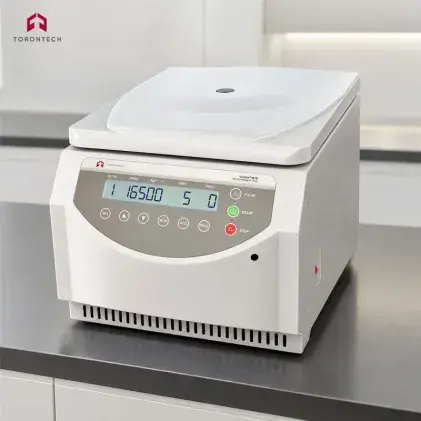
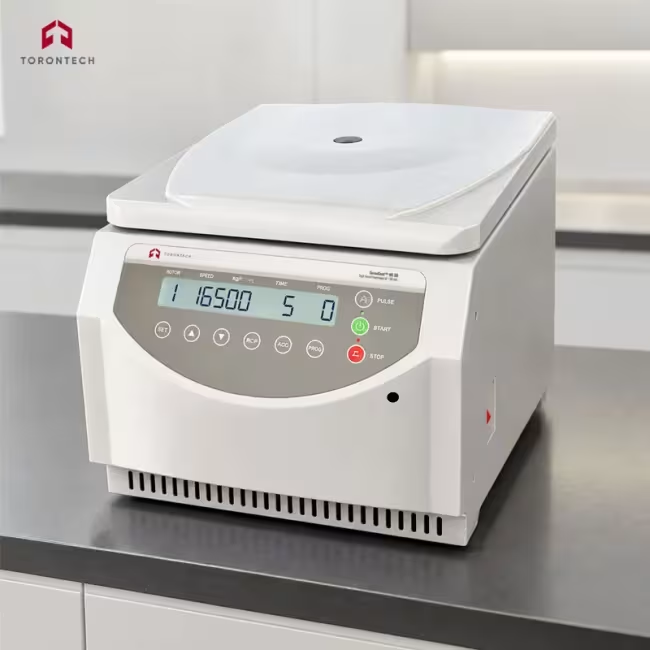
| ToronCent™ HS 50 | 16,500 rpm / 26,054 x g | 6 x 50 mL | Seven fixed angle rotors machined from 7075-T6 aluminum alloy, driven by a brushless DC motor at 20 kg net weight. Built for pelleting rather than gradient work. |
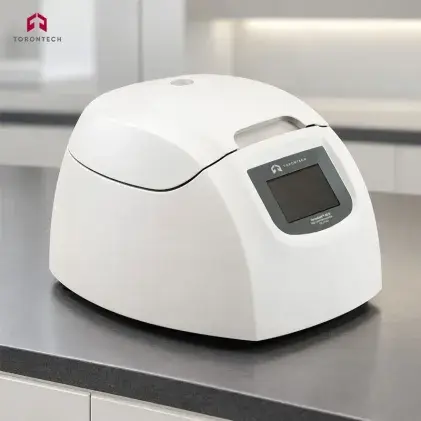
| ToronCent™ HS M | 16,500 rpm / 18,360 x g | 12 x 5 mL | A microcentrifuge for the small-volume bench, with a 5-inch touchscreen, mid-run parameter adjustment, and capillary rotors for hematocrit. The lightest model at 11 kg. |
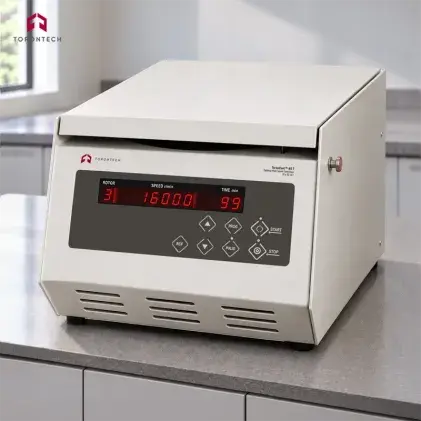
| ToronCent™ HS T | 16,000 rpm / 21,532 x g | 6 x 50 mL | A simply operated model with a digital speed, time, and RCF readout instead of a programmable interface. The quietest unit in the range at ≤62 dB(A). |
How to Choose the Right High Speed Centrifuge
- For bulk volumes above one liter per cycle: choose the HS LC, the only model with 750 mL swing buckets and aerosol-tight carriers.
- For a shared lab covering microliters through bottles: choose the HS MP, whose 15 rotors and five-step programming cover the widest span of formats.
- For clinical work including hematocrit: choose the HS B for its dedicated capillary rotor alongside 100 mL swing capacity, or the HS M if your samples stay small.
- For microtube and spin column work: choose the HS M, sized and priced for the small-volume bench rather than bulk clarification.
- For maximum g-force on 50 mL tubes: choose the HS 50, which delivers 26,054 x g and the highest field of any model outside the HS LC.
- For teaching labs and occupied bench space: choose the HS T, the quietest model and the simplest to train a rotating group of users on.
- For gradient separations and flat pellets: choose any model with swing rotors, since the HS 50 and HS T carry fixed angle rotors only.