
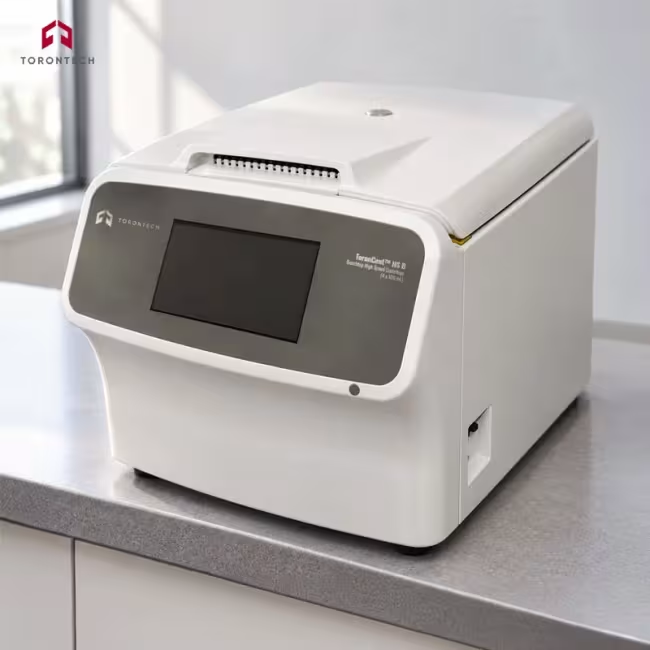
Benchtop High Speed Centrifuge (4 x 100 mL) - ToronCent™ HS B
ToronCent™ HS B benchtop high speed centrifuge fits a 380 mm wide footprint and still reaches 18,500 rpm and 23,797 x g. Fifteen magnetically identified rotors cover microtubes, PCR strips, hematocrit capillaries, conical tubes, 100 mL bottles, and microplates. Biochemistry and clinical laboratories short on bench space get high speed pelleting and routine clinical work on one drive. Net weight is 36 kg and power draw peaks at 700 W.
A dedicated 12 x 1.5 / 2.2 mL angle rotor delivers the top speed for pelleting fine precipitates and subcellular material. The 4 x 100 mL swing rotor handles bulk clarification and blood tube work at the other end of the capacity range. A hematocrit rotor spins 24 capillaries for packed cell volume determination, a test that few high speed benchtop units support directly. Automatic magnetic rotor recognition caps speed to whichever rotor is fitted.
A 7-inch full touchscreen shows every parameter on one view and converts rpm to RCF automatically as the operator adjusts speed. Stepless speed setting removes the fixed increments that knob-driven instruments impose. Named program memories store recurring methods, so technicians recall a validated setup rather than re-entering values. Ten acceleration and eleven deceleration stages control the ramp, and free coast stop time can be set. Self-diagnostics monitor door interlock, over-speed, motor temperature, misoperation, and communication faults.
Benchtop High Speed Centrifuge (4 x 100 mL) - ToronCent™ HS B Applications
The ToronCent™ HS B serves biochemistry, clinical, and molecular laboratories that need high g-force capability without surrendering a large share of the bench.
- Biochemistry and Protein Work: pellets precipitates, clarifies lysates, and concentrates fractions at up to 23,797 x g in the high speed microtube rotors
- Clinical and Diagnostic Laboratories: separates serum and plasma in the 4 x 100 mL swing rotor, processing 12 blood collection tubes per cycle
- Hematology and Packed Cell Volume Testing: determines hematocrit on 24 capillary tubes per run using the dedicated microhematocrit rotor
- Molecular Biology and PCR Workflows: collects reaction volumes in 48 PCR tubes per cycle and spins down nucleic acid precipitates and spin columns
- Immunoassay and Plate Handling: settles reagents and clears bubbles in 96-well ELISA plates, deep-well plates, and filter plate reagent kits
- Cell Culture Support: pellets cells and washes in 15 mL and 50 mL conical tubes, with 100 mL bottles available for larger harvests
- Pharmaceutical Quality Control: clarifies formulations and prepares samples ahead of chromatographic or spectroscopic analysis
- Food and Beverage Analysis: separates fat, solids, and aqueous phases in dairy, juice, and beverage samples
- Veterinary Diagnostics: runs animal blood and urine samples, including capillary hematocrit on small-volume species
- Teaching Laboratories: gives students one compact platform for microtube, conical tube, capillary, and plate protocols
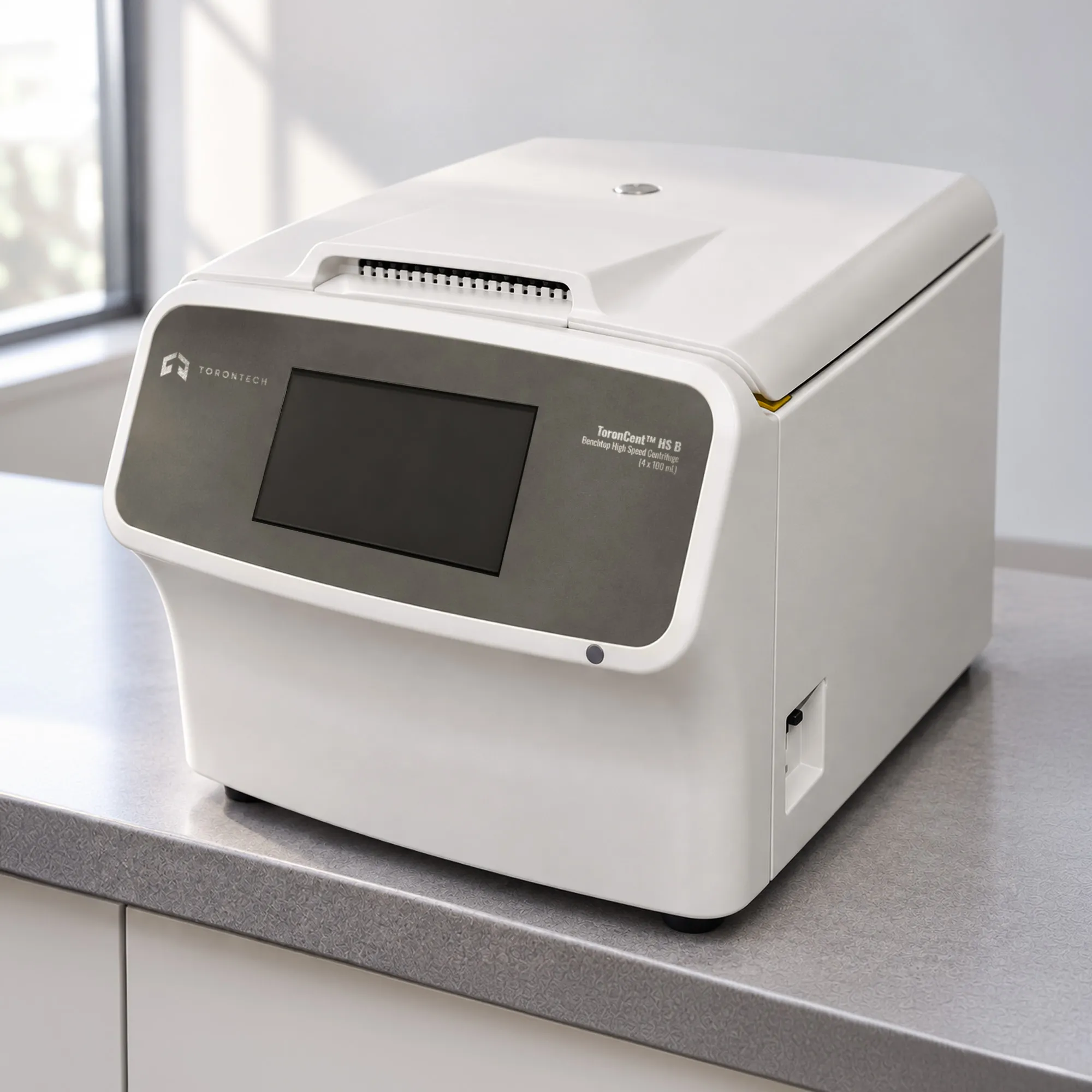
Benchtop High Speed Centrifuge (4 x 100 mL) - ToronCent™ HS B Key Features
The ToronCent™ HS B combines a 15-rotor library, magnetic rotor recognition, and a full touchscreen interface in a compact housing.
- 18,500 rpm Maximum Speed and 23,797 x g: pellets fine precipitates and subcellular fractions that most compact benchtop units cannot bring down
- 15 Interchangeable Rotors: covers 0.2 mL PCR tubes, hematocrit capillaries, conical tubes, 100 mL bottles, and 96-well plates on a single drive
- Dedicated Microhematocrit Rotor: measures packed cell volume on 24 capillaries per run, adding a hematology test most high speed centrifuges leave to a separate instrument
- 4 x 100 mL Swing Rotor: produces flat pellets with a clean supernatant boundary for blood tube separation and bulk clarification
- Automatic Magnetic Rotor Identification: recognizes each of the 15 rotors and applies its speed ceiling as over-speed protection
- Automatic RCF Conversion: displays relative centrifugal force alongside speed and recalculates for the fitted rotor, so operators run methods at the g-force a protocol specifies
- Stepless Speed Adjustment: sets any speed within range rather than stepping through fixed increments, allowing methods to be matched exactly
- 7-Inch Full Touchscreen: presents all running and setpoint parameters on one view for readout at a glance
- Named Program Memories: stores and labels recurring methods by name, giving consistent parameters across operators and shifts
- 10 Acceleration and 11 Deceleration Stages: matches the ramp profile to the sample so gradients and loose pellets survive the stop
- Settable Free Coast Stop: lets the rotor slow without braking over a defined interval, which suits separations that a hard stop would disturb
- Multi-Point Self-Diagnostics: monitors door interlock faults, over-speed conditions, motor overheating, misoperation, and communication errors
- Wind Deflector Airflow Design: directs chamber airflow to carry frictional heat away and hold sample condition through longer runs
- Vibration Damping System: absorbs residual rotor imbalance to keep operation stable and reduce transmitted noise
- Compact 380 mm Footprint: occupies less bench width than comparable high speed units, at a 36 kg net weight
Theory and Method
Protocols specify relative centrifugal force, while a motor controls rotational speed, and the two are not interchangeable between rotors. Relative centrifugal force follows RCF = 1.118 x 10⁻⁵ x r x N², where r is the rotor radius in millimeters and N is speed in rpm. A method calling for 15,000 x g therefore needs a different rpm setting on a wide 100 mL rotor than on a compact microtube rotor. The instrument reads the fitted rotor and converts between the two on screen.
Packed cell volume measurement relies on the same field acting on whole blood in a narrow capillary. Erythrocytes are denser than plasma, so sustained high g drives them toward the sealed end of the tube until the cell column stops compressing further. The ratio of packed cell length to total column length gives hematocrit directly, with no reagent or optical step. The dedicated rotor holds 24 capillaries at 13,000 rpm and 17,369 x g, the sustained field that test requires.
A spinning rotor drags the air around it, and that drag heats the chamber, raises noise, and consumes motor power. The wind deflector shapes airflow inside the bowl so heat moves away from the sample rather than building around it. Residual imbalance caused by unequal tube loading generates vibration at the rotor's rotational frequency, which the damping system absorbs before it reaches the bench. Quieter, steadier running follows, and the instrument holds ≤65 dB(A).
Benchtop High Speed Centrifuge (4 x 100 mL) - ToronCent™ HS B Technical Specifications
| Parameter | Specification |
|---|---|
| Maximum Speed | 18,500 rpm |
| Maximum RCF | 23,797 x g |
| Maximum Capacity | 4 x 100 mL |
| Speed Accuracy | ±10 rpm |
| Time Setting Range | 1 s to 99 min 59 s, or 1 min to 99 h 59 min |
| Rotor Identification | Automatic, magnetic, 15 rotors |
| Speed Adjustment | Stepless |
| RCF Display | Automatic conversion, shown on the same screen |
| Display | 7-inch full touchscreen |
| Program Memory | Multiple named program memories |
| Acceleration Stages | 10 |
| Deceleration Stages | 11 |
| Free Coast Stop Time | Settable |
| Noise Level | ≤65 dB(A) |
| Voltage | AC 220 V, 50/60 Hz (110V is also available) |
| Power Consumption | 700 W |
| Dimensions (W x D x H) | 380 x 505 x 360 mm |
| Packing Dimensions (W x D x H) | 480 x 780 x 460 mm |
| Net Weight | 36 kg |
Angle Rotor Options
| Max Capacity | Max Speed | Max RCF | Adapters Available |
|---|---|---|---|
| 12 x 1.5 / 2.2 mL | 18,500 rpm | 23,797 x g | 0.2 mL, 0.5 mL |
| 24 x 1.5 / 2.0 mL | 15,000 rpm | 21,532 x g | |
| 12 x 5 mL | 15,000 rpm | 15,840 x g | 0.5 mL, 1.5 mL |
| 30 x 1.5 / 2.0 mL | 14,000 rpm | 22,140 x g | |
| 48 x 1.5 / 2.0 mL | 13,000 rpm | 18,525 x g | 0.2 mL, 0.5 mL |
| 6 x 50 mL | 13,000 rpm | 17,947 x g | 1.5, 5, 10, 15, 20, 25, 30 mL |
| 12 x 10 mL | 13,000 rpm | 17,370 x g | 1.5 mL, 5 mL |
| 6 x 8 x 0.2 mL (PCR tube) | 13,000 rpm | 16,020 x g | |
| 6 x 50 mL (conical) | 12,000 rpm | 15,292 x g | 15 mL (conical); 50 mL round bottom adapter included |
| 8 x 15 mL (conical) | 12,000 rpm | 13,200 x g | 5 mL |
| 4 x 100 mL | 10,000 rpm | 10,744 x g | 5, 10, 15 mL (conical/round); 25, 50 mL (conical/round) |
Hematocrit Rotor
| Max Capacity | Max Speed | Max RCF |
|---|---|---|
| 24 hematocrit capillaries | 13,000 rpm | 17,369 x g |
Swing Rotor Options
| Max Capacity | Max Speed | Max RCF | Bucket Type |
|---|---|---|---|
| 24 x 1.5 / 2.2 mL | 13,000 rpm | 16,816 x g | Integral carrier |
| 4 x 100 mL | 5,000 rpm | 3,773 x g | Round bucket |
| 2 x 2 x 96-well | 4,000 rpm | 2,200 x g | Microplate bucket |
Bucket and Adapter Configurations
| Bucket Type | Adapter Configurations |
|---|---|
| Round bucket, 4 x 100 mL swing rotor | 4 x 3 x 10 mL blood collection tube; 4 x 1 x 15 mL; 4 x 1 x 15 mL (conical); 4 x 1 x 50 mL; 4 x 1 x 50 mL (conical) |
| Microplate bucket | 2 x 6 x 96 ELISA microplate; 2 x 2 x 96 deep-well plate; 2 x 1 x 96 filter plate reagent kit |
| Custom configurations | Available on request |
| Microtube swing carrier | 0.2 mL, 0.5 mL adapters |