
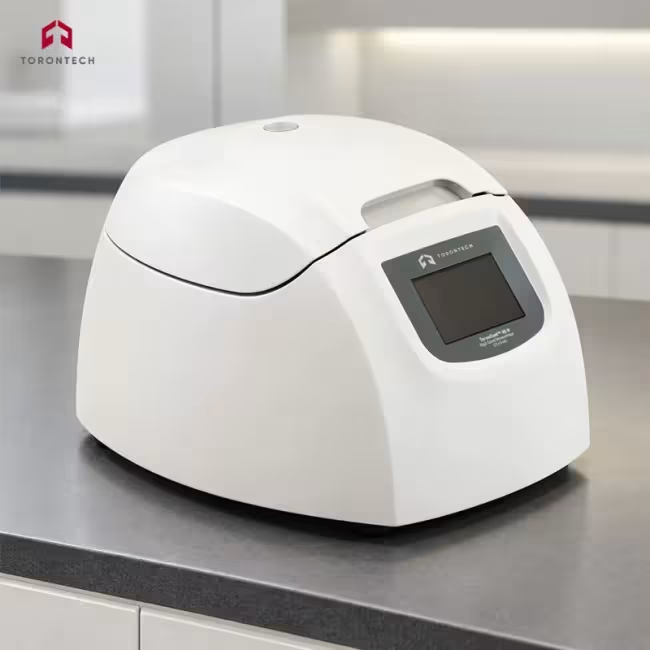
High Speed Microcentrifuge (12 x 5 mL) - ToronCent™ HS M
ToronCent™ HS M high speed microcentrifuge spins 12 x 1.5 mL microtubes at 16,500 rpm and 18,360 x g in an 11 kg housing that draws 250 W. Seven angle rotors handle 0.2 mL PCR strips, 0.5 mL and 1.5 mL microtubes, 5 mL tubes, and hematocrit capillaries. Molecular biology, biochemistry, and clinical laboratories use it for nucleic acid purification, spin column work, and small-volume pelleting. The 320 mm wide footprint fits a shared bench or a fume hood shelf.
Maximum tube capacity and maximum speed come from different rotors in the set. The 12 x 5 mL rotor holds the largest working volume and runs at 12,000 rpm and 10,142 x g, while the microtube rotors reach the headline 16,500 rpm. An 18 x 0.5 mL rotor matches that top speed for high throughput small-volume work. Selecting the rotor to suit the tube format therefore sets the g-force available for a given protocol.
A 5-inch HD touchscreen takes direct numeric entry and shows setpoints beside live running values on one view. Parameters can be adjusted mid-run without stopping the rotor, which suits method development and troubleshooting. Multiple user-defined programs store recurring protocols for recall. Ten acceleration and eleven deceleration rates control the ramp. Microprocessor control and a DC brushless motor keep the drive stable and quiet at ≤65 dB(A).
High Speed Microcentrifuge (12 x 5 mL) - ToronCent™ HS M Applications
The ToronCent™ HS M covers the small-volume end of laboratory separation, where sample is measured in microliters and recovery matters more than throughput.
- Nucleic Acid Purification: drives binding, wash, and elution steps through silica membrane spin columns for DNA and RNA extraction kits
- PCR Sample Preparation: collects reaction volumes in 24 PCR tubes per cycle using the strip rotor, clearing condensate before and after thermal cycling
- Molecular Biology and Cloning: pellets plasmid preparations, precipitated nucleic acids, and bacterial cultures in 1.5 mL and 2.0 mL microtubes
- Protein and Enzyme Work: clarifies small-volume lysates and recovers precipitates at up to 18,360 x g ahead of assay or electrophoresis
- Hematology and Packed Cell Volume Testing: determines hematocrit on 12 or 24 capillary tubes per run using the dedicated capillary rotors
- Clinical and Diagnostic Laboratories: separates serum and plasma in 5 mL tubes for small-draw and pediatric samples
- Microbiology: harvests bacterial cells and separates culture supernatant for downstream assay
- Forensic and Genetic Testing: processes trace samples through extraction columns where every microliter of eluate counts
- Pharmaceutical Quality Control: clarifies small-volume formulations ahead of chromatographic analysis
- Teaching Laboratories: gives students a light, low draw platform for microtube and spin column protocols
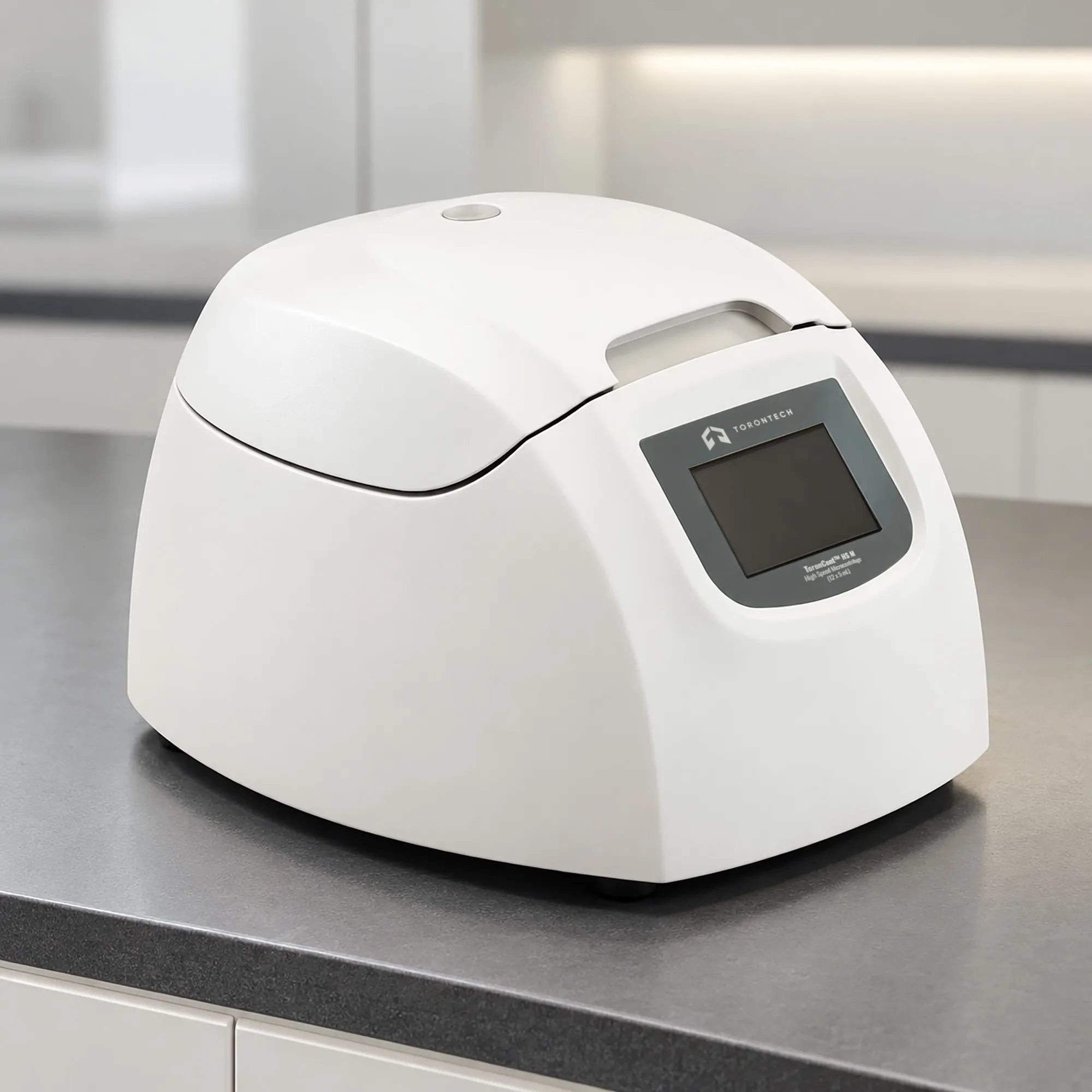
High Speed Microcentrifuge (12 x 5 mL) - ToronCent™ HS M Key Features
The ToronCent™ HS M puts a touchscreen interface and a brushless drive into the smallest housing in the ToronCent™ high speed range.
- 16,500 rpm Maximum Speed and 18,360 x g: covers the g-force range that published microtube and spin column protocols call for
- Seven Angle Rotors: handles 0.2 mL PCR strips, 0.5 mL and 1.5 mL microtubes, 5 mL tubes, and hematocrit capillaries on one drive
- Dedicated Capillary Rotors: measure packed cell volume on 12 or 24 capillaries per run, adding a hematology test to a molecular biology bench
- 18 x 0.5 mL High Throughput Rotor: runs the maximum speed with an extra six positions, raising batch size for small-volume work
- Parameter Adjustment During a Run: changes speed or time without stopping the rotor, so a method can be corrected mid-spin rather than restarted
- 5-Inch HD Touchscreen: shows setpoints beside live running values on a single view for readout at a glance
- Direct Numeric Entry: accepts values by keypad rather than stepping a knob back and forth, cutting setup time and entry error
- User-Defined Program Memory: stores recurring protocols for direct recall, giving consistent parameters across operators and shifts
- 10 Acceleration and 11 Deceleration Rates: match the ramp to the sample, with gentle stops for loose pellets and fast ones for column spins
- Microprocessor-Controlled DC Brushless Motor: holds speed steadily without carbon brush wear or brush dust, and runs quietly at ≤65 dB(A)
- Door Lid Interlock: keeps the chamber closed while the rotor turns and prevents opening until it comes to rest
- Over-Speed and Misoperation Protection: halts a run that exceeds rotor limits or follows an invalid parameter entry
- 1 Second Timer Resolution: sets short spins precisely for column steps that call for 15 or 30 seconds
- 11 kg Net Weight and 320 mm Footprint: lifts by hand and takes the least bench space of any ToronCent™ high speed unit
- 250 W Power Consumption: draws less than a benchtop hotplate, suiting shared or lightly served circuits
Theory and Method
Relative centrifugal force, not rotational speed, defines what a protocol needs. The relationship is RCF = 1.118 x 10⁻⁵ x r x N², where r is rotor radius in millimeters and N is speed in rpm. Microcentrifuge rotors carry a small radius, so they reach useful g-force at high rpm while staying compact and light. The 12 x 1.5 mL rotor produces 18,360 x g at 16,500 rpm, which covers most microtube protocols published for benchtop work.
Silica membrane spin columns depend on centrifugal force to move liquid through a packed frit rather than to sediment a particle. Chaotropic salts in the binding buffer strip water away from nucleic acids, letting them adsorb onto the silica while the column spins and the lysate passes through. Ethanol washes then carry contaminants past the bound sample, and a low salt buffer releases it. Each of those steps needs a reproducible g-force and a clean stop, since residual buffer in the frit dilutes the eluate.
Ramp behavior matters more at small volumes than at large ones. A 1.5 mL pellet holds only a few microliters of packed material, so an abrupt stop can lift it back into suspension and cost the whole recovery. Ten acceleration and eleven deceleration rates let an operator pick a gentle stop for loose pellets and a fast one for column spins. Setting parameters during a run allows a protocol to be corrected without discarding the sample.
High Speed Microcentrifuge (12 x 5 mL) - ToronCent™ HS M Technical Specifications
| Parameter | Specification |
|---|---|
| Maximum Speed | 16,500 rpm |
| Maximum RCF | 18,360 x g |
| Maximum Capacity | 12 x 5 mL |
| Speed Accuracy | ±30 rpm |
| Time Setting Range | 1 s to 99 min 59 s |
| Motor Type | DC brushless, microprocessor controlled |
| Display | 5-inch HD touchscreen |
| Parameter Entry | Direct numeric input, adjustable during a run |
| Program Memory | Multiple user-defined programs |
| Acceleration Rates | 10 |
| Deceleration Rates | 11 |
| Protection Functions | Over-speed, door lid interlock, misoperation |
| Noise Level | ≤65 dB(A) |
| Voltage | AC 220 V ±22 V, 50 Hz (110V is also available) |
| Power Consumption | 250 W |
| Dimensions (W x D x H) | 320 x 370 x 235 mm |
| Packing Dimensions (W x D x H) | 530 x 410 x 290 mm |
| Net Weight | 11 kg |
Angle Rotor Options
| Max Capacity | Max Speed | Max RCF | Adapters Available |
|---|---|---|---|
| 12 x 1.5 mL | 16,500 rpm | 18,360 x g | 0.2 mL, 0.5 mL |
| 18 x 0.5 mL | 16,500 rpm | 18,360 x g | |
| 3 x 8 x 0.2 mL (PCR strip) | 15,000 rpm | 13,800 x g | |
| 24 x 1.5 mL | 13,000 rpm | 16,170 x g | 0.2 mL, 0.5 mL |
| 12 x 5 mL | 12,000 rpm | 10,142 x g | 0.5 mL, 1.5 mL |
| 12 capillaries | 12,000 rpm | 14,800 x g | |
| 24 capillaries | 12,000 rpm | 14,800 x g |