
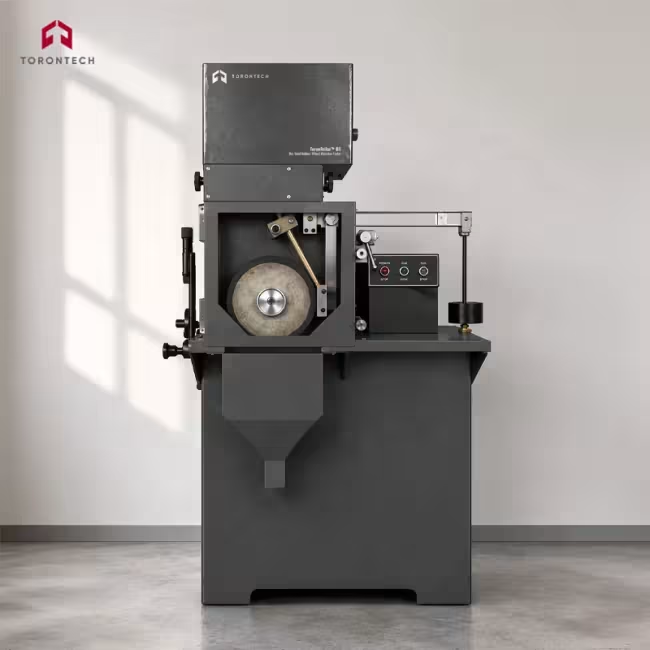
Dry Sand Rubber Wheel Abrasion Tester
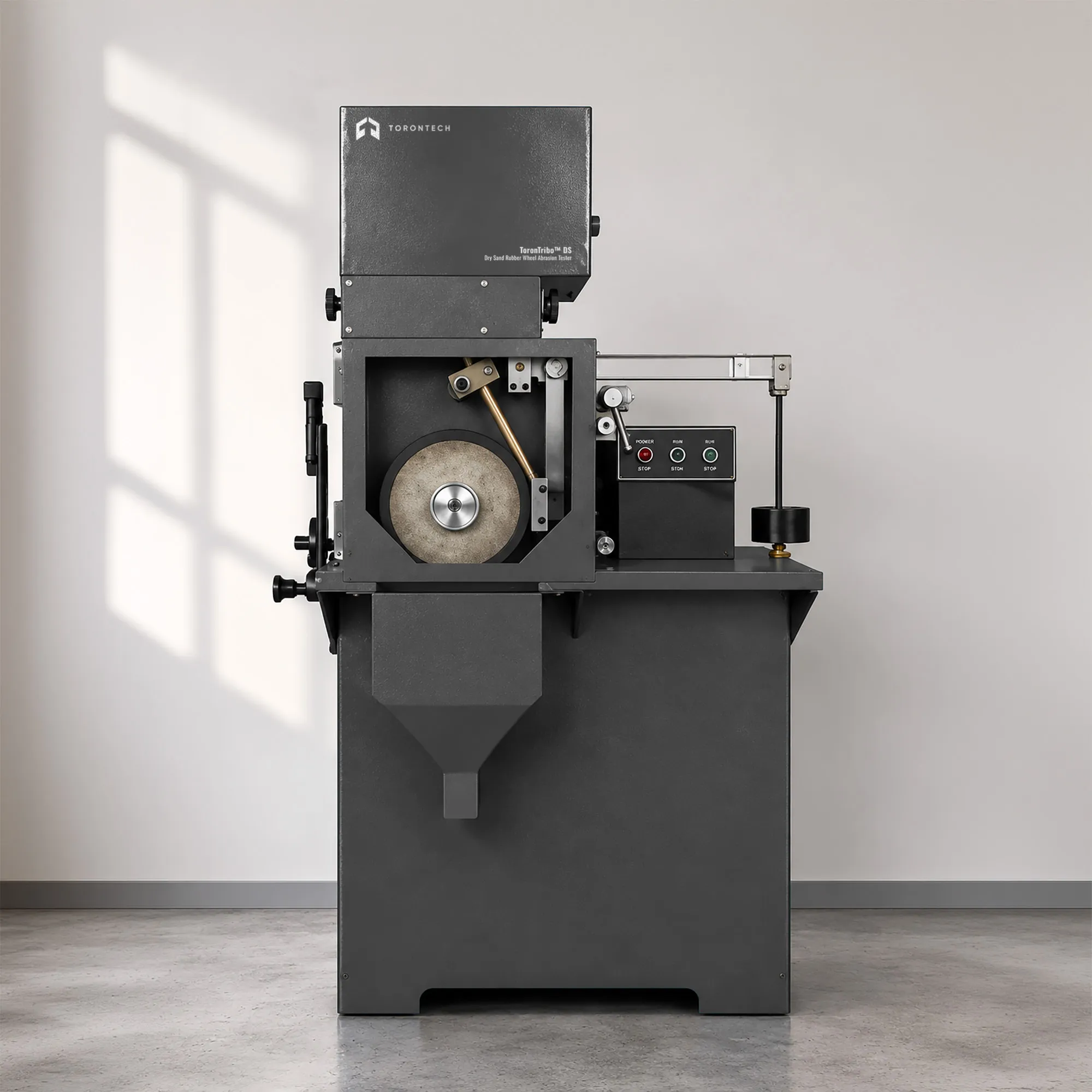
Dry Sand Rubber Wheel Abrasion Tester - ToronTribo™ DS
Dry Sand Rubber Wheel Abrasion Tester ranks the resistance of metallic and non-metallic materials to scratching abrasion, serving materials laboratories, hardfacing manufacturers, and component developers in mining, construction, and agricultural equipment industries. The ToronTribo™ DS drives a clockwise-rotating rubber wheel against a test specimen while quartz sand or similar mineral abrasives fall freely through a metal sand nozzle into the contact zone, reproducing the three-body abrasive wear conditions found in earthmoving, mineral processing, and agricultural equipment.
The tester applies a maximum load of 130 N against a 228.6 mm rubber wheel held at 60 Shore hardness, rotating at 200 ±10 rpm. Test specimens measuring 76 x 25.5 x 12 mm are held against the wheel while abrasive sand flows continuously through the contact zone, and material loss from the specimen after a defined test duration indicates its relative abrasion resistance. The instrument's compact 710 x 740 x 1600 mm footprint suits standard laboratory installation.
Hardfacing and wear-plate manufacturers, materials research laboratories, and component developers use the ToronTribo™ DS to rank candidate materials, coatings, and heat treatments by abrasion resistance before committing to full-scale field testing. Because the test method standardizes abrasive particle size, load, and wheel condition, results support direct, repeatable comparison between materials tested at different times or in different laboratories.
Dry Sand Rubber Wheel Abrasion Tester - ToronTribo™ DS Applications
The ToronTribo™ DS supports abrasion resistance evaluation for materials and coatings used in equipment exposed to sand, gravel, and mineral abrasives.
- Mining Equipment Wear Component Testing: ranks abrasion resistance of materials used in crusher liners, chutes, and other components exposed to mineral abrasives
- Hardfacing and Weld Overlay Evaluation: compares wear resistance of hardfacing alloys and weld overlay materials applied to protect wear-prone surfaces
- Earthmoving and Construction Equipment Materials: assesses wear resistance of materials used in bucket teeth, blades, and ground-engaging tools
- Agricultural Equipment Component Testing: evaluates abrasion resistance of plow shares, tillage tools, and other soil-contacting components
- Coating and Surface Treatment Comparison: ranks coated versus uncoated materials to quantify the abrasion resistance benefit of a given surface treatment
- Metal Alloy and Heat Treatment Screening: compares different alloy compositions and heat treatment conditions for abrasion resistance during material development
- Quality Control and Material Certification: verifies that incoming material or coating batches meet expected abrasion resistance specifications
Standards
The ToronTribo™ DS supports test procedures aligned with the internationally recognized ASTM standard for dry sand/rubber wheel abrasion testing.
- ASTM G65-16(2021) - Standard Test Method for Measuring Abrasion Using the Dry Sand/Rubber Wheel Apparatus
Dry Sand Rubber Wheel Abrasion Tester - ToronTribo™ DS Key Features
The ToronTribo™ DS combines standardized rubber wheel and abrasive delivery control for repeatable dry sand abrasion testing.
- Standardized Rubber Wheel: uses a 228.6 mm diameter wheel at 60 Shore hardness, matching internationally recognized test method requirements
- Controlled Wheel Rotation: maintains rotation speed at 200 ±10 rpm for consistent abrasive contact conditions throughout the test
- Precise Load Application: applies up to 130 N of load against the test specimen for controlled abrasive contact severity
- Free-Falling Abrasive Delivery: feeds quartz sand or similar mineral abrasives through a metal sand nozzle for consistent three-body abrasive wear conditions
- Standard Specimen Compatibility: accepts 76 x 25.5 x 12 mm test specimens matching common abrasion test requirements
- Compact Laboratory Footprint: fits standard laboratory space at 710 x 740 x 1600 mm
Theory and Method
Dry sand rubber wheel abrasion testing reproduces a form of three-body abrasive wear, in which loose abrasive particles roll and slide between two surfaces rather than remaining fixed to either one. Quartz sand or another mineral abrasive falls freely through a nozzle into the gap between a rotating rubber wheel and a stationary test specimen held against the wheel under a controlled load. As the wheel rotates, it carries sand particles into the contact zone, where they abrade the specimen surface before falling away, and the specimen's material loss over a fixed test duration provides the basis for ranking abrasion resistance.
The rubber wheel's role in this test is significant, since its resilience allows abrasive particles to indent and roll rather than simply scratch past, more closely reproducing how abrasive particles behave in service compared to a rigid abrasion surface. The ToronTribo™ DS controls wheel hardness, rotation speed, and applied load precisely, along with abrasive particle size and flow rate, so that the severity of abrasive contact remains consistent from test to test. This standardization is what allows results from different materials, tested at different times, to be compared meaningfully.
Because this test method does not attempt to replicate the exact abrasive particle size, shape, pressure, or corrosive conditions of any specific field environment, its primary value lies in ranking materials relative to one another rather than predicting an exact service life. Comparing the volume loss of a new material or coating against a reference material with known field performance gives engineers a practical way to estimate how the new material is likely to perform under similar abrasive conditions, without requiring lengthy and costly field trials for every candidate material.
Dry Sand Rubber Wheel Abrasion Tester - ToronTribo™ DS Technical Specifications
| Parameter | Specification |
|---|---|
| Maximum Load | 130 N |
| Rubber Wheel Rotation Direction | Clockwise |
| Rubber Wheel Speed | 200 ± 10 rpm |
| Rubber Wheel Diameter | 228.6 mm |
| Rubber Wheel Hardness | 60 (Shore hardness) |
| Sample Size | L76 mm x W25.5 mm x H12 mm |
| External Dimensions | L710 mm x W740 mm x H1600 mm |