Types of Abrasion Testers: Technical Selection Guide
Proven surface durability delivers an immediate commercial edge. When materials resist continuous friction and abrasive wear, product reliability climbs and customer trust follows. Verifying that performance in the laboratory gives your team the empirical data needed to satisfy tough client audits.
This guide details essential abrasion testing methods, helping your facility select the right setup to optimize quality control.
Key Takeaways
- Contact mechanics dictate equipment choice: match two-body cutting, three-body rolling, impact fragmentation, or slurry erosion to real-world operating exposure.
- Volumetric loss is essential: converting raw mass loss using material density provides the only reliable baseline for comparing materials with different densities.
- Standards alignment ensures audit readiness: verifying material performance against published ASTM, ISO, IEC, and AASHTO test standards supports compliance with client specifications and industry guidelines, including AREMA railway ballast recommendations.
- Application-driven selection: matching testing platforms to specific industry sectors mitigates premature component wear and structural failure risk across civil works, mining, telecommunications, and manufacturing.
Fundamental Wear Mechanisms
Tribological literature classifies wear mechanisms by contact regime: two-body systems where fixed asperities slide across a surface, and three-body configurations where loose particles roll or slip between counter-surfaces.
Two-body abrasion causes surface damage via micro-cutting and plowing from rigid cutting points. Three-body wear involves free abrasive particles, causing low-stress surface scratching under moderate loads or high-stress particle crushing and micro-spalling when normal forces shatter the abrasive grains.
Dynamic operating environments introduce additional degradation modes. Impact-abrasion pairs mechanical shock with frictional shearing, which is widely documented in industrial mineral comminution and crushing circuits. Hydro-abrasive and slurry erosion occurs when liquid carriers drag abrasive particles across surfaces, causing continuous fluid-borne shear and surface fatigue.
In our view, identifying whether field exposure involves dry scratching, impact fragmentation, or fluid erosion is the essential first step in selecting an appropriate test configuration.
Types of Abrasion Testers
Selecting an appropriate instrument requires matching operational kinematics to field service conditions.
Benchmark Laboratory Systems
Industrial sectors utilize varied mechanical geometries depending on material class and stress regime. Dry sand rubber wheel systems standardized under ASTM G65 deliver silica sand against a flat specimen under defined mechanical loads to induce three-body, low-stress scratching.
Pin-on-disk and pin-on-drum units evaluate sliding wear in tool steels, minerals, and rock-cutting assemblies under ASTM G99 and ASTM G132. Rotary platform Taber systems under ASTM C1353 and ASTM D3884 evaluate stone, textiles, and coatings under rotating abrasive wheels. In elastomeric testing, rotary drum units operating under ASTM D5963 and disc-to-wheel Lambourn testers evaluate rolling and slip-induced mass loss in rubber compounds.
For high-stress gouging and crushing, jaw crushers operating under ASTM G81 and specialized Ball Mill Abrasion Testers (BMAT) simulate impact and crushing degradation on mining alloys and grinding media.
Commercial Testing Portfolio
To address commercial quality control demands, we at Torontech manufacture six cost-effective testing platforms built for high-throughput laboratory environments:
ToronLA C131: Aggregate Impact and Abrasion
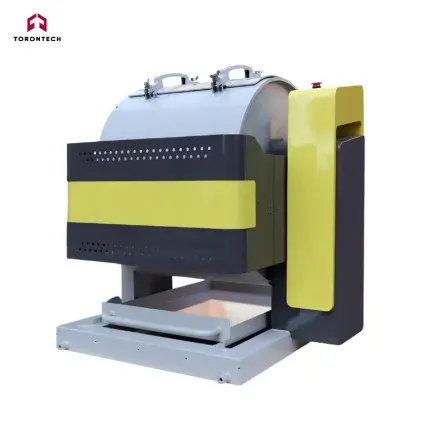
The Los Angeles Abrasion Tester (Model: ToronLA™ C131) evaluates structural degradation in coarse aggregates for highway pavements, airport runways, and railway ballast. The machine rotates aggregate samples and steel charges inside a rolled steel drum (internal dimension: 710mm×510mm(±5mm); 12mm wall thickness) at 31 to 33 RPM (31-33 r.p.m).
An interior shelf drops the mixture to induce simultaneous impact crushing and surface abrasion. Driven by an electric motor with a speed reducer, it includes a digital counter, a powder-coated exterior finish, and a steel unloading tray. External dimensions are 942x959x948mm, with an equipment weight of 340kg and electrical requirements of AC220V 50HZ/60HZ with a 750W motor rating (110V is also available).
Available accessories and replacement parts include:
- Part No. 42-5305/01A1: Set of 12 abrasive charges: 1.13/16” (7 pcs) and 1.7/8” (5 pcs)
- Part No. 42-5305/01A2: Set of 12 abrasive charges: 1.7/8”
- Part No. 42-5305/01A3: Noise reduction and safety cabinet (110kg)
- Part No. 42-5305/01A4: Steel tray for specimen unloading
- Part No. 42-5305/01A5: Protective cover
ToronAT-UHMW: Polymer Slurry Wear
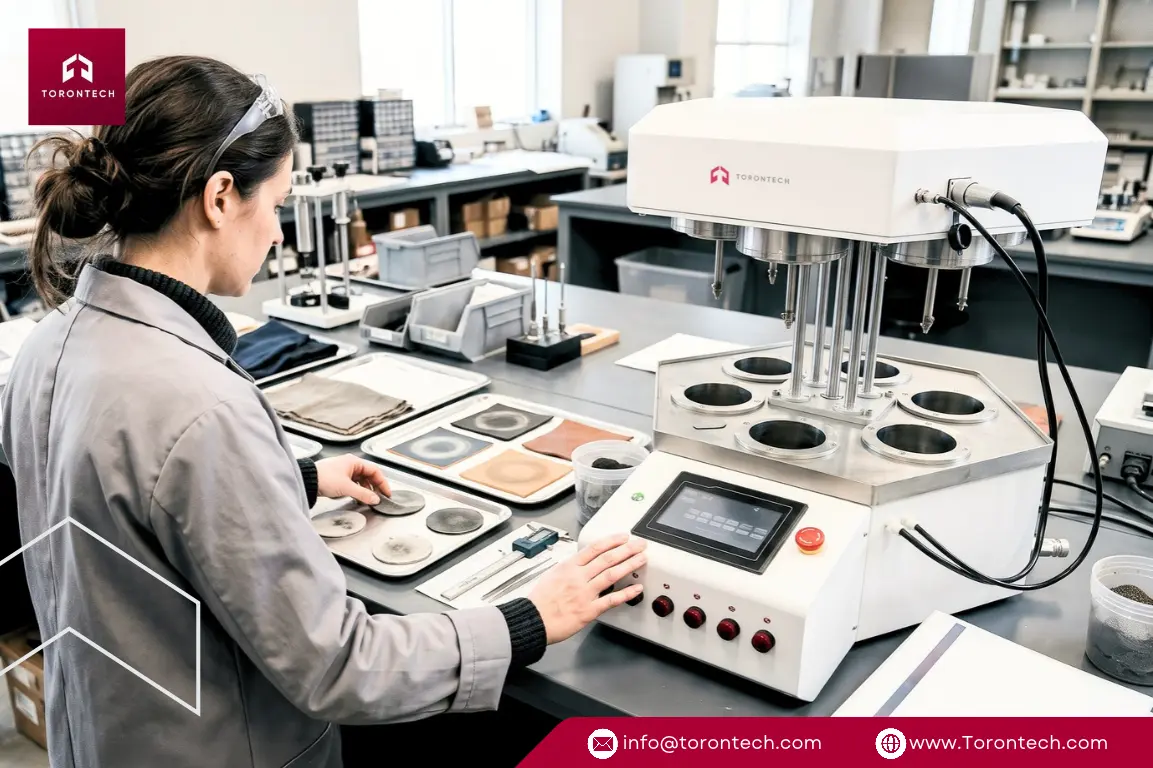
The PE-UHMW Abrasion Resistance Tester (Model: ToronAT™-UHMW) evaluates ultra-high molecular weight polyethylene, high-density polyethylene, and industrial resins used in chutes, hopper liners, and slurry pipelines. It provides 6 test stations driven simultaneously by a synchronous belt connected to a single spindle motor, ensuring identical kinematic exposure across all cups at speeds from 800 to 1400 r/min.
Test coupons rotate inside individual stainless steel cups filled with 450g silica sand and 300g water. A 5.1 KW refrigeration cooling unit circulates through copper tubing in a 35-liter tank, holding slurry temperatures to ±0.5 ℃ with under 1°C variance across all cups. Dimensions are 1.2 × 0.5 × 1.2 m, weight is 220 kg, and electrical supply is 220V AC 2Kva (110V is also available).
TT-OFCA Series: Cable Jacket and Marking Wear
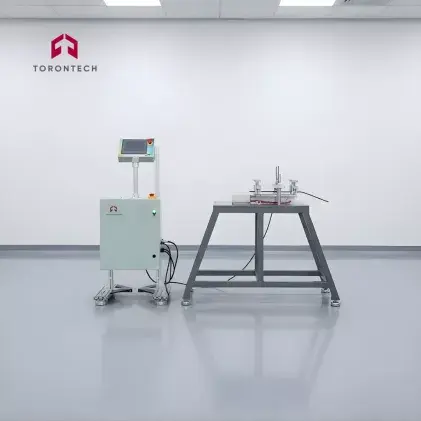
The Optical Fiber Cable Abrasion Testing Machine (TT- OFCA Series / CCA-1000-2024) evaluates jacket toughness and print permanence on telecommunication and armored cables. The machine clamps cable specimens (approximately 750 mm length) while a reciprocating drive arm operates at 55 ± 5 cycles/min for a pre-set range of 1 ~ 9999 cycles. Normal load is adjusted using supplied deadweights (Bracket 5N x 2, Mass 5N x 2, Mass 10N x 2). The working frame measures 1300 x 650 x 1400 mm:
- Method E2A (Sheath Abrasion): Drives a 1 mm diameter steel needle across a 10 mm stroke length.
- Method E2B 1 / Method 1 (Rigid Markings): Moves a 1 mm steel needle across a 40 mm stroke length over embossed, indented, or sintered print.
- Method E2B 2 / Method 2 (Other Markings): Moves a wool felt pad across a 100 mm stroke length over standard surface print.
ToronTribo WS: Wet Sand Slurry Wear
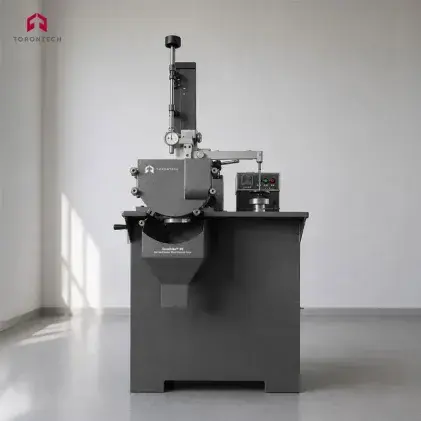
The Wet Sand Rubber Wheel Abrasion Tester (Model: ToronTribo™ WS) evaluates metallic alloys, coatings, and hardfacings exposed to abrasive slurry in pumps, impellers, and pipelines. It rotates a 178 mm diameter rubber wheel (available in Shore hardness 50, 60, or 70) counterclockwise inside a slurry bath holding 1000 g water and 1500 g sand.
The system operates at four selectable speeds (181, 240, 374, or 498 rpm) under normal loads up to 225 N on specimens measuring L57 mm x W25.5 mm x H6 mm. External dimensions are L710 mm x W740 mm x H1600 mm, with an equipment weight of approximately 300 kg.
ToronTribo SRW: Dual-Mode Dry and Wet Wear
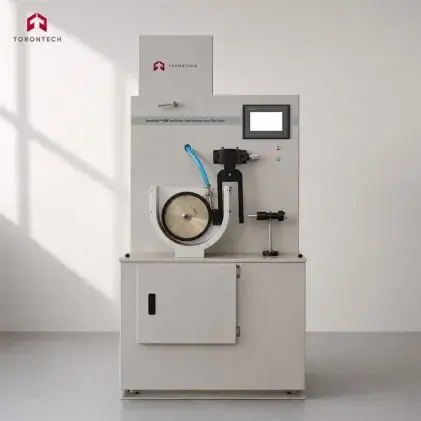
The Sand/Rubber Wheel Abrasion Tester (Dual-Mode) (Model: ToronTribo™ SRW) performs both dry sand and wet sand three-body wear evaluations on a single platform. Built for laboratories evaluating hardfacing alloys, wear plates, and ground-engaging tools, it accommodates dry free-falling sand and wet aqueous mortar.
A variable frequency drive regulates speeds up to 500 rpm with automatic loading from 3 to 300 N, maximum friction capacity of 300 N, and duration programming up to 999,999 revolutions. External dimensions are L700 mm x W600 mm x H1450 mm, weight is 85 kg, and electrical supply is 220V, 16A, 50Hz or 60Hz (110V is also available).
ToronTribo DS: Dry Sand Scratching Wear
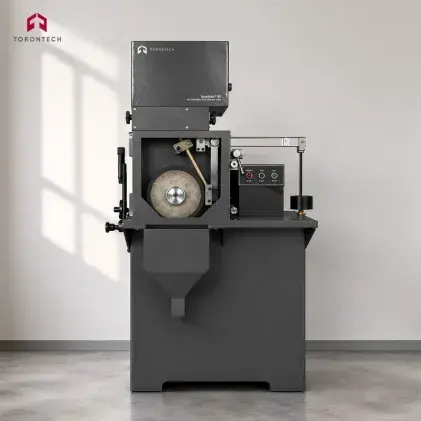
The Dry Sand Rubber Wheel Abrasion Tester (Model: ToronTribo™ DS) gauges low-stress scratch resistance on metals, hardfacings, liners, and tillage tools.
Standardized quartz sand feeds through a calibrated metal nozzle into the interface between a clamped specimen (L76 mm x W25.5 mm x H12 mm) and a clockwise-rotating 228.6 mm diameter rubber wheel (60 Shore hardness). Operating at 200 ± 10 rpm under normal loads up to 130 N, the unit measures dimensional resistance to dry scratching. Dimensions are L710 mm x W740 mm x H1600 mm.
Wear Quantification and Calculations
Standard test specifications translate physical wear into standardized metrics:
Volumetric Loss Conversion
Raw mass loss recorded on an analytical balance must be converted to volume loss to allow accurate comparison across materials with different densities:
Mass Loss (Delta m) = Initial Mass (m_initial) - Final Mass (m_final)
Volume Loss (Delta V, in mm^3) = [Mass Loss (Delta m, in grams) / Density (rho, in g/cm^3)] * 1000
Performance Indices and Failure Criteria
- Aggregate Degradation Percentage (ASTM C131): Calculated from the proportion of crushed material passing a standard 1.70 mm (No. 12) sieve after drum rotation:
- Aggregate Abrasion Loss (%) = [(Initial Mass - Retained Mass) / Initial Mass] * 100
- Relative Abrasion Index (ISO 15527, Annex B): Wear resistance in polymer slurry testing is indexed against a control coupon tested under identical conditions:
- Abrasion Index = (Specimen Volume Loss / Reference Volume Loss) * 100
- Cable Integrity Criteria (IEC-60794-1-2): Method E2A measures the cycle count required to wear through the outer cable sheath or expose internal structural elements such as buffer tubes and strength members. Method E2B evaluates print durability, requiring markings to remain legible to the unaided eye after completing the prescribed test cycles.
Abrasion Testing Standards
Adhering to published standards confirms testing compliance during customer and regulatory audits:
Infrastructure and Aggregates
- ASTM C131: Standard Test Method for Resistance to Degradation of Small-Size Coarse Aggregate by Abrasion and Impact in the Los Angeles Machine (supported by ToronLA™ C131). In North American civil engineering, this aligns with AASHTO T 96, where public transportation agencies enforce multi-tiered project specifications that restrict aggregate degradation according to layer depth and mechanical exposure, ranging from strict thresholds below 25% or 30% for high-friction surface asphalt to 45% or 50% for base courses and structural concrete. It also serves as a baseline test method referenced under AREMA Chapter 1 recommendations to verify that railway track ballast resists fragmentation under heavy freight axle loading.
- EN 1097-2: European tests for mechanical properties of aggregates (impact fragmentation).
- NF P18-573, UNE 83 114, UNI 8520-19, CNR NO. 34: European national aggregate testing standards.
Polymers and Resins
- ISO 15527: Plastics: Compression-moulded sheets of polyethylene (PE-UHMW, PE-HD): Requirements and test methods, with Annex B specifying the sand-slurry abrasion test (supported by ToronAT-UHMW).
- SH/T 1818, TCSTM 00173, DB51/T 2450: Specialized standards governing polymer slurry wear behavior.
Cables and Communications
- IEC-60794-1-2-E2A: Optical cable test procedures: Sheath abrasion resistance (supported by TT- OFCA Series).
- IEC-60794-1-2-E2B: Optical cable test procedures: Marking durability under friction.
Three-Body Abrasive Wear
- ASTM G65-16 / ASTM G65-16(2021): Standard Test Method for Measuring Abrasion Using the Dry Sand/Rubber Wheel Apparatus (supported by ToronTribo™ DS and ToronTribo™ SRW).
- ASTM G105-20: Standard Test Method for Conducting Wet Sand/Rubber Wheel Abrasion Tests (supported by ToronTribo™ WS and ToronTribo™ SRW).
- ASTM B611-13: Standard Test Method for Determining the High Stress Abrasion Resistance of Hard Materials, which evaluates cemented carbides and hard metals under high-stress slurry conditions using a rotating steel wheel and aluminum oxide abrasive (supported by ToronTribo SRW per manufacturer specifications).
Abrasion Test Methods Comparison
The table below provides a direct technical comparison across our commercial instrumentation:
| System | Motion & Contact Mechanism | Operating Speed | Normal Load | Working Medium |
|---|---|---|---|---|
| ToronLA™ C131 | Drum impact and friction | 31 to 33 RPM | Charge mass (12 steel balls) | Steel charges (1.13/16” & 1.7/8”) |
| ToronAT™-UHMW | Immersed rotary disk (6 stations) | 800 to 1400 r/min | Not applicable (unloaded rotation in slurry) | Silica sand slurry (450g sand / 300g water) |
| TT- OFCA Series | Linear reciprocating stroke | 55 ± 5 cycles/min | Configurable via deadweights (5N brackets, 5N masses, 10N masses) | 1 mm steel needle or wool felt pad |
| ToronTribo™ WS | Rotary three-body (counterclockwise) | Selectable speeds: 181, 240, 374, or 498 rpm | Up to 225 N | Sand/water mortar (1500g sand / 1000g water) |
| ToronTribo™ SRW | Dual-mode rotary (dry or wet) | Up to 500 rpm | 3 to 300 N automatic | Free-falling dry sand or mortar slurry |
| ToronTribo™ DS | Rotary three-body (clockwise) | 200 ± 10 rpm | Up to 130 N | Free-falling quartz or mineral sand |
Protocol Discrepancies and Selection Logic
Different contact geometries and environmental states yield disparate wear rankings. Acknowledging these operational differences ensures proper equipment selection:
- Tool Abrasivity vs. Specimen Abrasiveness: Stylus scratch tests like the Cerchar method (ASTM D7625) evaluate rock aggressiveness by measuring wear flat geometry on the tool point after a 10 mm traverse. Conversely, standard industrial systems like the Los Angeles drum measure the aggregate specimen's own structural breakdown under combined impact and attrition.
- Environmental Moisture Influence: Liquid exposure alters surface shear dynamics, where laboratory investigations into stone paving demonstrate that moisture saturation significantly degrades rotary abrasion resistance compared to dry baseline testing.
- Dynamic Shock vs. Continuous Scratching: Tumbling drum tests combine fracturing impact with abrasive rubbing, whereas rubber wheel systems isolate steady, three-body low-stress scratching.
Equipment Selection Guide
- Transportation and Highway Infrastructure: For qualifying road base, asphalt stone, and railroad ballast against crushing, select the ToronLA™ C131.
- Agricultural Equipment Manufacturing: For verifying tillage tools, plow shares, and sweeps against abrasive soil friction, select the ToronTribo™ DS.
- Resource Extraction and Slurry Transport: For evaluating dredge pumps, slurry pipes, and mixer impellers against sand-water slurries, select the ToronTribo™ WS.
- Heavy Machinery OEM and Wear Plate Fabrication: For qualifying hardfacing weld overlays and bucket teeth across dry dust and wet mud, select the ToronTribo™ SRW.
- Bulk Material Handling and Liners: For checking industrial polymers used in grain chutes, hoppers, and pipeline liners, select the ToronAT™-UHMW.
- Telecommunications and Utility Cabling: For testing armored optical cables and marking permanence against trench installation friction, select the TT- OFCA Series.
Calibration and Consumable Management
Maintaining repeatable test data requires strict consumable and kinematic verification:
Abrasive Media Control
Particle size distribution and moisture levels must strictly match standard specifications. Slurry setups require precise liquid-to-solid formulations (450g sand / 300g water on the ToronAT™-UHMW; 1000g water / 1500g sand on the ToronTribo™ WS). Steel charges must be weighed periodically to detect spherical mass loss.
Rubber Wheel Verification
Changes in wheel durometer directly alter the contact area. The ToronTribo™ WS accommodates wheels of 50, 60, or 70 Shore hardness (178 mm diameter), while the ToronTribo™ DS uses a 60 Shore hardness wheel (228.6 mm diameter). Wheels must be inspected regularly for diameter loss and surface grooving.
Thermal Regulation
The ToronAT™-UHMW uses copper heat-exchange tubing and a 5.1 KW refrigeration cooling unit to hold slurry temperatures to ±0.5 ℃ with under 1°C variance across all 6 test cups, preventing localized polymer softening.
Kinematic Precision
Torontech systems utilize precise speed control, including rotation precision of 1% at or above 1000 r/min and 10 r/min below 1000 r/min on the ToronAT-UHMW, fixed speed reduction gearing (31 to 33 RPM) on the ToronLA C131, and variable frequency regulation up to 500 rpm on the ToronTribo SRW.
Proven Abrasion Testing Equipment from Torontech
Selecting the right testing setup requires aligning operating conditions with correct kinematics, loads, and compliance codes. At Torontech, we provide cost-effective products built to deliver dependable, repeatable wear data across civil, mining, telecommunications, and polymer applications.
Contact our technical team today to discuss equipment specifications, verify standard compliance, or request a quotation for your facility.
References (Click to expand)
- Alber, M., Yaralı, O., Dahl, F., Bruland, A., Michalakopoulos, T., Cardu, M., Hagan, P., Aydin, H., & Özarslan, A. (2013). ISRM Suggested Method for Determining the Abrasivity of Rock by the CERCHAR Abrasivity Test. Rock Mechanics and Rock Engineering, 47, 261-266.
- Budinski, K., & Budinski, S. (2017). On replacing three-body abrasion testing with two-body abrasion testing. Wear, 1859-1865.
- Buyuksagis, I. S., Çakır, A., Gursoy, M., & Rostami, J. (2024). Comparison of European (EN) and American (ASTM) Abrasion Resistance Test Standards on Some Igneous and Carbonate Origin Natural Stones Subjected to Foot Traffic. 58th U.S. Rock Mechanics/Geomechanics Symposium.
- Chae, E., Yang, S. R., & Choi, S.-S. (2024). Abrasion Behaviors of Silica-Reinforced Solution Styrene-Butadiene Rubber Compounds Using Different Abrasion Testers. Polymers, 16.
- Hawk, J., Wilson, R. D., Tylczak, J., & Dogan, O. (1999). Laboratory abrasive wear tests : investigation of test methods and alloy correlation. Wear, 225, 1031-1042.
- Misra, A., & Finnie, I. (1980). A classification of three-body abrasive wear and design of a new tester. Wear, 60, 111-121.
- Mucha, K. (2023). Application of Rock Abrasiveness and Rock Abrasivity Test Methods: A Review. Sustainability.
- Pondicherry, K., Sukumaran, J., De Baets, P., & Keresztes, R. (2015). Abrasion test facilities: a review. 19-29.
- Pourasiabi, H., & Gates, J. D. (2022). Ball mill abrasion test (BMAT): Method development and statistical evaluations. MethodsX, 9.
- Stevenson, A., & Hutchings, I. (1996). Development of the dry sand/rubber wheel abrasion test. Wear, 195, 232-240.