
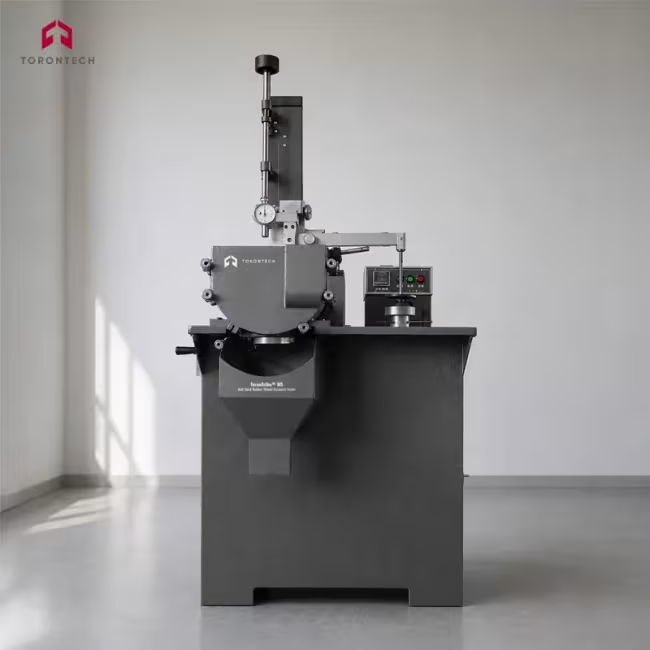
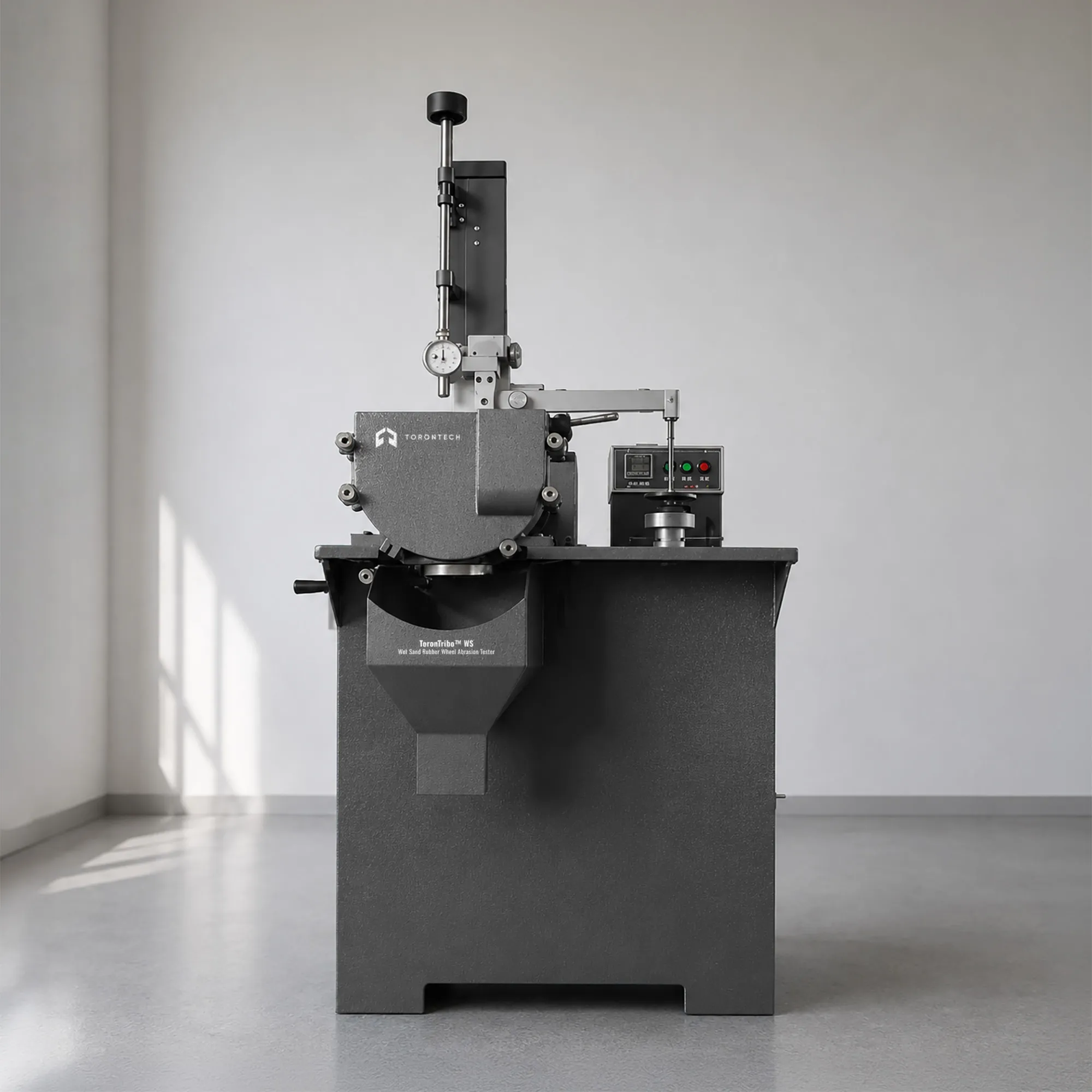
Wet Sand Rubber Wheel Abrasion Tester
Wet Sand Rubber Wheel Abrasion Tester - ToronTribo™ WS.
Wet Sand Rubber Wheel Abrasion Tester ranks the resistance of metallic and non-metallic materials to scratching abrasion under slurry conditions, serving materials laboratories, mining equipment manufacturers, and component developers working with wet abrasive environments. The ToronTribo™ WS drives a counterclockwise-rotating rubber wheel through a mixture of mineral sand, gravel, and water to abrade a test specimen, reproducing the semi-free abrasive wear conditions found in slurry pumps, dredging equipment, and other machinery exposed to wet mineral abrasives.
The tester applies a maximum load of 225 N against a 178 mm rubber wheel, with wheel hardness selectable at 50, 60, or 70 Shore hardness and wheel speed selectable at 240, 181, 374, or 498 rpm to match different test protocols. The standard mortar mixture combines 1000 g of water with 1500 g of sand, and test specimens measuring 57 x 25.5 x 6 mm are held against the wheel as the slurry passes through the contact zone. At approximately 300 kg, the instrument fits standard laboratory installation within a 710 x 740 x 1600 mm footprint.
Mining equipment manufacturers, hardfacing developers, and materials research laboratories use the ToronTribo™ WS to rank candidate materials and coatings by wet abrasion resistance before committing to full-scale field or pilot-plant testing. Because the wet sand test introduces water into the abrasive mixture, results reflect a different wear mechanism than dry sand testing, better representing slurry and wet mineral processing environments.
Wet Sand Rubber Wheel Abrasion Tester - ToronTribo™ WS Applications
The ToronTribo™ WS supports wet abrasion resistance evaluation for materials and coatings used in equipment exposed to slurries and wet mineral abrasives.
- Slurry Pump Component Testing: ranks abrasion resistance of materials used in pump liners, impellers, and other components exposed to mineral slurries
- Dredging Equipment Material Evaluation: assesses wear resistance of materials used in dredge pumps, pipes, and cutter components exposed to wet abrasive sediment
- Mineral Processing Equipment Testing: compares wear resistance of materials used in wet grinding mills, classifiers, and slurry handling systems
- Hardfacing and Coating Evaluation for Wet Service: quantifies how hardfacing alloys and coatings perform under wet abrasive conditions compared to dry abrasion
- Wastewater and Slurry Transport Component Testing: evaluates materials used in pipes, valves, and fittings exposed to abrasive slurries
- Comparative Material Ranking Under Wet Conditions: ranks candidate materials and heat treatments specifically for wet abrasive service rather than dry abrasion
- Quality Control and Material Certification: verifies that incoming material or coating batches meet expected wet abrasion resistance specifications
Standards
The ToronTribo™ WS supports test procedures aligned with the internationally recognized ASTM standard for wet sand/rubber wheel abrasion testing.
- ASTM G105-20 - Standard Test Method for Conducting Wet Sand/Rubber Wheel Abrasion Tests
Wet Sand Rubber Wheel Abrasion Tester - ToronTribo™ WS Key Features
The ToronTribo™ WS combines selectable wheel hardness and speed with precise slurry control for repeatable wet abrasion testing.
- Selectable Rubber Wheel Hardness: offers 50, 60, or 70 Shore hardness options to match different test severity requirements
- Multiple Wheel Speed Settings: provides four selectable speeds (240, 181, 374, or 498 rpm) to reproduce different abrasive contact conditions
- Controlled Slurry Mixture: maintains a standard 1000 g water to 1500 g sand mortar ratio for consistent wet abrasive contact
- Precise Load Application: applies up to 225 N of load against the test specimen for controlled abrasive contact severity
- Standard Specimen Compatibility: accepts 57 x 25.5 x 6 mm test specimens matching common wet abrasion test requirements
- Compact Laboratory Footprint: fits standard laboratory space at 710 x 740 x 1600 mm and approximately 300 kg
Theory and Method
Wet sand rubber wheel abrasion testing reproduces a semi-free three-body abrasive wear condition, in which abrasive sand particles suspended in water pass between a rotating rubber wheel and a stationary test specimen held against the wheel under load. As the wheel rotates through the sand-and-water mortar, it carries the slurry into the contact zone, where abrasive particles roll and slide against the specimen surface before being carried away, and the specimen's material loss over a fixed test duration provides the basis for ranking abrasion resistance.
Introducing water into the abrasive mixture changes the wear mechanism compared to dry sand testing in a meaningful way. The water reduces friction between the abrasive particles and the rubber wheel, changing how particles roll, slide, and embed at the contact interface, and can also introduce corrosive or electrochemical effects for some metals that would not occur under dry conditions. The ToronTribo™ WS controls wheel hardness, rotation speed, and the sand-to-water ratio of the mortar precisely, so that the severity and character of wet abrasive contact remains consistent from test to test.
Because different applications expose materials to different wheel speeds and abrasive severities, the ToronTribo™ WS offers multiple selectable wheel speeds and hardness levels rather than a single fixed configuration. Running a candidate material across these different test conditions gives engineers a more complete picture of how it will perform across the range of wet abrasive severities it may encounter in slurry pumps, dredging equipment, or mineral processing machinery, rather than relying on a single data point from one fixed test condition.
Wet Sand Rubber Wheel Abrasion Tester - ToronTribo™ WS Technical Specifications
| Parameter | Specification |
|---|---|
| Maximum Load | 225 N |
| Rubber Wheel Rotation Direction | Counterclockwise |
| Rubber Wheel Speed | 240, 181, 374, or 498 rpm |
| Rubber Wheel Diameter | 178 mm |
| Rubber Wheel Hardness | 50, 60, or 70 (Shore hardness) |
| Mortar Ratio | 1000 g water / 1500 g sand |
| Sample Size | L57 mm x W25.5 mm x H6 mm |
| External Dimensions | L710 mm x W740 mm x H1600 mm |
| Weight | Approximately 300 kg |