Dry Sand vs Wet Sand Abrasion Test: ASTM Standards
Relying on nominal handbook hardness numbers to predict wear resistance is an expensive gamble that risks premature equipment failure.
An accurate dry sand vs wet sand abrasion test provides engineering teams with standardized volume-loss data to qualify alloys and coatings before field installation. Standardized bench testing eliminates catalog guesswork, protecting uptime and your bottom line.
Key Takeaways
- Contact Environment: Dry sand procedures test metallic and non-metallic materials, including coatings and hardfacing, against unlubricated, free-flowing quartz grit, whereas wet sand setups introduce a sand-water slurry that alters interfacial friction.
- Standard Protocols: ASTM G65 establishes the procedure for dry rubber wheel abrasion, while ASTM G105 defines requirements for wet slurry contact.
- Evaluation Baseline: Both standards evaluate wear resistance by measuring specimen mass loss and converting it to volume loss (mm3) based on material density, ensuring fair comparisons between materials of different densities.
- Fluid Influences: Liquid media can accelerate degradation through wear-corrosion interactions or reduce mass loss by creating a protective hydrodynamic fluid film.
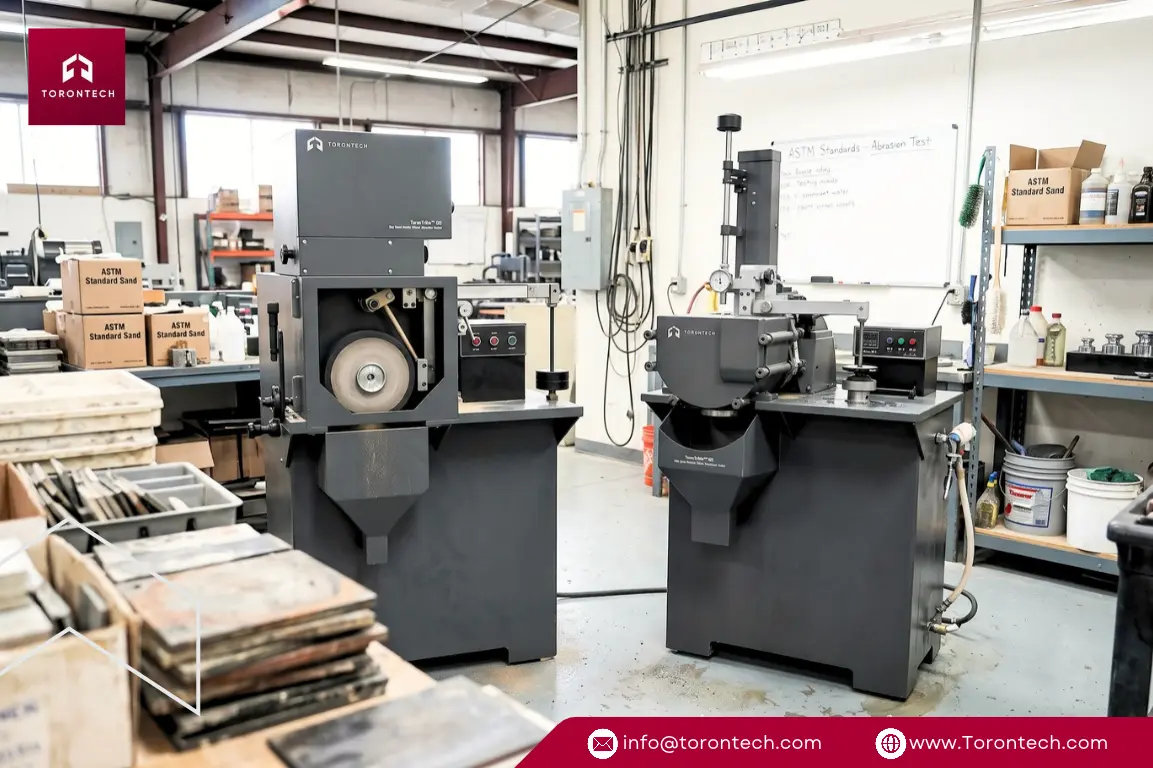
- Laboratory Configuration: Facilities can select dedicated single-purpose test rigs or install multi-protocol systems like the ToronTribo™ SRW to conserve floor space.
Wear Mechanisms and Methodology
Published research establishes that whether slurry contact produces greater material loss than dry sand depends on substrate metallurgy, contact mechanics, and chemical interactions. From our perspective as an equipment manufacturer, treating dry sand and wet sand tests as interchangeable misjudges how contact interfaces degrade, because liquid media alter friction states and degradation pathways.
Contact Micromechanisms
At the contact patch between the rotating counterface and the test coupon, several mechanical actions dictate surface damage:
- Micro-cutting and grooving dominate metallic wear when abrasive particles embed into the counterface and score deep furrows across the surface under normal load.
- Particle motion transitions from rolling to sliding as applied normal load and substrate hardness increase, altering the resulting wear tracks.
- Abrasive particle crushing occurs under elevated contact stresses, modifying grain geometry and altering ongoing mass loss rates.
- Hydrodynamic fluid lift and slurry concentration govern the true penetration depth of abrasive grains across applied normal loads.
- Protective hard phases, such as tungsten carbide grains or TiC precipitates, act as physical barriers against abrasive cutting across both dry and wet regimes.
Wear-Corrosion Interactions vs Slurry Lubrication
In metallic alloys, aqueous environments frequently accelerate material removal because mechanical scraping strips protective oxide films, enabling continuous electrochemical attack. Documented laboratory pipeline evaluations showed 20% to 70% greater wear losses in wet sand than in dry sand.
Tungsten carbide drill bit components similarly lost significantly more volume in wet sand contact due to interfacial adhesion and accelerated electrochemical attack, an accelerated degradation pattern also observed in non-metallic porous ceramic pieces subjected to tumbling wear.
Conversely, water can function as an interfacial lubricant under specific pairings, reducing three-body abrasive cutting by introducing hydrodynamic film separation that promotes particle sliding over aggressive micro-cutting. When evaluating mild steel against rounded grit, wet tests produced lower wear rates because hydrodynamic fluid films prevented direct abrasive digging.
Liquefied sand mixtures similarly prompt abrasive grains to slide rather than bite into mineral sandstones, leading to higher dry volume losses compared to water-soaked stone, while elastomeric rubber specimens lose more mass in dry runs because water lubricates the contact zone during wet tests. Accounting for this variable fluid influence is essential when establishing material specifications.
North American Industrial Context
In our assessment, the mechanical differences between dry cutting and wet slurry wear reflect operating conditions found across North American heavy industry:
- In dry mineral handling operations across the Western United States, primary ore crushers, transfer hoppers, and haul truck liners endure unlubricated three-body scratching where mineral particles gouge metal surfaces without chemical attack.
- In contrast, hydrotransport piping in Alberta oil sands processing and dredging lines along the US Gulf Coast expose components to abrasive solids suspended in liquid. In these environments, continuous mechanical depassivation of protective surface layers combines with aqueous media to accelerate total metal loss through wear-corrosion mechanisms.
Interpreting Test Results and Surface Treatments
Standardized abrasion testing relies on measuring coupon mass loss before and after defined test cycles and converting that loss to volume loss (mm3) using material density to rank comparative material durability.
Academic investigations demonstrate that surface treatments perform markedly differently depending on the contact medium. In a comparative evaluation of powder-pack borided steel, an 8-hour treatment improved wear resistance by approximately 24 times in dry ASTM G65 testing, while a 10-hour treatment produced roughly 23 times improvement under wet ASTM G105 testing, reflecting how interfacial fluid modifies shear stresses across different processing cycles.
In our view, relying on theoretical calculations without standardized physical mass loss data creates unnecessary exposure to premature equipment failure.
In routine industrial testing and quality verification, these metrics serve two primary roles:
- Duration and Material Loss Ranking: Under standardized ASTM procedures, test duration is governed by cumulative wheel revolutions rather than arbitrary run time. ASTM G65 procedures run for specific revolution counts ranging from 100 revolutions for thin coatings up to 6,000 revolutions for bulk alloys. Similarly, ASTM G105 wet tests run across multi-stage cycles totaling 4,400 revolutions. On programmable equipment such as the dual-mode ToronTribo SRW, operators can configure cycle counters up to 999,999 revolutions to execute both standard compliance runs and extended wear trials. Recording mass loss over these known revolution counts and dividing by specimen density yields the standardized volume loss needed to rank competing alloys objectively.
- Surface Treatment Qualification: Standardized mass loss tracking verifies protective coatings, hardfacing alloys, and weld overlays, establishing empirical wear-rate baselines that engineering teams compare against application-specific procurement specifications across manufacturing supply chains.
Dry Sand Testing: ASTM G65 and ToronTribo™ DS
The dry sand rubber wheel procedure assesses unlubricated, three-body abrasive wear. Feeding dry ambient sand straight into the wheel-specimen interface lets fresh grit dissipate frictional heat while generating low-stress scratching abrasion. Under these dry conditions, mineral particles either roll across the contact zone or temporarily lodge into the counterface to gouge the test specimen.
Standard Scope: ASTM G65
ASTM G65 is formally designated as ASTM G65-16 and ASTM G65-16(2021), titled "Standard Test Method for Measuring Abrasion Using the Dry Sand/Rubber Wheel Apparatus." Dry sand testing introduces rounded quartz sand meeting AFS 50/70 specifications (212 to 300 micrometers) through a nozzle or diffusor into the wheel-specimen interface.
To accommodate different material thicknesses and wear resistance levels, the ASTM G65 standard establishes five distinct operational procedures:
- Procedure A: 130 N load, 6,000 revolutions. The most severe test, used as the primary benchmark for ranking high-wear alloys.
- Procedure B: 130 N load, 2,000 revolutions. A short variation of Procedure A used when volume loss exceeds 100 cubic millimeters.
- Procedure C: 130 N load, 100 revolutions. A short test designed specifically for thin protective coatings.
- Procedure D: 45 N load, 6,000 revolutions. A lighter-load variation used for less wear-resistant materials.
- Procedure E: 130 N load, 1,000 revolutions. A short variation of Procedure B used to classify low-to-medium resistance materials.
Across all procedures, relative abrasion resistance is ranked by calculating specimen volume loss in cubic millimeters.
Apparatus Specifications: ToronTribo™ DS
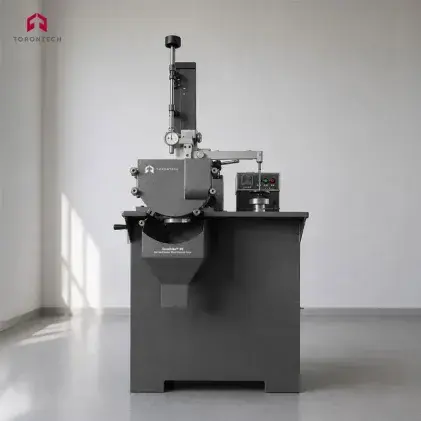
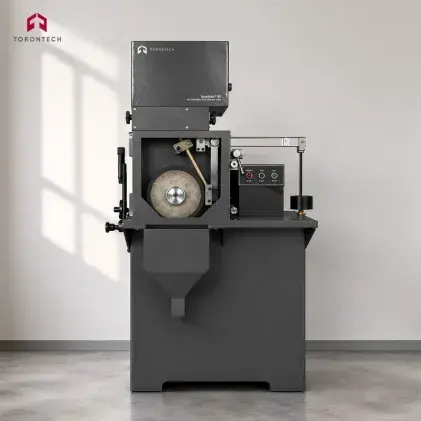
Our Dry Sand Rubber Wheel Abrasion Tester (ToronTribo™ DS) supports test procedures aligned with ASTM G65-16 and ASTM G65-16(2021) to evaluate three-body abrasive wear.
The apparatus operates a clockwise-rotating rubber wheel measuring 228.6 mm in diameter with a Shore hardness of 60, driven at a spindle speed of 200 ± 10 rpm. During testing, quartz sand or similar mineral abrasives feed freely into the contact zone through a metal sand nozzle.
Normal force is applied up to a maximum load of 130 N against a test specimen measuring L76 mm x W25.5 mm x H12 mm. Built for a standard laboratory installation, the frame occupies external dimensions of L710 mm x W740 mm x H1600 mm.
Industrial Applications
We view this dry testing configuration as an essential tool for quality control, material certification, coating comparison, and screening alloys or heat treatment batches across mining, construction, and agriculture.
In North American heavy industry, these evaluations reflect operating conditions for ground-engaging tools such as tillage components and planter assemblies used throughout the US Midwest farm belt. Similarly, materials screening for dry chutes, hoppers, secondary crushing liners, and hardfacing or weld overlays in open-pit mining operations across the Western United States and the Canadian Shield rely on dry abrasion testing to benchmark unlubricated component service life.
Wet Sand Testing: ASTM G105 and ToronTribo™ WS
When components operate in wet or submerged environments, abrasive mineral particles blend with water to form an abrasive slurry. Delivering that abradant as a liquid-sand mixture alters particle entrainment at the wheel interface, fundamentally modifying surface wetting and slurry lubrication. The presence of water alters interfacial adhesion and thermal dissipation, shifting the contact into semi-free three-body abrasive wear.
Standard Scope: ASTM G105
ASTM G105, titled "Standard Test Method for Conducting Wet Sand/Rubber Wheel Abrasion Tests," governs laboratory slurry abrasion procedures. The target contact regime centers on three-body wet scratching abrasion, which dictates primary mechanical degradation pathways.
Unlike unlubricated single-wheel testing, the defining operational requirement of ASTM G105 is a sequential multi-stage procedure engineered to eliminate rubber batch variability:
- An initial break-in stage is conducted on the specimen using a 50 Durometer A wheel.
- Testing then proceeds consecutively on the same test coupon using wheels of 50, 60, and 70 Durometer A (Shore A) hardness.
- Rather than reporting a single run, the final wear index is calculated from a least-squares linear regression line at nominal 60 Durometer and reported as volume loss in cubic millimeters.
For standardized ASTM G105 compliance, the baseline slurry charge requires 0.940 kg (940 g) of deionized water mixed with 1.500 kg (1500 g) of rounded AFS 50/70 quartz sand. Test platforms supporting this protocol, such as our ToronTribo WS aligned with the ASTM G105-20 edition, provide the necessary 50, 60, and 70 Shore hardness wheels to execute this multi-stage sequence, while documenting an operational mortar ratio of 1000 g water to 1500 g sand.
Apparatus Specifications: ToronTribo™ WS
Our Wet Sand Rubber Wheel Abrasion Tester (ToronTribo™ WS) supports test procedures aligned with ASTM G105-20. The apparatus drives a counterclockwise-rotating rubber wheel measuring 178 mm in diameter through a slurry of mineral sand and water, while product documentation also notes mechanical compatibility with mixtures containing gravel for specialized non-standard testing.
Operators can select spindle speeds of 240, 181, 374, or 498 rpm, where 240 rpm falls within the ASTM G105 tolerance of 245 plus or minus 5 rpm, while the remaining speeds provide non-standard settings for customized research, and access rubber wheels with hardness ratings of 50, 60, and 70 Shore A required to execute the sequential test stages specified in ASTM G105.
The abrasive slurry is prepared with a mortar ratio of 1000 g water / 1500 g sand (the page text also mentions gravel). The tester accommodates specimens measuring L57 mm x W25.5 mm x H6 mm and supports a maximum load of 225 N. Designed for standard laboratory installation, the machine measures L710 mm x W740 mm x H1600 mm and weighs approximately 300 kg.
Industrial Applications
Wet sand testing is critical for qualifying metallic and non-metallic materials, hardfacing layers, and protective coatings intended for wet service, wastewater transport, and slurry pumping.
In North American industrial settings, these wet conditions reflect harsh environments found in the oil sands operations of Alberta, Canada, where hydrotransport lines, bitumen extraction pumps, and tailings disposal systems handle dense mineral slurries, though formal ASTM G105 compliance requires standardized silica sand rather than uncalibrated field gravel. Likewise, sediment transport machinery and commercial dredging equipment operating along the Mississippi River inland waterway system and Great Lakes shipping channels require alloys and coatings validated against wet slurry abrasion.
Dual-Mode Testing: ToronTribo™ SRW
Because ASTM G65 and ASTM G105 utilize related geometric configurations, tribology researchers have demonstrated that a single testing structure can satisfy the mechanical loading levers, linkages, and motor speeds required across ASTM G65, ASTM G105, and ASTM B611 systems. In our view, multi-standard testing systems represent the most logical approach for facilities seeking broad testing versatility without consuming excessive laboratory floor space.
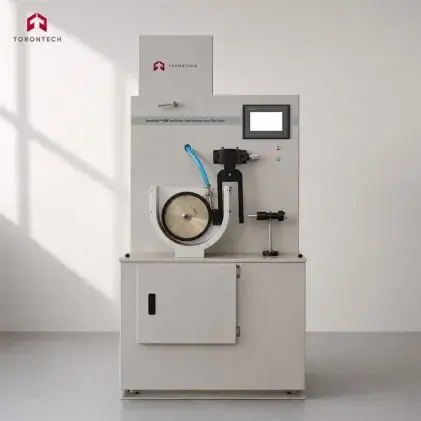
Our Sand/Rubber Wheel Abrasion Tester (Dual-Mode), designated as ToronTribo™ SRW, executes both dry sand and wet sand abrasion procedures on a single platform, enabling operators to switch between dry and wet protocols as needed.
The platform supports test procedures aligned with ASTM G65-16 / G65-16(2021) and ASTM G105-20, as well as ASTM B611-13 ("Standard Test Method for Determining the High Stress Abrasion Resistance of Hard Materials"), an evaluation method that specifies a steel wheel counterface and an aluminum oxide slurry rather than a rubber wheel and sand mixture. Contact our technical team to confirm specific counterface hardware configurations for ASTM B611 testing. In dry mode, sand falls freely through the contact zone, while in wet mode, the abrasive remains suspended in a water-based mortar.
The apparatus features automatic load application with a load range of 3 to 300 N, is rated for a maximum friction force of 300 N, and incorporates variable frequency speed regulation with a maximum spindle speed of 500 rpm. Test duration is governed by revolution count up to a maximum duration of 999,999 revolutions, with material ranking determined by specimen material loss.
Operating on a 220V, 16A, 50Hz electrical connection (with 110V also available), this 85 kg instrument occupies an external footprint of L700 mm x W600 mm x H1450 mm. It is built for a standard laboratory space evaluating materials and coatings, hardfacing alloys, and weld overlays across mining, mineral processing, construction, and earthmoving applications.
Technical Specifications Comparison
The table below provides a focused comparison of key operational parameters across our three testing systems:
| Specification | ToronTribo™ DS | ToronTribo™ WS | ToronTribo™ SRW |
|---|---|---|---|
| Aligned Standards | ASTM G65-16, ASTM G65-16(2021) | ASTM G105-20 | ASTM B611-13, ASTM G65-16 / G65-16(2021), ASTM G105-20 |
| Contact Mode & Abrasive Feed | Three-body wear; free-falling quartz sand via metal nozzle | Semi-free three-body wear; water/sand slurry (1000 g water / 1500 g sand) | Dual-mode; free-falling sand (dry) or water-based mortar (wet) |
| Applied Load | 130 N maximum | 225 N maximum | 3 to 300 N (automatic loading) |
| Spindle Speed | 200 ± 10 rpm | 240, 181, 374, or 498 rpm | Maximum 500 rpm |
| Wheel Dimensions & Hardness | 228.6 mm diameter; 60 Shore hardness (Clockwise) | 178 mm diameter; 50, 60, or 70 Shore hardness (Counterclockwise) | Configurable per Standard Protocol |
| Specimen Dimensions | L76 mm x W25.5 mm x H12 mm | L57 mm x W25.5 mm x H6 mm | Configurable per ASTM Specification |
Equipment Selection Guide
We believe selecting the appropriate testing system depends on matching equipment capabilities directly to your operating environment, specimen geometry, and target test standards:
Choose ToronTribo™ DS if:
- Your testing requirements focus on unlubricated, three-body abrasive wear aligned with ASTM G65-16 or ASTM G65-16(2021).
- You evaluate materials for equipment operating in dry friction environments, such as agricultural machinery builders in the US Midwest, heavy construction earthmoving OEMs, or dry mineral crushing plants.
- You need to perform alloy screening, coating comparisons, or hardfacing verification on metallic and non-metallic specimens measuring L76 mm x W25.5 mm x H12 mm.
Choose ToronTribo™ WS if:
- Your testing focus is wet, slurry-assisted semi-free three-body abrasive wear aligned with ASTM G105-20.
- You develop hardfacing overlays, pump impellers, or pipe linings for high-wear slurry environments, such as oil sands processing in Alberta, Canadian mineral refining circuits, or civil dredging operations along US waterways.
- Your test program requires access to wheels of 50, 60, and 70 Shore A hardness to execute standard sequential runs and operational speeds compliant with ASTM G105 using L57 mm x W25.5 mm x H6 mm specimens.
Choose ToronTribo™ SRW if:
- Your facility conducts direct dry versus wet comparison research on a single platform.
- You operate a commercial metallurgical laboratory, an industrial QC center, or a university engineering department in the US or Canada that must certify materials across both dry mining and wet slurry sectors without maintaining separate instruments.
- Your workflow benefits from automatic loading across a 3 to 300 N range, variable frequency speed regulation up to 500 rpm, and revolution-controlled test cycles up to 999,999 revolutions in an 85 kg apparatus aligned with ASTM G65, ASTM G105, and ASTM B611-13.
Torontech Solutions for Abrasion Testing
Matching laboratory equipment to actual field wear mechanisms ensures dependable material certification and quality control data. At Torontech, we provide cost-effective products built for standard laboratory installation, giving metallurgical laboratories, equipment manufacturers, and research institutions across North America reliable instrumentation for standardized abrasion ranking.
Whether your facility requires dedicated dry sand testing, slurry abrasion evaluation, or multi-protocol consolidation, our engineering team is ready to assist. Contact our technical specialists or submit a Request Quote form through our website to review equipment specifications and receive pricing.
References (Click to expand)
- Ali, A., & Zalzala, M. K. A.-R. (2023). An Investigation to the Abrasive Wear in Pipes Used for Oil Industry. Journal of Engineering.
- Gee, M., Gant, A., & Byrne, W. P. (2005). An NPL Rotating Wheel Abrasion Test Summary.
- Makki, M. H. (2023). Experimental and Modeling Study of Abrasive Wear of Tungsten Carbide Drilling Bit in Wet and Dry Conditions. Journal of Engineering.
- Martínez-Trinidad, J., Campos-Silva, I., & García-León, R. (2021). Dry and Wet Abrasion Wear Resistance on Borided AISI 1045 Steel. Journal of Bio- and Tribo-Corrosion, 7.
- Nahvi, S., Shipway, P., & Mccartney, D. G. (2009). Particle motion and modes of wear in the dry sand-rubber wheel abrasion test. Wear, 267, 2083-2091.
- Peralta, A., & David, A. (2015). Diseño y construcción de un equipo de laboratorio de desgaste abrasivo según normas ASTM G65, ASTM G105 y ASTM B611.
- Stevenson, A., & Hutchings, I. (1996). Development of the dry sand/rubber wheel abrasion test. Wear, 195, 232-240.
- Trinidad, J. L. S., Amengual, J., & Caram, G. (2013). Diseño de una Máquina Para Ensayos de Abrasión Seca & Abrasión Húmeda.
- Vite, M., Castillo, M., Hernández, L. H., Villa, G., Cruz, I. H., & Stéphane, D. (2004). Dry and wet abrasive resistance of Inconel 600 and stellite. Wear, 258, 70-76.
- Wirojanupatump, S., & Shipway, P. (1999). A direct comparison of wet and dry abrasion behaviour of mild steel. Wear, 233, 655-665.