Tensile Tester in Mexico for Long Cables and Micron-Level Strain
Your specimen is a six-meter conductor, but your load frame offers one meter of test space. Or the clip-on extensometer slips off an elastomer sample long before it reaches elongation at break.
Both problems trace back to geometry, not force. Choosing a tensile tester in Mexico starts with what you actually pull, so Torontech builds around two gaps most catalogs ignore: long-specimen horizontal frames and non-contact strain measurement.
Grid Expansion Is Driving Conductor and Cable Testing
Mexico committed roughly 8.18 billion dollars to its National Transmission Network between 2025 and 2030. The program covers 275 new transmission lines totaling 6,735 kilometers, plus 524 substation works.
That plan leans on high-temperature conductors and fiber optic ground wire. Consequently, conductor mills, hardware fabricators, and CFE laboratories such as LAPEM need documented breaking load values on full-length samples before material reaches a tower.
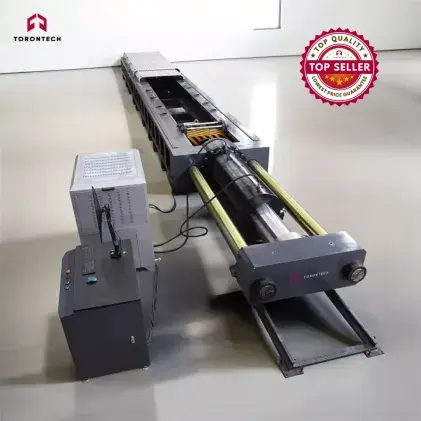
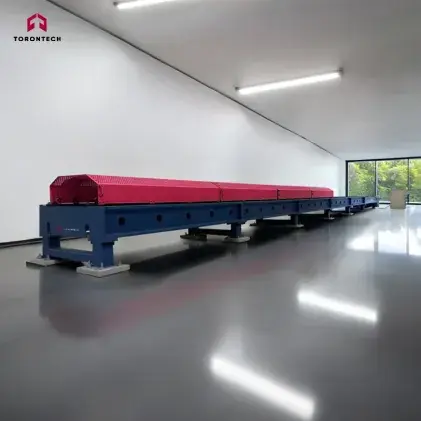
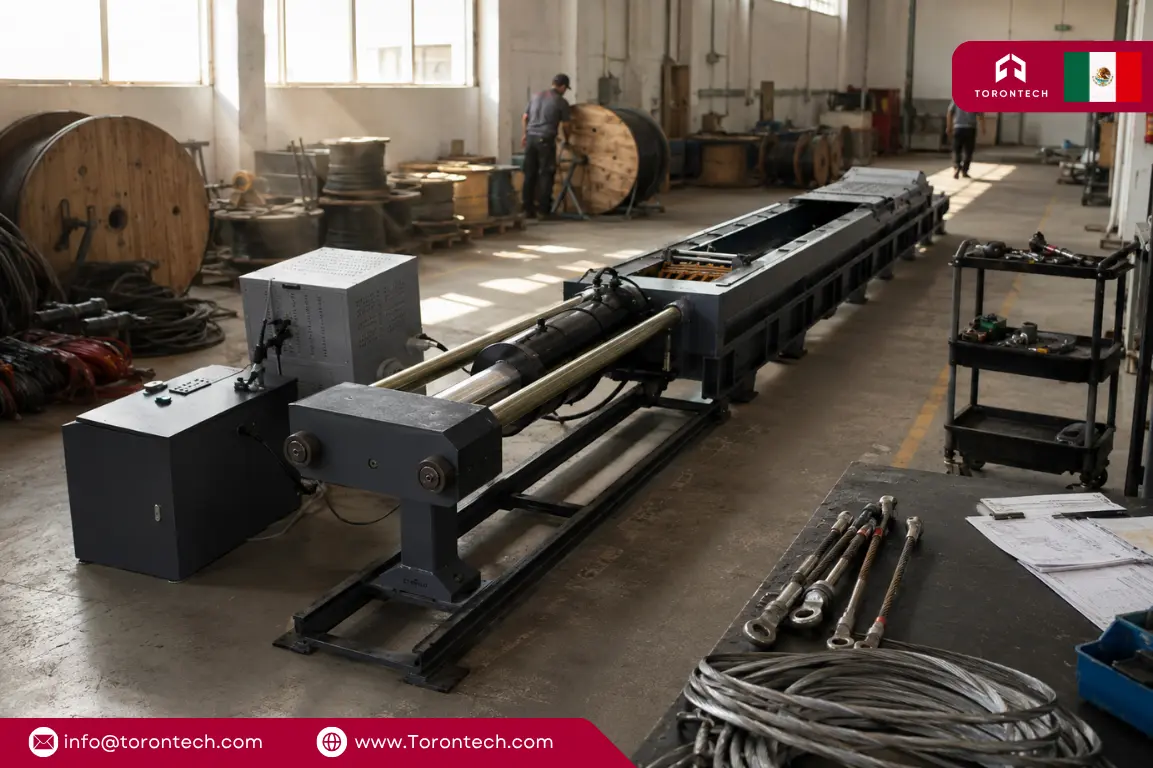
The horizontal tensile test bed answers that requirement directly. Its TT-HTTM-1000 configuration delivers 1,000 kN through a 6 m span between fixtures, with load indication accuracy within ±1%.
A horizontal layout matters here for a practical reason. Long specimens stored vertically need tall towers and difficult loading, whereas a bed on rollers lets two technicians position a heavy conductor at floor level.
Furthermore, the bed accepts the fixtures conductor work demands: alloy socket terminations, dead-end assemblies for OPGW, and interchangeable grips for rope, chain, and shackle. Dual displacement sensors cancel bias from slight misalignment.
Where a Tensile Tester in Mexico Earns Its Keep
Beyond the grid, demand concentrates in export manufacturing. Mexican autoparts production reached roughly 119 billion dollars in 2025, with electrical components alone accounting for close to a fifth of that value.
Wire harness plants across the northern border states, aerospace suppliers in Querétaro, and steel producers feeding construction all run tensile programs. However, their specimens differ enormously, and so should their frames.
| Sector | Typical Specimen | Frame Fit |
|---|---|---|
| Transmission and cable | 6 m conductor, socket terminated | Horizontal test bed, 1,000 kN |
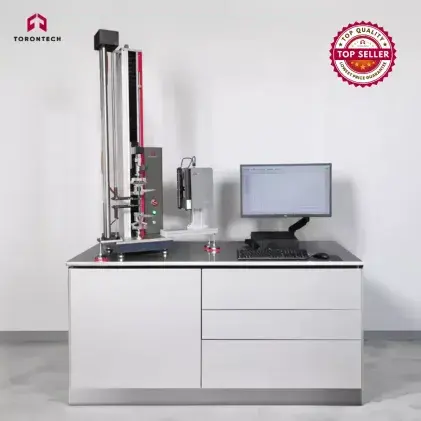
| Harness and connectors | Crimp joints, terminals, thin wire | Single column, up to 10 kN |
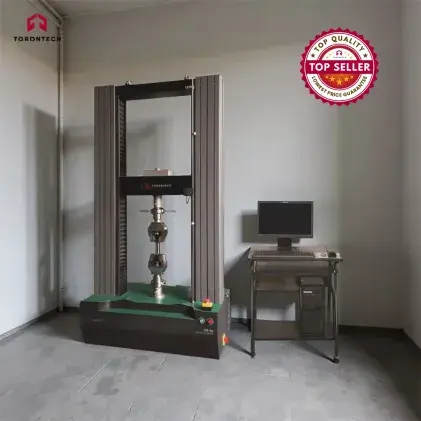
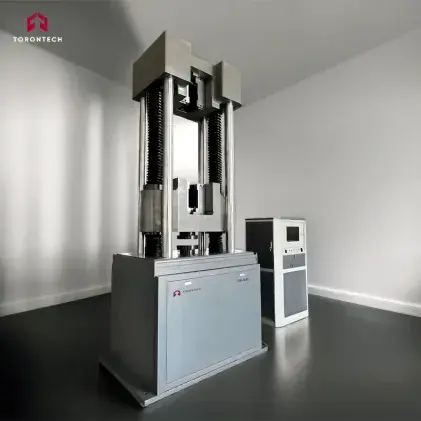
| Steel, rebar, strand | Bar, plate, prestressing strand | Servo-hydraulic, up to 3,000 kN |
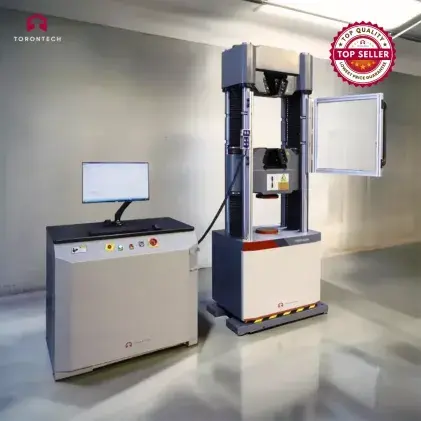
| Polymers and elastomers | Dumbbell specimens, high elongation | Electromechanical plus optical strain |
Nearshoring sharpens the pressure. As Tier 1 suppliers localize work that once sat in Asia, customer audits and USMCA content documentation increasingly ask for test records generated on site rather than certificates forwarded from a distant mill.
For light components, the Tensi-10 single column tester covers routine quality control at up to 10 kN. Meanwhile, heavy structural work moves to servo-hydraulic frames and the TTM-3000, which reaches 3,000 kN.
Non-Contact Strain Measurement for Difficult Specimens
Clip-on devices fail exactly where Mexican labs need data most: rubber seals, thin films, hot specimens, and conductor breaks that release dangerous energy. Attaching hardware to those samples introduces slippage, damage, or risk.
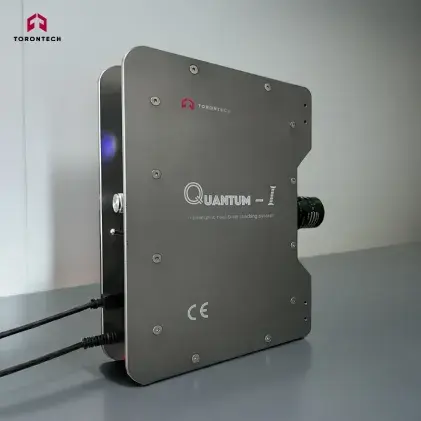
The Quantum Series video extensometer uses Digital Image Correlation to track a pattern on the specimen surface instead. Accuracy meets ISO 9513 Class 0.5, and the Quantum-2 reaches 0.2 μm resolution.
Two capabilities matter for stamping and forming work. The system measures axial and lateral strain at the same time, which yields plastic strain ratio for sheet metal and area reduction for rod without a second sensor.
Safety improves as well. Nobody reaches into the test space to fit or remove a device, which matters when a 1,000 kN conductor sample fails or when a specimen sits inside a heated chamber.
Additionally, every test saves as images. Therefore, an engineer can change gauge length after the fact and reanalyze the run, rather than scrapping material to repeat a test that was framed incorrectly.
Standards, Accreditation, and Force Planning
Torontech universal testing machines are built to ASTM and ISO test protocols, spanning 10 kN through 3,000 kN. Mexican buyers should map four separate questions before requesting a quote:
- Force range: size the load cell so routine tests land between 20% and 80% of capacity, not at the extremes
- Specimen length: vertical frames cap out quickly, while horizontal beds extend to 6 m and can be customized further
- Strain method: contact extensometry for metals, optical tracking for elastomers, films, and high-energy failures
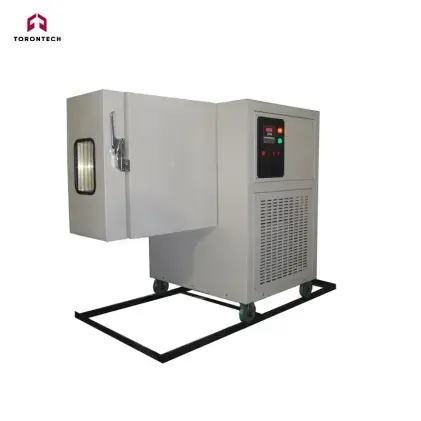
- Temperature: tensile chambers and furnaces extend the same frame into hot and cold test conditions
Accreditation adds a fourth layer. Laboratories seeking recognition from ema work under NMX-EC-17025-IMNC-2018, the Mexican adoption of ISO/IEC 17025, which demands traceable calibration and documented measurement uncertainty. The reverse loading structure on the horizontal bed supports on-machine load cell calibration for that purpose.
Configure a System Around Your Specimen
Two labs testing the same alloy can need completely different machines. Specimen length, termination method, elongation range, and reporting format drive the specification far more than a headline force rating does.
Torontech engineers fixtures, grips, and strain devices to match, and can extend bed length or modify jaw geometry when a standard configuration does not fit. The company supports Mexico through its North America operation in Miami alongside its Toronto headquarters.
Send your drawings, standards list, and expected specimen dimensions to the Torontech team for a configuration proposal. Explore the complete universal testing machine and tensile tester range to see the frames available.