


Isothermal Stress Relaxation Tester for Reinforcing and Prestressing Steel
Isothermal Stress Relaxation Tester – Precision Testing to ASTM E328 & ISO 15630-3 Standards
The Isothermal Stress Relaxation Tester measures how much pre-tensioning force a prestressing steel specimen loses when it is held at constant length and constant temperature over an extended period. Torontech builds the TT-SR Series for laboratories, steel producers, and structural testing facilities that qualify prestressed concrete (PC) strand, wire, and bar. The machine holds a specimen at a fixed strain, usually after tensioning it to 70 to 80 percent of its ultimate tensile strength, and records the gradual decay of load against time.
From this load-decay curve, the TT-SR Series reports the 1000-hour relaxation rate that engineers rely on to predict long-term load behavior in prestressed structures. Accurate relaxation data lets a designer account for the slow loss of compressive prestress in concrete, which protects bridges, building beams, and parking decks against excessive deflection and cracking across their service life. The system runs to ASTM E328 and ISO 15630-3, the two test methods that govern stress relaxation measurement for prestressing steel.
A servo-controlled drive maintains closed-loop control over load, displacement, and strain, while high-precision linear scales track the true strain inside the specimen gauge length. Holding genuine strain constant, rather than grip position, removes errors caused by the specimen settling into its anchorage and keeps the recorded relaxation curve representative of the material itself.
Isothermal Stress Relaxation Tester for Reinforcing and Prestressing Steel - TT-SR Series Applications
The TT-SR Series supports relaxation testing across the prestressing steel supply chain and the laboratories that certify it.
- Prestressed Concrete Strand Production: relaxation testing of seven-wire PC strand to confirm low-relaxation grade behavior before strand ships to precast and post-tensioning projects
- PC Wire and Bar Manufacturing: qualification of prestressing wire and bar so residual force stays within the limits design codes assume
- Bridge and Infrastructure Engineering: verification of long-term tendon performance for post-tensioned and cable-stayed bridge structures
- Precast Concrete Plants: incoming inspection of strand lots to check supplier relaxation data against in-house results
- Structural Cable and Rope Testing: relaxation measurement of high-tensile rope and strand used in suspension and stay-cable systems
- Materials Research and Development: study of relaxation behavior in new steel grades, coatings, and heat-treatment conditions
- Certification and Third-Party Laboratories: independent relaxation testing for compliance reporting to ASTM E328 and ISO 15630-3
Isothermal Stress Relaxation Tester for Reinforcing and Prestressing Steel - TT-SR Series Standards
The TT-SR Series performs isothermal stress relaxation tests to the international methods that define the procedure for prestressing steel.
- ASTM E328 - Standard Test Methods for Stress Relaxation for Materials and Structures
- ISO 15630-3 - Steel for the Reinforcement and Prestressing of Concrete, Test Methods, Part 3: Prestressing Steel
The TT-SR Series combines a stiff load frame, servo control, and direct strain measurement to produce repeatable relaxation data over long test durations.
- Rigid Load Frame: a heavy, stiff frame (about 1,650 kg) limits elastic deformation under load, so the measured relaxation reflects the specimen and not the machine
- Servo-Controlled Drive: closed-loop control of load, displacement, and strain holds the set condition steadily and runs quietly through long tests
- True-Strain Measurement: MITUTOYO linear scales read strain directly on the specimen gauge length, removing the slippage errors that affect systems controlling only grip travel
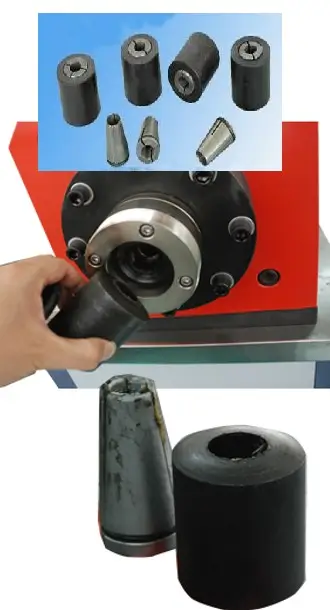
- Self-Aligning Anchorage: a triple-wedge housing with a spherical head keeps the test piece perpendicular to the bearing plane for clean axial loading and repeatable results
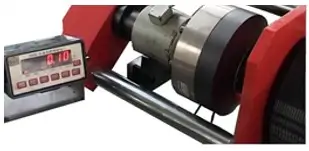
- In-Situ Calibration System: a master load cell mounts directly on the frame to verify the machine load cell and full load path without removing it, shortening downtime and preserving traceability
- Automated 1000-Hour Calculation: the software computes the 1000-hour tensile stress relaxation rate and handles the logarithmic extrapolation, reducing manual analysis
- Live Test Curves: real-time graphs of load versus time, temperature versus time, and relaxation rate versus time let operators follow the test as it develops
- Integrated Temperature Recording: a high-precision recorder logs ambient temperature so the software can compensate and correct the load curve
- Configurable Methods and Reports: user-defined loading steps and editable report templates adapt the system to specific standards and customer formats
- Guided ToronSoft Operation: graphical icons walk operators through test configuration, lowering the training burden for new users
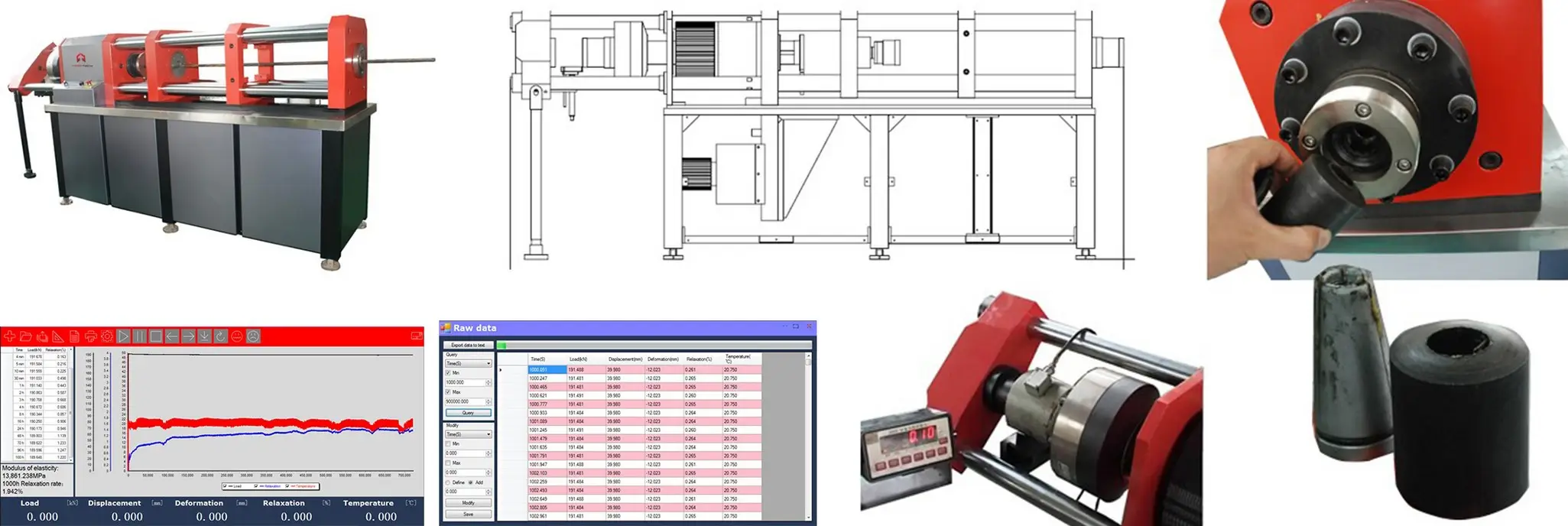
Theory and Method
Stress relaxation describes the slow drop in stress that occurs when a material is held at a fixed total strain. When a prestressing strand is locked at constant length, the total strain stays the same, while the internal split between elastic and plastic strain shifts over time. Microscopic creep mechanisms, mainly the thermally activated movement of dislocations within the steel, convert a small fraction of elastic strain into permanent plastic strain. Stress depends only on the elastic portion of strain, so this conversion appears as a measurable loss of load.
Temperature drives the rate of this process because dislocation movement is thermally activated, so a warmer specimen relaxes faster than a cooler one. Holding the specimen at a constant, known temperature keeps the relaxation rate stable and repeatable, which is why the method is called isothermal. The TT-SR Series pairs a high-precision temperature recorder with the load measurement, so the software compensates for small ambient swings and corrects the recorded curve.
During a test, the operator anchors the specimen at both ends, tensions it to the target initial force, and holds the length fixed while the system logs load and temperature against time. Because a complete test can run for 1000 hours or longer, the software fits the measured data with a logarithmic regression and extrapolates the 1000-hour relaxation rate from a shorter recording. Tracking the true strain on the gauge length keeps the held strain accurate even as the specimen seats into its anchorage.
Technical Specifications
The TT-SR Series is available in three load capacities. Specifications that change by model appear first, followed by the parameters shared across the range.
Model-Specific Specifications
Parameter | TT-SR-300 | TT-SR-400 | TT-SR-500 |
Load Capacity | 300 kN | 400 kN | 500 kN |
Measuring Range | 6–300 kN | 8–400 kN | 10–500 kN |
Load Resolution | 1.5 N | 2 N | 2.5 N |
Common Specifications
Parameter | Specification |
Load Accuracy | ±0.5% |
Loading Stroke | 100 mm |
Position Accuracy | ±0.5% |
Maximum Loading Speed | 100–5000 N/s |
Temperature Measuring Accuracy | ±0.3°C |
Anchorage for PC Strands | Ø9.5, Ø12.7, Ø15.2, Ø15.7 mm (other diameters on request) |
Horizontal Span | 1000 mm |
Load Frame Dimensions (W × D × H) | 2700 × 480 × 1150 mm |
Computer Table Dimensions (W × D × H) | 600 × 600 × 1300 mm |
Total Weight | 1650 kg |
Power Supply | 3-phase + E + N, 380 VAC ±10%, 50–60 Hz, 10 A |
Standard Configuration
Item | Description |
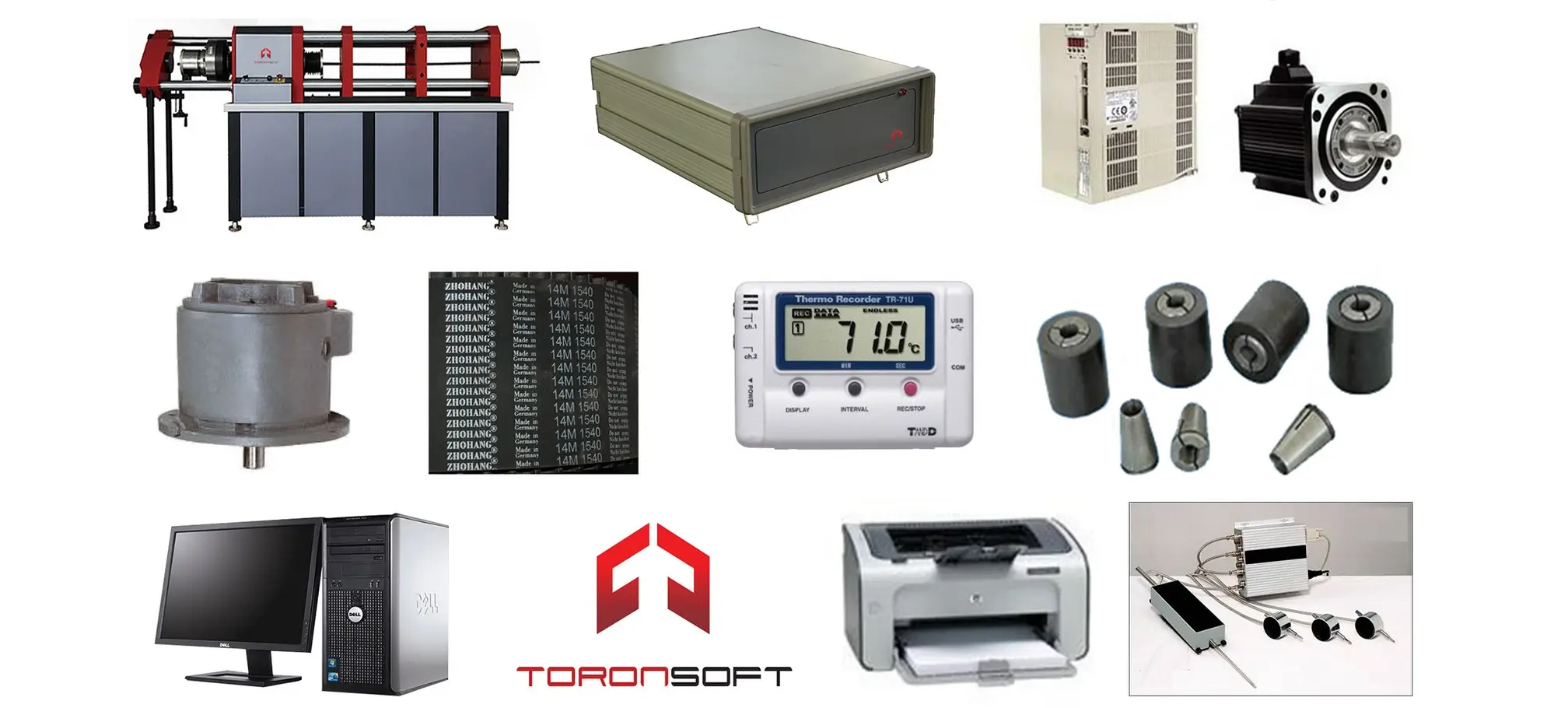
Main Unit | Rigid load frame with the servo loading assembly and specimen anchorage stations |
Control Unit | Electronics cabinet housing the drive and measurement controls |
Servo Drive System | Servo driver and motor providing closed-loop load, displacement, and strain control |
Speed Reducer and Toothed Belt | Mechanical transmission delivering smooth, controlled loading |
Temperature Recorder | High-precision recorder logging ambient temperature for compensation |
Anchorage Set | Self-aligning triple-wedge anchorages for the specified PC strand diameters |
Linear Gauge Extensometer | Gauge-length strain measurement using MITUTOYO linear scales |
Computer and ToronSoft | PC preloaded with ToronSoft for test control, data logging, and reporting |
Printer | Hard-copy output of test reports |
In-Situ Calibration System | Master load cell interface for on-machine verification of the load path |
Optional Accessories
Item | Description |
Additional Anchorages | Anchorages for other PC strand, wire, or bar diameters, supplied on request |
 | |
| Calibrate load cell on machine. There is no need to remove load cell from testing machine and calibrate it on other machines, the master load cell is available to be installed next to the machine load cell for calibration. | Anchorage |
 |  |

