Stress Relaxation Testers: Advantages & How to Choose
We believe that the importance of a high-quality stress relaxation tester is something that often gets understated. For anyone working with materials like prestressed steel or structural polymers, knowing exactly how a component will perform over its entire lifespan isn't just a nice-to-have; it's a core requirement.
Let's walk through why we see this equipment as so fundamental and what separates a great tester from a merely adequate one.
The Core Advantage of a Stress Relaxation Tester
Stress relaxation is what happens when you hold a material at a fixed strain—over time, the internal stress it exerts will naturally decrease. Failing to account for this is, in our professional opinion, one of the most significant risks in component design today.
The primary advantage of a stress relaxation tester is its ability to provide a clear window into a material's long-term behavior. It simulates real-world, long-duration conditions, giving you the kind of data that allows you to:
- Gain Genuine Confidence in Your Components. Replace assumptions with certainty. The data helps prevent long-term failures in everything from bridge cables to automotive bolts, ensuring structural integrity for years to come.
- Make Better, More Cost-Effective Material Choices. Compare materials not only by initial strength but by long-term stability—leading to smarter, more economical design decisions.
- Meet and Exceed Quality Standards. Obtain traceable, hard evidence for certification with standards like ASTM E328 and ISO 15630-3.
- Support New Material Development. Enable research and validation for next-generation alloys or composites through reliable, long-duration testing.
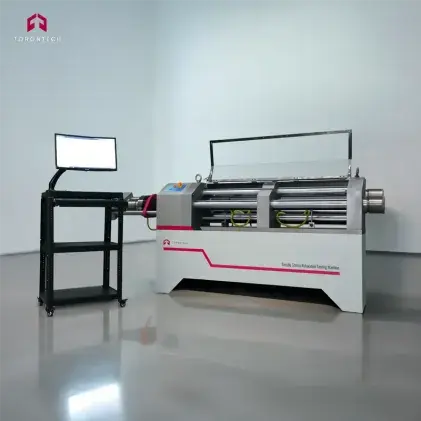
Delivering this level of insight is precisely why we engineered our Isothermal Stress Relaxation Tester; it’s built to provide the clear, long-term data that our clients rely on for these critical tasks.
Key Industries Where This Testing Is Essential
We consistently see this equipment deployed in sectors where material failure has serious consequences. The application is broad, but the need for reliability is constant.
Civil Engineering and Construction
In large-scale infrastructure, the performance of prestressed concrete is paramount. For instance, the steel tendons running through a bridge girder are stretched to a specific tension; stress relaxation testing verifies that they will maintain that tension for a 50+ year lifespan, preventing sag and ensuring safety.
Automotive and Aerospace
In these fields, component reliability is non-negotiable. An engine head bolt, for example, must maintain its clamping force across thousands of heat cycles to prevent a critical gasket leak. This data is essential for validating the long-term performance of these high-stress parts.
Energy and Power Generation
For components in demanding environments, safety is the primary concern. Consider the high-pressure bolts on a pipeline flange; they cannot loosen over time. Stress relaxation data is essential for predicting the service life of these parts and maintaining safe operations.
Heavy Industrial Machinery
Manufacturers of equipment like large stamping presses rely on this data to ensure durability. The bolts holding the press frame together must endure millions of cycles without losing their preload. This testing confirms the long-term integrity of such critical fastening systems.
Telecommunications
The focus here is on uninterrupted service over decades. An aerial fiber optic cable, for instance, must maintain its tension to avoid sagging and signal loss. This data validates that the cable and its mounting hardware will perform reliably for their entire planned service life.
How to Choose a Stress Relaxation Tester: Professional Guide
Understanding the advantages is the first step. This brings us to a critical question for any lab manager or engineer: how to choose a stress relaxation tester that will deliver reliable results for years to come. From our experience, these are the areas that truly separate a high-performance machine from the rest.
1. Unwavering Temperature Stability
The quality of your data is directly tied to the machine's ability to hold a perfectly stable isothermal environment. Even a small temperature drift can introduce significant errors.
This was a core design principle for our Isothermal Stress Relaxation Tester, which uses a sealed, uniform heat zone to ensure the only variable you're measuring is the material's behavior. This is the foundation of a repeatable test result.
2. High-Fidelity Accuracy
A system with a precision, servo-controlled drive is essential. It actively maintains a constant level of strain on the sample, making microscopic adjustments as the material relaxes.
The active, closed-loop control we designed into our testers is the difference between collecting approximate data and capturing precise, actionable intelligence about your material's properties.
3. Full Compliance with Key Standards
Your results need to be universally accepted.
A machine built to conform to major standards like ASTM E328 and ISO 15630-3 ensures your data is credible and comparable with results from other labs—critical for certification and validation processes.
4. Software That Works for You, Not Against You
A modern system should streamline your workflow. We are firm believers in automated data logging and intuitive software because it directly impacts your lab's efficiency.
The software accompanying our testers is designed for straightforward setup and automated reporting, getting data to decision-makers faster.
5. Built for Long-Duration Performance
These tests are not short sprints; they are marathons. The equipment must be engineered for continuous, uninterrupted operation. This requires a heavy-duty frame and durable components.
A failed test at the 800-hour mark means a huge loss of time and resources—which is why we build our testers with the industrial-grade endurance needed to protect that investment.
Torontech: Performance, Durability & Value
At Torontech, our goal is to provide equipment that delivers on its promises. Our Isothermal Stress Relaxation Tester was developed for serious industrial and research labs that require dependable results without an excessive price tag.
It features the high-precision, servo-controlled system we mentioned, ensuring you get clean data you can act on. With a real-time display and automated logging that aligns with key industry standards, our system is designed to make your lab's workflow much more efficient. We believe this combination of performance and practical design is why our machines are used in quality control facilities all over the world.
If you are looking for a stress relaxation testing solution that offers a smart blend of precision, durability, and sound economics, we would be glad to speak with you. Contact our team for a quote, and let's discuss how our cost-effective equipment can support your objectives.
References
- Birnbaum, P., Pilz, S., Neufeld, K., & Kunke, A. (2023). Investigating the Static Recrystallization Behavior of 22MnB5 Manganese–Boron Steel through Stress Relaxation Analysis. Metals. doi.org/10.3390/met13101646
- Rao, G., Gupta, O., & Pradhan, B. (2011). Application of stress relaxation testing in evaluation of creep strength of a tungsten-alloyed 10% Cr cast steel. International Journal of Pressure Vessels and Piping, 88, 65–74. doi.org/10.1016/J.IJPVP.2011.02.005
- Zheng, W., Zhu, J., & Yuan, W. (2023). Tempering stress relaxation behavior and microstructure evolution of 300 M steel. Materials Characterization. doi.org/10.1016/j.matchar.2023.112688
- Sinha, N., & Kearsey, R. (2001). Optimizing Deformation Path for Stress Relaxation Tests on Superalloys at High Temperatures. doi.org/10.1115/2001-GT-0421