Short Path Distillation vs Rotary Evaporator Guide
Buying the wrong extraction hardware can instantly ruin your output and torch your budget. Settling the short path distillation vs rotary evaporator debate is the easiest way to protect your capital.
While both systems isolate mixtures under vacuum, they serve entirely different production stages. Here is our direct, honest breakdown to help you choose the exact setup for your daily workflow.
Quick-Reference Comparison
For an instant overview, here is a side-by-side look at how we compare the main daily operations of the two systems:
| Feature | Rotary Evaporator | Short Path Distillation |
|---|---|---|
| Primary Function | Bulk solvent recovery, concentration | Fractioning, high-purity isolation |
| Process Speed & Throughput | Fast and continuous (non-stop action) | Slow, careful batch work |
| Vacuum Level | Moderate suction | Mega deep vacuum |
| Operational Complexity | Low (standard, repeatable steps) | High (requires serious practice and skill) |
| Physical Footprint | Fits anywhere (bench-top to giant floor models) | Mostly fits on a small table |
| Capital Cost | Friendly to mid-range | A bit more of a serious investment |
Breaking Down the Basics
To compare these two primary systems, we must look at how they actually operate during active runs.
What is a Rotary Evaporator?
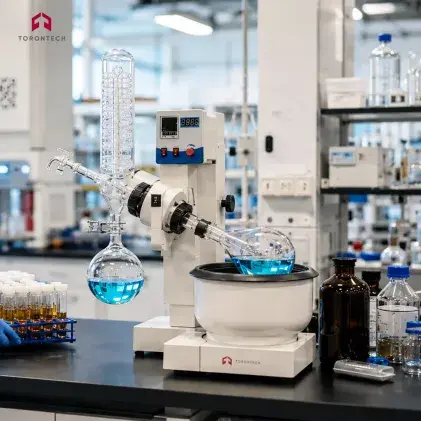
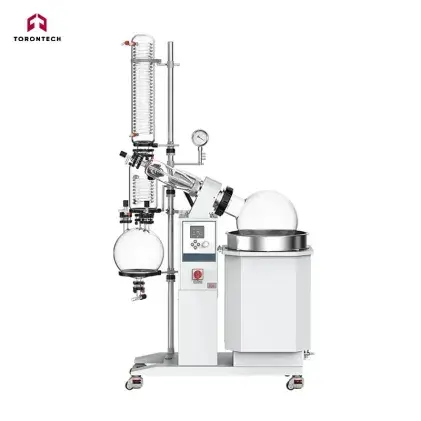
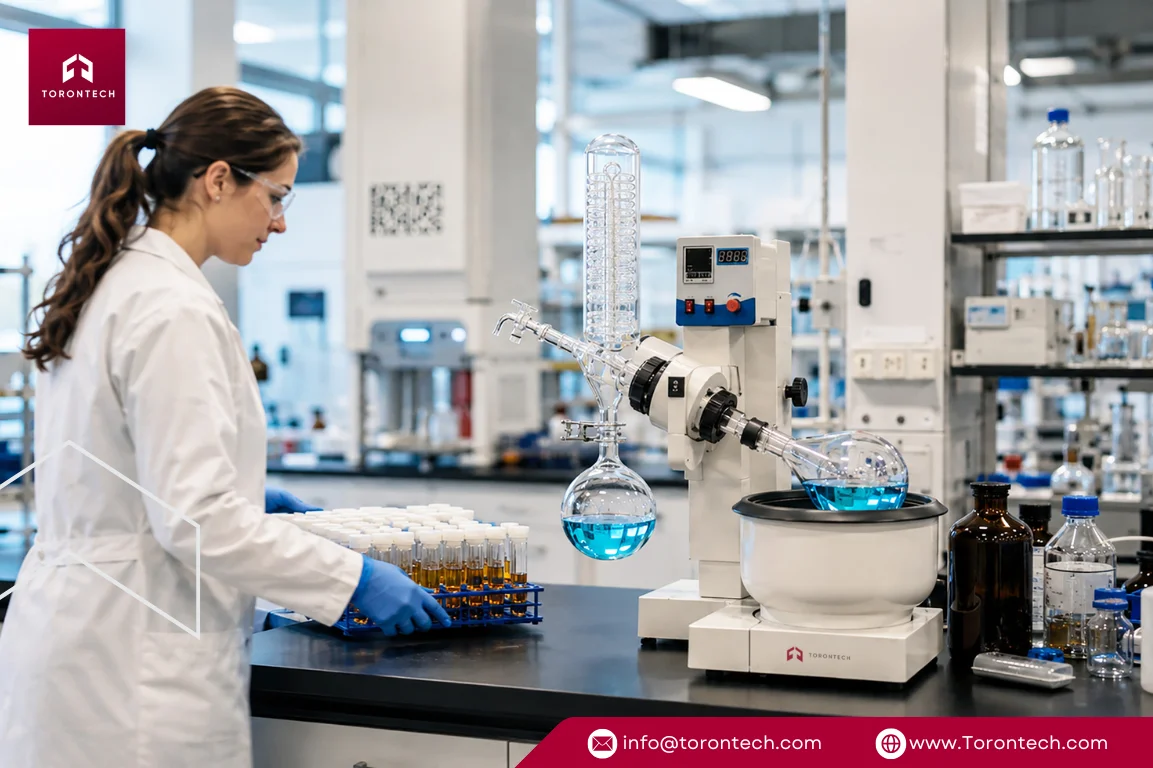
A rotary evaporator (often referred to simply as a "rotovap" in laboratory settings) is an absolute necessity in almost any active workspace. We engineer these systems to isolate volatile liquid solvents from non-volatile extracts as gently and quickly as possible. For instance, a standard industry application involves stripping ethanol from a botanical wash to leave behind a thick, concentrated resin.
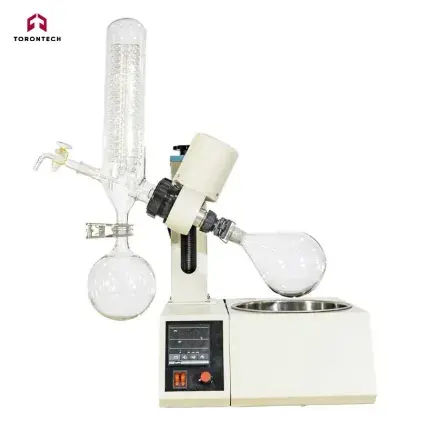
In our view, the efficiency of the rotovap lies in its straightforward design: you use a manual or motorized lift to safely lower your evaporation flask into a precise water or oil bath (like those featured in our EV-52 Series) while a vacuum pump reduces the internal system pressure.
That rotation spreads the liquid into a very thin, consistent layer across the interior glass wall, vastly increasing the active surface area so the solvent evaporates quickly. The resulting vapor contacts a cooled condenser, returns to liquid state, and drains safely into a collection flask.
There is no trace of scorched, half-evaporated residue when operated correctly. It is an exceptional solution when you need to quickly clear away bulk liquids without thermal degradation of your active ingredients.
Related article: Complete Guide to Rotary Evaporation
What is Short Path Distillation?
Short path distillation is a distinct, highly precise purification methodology. The entire configuration is assembled so that the vapor only needs to travel a very small distance, often just a few inches, from the heated evaporation flask to the cooling condenser. A typical industrial application here is fractioning specific, high-value fragrance compounds from a raw essential oil mixture without altering their delicate scent profile.
Because the pathway is so short and the system operates under a deeply pulled vacuum, the internal pressure drops to near-zero. From an engineering standpoint, we find this configuration incredibly elegant: it enables operators to boil off heavy, viscous compounds that normally require extreme heat at much lower temperatures, keeping your valuable, sensitive materials completely safe from getting scorched.
The Core Differences: Rotary Evaporator vs Short Path Distillation
When comparing a rotary evaporator vs short path distillation setup, we believe the decision hinges on one primary operational approach: bulk solvent recovery vs. precision purification.
The Primary Objective:
- Rotary Evaporators are, in our opinion, the absolute standard for stripping away bulk liquids. If you have gallons of ethanol to extract from a mixture, the rotovap is your tireless workhorse.
- Short Path Distillation setups are built for high-level refinement and fractioning. We suggest using these to isolate specific chemical compounds from one another based on small differences in their boiling points.
Vacuum Levels and Boiling Temperatures:
- Rotovaps utilize a moderate vacuum level suited for common solvents, including some higher-boiling solvents when utilizing optimized conditions.
- Short Path setups require deeply pulled vacuums. We consider this absolutely vital when dealing with thick, high-boiling-point extracts (like essential oils or heavy plant compounds) that require reduced temperatures to avoid burning.
Process Speed and Continuity:
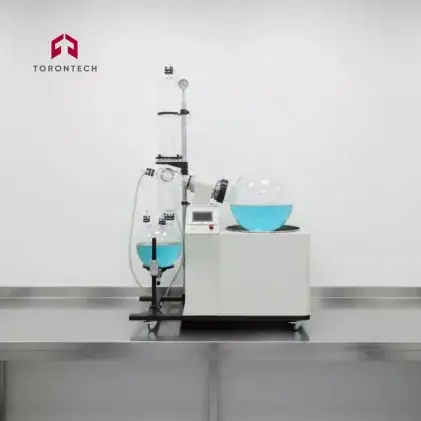
- Rotary Evaporation is a continuous, relatively speedy process. We observe facilities processing high volumes of solvent quickly, particularly when utilizing larger, industrial-scale models like our high-capacity 100L Rotary Evaporator.
- Short Path Distillation is a slower, careful batch process. We always advise operators that short path demands close, continuous monitoring of temperature fractions, or the entire batch purity will be compromised.
Operational Considerations: Maintenance, Cost, and Space
Beyond chemical separation, laboratory managers and procurement officers must manage the daily practical realities of these systems. We often see facilities overlook these operational factors:
Ease of Use & Maintenance
Rotovaps are largely "plug, play, and clean." You wash the glassware, change the bath water, rely on motorized lifts for safe flask handling, and the system is ready for the next run. Short path is a much more demanding system. It is highly sensitive to the skill level of your technician. In our view, an untrained operator running a short path setup can easily cause a costly operational error.
Capital Cost
We find that a standard rotary evaporator usually demands a smaller upfront investment compared to a high-quality short path system. However, both will scale in cost as you introduce automated features and larger capacities.
Physical Footprint
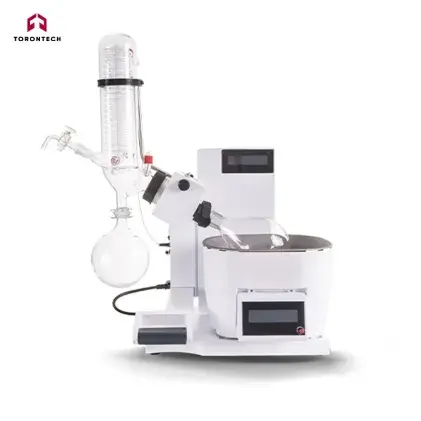
Rotovaps offer high flexibility. At Torontech, we offer them in sizes ranging from straightforward, compact benchtop units like the AVR-001 to massive 100L industrial setups. Short path setups are typically confined to a benchtop but require careful planning for auxiliary gear like vacuum pumps and cold traps.
Which System Does Your Laboratory Need?
Based on our observations across the sector, we suggest a simple rule of thumb when deciding between these two setups:
We highly recommend a Rotary Evaporator if:
- You are performing routine solvent stripping or concentrating samples.
- You need to quickly isolate volatile solvents from a crude extract without damaging the valuable ingredients.
- You are operating in food and beverage, environmental testing, or general chemical facilities (for example, utilizing explosion-proof models like our R-2020Ex for hazardous environments).
- You require high-volume processing capabilities (ranging from small benchtop units to 100L industrial systems).
We suggest utilizing Short Path Distillation if:
- You have already stripped your primary solvent and now need to purify the remaining crude oil or extract.
- Your goal is high-purity isolation of specific chemical compounds or essential oils (such as isolating specific pharmaceutical active ingredients or high-grade hemp derivatives).
- You are working with highly heat-sensitive materials that require deeply pulled vacuum levels to distill correctly.
Industry Use Cases: The Combined Workflow
In high-throughput sectors, we believe arguing about one versus the other is unnecessary because they work beautifully as a collaborative team. Facilities across multiple disciplines use this exact two-step approach:
1. Botanical Extraction and Essential Oils
The raw material is processed with a solvent. A high-capacity rotary evaporator is used for the initial solvent recovery phase, quickly boiling off the extraction solvent to leave behind a concentrated crude oil.
That crude oil is then transferred into a short path distillation unit. Under a deeply pulled vacuum, the technician carefully separates the desired active compounds from unwanted fats and waxes based on exact boiling points, yielding a highly purified distillate.
2. Flavor and Fragrance Profiling
After washing raw ingredients (like vanilla beans or citrus peels) in a liquid solvent, the rotovap pulls the bulk liquid away. Then, technicians use short path distillation to pull apart the exact esters and terpenes needed for a final, highly concentrated perfume or flavoring formula.
3. Pharmaceutical Processing
A manufacturing facility uses a rotary evaporator to clear out gallons of reaction solvent after synthesizing a new batch of medicine. Afterward, they rely on a short path setup to pull the final active pharmaceutical ingredient away from any heavy, unwanted leftover byproducts.
By combining both systems, we believe facilities achieve the perfect balance of volume, speed, and product purity.
Optimize Lab Separation Output with Torontech
Selecting the correct equipment is a long-term investment in your laboratory’s operational efficiency and output. At Torontech, we believe that modern facilities should not have to compromise between high-level performance and bottom-line value.
For over 20 years, Torontech has supplied global clients with cost-effective solutions and innovative technologies. Our systems are engineered to deliver precise temperature control, ease of operation, and excellent safety features across all production scales.
We invite you to make your solvent stripping process exceptionally smooth while keeping your valuable compounds fully protected. Explore Torontech’s comprehensive range of Rotary Evaporators today and let our helpful equipment experts help you find the absolute perfect fit for your facility.
References (Click to expand)
- Abdullah, A. S., et al. (2019). Rotating-drum solar still with enhanced evaporation and condensation techniques: Comprehensive study. Energy Conversion and Management.
- Chen, Y., Wang, W., & Zhang, Q. (2023). Investigation of Factors Affecting the Rate of High-Boiling-Point Solvent Removal Using a Rotary Evaporator. Synlett.
- Dewi, L. K., et al. (2018). Comparative Study of Isolation Methods of Solvent Extraction and Steam Distillation of Basil Essential Oil on the Composition of Active Compounds. Rekayasa Bahan Alam dan Energi Berkelanjutan.
- Duan, Z., et al. (2022). Study on mass transfer and heat transfer in transition zone of short-path distillation separation equipment based on N-dodecanol and N-hexadecanol. Korean Journal of Chemical Engineering, 39, 306-315.
- Ketenoglu, O., & Tekin, A. (2015). APPLICATIONS OF MOLECULAR DISTILLATION TECHNIQUE IN FOOD PRODUCTS. Italian Journal of Food Science, 27, 277-281.
- Kolesnichenko, I., Goloverda, G., & Kolesnichenko, V. (2019). A Versatile Method of Ambient-Temperature Solvent Removal. Organic process research & development, 24, 25-31.
- Kulikova, N., Chernobrovina, A., Roeva, N., & Popova, O. (2023). Evaporation as a Method for Obtaining Plant Concentrates. Food Processing: Techniques and Technology.
- Martins, P. F., et al. (2012). Evaluation of methyl chavicol concentration by different evaporation processes using central composite experimental design. Separation and Purification Technology, 98, 464-471.
- Seifollahi, F., Eikani, M. H., & Khandan, N. (2024). Cold-pressed camelina oil deacidification using short path molecular distillation: An optimization study and comparison with conventional techniques. Food and Bioproducts Processing.
- Shi, X., et al. (2020). Performance evaluation of different extractive distillation processes for separating of a quaternary low-boiling solvent mixture. Process Safety and Environmental Protection, 137, 246-260.
- Xu, X. (2019). Short-Path Distillation for Lipid Processing. Healthful Lipids.
- Zhang, Z., et al. (2023). Optimal design and multicriteria comparison of extractive distillation processes for separating of a quaternary low-boiling solvent mixture. Separation and Purification Technology.