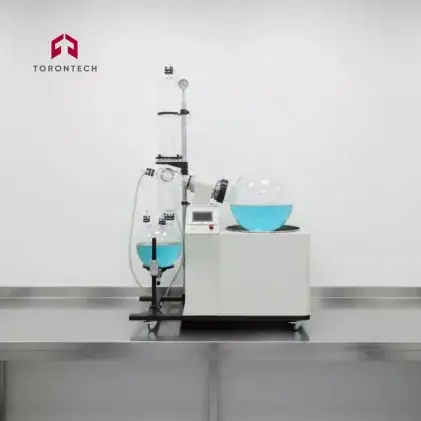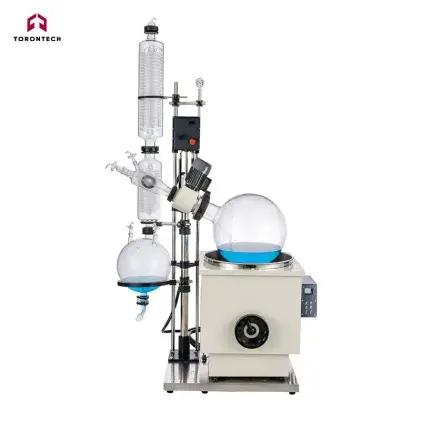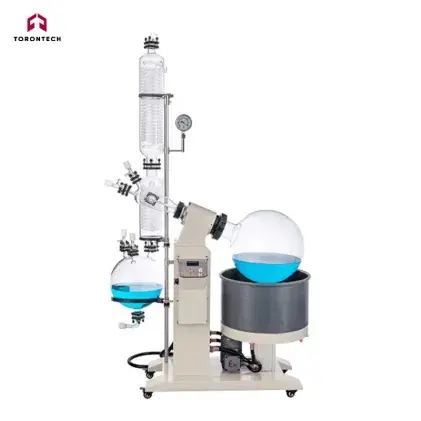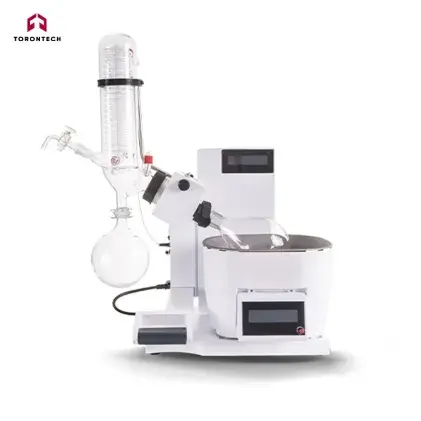
Rotary Evaporator
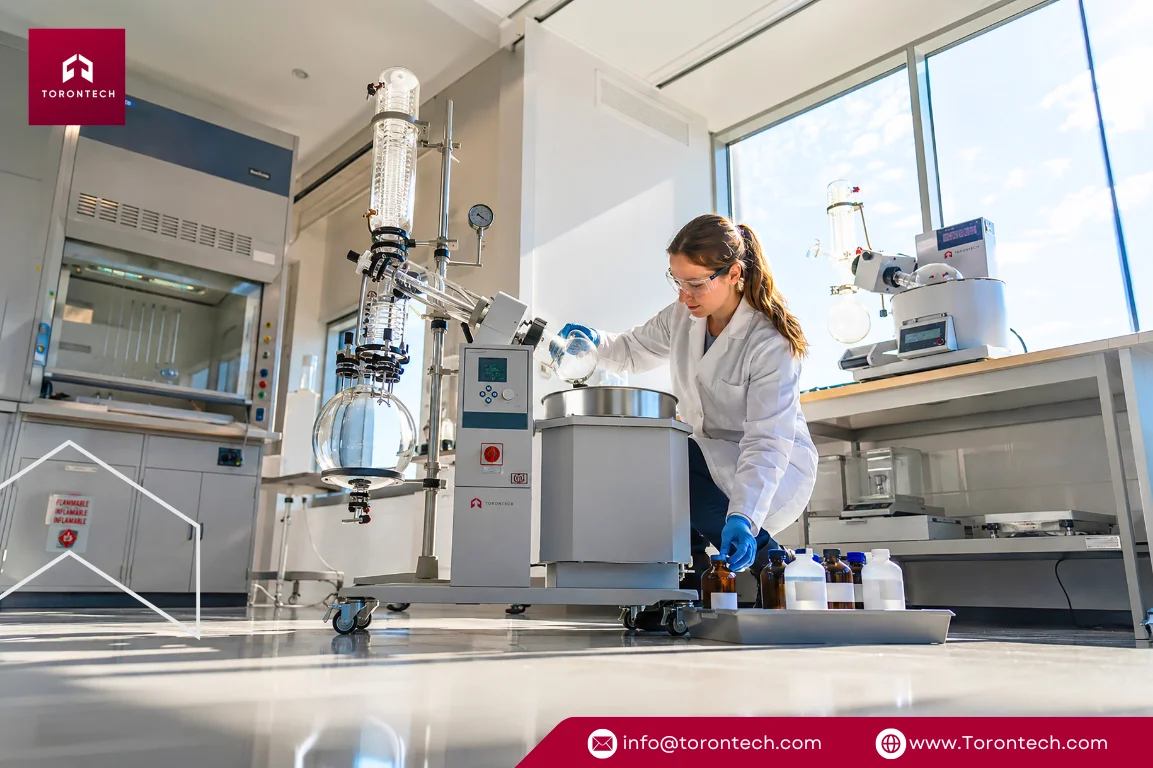
A rotary evaporator is a laboratory instrument designed to gently and efficiently remove solvents from samples by evaporation.
Commonly used in chemical, pharmaceutical, and academic research laboratories, rotary evaporators are essential for processes such as solvent recovery, sample concentration, and purification.
Their ability to perform evaporation under reduced pressure makes them ideal for handling heat-sensitive substances while minimizing the risk of degradation.
Why Choose Torontech Rotary Evaporators?
- Wide Variety: Models to suit every scale and application.
- Advanced Features: Energy-efficient designs with modern safety standards.
- Reliable Performance: Built for consistent and accurate results.
- Global Support: Expert technical assistance and customer care.
Whether you’re in need of a high-capacity rotary evaporator for industrial production or a compact system for your laboratory, Torontech’s range ensures optimal performance and results.
Contact us today to explore the instrument and how they can support your evaporation needs.
Applications of Rotary Evaporators
Rotary evaporators are used in a wide range of industries, including:
- Chemical and Pharmaceutical Research: For distillation, crystallization, and synthesis of chemical compounds.
- Food and Beverage: To concentrate flavors, extract necessary oils, and analyze food components.
- Environmental Testing: For solvent extraction in pollutant analysis.
- Academic Research: Aiding in organic synthesis and analytical chemistry experiments.
Torontech's Range of Rotary Evaporators
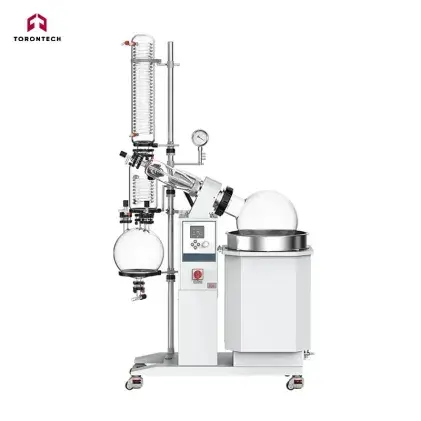
Torontech offers a comprehensive selection of rotary evaporator for sale, tailored to meet diverse laboratory and industrial needs. Whether you require a compact bench-top model, a versatile lab-scale system, or a robust pilot-scale unit, Torontech has the right solution. Our rotary evaporator machines are designed for high performance, safety, and ease of use, with features such as precise temperature control, advanced vacuum systems, and durable construction.
1. Gentle Solvent Removal
By evaporating under vacuum at a low bath temperature, the rotary evaporator removes solvent without overheating heat-sensitive samples.
2. Rotating Evaporation Flask
Rotation spreads the sample as a thin film over the flask wall, which increases the surface area and speeds evaporation while preventing bumping.
3. Efficient Condenser
A cooled condenser recovers the evaporated solvent quickly, which improves recovery and keeps the process clean.
4. Controlled Heating Bath
A precise water or oil bath holds the chosen temperature steadily for consistent, repeatable distillation.
5. Vacuum Compatibility
The system works with a vacuum pump and controller to lower the boiling point, which allows faster evaporation at gentler temperatures.
6. Easy Flask Handling
A motorized or manual lift raises and lowers the flask into the bath safely, which simplifies setup and cleaning.
How Rotary Evaporators Work
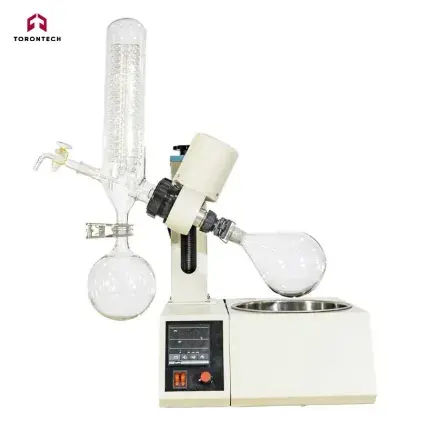
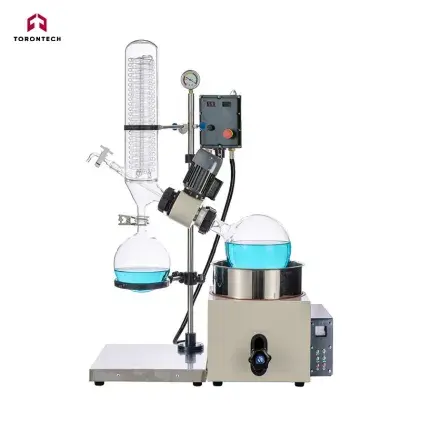
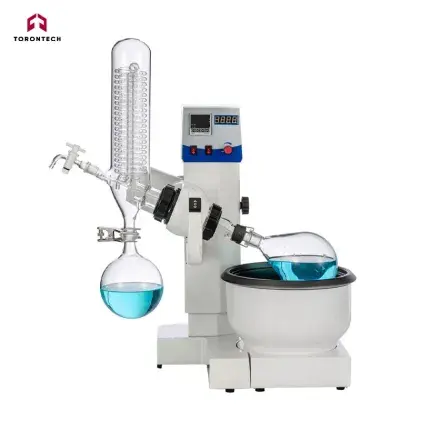
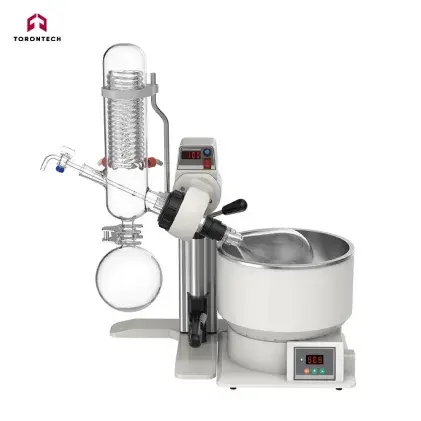
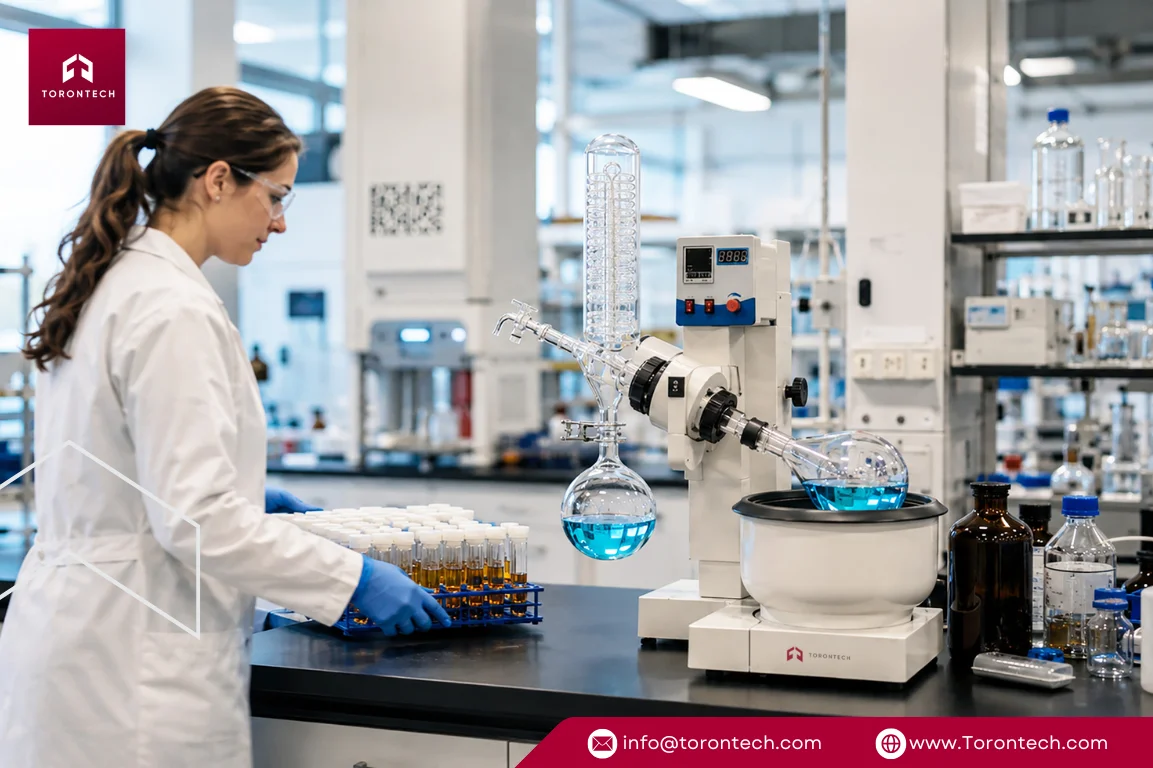
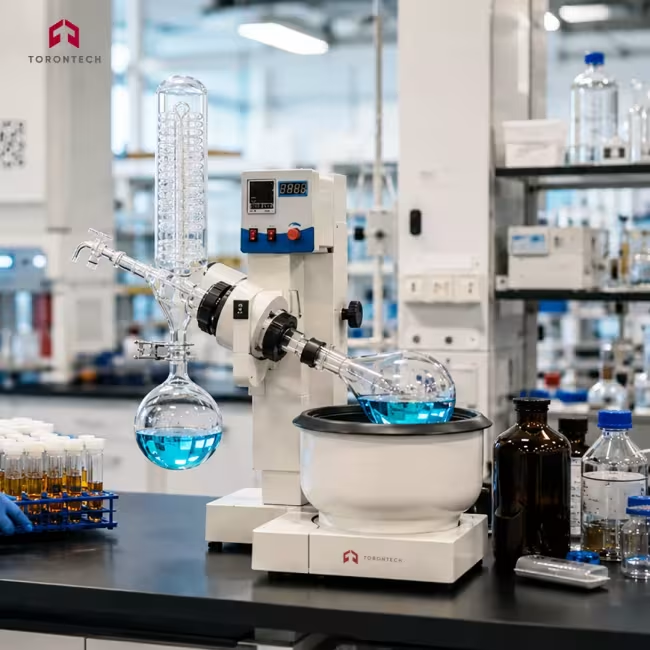
The rotary evaporator consists of a rotating flask that holds the sample, a water bath to provide controlled heating, a condenser to cool and collect the evaporated solvent, and a vacuum system to reduce pressure and lower the boiling point of the liquid. This design enables rapid solvent removal while helping protect heat-sensitive samples.
As the flask rotates, the liquid spreads into a thin film over the inner wall, which increases surface area and speeds evaporation. The reduced pressure allows the solvent to boil at a lower temperature, and the vapor then passes to the condenser where it cools and is collected in a receiving flask. This combination of rotation, mild heat, and vacuum improves evaporation efficiency while reducing bumping and thermal degradation.
Compare Rotary Evaporator Models
Side-by-side comparison grouped by scale to help users choose faster.
Industrial and High-Capacity
| Feature | Rotary Evaporator 100L |
|---|---|
| Scale category | High-capacity / industrial |
| Best for | Large-volume solvent recovery and high-throughput evaporation |
| Typical users | Production environments, pilot production lines, industrial labs |
| Why choose | When your workflow needs very high capacity rather than compact footprint |
Bench-top and Lab-scale
| Feature | AVR-001 | EV-52A / EV-52C / EV-5299 | EV-201D / EV-301 / EV-501 | EV-2000 / EV-3000 / EV-5000 | Lab-scale Rotary Evaporator |
|---|---|---|---|---|---|
| Scale category | Bench-top | Bench-top (model series) | Bench-top (model series) | Bench-top (model series) | Lab-scale |
| Best for | General lab evaporation and routine solvent recovery | Routine lab workflows needing flexible bench configurations | Routine lab workflows with broader model options | Bench-top setups where you need higher capacity than basic models | Labs needing more capacity than bench-top, but not full pilot scale |
| Typical environments | Academic and R&D labs | QC, R&D, chemical labs | QC, R&D, chemical labs | R&D, scale-up experiments, lab production support | R&D scale-up, method development, higher-volume lab processing |
| Footprint priority | Compact bench setup | Compact to medium (depends on configuration) | Compact to medium (depends on configuration) | Medium (bench + higher capacity) | Medium to large (lab-scale system) |
| Selection tip | Pick if you need a straightforward bench-top evaporator | Pick if you want common bench-top choices in one series | Pick if you need model range within the series | Pick if you need higher output while staying bench-based | Pick when bench-top is limiting your throughput |
Pilot-Scale Systems
| Feature | EV-1002 / EV-2002 / EV-3002 / EV-5003 | EV-1005 / EV-1010 / EV-1020 / EV-1050 | R-1005 / R-1050 / R-2020Ex / R-2050Ex |
|---|---|---|---|
| Scale category | Pilot-scale (EV series) | Pilot-scale (EV series) | Pilot-scale (R series) |
| Best for | Scale-up evaporation and solvent recovery beyond lab-scale | Scale-up evaporation and solvent recovery beyond lab-scale | Pilot-scale work in demanding environments (includes Ex models) |
| Typical environments | Pilot plants, process development, production support labs | Pilot plants, process development, production support labs | Pilot plants and process environments requiring Ex options |
| Selection tip | Choose this EV set based on your target capacity range | Choose this EV set based on your target capacity range | Choose when you need Ex-rated options or this R-series configuration |