Selecting a Concrete Freeze Thaw Chamber: Rapid vs Slow
Early concrete surface failure is an expensive liability no contractor can afford.
Choosing between a slow freeze thaw test vs rapid freeze thaw test dictates whether your facility clears client testing backlogs or stalls on public agency approvals.
You need dependable, audit-proof data that protects your capital and keeps projects moving forward.
Here is our direct comparison to help you choose the right testing setup.
Key Takeaways
- Target Standards: Rapid testing centers on ASTM C666 for structural concrete, while slow testing addresses ASTM C67, GB/T 50082, and masonry specifications.
- Testing Speed: Rapid cycles complete in 2.5 to 4 hours (finishing 300 cycles in approximately 4.5 to 7 weeks of active cycling), whereas slow cycles require 12 to 24+ hours each (spanning 2 to 4 months).
- Failure Modes: Rapid cycling generates high internal hydraulic pore pressure, whereas slow cycling simulates gradual critical saturation and surface scaling.
- Chamber Design: The ToronRFTC™ Series utilizes automated liquid antifreeze heat exchange, while the ToronSFTC™ utilizes air cooling with an external movable water reservoir.
Testing Standards and Regulatory Frameworks
Selecting laboratory equipment begins with identifying the governing test standards mandated by client contracts, municipal specifications, and transport authorities.
Rapid Testing Standards: ASTM C666 and AASHTO T 161
The baseline standard for rapid cyclic testing across state highway contracts is ASTM C666 / C666M (Standard Test Method for Resistance of Concrete to Rapid Freezing and Thawing). State highway authorities routinely specify this test method through their own agency codes under AASHTO T 161.
Departments of transportation such as the Minnesota Department of Transportation (MnDOT), the New York State Department of Transportation (NYSDOT), and the Pennsylvania Department of Transportation (PennDOT) mandate this protocol to approve concrete mix designs for bridge decks, precast highway median barriers, and high-performance pavement overlays.
Similarly, airport concrete paving projects governed by Federal Aviation Administration (FAA) specifications (specifically airfield apron concrete specifications such as Item P-501) call for accelerated freeze-thaw verification to ensure taxiway and runway concrete resists surface crumbling under heavy aircraft loads.
Across Canada, provincial transportation ministries, including the Ministry of Transportation of Ontario (MTO) and Transports Québec, rely directly on ASTM C666 to verify the internal freeze-thaw durability of structural concrete, frequently pairing it with separate surface deicer scaling assessments (such as CSA A23.2-22C or MTO LS-412) to ensure public works withstand severe northern winter salting regimens.
ASTM C666 operates through two distinct procedures:
- Procedure A (Rapid Freezing and Thawing in Water): Test specimens remain completely submerged in water within specialized containers throughout both the cooling and warming phases, producing an exceptionally punishing exposure for saturated concrete.
- Procedure B (Rapid Freezing in Air and Thawing in Water): Specimens are chilled within cold air during the freezing phase before being submerged in clean drinking water for the thawing stage.
While ASTM C666 is universally required for highway agency approvals, research engineers emphasize that rapid laboratory baths represent an accelerated stress protocol rather than an exact replica of natural weather. Evaluations of conventional and pervious concrete demonstrate that keeping specimens submerged continuously exaggerates moisture exposure compared to roadside field conditions.
To translate aggressive laboratory data into expected service life, advanced fatigue research models indicate that one accelerated laboratory cycle corresponds to roughly 8 to 9 natural winter freeze-thaw cycles in the field. In our view, this built-in conservatism represents an essential safety buffer. When verifying concrete mixes for critical bridges designed for a 75- to 100-year design life, an aggressive laboratory test provides valuable assurance against premature microstructural failure.
Slow Testing Standards: ASTM C67, GB/T 50082, and Masonry Codes
ASTM C666 serves structural concrete beams, but slower cycles govern traditional architectural materials and unconfined building products:
- ASTM C67 / C67M: The primary testing benchmark across North American architectural guidelines to evaluate weight loss, surface spalling, and structural cracking in clay bricks and structural terracotta.
- GB/T 50082 (Slow Freezing Method): A systematic framework applied in research to evaluate conventional concrete durability under gradual, unaccelerated temperature shifts.
- ASTM C1262 and ASTM C1645: Standard North American test methods governing dry-cast manufactured concrete units. ASTM C1262 evaluates segmental retaining wall units and related concrete masonry units, while ASTM C1645 specifically addresses interlocking concrete pavers, both using controlled slow-cycle freezing to measure mass loss and surface degradation.
Failure Mechanisms: Hydraulic Pressure vs Natural Weathering
The thermal ramp rates of these two approaches produce fundamentally different physical distress mechanisms within the material pores.
Capillary Water Swelling and Hydraulic Pore Stress
During rapid laboratory testing (which typically cycles between -18 °C and 5 °C every 2 to 4 hours), free water trapped inside concrete capillary pores swells by roughly 9% as it transitions into solid ice. This volume increase expels unfrozen pore water through the capillary network, generating elevated internal hydraulic and osmotic pressures.
Because specimens inside rapid testing chambers remain immersed in water during every thaw phase, external pores stay fully saturated. When the freeze cycle starts, an outer shell of ice develops quickly across the specimen surface, confining the internal pore water and forcing it to freeze under rigid, unyielding external boundaries.
Microstructural Degradation and Air-Void Defense
This aggressive stress cycle alters the internal pore structure within hours. Research demonstrates that fast cycling increases average pore diameter, reduces the overall volume of pores smaller than 100 μm, and causes micro-pores to coalesce into open structural cracks.
Standard C30 concrete mixes can deteriorate in as few as 50 rapid chamber cycles, while surviving 450 simulated natural weather cycles without structural compromise. This makes rapid cycling an uncompromising verification of air-entraining admixtures. Published data confirms that air-entrained concrete experiences only about one-third the surface pore damage of non-air-entrained mixes when subjected to rapid cycling.
Critical Saturation and Gradual Surface Scaling
Under natural diurnal cycles or slow laboratory programs, where temperatures decrease at controlled rates such as 20 °C per hour or slower rather than through sudden thermal shock, external physical constraints are less severe, allowing internal moisture to escape outward as ice crystals form. We view slow testing as a specialized approach particularly suited for identifying surface-level weathering:
Diurnal Thermal Shifts in Continental Climates
Regions such as the Canadian Prairies (including Calgary and Edmonton) or the high-altitude US Mountain West (including Denver and Salt Lake City) experience intense daytime solar radiation that thaws exposed concrete surfaces, followed by rapid sub-zero drops overnight. Slower laboratory cycles replicate this gradual, day-to-night water migration and pore filling without introducing excessive hydraulic shock.
Deicing Chemical Saturation
Throughout the snowy US Great Lakes, the Northeast corridor, and Eastern Canada (Ontario and Quebec), highway operations use heavy salt treatments. Salt-laden slush repeatedly saturates roadside barriers, driving concrete past its critical saturation point (roughly 91.7% of total pore volume) and gradually breaking down the cement paste.
Extended Deep-Freeze Dwell Times
Research demonstrates that slower freezing speeds paired with longer hold times at minimum temperatures cause more severe surface flaking and scaling, even over fewer total cycles. In our assessment, this makes slow chambers valuable for masonry testing, where rapid tests might miss the exact surface-scaling mechanisms that cause historic brick facades and sidewalk pavers to deteriorate in northern climates.
Operational Timelines: Slow Freeze Thaw Test Chamber vs Fast
When comparing a slow freeze thaw test chamber vs fast machine, balancing temperature capabilities with laboratory project deadlines is what keeps your facility operating efficiently.
Equipment Specification
| Rapid Chamber (ToronRFTC™ Series) | Slow Chamber (ToronSFTC™) |
|---|---|
| -20°C to +25°C (adjustable) | -35°C to +50°C |
| <2°C | ≤ ±1°C within the chamber |
| ±0.5°C (Accuracy) / 0.06°C (Resolution) | ±1°C (Measurement Accuracy) |
| Freeze: -17 ±2°C / Thaw: +8 ±2°C | Governed by custom test curve |
| 1.5–2.5 hours | 0–9999 hours (adjustable, cooling rate ≤ 20°C/hr) |
| 1.0–1.5 hours | 0–9999 hours (adjustable) |
| 2.5–4 hours | Customizable (typically 12 to 24+ hours) |
| Automated multi-cycle management | 0–9999 cycles (adjustable) |
Rapid Testing: The 4.5-to-7-Week Turnaround
Across the northern United States and Canada, outdoor concrete paving follows a compressed seasonal schedule (generally May through October).
Ready-mix suppliers and testing laboratories cannot afford extended delays while inspectors approve new mix formulations. Because our ToronRFTC™ completes cycles in 2.5 to 4 hours (delivering 6 to 9 full cycles every day), a complete 300-cycle ASTM C666 test program requires approximately 4.5 to 7 weeks of continuous machine cycling, before factoring in required periodic intermediate resonance measurements.
This accelerated turnaround enables laboratories to certify mix designs and issue billing approvals before seasonal construction windows close.
Slow Testing: The Multi-Month Horizon
Slow testing protocols require between 25 and 100+ cycles, with individual cycles running from 12 to 24 hours. Consequently, an entire test series occupies chamber space for 2 to 4 months. Commercial facilities testing historic clay bricks under ASTM C67 or qualifying precast architectural stones must account for these extended testing commitments when organizing their laboratory workflow and bidding project schedules.
Damage Evaluation and Auxiliary Equipment
Freezing specimens represents only half the testing workflow; laboratories must accurately quantify internal distress, surface peeling, or structural loss.
Rapid Damage Evaluation (Dynamic Modulus and Durability Factor)
Under ASTM C666, testing is non-destructive at intermediate intervals (typically every 30 to 36 cycles):
- Relative Dynamic Modulus of Elasticity (RDME): Evaluated by testing specimens with fundamental transverse resonant frequency equipment conforming to ASTM C215.
- Durability Factor (DF): A standardized numerical metric used to quantify the overall frost resilience of concrete specimens under ASTM C666:
- Governing Formula: Calculated as DF = (P * N) / M, where P is the relative dynamic modulus of elasticity at N cycles (percent), N is the cycle count at test termination or exposure completion, and M is the specified terminal cycle target (typically 300 cycles).
- Standard Test Cutoff: ASTM C666 specifies that exposure for an individual specimen terminates early if its relative dynamic modulus falls below 60%.
- Agency Acceptance Benchmarks: While 60% serves as the test termination floor, most North American state DOTs and municipal specifications require a minimum Durability Factor of 80 to 85 for standard pavement mixes, and 90 or higher at 300 cycles for high-exposure infrastructure like bridge decks subjected to deicing chemicals.
- Specimen Dilation: Dilation and length changes are tracked using precision length comparators conforming to ASTM C490.
- Historical Quick-Screening Methods: In earlier concrete research, screening methods were developed to estimate performance. For instance, the one-cycle slow-freeze test was developed to correlate specimen strain measurements during a single 4-hour cooling window with 100-cycle durability factors specifically to evaluate coarse aggregate frost susceptibility.
Slow Damage Evaluation (Weight Loss, Crushing, and Visual Checks)
For architectural masonry, structural bricks, and slow-cycle concrete cubes, damage evaluation relies on physical loss and load resistance:
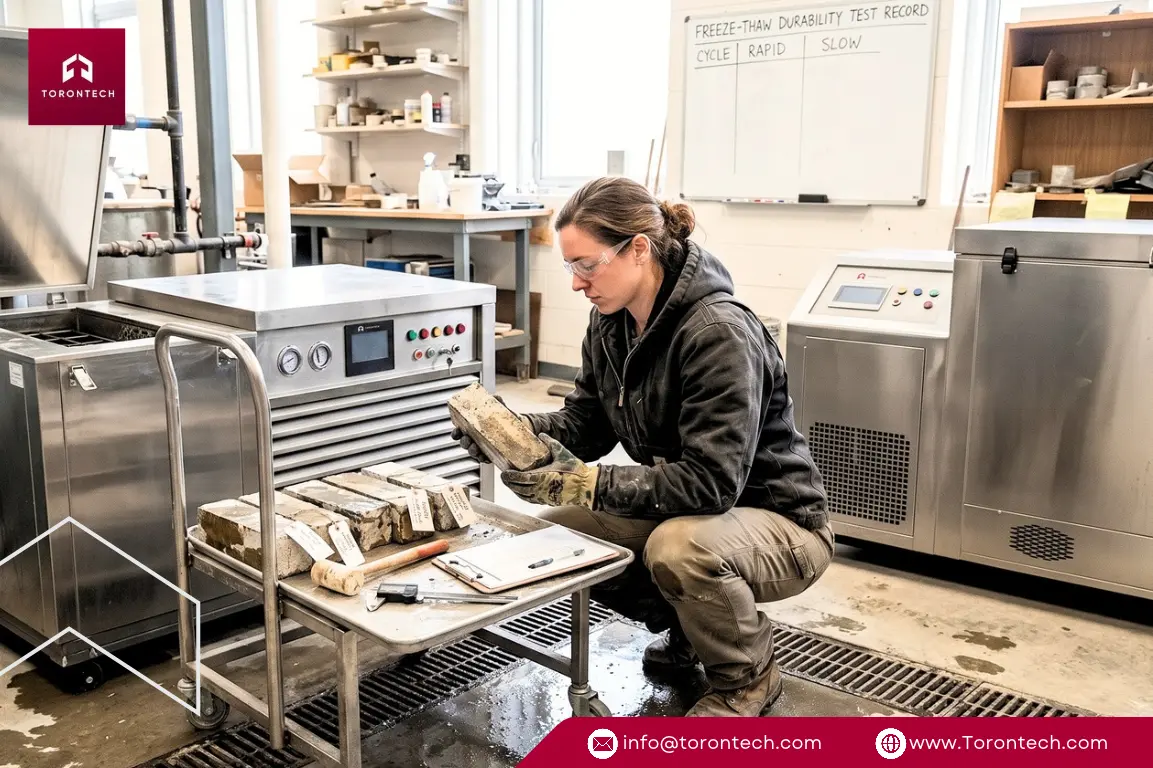
- Mass Loss Percentage: Prisms and bricks are oven-dried, brushed clean of loose material, and weighed on high-capacity analytical balances to quantify surface spalling.
- Compressive Strength Loss: Following completion of the target exposure cycles and thorough thawing to room temperature, specimens are tested in a calibrated compression machine alongside unfrozen companion specimens to determine the percentage of compressive strength reduction.
- Visual Damage Scoring: Pitting, chipped corners, and surface pop-outs are photographed and graded against standard visual damage scales.
Chamber Engineering: Rapid Freeze Thaw Test Chamber vs Slow
Because thermal transition rates differ significantly between fast and slow methods, the mechanical build of a rapid freeze thaw test chamber vs slow system must be engineered for its intended operational demands.
In our engineering view, attempting to force a single environmental chamber to handle both high-velocity fluid-immersion cycling and slow dry-air masonry testing leads to mechanical compromises. Purpose-built testing platforms deliver superior thermal consistency, lower maintenance overhead, and cleaner audit compliance.
Rapid Architecture: ToronRFTC™ Series
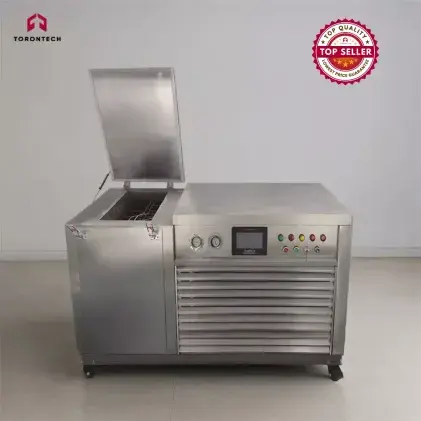
To maintain the rapid temperature transitions required by ASTM C666, our ToronRFTC™ Series utilizes an automated liquid heat-exchange system. The thermal cooling system uses a high-efficiency Danfoss compressor filled with eco-friendly R404 refrigerant, integrated with an optimized evaporative condenser system for high-velocity heat extraction.
Instead of circulating cold air alone, the chamber circulates a dedicated liquid heat-exchange medium (antifreeze) directly around the specimen containers, ensuring rapid and uniform thermal conduction into the center of every concrete prism.
System operation is managed by a digital microprocessor control system that tracks temperatures in real time and handles cycle sequencing automatically. To alleviate the physical strain of manually hoisting heavy, wet concrete prisms, we incorporate an automatic lid-lift mechanism.
The system is built with a heavy-gauge stainless steel chamber, corrosion-resistant stainless steel internal piping, and high-density thermal insulation to minimize heat loss during operation. Because the ToronRFTC circulates a liquid heat-exchange medium around water-filled specimen containers, the standard factory build is configured specifically for ASTM C666 Procedure A (rapid freezing and thawing in water).
Testing facilities whose contracts mandate Procedure B (rapid freezing in air and thawing in water) should confirm specialized container setups and testing configurations with our engineering team prior to placing an order.
Slow Architecture: ToronSFTC™
The ToronSFTC™ is built for long-duration environmental stability and controlled linear cooling across a temperature range of -35°C to +50°C. Refrigeration duties are handled by a quiet, imported low-temperature compressor built for continuous multi-week operation.
An external movable water reservoir automates filling, soaking, and draining during freeze-thaw and drying routines, supported by an environmentally friendly water filtration and storage system to prevent particulate buildup from clogging internal piping.
System controls are centered around an industrial PLC connected to a large color touchscreen interface. Technicians can execute standard pre-loaded temperature curves or configure multi-step custom protocols with one touch. The system includes onboard memory for automatic data recording, alongside free PC software for remote monitoring, curve creation, and data management. The structural frame features a stainless steel inner tank and chamber protected by high-efficiency polyurethane insulation.
(Academic research papers evaluate experimental concrete mixes using unique one-off laboratory setups. Commercial testing facilities depend on standardized, factory-built chambers to ensure test data withstands third-party inspection.)
Specimen Capacities, Facilities, and Operational TCO
Before issuing equipment procurement orders, laboratory directors must verify chamber capacity, facility utility hookups, and ongoing maintenance requirements to manage total operating costs.
ToronRFTC™ Rapid Test Chamber Capacity Tiers
The ToronRFTC™ Series is designed specifically for standard 100 x 100 x 400 mm concrete test beams across three model sizes:
- ToronRFTC™ 3: Holds 10 specimens (100×100×400 mm); requires 60 liters of antifreeze; peak electrical draw of 2.8 kW.
- ToronRFTC™ 5: Holds 16 specimens (100×100×400 mm); requires 80 liters of antifreeze; peak electrical draw of 3.5 kW.
- ToronRFTC™ 9: Holds 28 specimens (100×100×400 mm); requires 120 liters of antifreeze; peak electrical draw of 5.0 kW.
Day-to-day maintenance for the rapid series involves verifying antifreeze fluid levels and glycol concentrations, maintaining clear airflow pathways around the evaporative condenser, and following routine refrigeration compressor service intervals.
ToronSFTC™ Slow Test Chamber Specifications
The ToronSFTC™ accommodates diverse building materials, masonry units, and concrete cubes:
- Specimen Capacity: Holds up to 54 concrete test cubes (100 × 100 × 100 mm), up to 60 standard red bricks, or up to 5 wall bricks (190 × 190 × 390 mm).
- Physical Footprint: Internal chamber dimensions are 1100 × 500 × 500 mm; overall equipment dimensions are 1800 × 850 × 1300 mm; total equipment weight is 200 kg.
- Electrical Requirements: Operates on standard 220V power (with 110V available upon request).
Regular maintenance involves flushing the external movable water reservoir, replacing water filtration elements, and conducting scheduled servicing on the low-temperature compressor.
Decision Framework: Concrete Freeze Thaw Equipment Selection
In our assessment, the most effective purchasing strategy is straightforward: match the machine directly to your contract obligations and the structural materials you test, rather than selecting excess features you will not use. Use this clear decision guide for your concrete freeze thaw equipment selection:
Choose the ToronRFTC™ Series if:
- Your testing contracts mandate compliance with ASTM C666 Procedure A (rapid freezing and thawing in water) or aligned regional DOT specifications.
- You primarily test standard 100 x 100 x 400 mm structural concrete beams.
- Your testing schedule requires rapid turnaround (completing 300 cycles in approximately 4.5 to 7 weeks of active cycling) to meet commercial construction deadlines.
- You need automated, high-velocity fluid circulation to track specimen center temperatures (-17 ±2°C freeze, +8 ±2°C thaw).
Choose the ToronSFTC™ if:
- You test building bricks, ceramic tiles, architectural masonry, 190 × 190 × 390 mm wall blocks, or 100 × 100 × 100 mm concrete cubes.
- Your laboratory supports historic building restoration projects (such as testing clay bricks under ASTM C67 in historic urban centers like Boston, Chicago, Montreal, or Toronto).
- Your testing protocols call for extended holding times with programmable freezing and thawing phases up to 9999 hours per cycle.
- You require an expanded operating temperature range (-35°C to +50°C) with controlled cooling rates of ≤ 20°C per hour to simulate natural weather conditions.
- You prefer touchscreen PLC controls with integrated water filtration and external reservoir management.
Select Accurate Freeze-Thaw Chambers at Torontech
Selecting the right freeze-thaw test chamber ensures your laboratory delivers defensible, audit-ready test data while keeping ongoing operating costs predictable. At Torontech, we supply dependable, cost-effective testing equipment built to maintain high accuracy through demanding commercial testing schedules.
Contact our technical sales team today to review your testing standards, verify specimen configurations, and receive a detailed quotation prepared for your facility.
References (Click to expand)
- Deng, C., Yu, L., Wang, H., Liu, Z.-L., & Fan, D. (2024). Frost Resistance Differences of Concrete in Frequent Natural Freeze–Thaw versus Standard Rapid Method. Buildings, 14(8), 2489.
- Jierula, A., Wu, C., Fu, Z., Niyazi, H., & Li, H. (2024). Experimental Study of Recycled Concrete under Freeze–Thaw Conditions. Materials, 17(16), 3934.
- Luo, H., Zhou, X., Yang, Y., Li, F., & Wu, Y. (2025). Freeze–thaw deterioration mechanisms of concrete under low-temperature high-frequency cycling in high-altitude mountainous regions. Case Studies in Construction Materials, e05594.
- Lv, D., Liu, H., He, F., Wang, W., Miao, Q., Li, H., Wang, F., Zhao, J., & Shi, C. (2024). Freeze–Thaw Damage Characteristics of Concrete Based on Compressive Mechanical Properties and Acoustic Parameters. Materials, 17(5), 1010.
- Şahin, Y., Akkaya, Y., & Taşdemi̇r, M. (2020). Effects of freezing conditions on the frost resistance and microstructure of concrete. Construction and Building Materials, 121458.
- Taheri, B., Ramezanianpour, A., Sabokpa, S., & Gapele, M. (2020). Experimental evaluation of freeze-thaw durability of pervious concrete. Journal of Building Engineering, 33, 101617.
- Walker, R. D., Pence, H., Hazlett, W. H., & Ong, W. (1969). One-Cycle Slow-Freeze Test for Evaluating Aggregate Performance in Frozen Concrete. NCHRP Report, 65.
- Yu, H.-F., & Yan, K. (2017). An equation for determining freeze-thaw fatigue damage in concrete and a model for predicting the service life. Construction and Building Materials, 137, 104-116.