LIBS vs OES: Comparative Guide for Material Testing
Are you ready to maximize your profit margins with instant, highly accurate metal analysis? While LIBS is technically an optical emission spectroscopy branch, practitioners typically evaluate libs vs oes as separate practical tools.
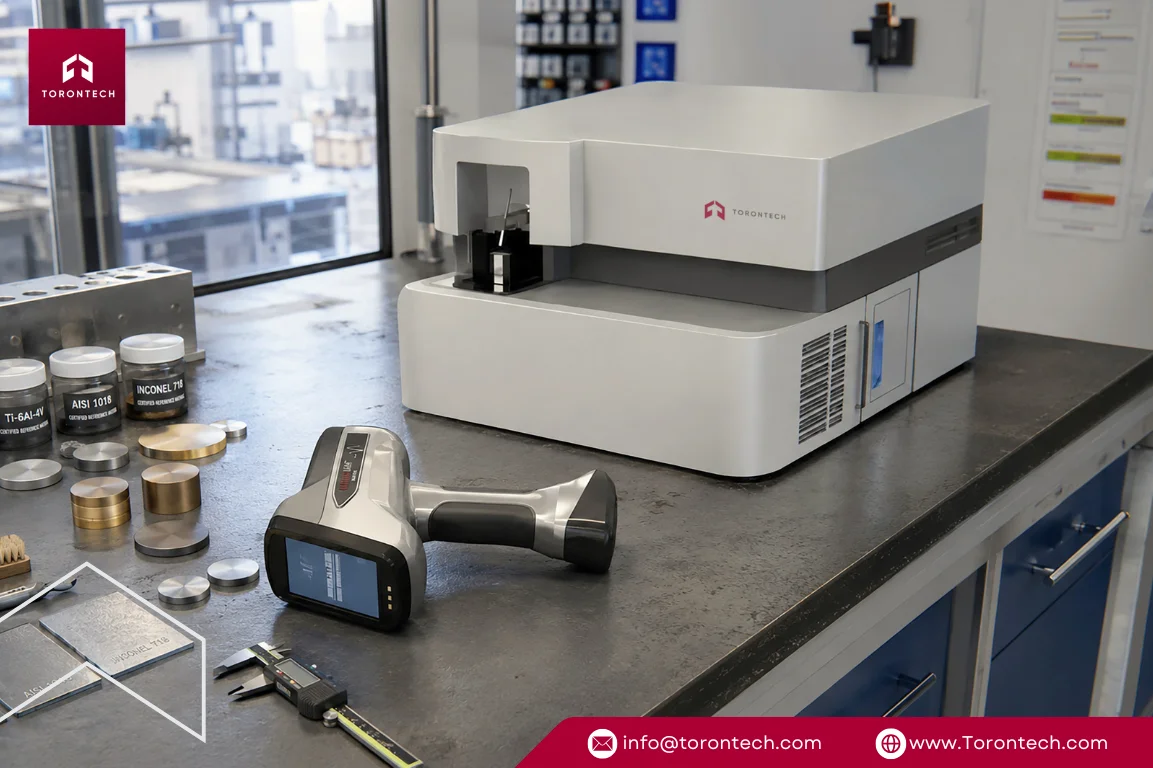
This comparative OES vs LIBS guide highlights key trade-offs to help your facility invest in the most cost-effective machine. Let us look first at how they stack up:
| Feature | LIBS (e.g., ToronLIBS™ V & P Series) | OES (e.g., Torontech TT-OES9000) |
|---|---|---|
| Portability and Form Factor | Ultra-lightweight (1.25 kg to 1.77 kg), battery-operated handheld device | Stationary laboratory unit (80 to 120 kg) or cart-mounted mobile system |
| Analysis Speed | Instantaneous (~1-second analysis, real-time screen display) | Standard industrial cycle (10 to 20 seconds) |
| Sample Preparation | Minimal to none (optional surface grinder for carbon tests) | Required (grinding or sanding to create a flat, conductive surface) |
| Consumable Requirements | None for standard models; mini Argon cartridges for carbon/lithium units | High-purity (99.999%) Argon gas supply and certified calibration standards |
| Analytical Scope and Performance | High speed sorting, carbon in steel (P100), lithium in battery scrap (P200) | Laboratory-grade precision (simultaneous analysis of up to 31 elements) |
| Primary Applications and Settings | Scrap metal sorting, field PMI, remote on-site mineral exploration | Routine foundry bulk metal analysis, melting floor quality control |
To comprehend why these physical differences exist and how they affect your operating budgets, let us look closer at the internal mechanics and our professional perspective on each setup.
Overview of LIBS Technology
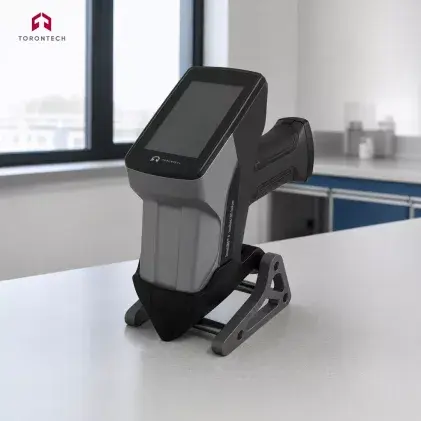
LIBS analyzes your sample by sending a brief, highly concentrated laser pulse to vaporize a microscopic portion of the metal, creating a localized plasma. As that glowing cloud cools down, the device reads the light spectra to identify the exact chemical elements inside the material.
A major advantage here is pure, unadulterated versatility.
- Ultra-lightweight scrap sorting: Our ToronLIBS™ V ranks among the lightest handheld units available at a mere 1.25 kg (2.75 lb). It identifies aluminum, copper, and stainless steel grades in approximately one second flat, making it ideal for high-volume scrap yards and metal traders.
- Specialized trace element analysis: Our ToronLIBS™ P Series (weighing 1.77 kg with battery and argon cartridge installed) includes two distinct variations: the ToronLIBS™ P100 for measuring low-ppm Carbon in steel pipelines, and the ToronLIBS™ P200 for quantifying Lithium in lithium-ion battery scrap or mining ores.
- Built-in argon purge and camera: To capture low-level carbon and lithium emissions cleanly, the ToronLIBS™ P Series features an onboard replaceable argon cartridge to displace atmospheric interference around the plasma, along with an integrated macro camera to photo-document exact test locations.
- Seamless digital connectivity: Both series feature 16 GB of onboard storage along with dual-band Wi-Fi and Bluetooth 4.1, letting your team export digital reports instantly without touching a pen.
For example, in remote operations like pipeline inspections in the Alberta oil sands or mineral exploration in Northern Ontario and Quebec, hauling heavy gas cylinders is logistically impractical. A battery-operated tool provides the necessary freedom of movement in these challenging geographic settings.
Overview of OES Technology
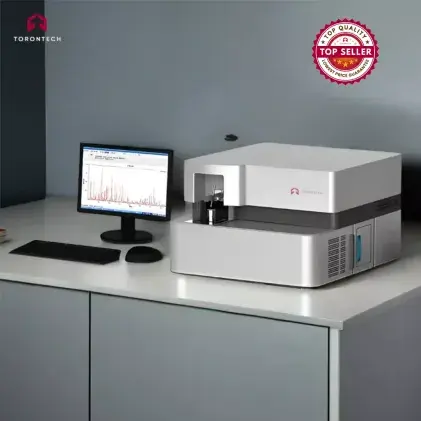
Instead of a laser, traditional spark-OES utilizes raw electrical energy to ignite an electrical discharge on the metal surface, generating a brilliantly bright plasma. A high-resolution optical system reads those light emissions to give you a complete, highly detailed breakdown of the alloy's chemical makeup.
While portable laser guns receive massive attention, we believe that classical spark-OES remains entirely indispensable if you are melting down metals. The evidence consistently finds that conventional spark-OES performs similarly to or slightly better than LIBS for routine metallurgical bulk analysis in a laboratory setting.
- Laboratory-grade optics: Stationary setups like our TT-OES9000 (which you can order as a compact 80 kg Benchtop Model or a massive 120 kg Floor Model) are the core standard on foundry floors. Because it utilizes a Paschen-Runge optical system (featuring a 400mm Rowland Circle) with high-resolution multi-CCD detectors reading broad light wavelengths from 130nm to 800nm, it delivers incredibly accurate, laboratory-grade numbers.
- Broad elemental tracking: Utilizing a HEPS digital excitation source, it simultaneously tracks up to 31 different elements across iron, aluminum, copper, zinc, titanium, nickel, and lead base matrices.
In major industrial centers across Southern Ontario, such as Hamilton, and foundries throughout the US Midwest, meeting tight ASTM specifications for the automotive supply chain requires this exact level of laboratory certainty.
Key Operational Differences: LIBS vs. OES
Let us look closer at how this equipment comparison plays out in day-to-day operations.
1. Portability and Setting
LIBS is highly mobile. At just 1.25 kg for the ToronLIBS™ V and 1.77 kg for the ToronLIBS™ P Series, operators can easily carry these devices across a busy yard or up a tall structure. OES is inherently a heavier setup. Moving a wheeled cart version across a massive factory floor takes coordinated effort, as you still have to drag around a high-pressure Argon gas tank.
2. Element Detection and Limits of Detection (LOD)
If your work requires identifying the absolute lowest trace concentrations of impurities like Phosphorus or Sulfur to pass strict high-end certifications, stationary OES remains unmatched. On the flip side, if your team needs specialized field verification, the ToronLIBS™ P100 measures Carbon in steel, while the ToronLIBS™ P200 quantifies Lithium in battery scrap or spodumene ores instantly using its onboard argon purge.
3. Testing Speed and Sample Preparation
LIBS offers immediate, satisfyingly fast results in about one second. With OES, your operators must spend a few minutes grinding a flat, clean surface on every single sample.
Conventional spark-OES is simpler and fast for conductive metals (especially with modern Ethernet data transmission based on the DM9000A chip processing spectra data internally), but that mandatory physical grinding time is simply unavoidable.
Read more: Pro Tips: Spark OES Sample Preparation Guide
4. Total Cost of Ownership and Consumables
We often see procurement managers focus heavily on the initial purchase price while ignoring long-term operating costs. OES requires a continuous supply of 99.999% high-purity Argon gas (burning through about 5 liters per minute during active spark mode).
Standard LIBS units like the ToronLIBS™ V operate purely on rechargeable batteries with zero consumable gas fees. The specialized Handheld LIBS Analyzer ToronLIBS™ P Series utilizes miniature, easily replaceable argon cartridges only when firing specialized carbon or lithium tests.
Analytical and Physical Limitations
We believe that every testing method has specific limitations, and we prioritize absolute transparency with our clients to ensure you make the right investment.
LIBS Technical Constraints
Because LIBS tests the absolute surface of the material, plasma conditions and signal strength can vary based on laser parameters and sample characteristics. This issue, known as matrix dependence, remains a recurring limitation across various application areas.
While newer calibration strategies help reduce these severe matrix effects, they do not completely eliminate the limitation in general daily use. Surface dirt, oxidation, or paint can also skew the analysis unless you utilize built-in "cleaning shots" or use an optional surface grinder before testing.
OES Technical Constraints
With OES, the sample must be electrically conductive and ground perfectly flat to seal against the spark chamber. While our TT-OES9000 features a clever adjustable sample clamp that grips small pieces ranging from 1mm to 8mm in diameter, testing tiny, highly irregular parts is still difficult without specialized external holders, making it less flexible for non-flat samples. Furthermore, your operations are permanently tied to a bulk Argon gas supply.
Application Analysis: Selecting the Right Technology
Scrap Sorting & Battery Recycling
LIBS is highly recommended. It clearly wins when analysis must be lightning-fast, in situ, or performed on irregular materials in hostile environments. Whether sorting bulk aluminum scrap under North American ISRI guidelines with the 1.25 kg ToronLIBS™ V, or quantifying materials for localized electric vehicle battery recycling supply chains with the ToronLIBS™ P200, these handheld tools process massive volumes of material efficiently while complying with strict verification standards.
Foundries & Steel Production
OES is essential. Spark-OES wins for routine bulk metal analysis because it is easier to automate and slightly better analytically in that specific niche. You must meet strict material standards like ASTM E415 or ASTM E1086, and the TT-OES9000 keeps your complex chemical mixtures precisely on track.
However, for field weldability checks on steel pipelines, the portable ToronLIBS™ P100 provides a fantastic mobile solution for carbon equivalent measurements.
PMI Inspectors
It depends on your workflow. LIBS enables applications that other setups simply cannot handle, including deep-ocean sensing, continuous conveyor-belt ore monitoring, and harsh-environment stand-off verification.
However, if your safety regulations require measuring comprehensive trace elements in a climate-controlled laboratory, conventional OES is the correct choice.
Choose the Right Torontech Analyzer for Your Budget
At the end of the day, you should not have to choose between purchasing an inaccurate tool or overextending your budget. The right equipment must simplify your workflow while protecting your bottom line.
Based in the US and Canada, Torontech has spent over twenty years delivering cost-effective solutions and highly creative technologies directly to industrial partners. We believe high-end material testing should be totally accessible without inflated brand markups.
Ready to find your ideal match? We invite you to contact Torontech today to request a quote or schedule a consultation with our technical team. Let us help you select the exact analytical setup to optimize your return on investment.
References (Click to expand)
- Andrade, D. F., Pereira-Filho, E., & Amarasiriwardena, D. (2020). Current trends in laser-induced breakdown spectroscopy: a tutorial review. Applied Spectroscopy Reviews, 56, 98 - 114.
- Bengtson, A. (2017). Laser Induced Breakdown Spectroscopy compared with conventional plasma optical emission techniques for the analysis of metals – A review of applications and analytical performance. Spectrochimica Acta Part B: Atomic Spectroscopy, 134, 123-132.
- Fortes, F. J., Moros, J., Lucena, P., Cabalín, L., & Laserna, J. (2013). Laser-induced breakdown spectroscopy. Analytical chemistry, 85 2, 640-69.
- Gaudiuso, R., Dell’Aglio, M., Pascale, O., Senesi, G., & Giacomo, A. (2010). Laser Induced Breakdown Spectroscopy for Elemental Analysis in Environmental, Cultural Heritage and Space Applications: A Review of Methods and Results. Sensors (Basel, Switzerland), 10, 7434 - 7468.
- Grünberger, S., Ehrentraut, V., Eschlböck-Fuchs, S., Hofstadler, J., Pissenberger, A., & Pedarnig, J. (2023). Overcoming the matrix effect in the element analysis of steel: Laser ablation-spark discharge-optical emission spectroscopy (LA-SD-OES) and Laser-induced breakdown spectroscopy (LIBS). Analytica chimica acta, 1251, 341005.
- Grünberger, S., Eschlböck-Fuchs, S., Hofstadler, J., Pissenberger, A., Duchaczek, H., Trautner, S., & Pedarnig, J. (2020). Analysis of minor elements in steel and chemical imaging of micro-patterned polymer by laser ablation-spark discharge-optical emission spectroscopy and laser-induced breakdown spectroscopy. Spectrochimica Acta Part B: Atomic Spectroscopy, 169, 105884.
- Harmon, R. S. (2024). Laser-Induced Breakdown Spectroscopy in Mineral Exploration and Ore Processing. Minerals.
- Markiewicz-Kęszycka, M., Cama-Moncunill, X., Casado-Gavalda, M. P., Dixit, Y., Cama-Moncunill, R., Cullen, P., & Sullivan, C. (2017). Laser-induced breakdown spectroscopy (LIBS) for food analysis: A review. Trends in Food Science and Technology, 65, 80-93.
- Pedarnig, J., Trautner, S., Grünberger, S., Giannakaris, N., Eschlböck-Fuchs, S., & Hofstadler, J. (2021). Review of Element Analysis of Industrial Materials by In-Line Laser—Induced Breakdown Spectroscopy (LIBS). Applied Sciences.
- Saeidfirozeh, H., Kubelík, P., Laitl, V., Křivková, A., Vrábel, J., Rammelkamp, K., Schröder, S., Gornushkin, I., Képeš, E., Žabka, J., Ferus, M., Pořízka, P., & Kaiser, J. (2024). Laser-Induced Breakdown Spectroscopy in Space Applications: Review and Prospects. TrAC Trends in Analytical Chemistry.
- Yueh, F., Singh, J. P., & Zhang, H. (2006). Laser‐Induced Breakdown Spectroscopy, Elemental Analysis.