
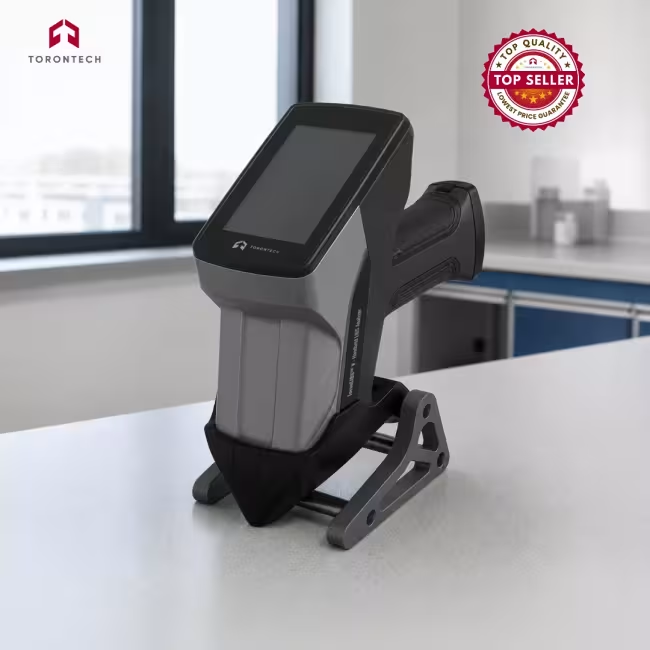
Handheld LIBS Analyzer - ToronLIBS™ V
Aluminum alloy analyzer identifies aluminum, copper, and stainless steel scrap on-site in about one second, using laser-induced breakdown spectroscopy (LIBS) instead of X-ray fluorescence. The Handheld LIBS Analyzer (ToronLIBS™ V) puts real-time positive material identification (PMI) in the hands of recyclers, scrap yard operators, and metal traders who need to confirm alloy grade before a purchase, a melt, or a shipment moves. Weighing 1.25 kg with the battery installed, it ranks among the smallest and lightest handheld LIBS instruments available, so it stays comfortable through a full shift of field or floor use.
Recyclers and fabrication shops use the ToronLIBS™ V to sort mixed non-ferrous scrap and confirm incoming raw material before it reaches a furnace or a production line. The instrument reads the elemental fingerprint straight from the laser-generated plasma and displays a grade match on its touchscreen, cutting the guesswork that comes with visual sorting alone. Minimal sample preparation keeps throughput high, which matters when a yard is processing large volumes of scrap under time pressure.
For teams that need PMI without the licensing, shielding, or radiation-safety training that X-ray-based analyzers require, the Handheld LIBS Analyzer offers a laser-only alternative with no ionizing radiation. Operators get accurate, repeatable alloy identification in scrapyards, trading floors, and production environments, without the added regulatory overhead that comes with radioactive source instruments.
Handheld LIBS Analyzer - ToronLIBS™ V Applications
The ToronLIBS™ V fits any workflow that needs a fast, on-site answer about alloy composition, particularly where aluminum and light alloys are involved.
- Scrap Metal Recycling and Sorting: identifies aluminum, copper, and stainless steel grades at the point of collection, reducing mixed-grade contamination and maximizing recovered material value
- Aluminum Alloy Verification: confirms alloy series before melting so recyclers and smelters can keep furnace charges consistent and avoid off-spec output
- Positive Material Identification (PMI): verifies alloy grade on components, fittings, and raw stock in petrochemical, power generation, and fabrication settings
- Metal Trading and Procurement: gives buyers and sellers a shared, on-site method to confirm material composition before a transaction closes
- Manufacturing Quality Control: screens incoming raw material and in-process parts for correct alloy grade before production continues
- Non-Ferrous Scrap Separation: sorts mixed streams of aluminum, copper, brass, and bronze scrap for higher-value resale
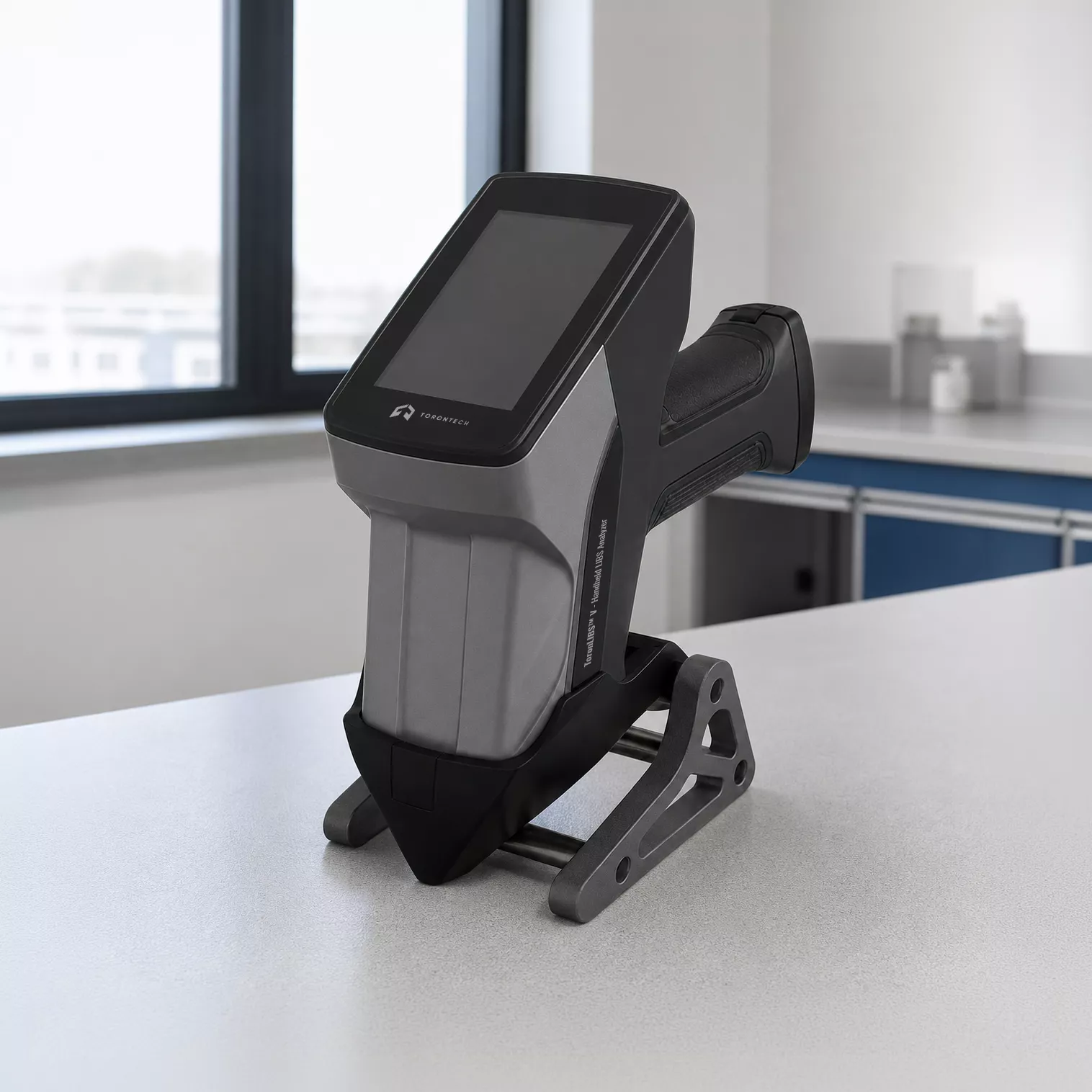
Handheld LIBS Analyzer - ToronLIBS™ V Key Features
The ToronLIBS™ V pairs a compact laser-based sensor with the connectivity and library tools a busy sorting or PMI operation needs.
- Compact, Lightweight Build: weighs 1.25 kg (2.75 lb) including the battery, ranking among the smallest and lightest handheld LIBS analyzers available, for comfortable one-handed operation all shift long
- Class 3B DPSS Laser: a passive Q-switched, 1064 nm solid-state laser generates the analysis plasma without ionizing radiation, removing the licensing and shielding requirements tied to X-ray-based analyzers
- High-Resolution Spectrometer: resolves emission lines to better than 0.2 nm, supporting accurate separation of closely spaced spectral peaks for reliable grade matching
- 4.3-Inch Capacitive Touchscreen: adjustable-brightness display stays readable in bright outdoor light or dim industrial interiors
- Dual-Band Wi-Fi and Bluetooth 4.1: 802.11 b/g/n/ac connectivity plus BLE support enable direct data transfer to a network, PC, or compatible printer
- 16GB Onboard Storage: retains extensive test history and grade libraries on the device without constant offloading
- Customizable UNS-Based Grade Library: ships with a standard alloy library that operators can expand or edit to match specific grading requirements
- Field-Ready Operating Range: rated for operation up to 35°C, supporting continuous use in scrapyards and production environments
- One-Year Factory Warranty: full parts coverage backs the instrument from the date of purchase
Theory and Method
Laser-induced breakdown spectroscopy identifies material composition by focusing a short, high-energy laser pulse onto a tiny spot on the sample surface. The pulse deposits enough energy within nanoseconds to vaporize a microscopic volume of material and ionize it into a plasma, a glowing cloud of free electrons, atoms, and ions that briefly reaches several thousand degrees. This ablation step gives LIBS its non-contact, minimal-preparation advantage over methods that require a polished surface or a dissolved sample.
As the plasma expands and cools over the following microseconds, its excited atoms and ions release energy as light at wavelengths specific to each element, producing an emission spectrum that works like a chemical fingerprint. The spectrometer in the ToronLIBS™ V resolves this emission to better than 0.2 nm, separating closely spaced spectral lines so the onboard software can match peak positions and intensities against a stored alloy grade library. The instrument converts that match into a displayed grade result and elemental breakdown within about a second of the laser pulse.
Because LIBS reads optical emission rather than fluorescence, it detects light elements such as beryllium and aluminum that X-ray fluorescence instruments often miss or under-report. This makes the technique well suited to aluminum-heavy scrap streams, where an accurate light-element response has a direct effect on sorting accuracy and recovered material value.
Handheld LIBS Analyzer - ToronLIBS™ V Technical Specifications
| Parameter | Specification |
|---|---|
| Technology | Laser-induced breakdown spectroscopy (LIBS), non-ionizing |
| Dimensions (L × W × H) | 227 × 86 × 234 mm (9.0 × 3.5 × 9.3 in) |
| Weight | 1.25 kg (2.75 lb), with battery |
| Laser | Class 3B, 1064 nm, passive Q-switched DPSS |
| Spectrometer Resolution | < 0.2 nm |
| Display | 4.3 in capacitive touchscreen, adjustable brightness |
| Internal Storage | 16 GB |
| Wi-Fi | 802.11 b/g/n/ac, 2.4 GHz and 5.0 GHz |
| Bluetooth | Bluetooth 4.1, BLE |
| Battery | 14.8 V lithium-ion, 3,250 mAh |
| Alloy Base Coverage | Aluminum, magnesium, low-alloy steel, and other common alloy bases |
| Element Capability | Broad multi-element range including Al, B, Be, Bi, Co, Cr, and additional elements (library dependent) |
| Grade Library | UNS-based, user-customizable |
| Control Software | Onboard grade-identification interface with customizable library and report export |
| Operating Temperature | Up to 35°C |
| Storage Temperature | Up to 40°C |
| Certifications | IC, FCC, CE, RoHS, IP54, laser safety |
Optional Accessories
| Item | Description |
|---|---|
| Bluetooth Printer | Wireless printer for on-site result printouts |
| Charger | Charging accessory for the lithium-ion battery |
| Carrying Case | Protective case for transport and storage |