A Guide to Choosing a Catheter Leak Tester
Getting your catheter testing strategy right is one of the most impactful decisions you can make for your production line.
In the medical device testing space, a small leak isn't a minor defect; it's a serious liability. It can compromise product sterility, affect fluid delivery, or lead to device failure during a critical medical procedure. This can result in costly recalls, cause serious damage to a brand's reputation, and create significant risks to patient outcomes.
So, choosing the right leak testing equipment is a decision with real consequences. With several methods on the market, the selection process for a catheter leak tester can feel overly complicated. We'll provide some practical guidance on how to choose a system that is genuinely right for your operation.
An Overview of Catheter Leak Testing Methods
In practice, we see two primary approaches used across the industry: pressure decay and vacuum decay.
With pressure decay testing, the device is filled with a specific amount of air to see if the pressure holds steady. If it doesn't, a leak exists. Vacuum decay testing is simply the reverse—a vacuum is applied, and the system watches to see if it remains constant.
Both are effective, clean methods for catheter testing, which is why they have become the industry standard.
Read more: A Guide to Catheter Leak Testing Methods
Key Factors for Choosing Your Catheter Leak Tester

1. Catheter Design and Its Impact on Leak Testing
The first thing to evaluate is the catheter you are actually producing. For instance, testing a multi-lumen central venous catheter (CVC) requires a system capable of testing each lumen channel in sequence to check for internal cross-lumen leaks. This is a completely different challenge than a simple Foley catheter.
For delicate devices, like catheters with stents, our professional recommendation is to use a vacuum decay test—like the method used by our ToronMed-CVLT01—to eliminate any risk of product deformation.
2. Sensitivity and Accuracy in Leak Testing Equipment
Your product’s final application will determine how sensitive your medical device testing needs to be.
You may need to detect minute, hard-to-detect leaks that could be critical failures. High-performance leak testing equipment should provide high-speed, accurate sampling to reliably capture even the slightest pressure fluctuations.
This ensures your results are not just an approximation but are consistently repeatable—a cornerstone of a strong quality control process.
3. Regulatory Demands for Medical Device Testing
Let's be clear: your catheter leak tester is a central part of your compliance program. The tester you select must perform in a way that satisfies the requirements of regulatory bodies like the FDA.
We also suggest confirming that its data capabilities align with standards like 21 CFR Part 11. Choosing a compliant tester from the outset simplifies validation and prepares you for any audits.
4. Usability in Catheter Testing Equipment
In a production environment, a system must be efficient to use. A machine that requires excessive training is a source of inefficiency that many businesses overlook. Consider a scenario with multiple production lines and rotating shifts; you need a tester that an operator can use confidently after minimal training.
A system with an intuitive interface, like the 7-inch color touchscreen on our ToronMed-CVLT01, is designed to be straightforward, displaying clear pass/fail indicators to streamline workflow.
5. Data Management in Your Quality Control Process
In modern device manufacturing, a complete record of every test is a fundamental part of quality control.
A capable tester must store a large number of test records, complete with all necessary details like timestamps and batch information. A practical example would be a quality audit where you need to pull the complete testing history for a specific batch from three months ago.
The ToronMed-CVLT01, for instance, can store a significant number of test records onboard and offers a simple USB port for data transfer, simplifying this entire process.
6. Finding a Cost-Effective Catheter Tester
The initial price is a factor, but the total cost of ownership is what really matters.
An affordable and dependable catheter leak tester allows your organization to scale its quality control operations. It makes it financially feasible to deploy multiple units, eliminate production bottlenecks, and transition from batch sampling to 100% inline testing.
This is the principle we built our cost-effective tester, the ToronMed-CVLT01, around—enabling broader, more thorough testing without an excessive capital investment.
Practical & Effective Solution From Torontech
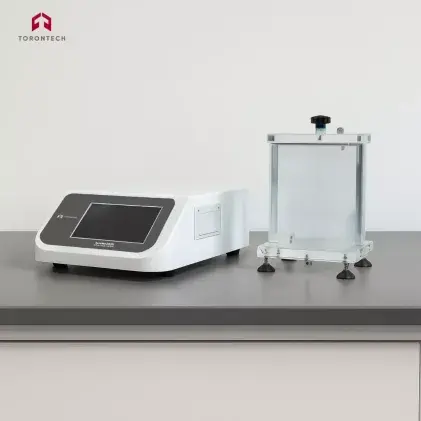
At Torontech, we developed our Catheter Vacuum Leak Tester (ToronMed-CVLT01) based on these exact business principles. It is a precision-engineered piece of leak testing equipment designed for accurate, reliable medical device testing equipment, without the excessive price tag. Its user-friendly interface, large data storage capacity, and built-in safety systems deliver exceptional operational value.
Choosing the right catheter leak tester is a critical business decision. By carefully weighing the factors we've outlined, you can select a system that genuinely supports your operational needs.
Ready to strengthen your quality control with a solution that makes financial sense? Request a personalized quote for the ToronMed-CVLT01 today, or schedule a free consultation with our technical experts to discuss your specific catheter testing requirements.