How to Choose a Catheter Cuff Inflation Tester
Knowing how to choose a catheter cuff inflation tester is a genuinely critical decision. It's one of those choices that seems straightforward, but has a ripple effect across production, quality, and even your company's market standing.
For the engineers and quality managers responsible for product integrity, you know that an unreliable piece of equipment doesn't just cause headaches—it creates real risk. A truly capable machine, on the other hand, is a genuine asset that pays for itself in confidence and consistency.
We've been in this field a long time, so we wanted to provide our perspective on the most important cuff inflation tester features and how they should influence your purchasing decision.
Why We View Proper Cuff Testing as Absolutely Critical

Before we get into specific features, it's useful to frame the discussion around the real-world outcomes of this process. These aren't just abstract ideas; they are tangible business realities that show up in your budget, in your audit reports, and in your customers' experiences. In our experience, a serious approach to cuff testing is essential for a few foundational reasons.
It's a Matter of Patient Safety
This is the ultimate priority and the standard by which all medical devices are judged. An improperly manufactured cuff can lead to serious clinical complications.
For example, think about an endotracheal tube used for a patient on a ventilator. Our tester is designed to verify the cuff's precise inflating diameter. If a cuff inflates even a millimeter wider than specified at a given pressure, it could exert dangerous force on the tracheal wall, potentially leading to tissue damage.
This is the kind of critical, fine-tolerance measurement that proper testing is designed to catch, preventing a potential adverse event before the product ever leaves the facility.
It Protects Your Company's Reputation
A product failure in the field is a scenario no one wants to face. The resulting recalls are costly, but the damage to your brand's credibility can be even more significant. Once physicians lose trust in a device, winning them back is an uphill battle.
We see solid testing not as a defensive measure, but as a proactive strategy. It ensures consistency from batch to batch, so the first product you make and the ten-thousandth are held to the exact same high standard.
It Simplifies Regulatory Adherence
Meeting the stringent requirements of bodies like the FDA and standards such as ISO 10555 can feel like a full-time job. A capable testing instrument does much of the heavy lifting. It provides the clean, verifiable proof needed to demonstrate compliance, complete with time-stamped data logs and user-level access controls.
When it's time to compile documentation for a submission, having that data organized and readily available makes a world of difference. It helps you move through audits smoothly and with less friction.
Related article: Improve Catheter Cuff Testing With Automation
Key Cuff Inflation Tester Features to Insist On

When considering how to choose a catheter cuff inflation tester, what separates a great machine from an merely adequate one are its core features. We believe it comes down to a handful of essential attributes.
Does it cover the full range of necessary tests?
This is one of the most important cuff inflation tester features. For example, the ToronMed-CCID01 isn't just for one type of product.
On Monday, your team could use it to verify the critical inflating diameter of a Foley catheter's balloon to ensure it anchors correctly. On Tuesday, they could use the same machine to perform a cannula collapse test on an intravascular catheter to confirm the tube won't buckle under pressure during insertion.
This ability to handle different ISO-specified tests for different products on a single platform is what makes it such an efficient tool for a modern production line.
Is the measurement data completely trustworthy?
You should never have to question your data.
We consider a high degree of precision—like an accuracy of ±0.5% FS—to be a non-negotiable feature. But it goes beyond that. The sensors need to be stable, and the machine should be easy to calibrate, so you can be certain the results are accurate on day one and on day five hundred.
Is it built to comply with key industry standards?
This is a simple pass/fail evaluation.
The equipment must be designed from the ground up to meet the demands of standards like ISO 10555-1. This means the pre-programmed test methods should align with the procedures outlined in the standards, which saves your team the enormous effort of developing and validating their own methods from scratch.
Is the system genuinely easy to use?
Life is too short to wrestle with dated, clunky software.
We advocate for a clear interface that reduces the learning curve for new operators and minimizes the chance of user error. A system with unambiguous pass/fail indicators and a logical workflow means faster testing, more reliable data, and less frustration for your team.
Is the construction truly built for the long haul?
Your work environment is demanding.
A machine that is constantly down for repairs is a production bottleneck. The device should be made from durable, corrosion-resistant materials and use high-quality pneumatic components. This focus on build quality translates directly to greater uptime and a lower total cost of ownership over the life of the machine.
Torontech: Your Partner in Cuff Testing
Ultimately, knowing how to choose a catheter cuff inflation tester means finding a solution that supports product quality and patient safety without straining your operational budget. It's a balancing act that every manufacturer has to perform.
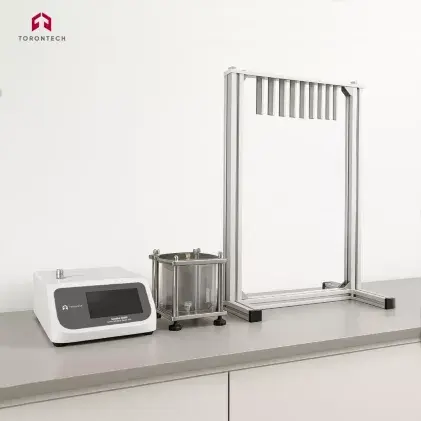
At Torontech, our philosophy is built on the belief that you shouldn't have to pay a premium for top-tier quality medical device testing equipment. We developed our ToronMed-CCID01 Catheter Cuff Inflating Diameter Tester to be the definitive answer to this challenge. It has the full suite of cuff inflation tester features we believe are essential, including high-precision accuracy and a user-friendly, GMP-compliant system. It delivers the capabilities you need, without the excessive price tag. It is, in our opinion, a sensible approach to a complex problem.
If a testing solution built on common sense and value sounds right for your workflow, contact us today for a personalized quote. We would be glad to discuss your specific challenges and see how we can help.