Improve Catheter Cuff Testing with Automation
Here at Torontech, our experience in the medical device industry has shown us one thing again and again: it’s often the smallest components that create the most significant problems. In our professional opinion, the inflatable cuff on a catheter is a primary example—a single component that can jeopardize the entire device's performance and safety.
This reality has forced a conversation about testing methods. We are consistently asked if traditional, manual testing is still sufficient. To be direct, we believe that for modern manufacturing, continuing with a manual process introduces a level of risk that is no longer acceptable.
The Real-World Consequences of a Cuff Failure

When a catheter cuff fails while in use, the consequences create a ripple effect of negative outcomes. We see it as a shared responsibility with our clients to prevent these events, which is why we view proper testing as a core business function, not just a line item on a quality checklist.
Direct Impact on Patient Safety
This is the most serious outcome. Imagine an endotracheal tube used on a patient in the ICU. A slow, undetected leak in the cuff can lead to inadequate ventilation and allow stomach contents to aspirate into the lungs, causing a severe case of pneumonia. From a liability and ethical standpoint, this is the one event that every manufacturer must actively work to prevent.
Disruption to Clinical Workflow
A device failure causes immediate problems for the healthcare professionals using it. A procedure must be stopped, the faulty device removed, and a new one prepped and inserted. This wastes valuable clinical time, consumes extra supplies, and can introduce new risks to an already sensitive procedure, creating frustration for the end-user.
Triggering Unwanted Regulatory Attention
A single device failure in the field can initiate a cascade of administrative burdens. It often requires a mandatory adverse event report to bodies like the FDA. A pattern of such events brings increased scrutiny, consumes internal resources for investigation, and can flag a product line for a full-scale audit.
Severe Brand and Financial Damage
Beyond the immediate clinical issues, a pattern of failures—or a single large recall—can be devastating. The direct costs of recalling and replacing products are immense. More importantly, it erodes the confidence of the hospitals and distributors who purchase your products, causing long-term damage to your company's reputation and market position.
The Comparison: Manual Process vs. Automated System
With so much on the line, how can you ensure the reliability of every cuff? We are convinced the answer is found in the testing equipment you employ. While manual testing has a long history, its limitations in a modern production environment are clear. It simply allows for too much human variability.
What Does "The Old Way" Actually Look Like?
Let’s be clear about what we mean by "manual testing." We're talking about a process that likely looks very familiar: a technician sits at a bench with a box of catheters. They pick one up and manually inject air from a syringe while trying to watch a separate pressure gauge to hit a specific target.
Then, they pick up a pair of digital calipers to measure the inflated balloon. And here is the first major point of failure: how hard do they squeeze? A soft, pliable cuff's measurement can change significantly based on the pressure applied by the calipers. Finally, they write the result by hand onto a batch record sheet. This entire workflow, from start to finish, is loaded with variables that are difficult, if not impossible, to control. This is exactly why a morning shift operator can get different results than the night shift operator, grinding production to a halt and casting doubt on an entire batch.
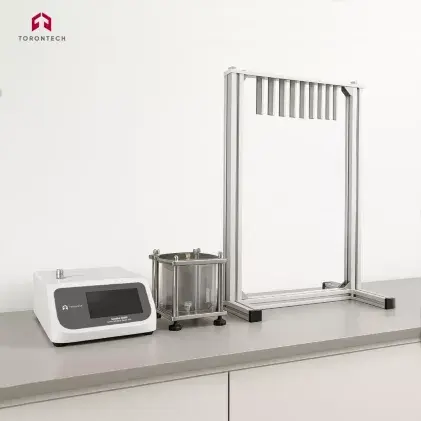
Automated systems deliver a level of consistency that we feel is the required standard for quality control today. This is the very principle that led us to develop equipment like our Torontech Catheter Cuff Inflating Diameter Tester—to remove procedural guesswork and provide our clients with verifiable results.
The data is clear: automated testing is a fundamentally more reliable method.
| The Feature | The Manual Process | The Automated System |
| Consistency of Results | Low. This is its most critical weakness. Results differ between operators, making a true standard impossible. | High. We consider this non-negotiable. Standardized test cycles create identical conditions for every single device. |
| Data Integrity for Audits | Difficult. Relies on handwritten logs, which are prone to error and can be a significant liability during an inspection. | Excellent. Creates secure, time-stamped digital records, offering true confidence and audit-readiness. |
| Production Throughput | Slow. It's a labor-intensive method that frequently creates a bottleneck in the production line. | Fast. It can execute a full range of tests in a fraction of the time, directly increasing production capacity. |
| Operator Requirements | High. Demands extensive training to even approach a level of consistency. | Low. With intuitive touchscreen interfaces, we enable our clients to reduce training costs and minimize operator error. |
| True Cost of Ownership | The initial cost is deceptive. We argue the long-term expenses from labor, rework, and risk make it the more costly option. | A sound investment. We engineer our systems for a clear ROI through lower operating costs and improved efficiency. |
Meeting the Demands of Regulatory Bodies

From our perspective, one of the greatest operational challenges for our clients is the demand for verifiable proof from regulatory authorities like the FDA and the EU. It is no longer enough to simply make a good product; you have to be able to prove it, on demand, with clear and objective evidence.
This is where a manual system truly falls short. Imagine an inspector asking for the testing records for a specific lot from seven months ago. For a manual process, this means a frantic search for a binder, followed by hope that the handwriting is legible and that every column was filled out correctly.
Related article: How to Choose a Catheter Cuff Inflation Tester
This is why we see automation as the only sustainable path forward. An automated system is engineered to provide what we call "defensible data." It's the kind of information that stands up to scrutiny. We built the Torontech Catheter Cuff Tester to be fully compliant with GMP computerized system requirements for precisely this reason. Features like secure, multi-level user access and a complete, un-editable audit trail are not just bells and whistles; they are fundamental. The audit trail shows exactly who ran which test, on which device, and at what time.
When an inspector asks for proof, you’re not digging through a cabinet—you’re confidently exporting a clean, time-stamped report. It transforms a high-stress, reactive situation into a simple, professional exchange of information.
Torontech: Cost-Effective, Compliant Testing
We know the argument for automation is compelling, but we are also keenly aware of real-world budget constraints. Our mission at Torontech is to bridge that gap. We believe quality medical testing equipment should be accessible, so we engineer cost-effective solutions that deliver exceptional performance.
Our Catheter Cuff Inflating Diameter Tester is the result of that philosophy. It was designed to solve the operational problems we've discussed: to eliminate the inconsistencies of manual work, to provide the audit-ready data needed for compliance, and to do it all with a simple, easy-to-operate interface.
If your organization is looking to improve quality and strengthen its compliance position, we believe it’s time to move beyond the limitations of manual testing.
Contact us at Torontech today. Let's have a conversation about our cost-effective catheter cuff testing solutions and how we can help you deliver safer, more reliable medical devices.