How to Perform an ESC Test Using ASTM D1693
We've seen it happen more times than we can count. A plastic component, engineered to be durable, fails unexpectedly in the field. The cause is often a persistent issue known as Environmental Stress Cracking (ESC), where a combination of physical stress and chemical exposure causes a material to fracture.
This single point of failure can compromise an entire product line, which is why a serious conversation about prevention through environmental stress cracking testing is necessary.
What is ASTM D1693 and Why Is It a Business Essential?
In our professional experience, the ASTM D1693 standard, often called the Bell Test, is the definitive benchmark for gauging the real-world performance of ethylene plastics (Choi et al., 2009; Gritsichine et al., 2023; Spagnuolo et al., 1995).
It’s more than a simple strength test; it’s a controlled simulation that shows how a material will behave when it’s under stress and in contact with chemical agents. It provides the clear, repeatable data needed to determine a material's ASTM D1693 ESCR (Environmental Stress-Cracking Resistance) value.
This standard is a critical part of the process for any industry where material failure has serious consequences:
- Consumer Packaging: Think of a laundry detergent bottle. The cap is under constant stress from being screwed on and off, all while being exposed to the chemical residue of the soap. This test predicts whether that cap will eventually crack, preventing leaks and protecting brand integrity.
- Automotive Manufacturing: A windshield washer fluid reservoir is a perfect example. It's a molded plastic part that has to endure engine heat, vibrations, and constant contact with a chemical cleaning agent. ESC testing ensures it won't split and fail prematurely.
- Medical Devices: Consider plastic instruments or trays that must be repeatedly sterilized with harsh chemical agents. The material has to resist becoming brittle and forming micro-cracks that could compromise sterility and patient safety.
- Infrastructure and Construction: When a high-density polyethylene pipe is buried, it’s under constant pressure from the soil above. This test is essential for verifying it will last for its intended service life (Choi et al., 2009; Gritsichine et al., 2023; Spagnuolo et al., 1995).
Related article: A Guide to Choosing the Right ESCR Tester
The Business Case for Proper ESC Testing
Frankly, choosing to bypass comprehensive ESC testing is a significant business risk. It helps manufacturers select resins with optimal resistance to cracking, which directly impacts product durability, safety, and compliance with industry standards (Choi et al., 2009; Gritsichine et al., 2023; Spagnuolo et al., 1995).
From a strategic perspective, integrating this procedure is about proactive quality control. It allows you to:
- Prevent Costly Field Failures: Go beyond assumptions and confirm your product's long-term durability with proper environmental stress cracking testing, protecting your operations from the logistical nightmare of a product recall.
- Solidify Your Market Reputation: Demonstrate a clear and serious commitment to quality, which builds customer trust and satisfies the stringent requirements of industry standards like ASTM D1693.
- Protect Your Bottom Line: Avoid the direct financial impact of defective products, from replacement costs to potential damage to client relationships.
- Drive Material Innovation: Use the data to understand a polymer's exact breaking point, which provides the critical insights needed to engineer stronger, more resilient products for the future.
Related article: Ductile vs Brittle: Is Your Plastic Reliable?
How to Perform an ESC Test: The ASTM D1693 Method
To get reliable data, you need a reliable process. This environmental stress cracking test method is designed for repeatability, ensuring that results are comparable anywhere in the world. The goal is to isolate the material's performance and remove any guesswork.
Step 1: Precise Sample Preparation
It all starts with the specimen. The plastic material is cut into uniform rectangles. Then comes the most critical part: creating the nick. A specialized tool is used to make a controlled cut of a specific depth.
Studies have shown that inconsistencies in notching can lead to significant variability in test results, with automated or heat notching methods improving reproducibility (Zhang et al., 2024; Gritsichine et al., 2022).
Step 2: Application of Constant Stress
Once prepared, each specimen is carefully bent into a "U" shape and slid into a channel in a metal specimen holder. This fixture is designed to hold the bent plastic under constant strain, applying a continuous tensile force that pulls at the material's internal structure. This setup mimics a plastic part under a sustained load.
Step 3: Controlled Chemical Exposure
With samples held under tension, they are placed inside a test tube and submerged in a stress-cracking agent—commonly Igepal CO-630 (Choi et al., 2009; Gritsichine et al., 2023; Zhang et al., 2024; Gritsichine et al., 2022).
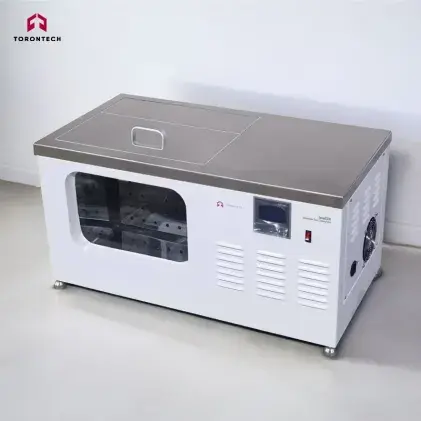
This assembly is then put into a water bath that maintains a constant, elevated temperature, often 50°C. This is where precise equipment, like our ToronESCR system, becomes critical. Temperature control is paramount; even a small fluctuation can dramatically skew results.
Step 4: Observation and Data Analysis
This is the evaluation stage. In modern testers like the ToronESCR, each station is monitored, and the technician can easily record the time of each failure. A "failure" is a crack that travels through the specimen's entire thickness.
The most common metric is the F50 value, which is the time it took for 50% of the specimens to crack. A material with an F50 of hundreds of hours is far superior to one that fails in just a few.
Key Variables That Impact Test Accuracy
Actionable results from any environmental stress cracking testing depend on controlling the variables that can influence the outcome. There are three primary areas we always watch:
- The Material's Inherent Properties: Research shows that the local crystallinity and phase morphology at the notch, rather than the bulk properties of the polymer, play the dominant role in how a crack starts and grows (Gritsichine et al., 2023; Gritsichine et al., 2022).
- Part Design and Finish: The precise geometry of the notch itself is a key variable. Stress triaxiality—the stress state at the notch—is a critical factor in determining where cracks initiate during testing (Zhang et al., 2024).
- The Exposure Environment: The absorption rate of the stress-cracking agent into the localized area of the notch can significantly influence how quickly failures occur (Gritsichine et al., 2023; Zhang et al., 2024; Gritsichine et al., 2022).
Torontech: Your Partner in ESC Testing
For companies looking to bring this essential ASTM D1693 testing process in-house, our ToronESCR Environmental Stress Cracking Tester is a practical, effective tool. As mentioned, we developed this system to provide the clear, reliable data and precise temperature control that this standard demands. It is a cost-effective solution for businesses that require accurate results and high throughput.
Ultimately, what company wants to deal with the fallout from an avoidable product failure? Bringing this capability into your own facility is a direct investment in your product's reliability and your company's reputation.
References
- Choi, B., Weinhold, J., Reuschle, D., & Kapur, M. (2009). Modeling of the fracture mechanism of HDPE subjected to environmental stress crack resistance test. Polymer Engineering and Science, 49, 2085-2091. doi.org/10.1002/pen.21458
- Gritsichine, V., Vlachopoulos, J., & Thompson, M. (2023). Understanding environmental stress cracking in the Bell Test at the notch region. Polymer Engineering & Science. doi.org/10.1002/pen.26545
- Zhang, Y., Wu, L., Jar, B., & Xing, X. (2024). Characterization of Environmental Stress Cracking in Polymers Through a Modified Bent Strip Test Method. Experimental Mechanics. doi.org/10.1007/s11340-024-01129-y
- Spagnuolo, D., Dehmer, P., Dunn, D., & Petrie, S. (1995). A Statistical Approach for the Evaluation and Selection of Medium Density Polyethylenes for Chemical Storage Canisters.
- Gritsichine, V., Marway, H., Vlachopoulos, J., & Thompson, M. (2022). Improving the consistency of environmental stress cracking resistance testing for polyethylenes. Polymer Engineering & Science. doi.org/10.1002/pen.26222