Ductile vs Brittle: Is Your Plastic Reliable?
A fundamental misconception about plastics can put an entire project at risk. We've seen it happen repeatedly: a team operates on the assumption that plastic is a single, predictable material. But when it comes to the crucial ductile vs. brittle debate, the real story of how a polymer performs under strain is where product reliability is truly decided.
Ductile vs. Brittle: What It Means and What It Looks Like
Before we can answer if is plastic ductile or brittle, it’s crucial to be clear on what these terms mean.
In technical terms, brittle materials are those that fracture suddenly with little deformation, while ductile materials undergo significant plastic, or permanent, deformation before they finally break (Pineau et al., 2016; Zhang et al., 2021). For us, the distinction comes down to a simple question: does the material deform before it breaks, or does it just fail without warning?
A ductile material is one that stretches and gives a lot before it finally breaks. A ductile failure typically leaves evidence of a struggle. You'll see the plastic has stretched thin, a process called "necking," and the fracture surface itself often appears dull and fibrous.
A brittle material is the opposite. It stays rigid and offers little to no warning, failing suddenly and completely when its limit is reached. A brittle failure is clean and sudden. The break is typically flat, with no signs of stretching around it, and the surface itself might even look granular.
Here's a straightforward comparison for the ductile vs. brittle properties:
| Key Characteristic | Ductile Materials | Brittle Materials |
|---|---|---|
| Behavior Under Load | Shows significant elongation | Fails with little deformation |
| Failure Mode | A gradual, drawn-out process | Abrupt and often total |
| Energy Absorption | High | Low |
| Think Of | A bent paperclip, mild steel | A shattered plate, cast iron |
Is Plastic Brittle or Ductile? Key Factors Decide
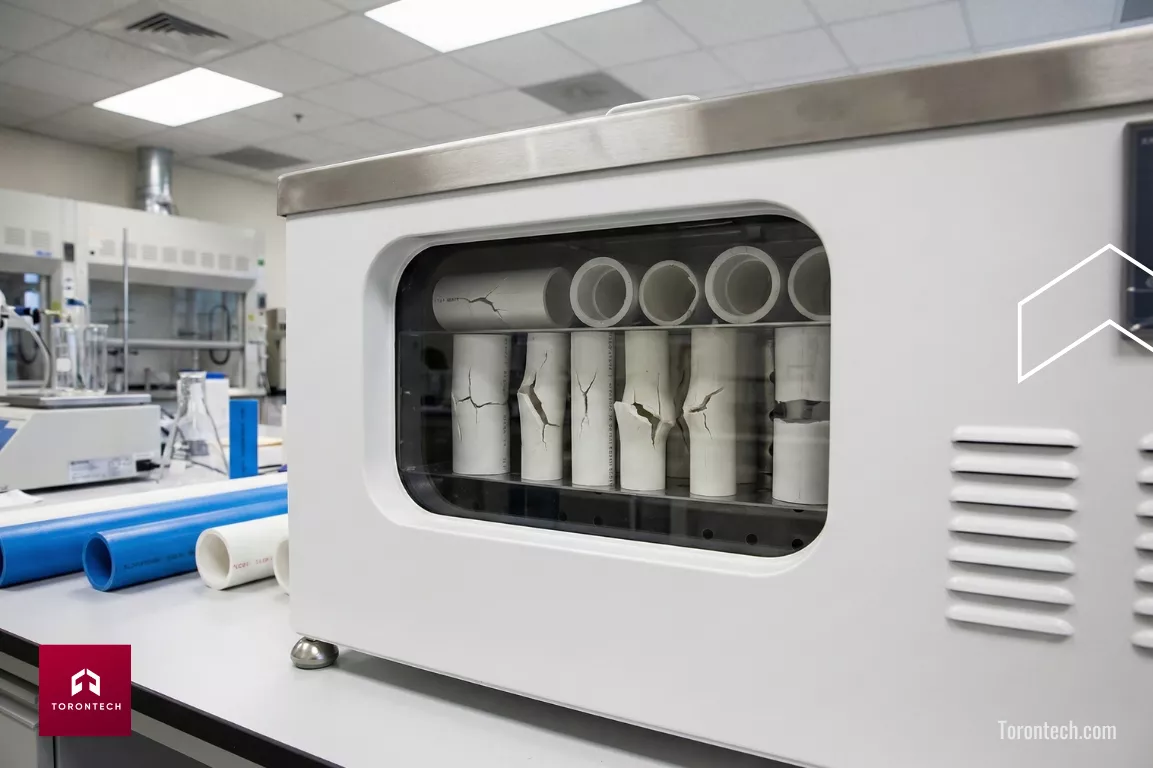
Plastics can be either brittle or ductile depending on their molecular structure and processing conditions. The transition between these behaviors, known as the brittle-to-ductile transition, is influenced by factors like temperature, strain rate, and material structure (Zhang et al., 2021; Choo & Sun, 2018; You et al., 2021; Brumblay et al., 2025).
Temperature:
This is a factor we can't stress enough. Many plastics have a specific temperature point where their properties change dramatically. For example, a polypropylene car bumper can easily absorb a low-speed impact in the summer but might shatter from the same impact during a freezing winter.
Molecular Structure and Processing:
The ductility or brittleness of a plastic is not always an inherent property. For example, polylactide (PLA) is typically brittle, but can be made ductile if its molecular chains are oriented through processes like biaxial stretching, allowing it to stretch significantly before breaking (Xu et al., 2020; Miehé et al., 2015).
Chemical Exposure:
In our experience, this is a frequent and costly oversight. A classic case is a polycarbonate housing for a medical device that develops cracks after being repeatedly wiped down with the wrong disinfectant. This specific type of failure is a prime example of what an Environmental Stress Cracking Tester is designed to identify.
In general, whether a plastic is ductile or brittle can be influenced by temperature, strain rate, and the degree of molecular orientation or crystallinity (Xu et al., 2020; Miehé et al., 2015; Zhang et al., 2021).
Why This Distinction Is Critical for Your Business
This isn't just an academic exercise; whether a plastic is ductile or brittle has a direct line to your product's performance, your customers' safety, and your company's bottom line. When a part fails unexpectedly in the field, the consequences can be severe. We're talking about more than just a single broken component; it can trigger a cascade of costly business problems, from expensive warranty claims and logistical nightmares of a full-scale product recall to the irreparable damage done to a brand's reputation for quality.
In industries like automotive or medical devices, a sudden brittle failure isn't just an inconvenience—it's a critical safety liability. This is where a primary cause of failure comes into play: a phenomenon known as environmental stress cracking.
This type of failure happens when a part, already under some physical load, is exposed to a chemical agent in its environment. The combination accelerates the formation of cracks, leading to a failure at a much lower stress level than your design specifications would predict. Quantifying a material's resistance to this specific failure is exactly why tools like an Environmental Stress Cracking Tester are used—they don't just provide data, they help prevent these catastrophic business outcomes by turning an unknown risk into a known variable.
Related article: A Guide to Choosing the Right ESCR Tester
So, How Is This Actually Tested?
The good news is that you don't have to guess how a material will perform. There are highly reliable and repeatable methods for measuring a plastic's resistance to this exact type of failure. The process, following standards like ASTM D1693, is straightforward:
- Induce Stress: Multiple samples of the plastic are intentionally notched and bent, then placed into a special holder that maintains a constant strain.
- Expose to an Agent: The entire apparatus is submerged in a controlled bath containing a specific reagent—a liquid known to cause stress cracking.
- Observe and Record: The samples are kept at a constant temperature and checked over time. The test records how long it takes for a certain percentage of the samples to show the first signs of cracking.
This entire standardized process is precisely what our equipment is engineered to perform, providing reliable and repeatable data on a material's long-term durability.
Read more: How to Perform an ESC Test Using ASTM D1693
Cost-Effective ESC Solutions by Torontech
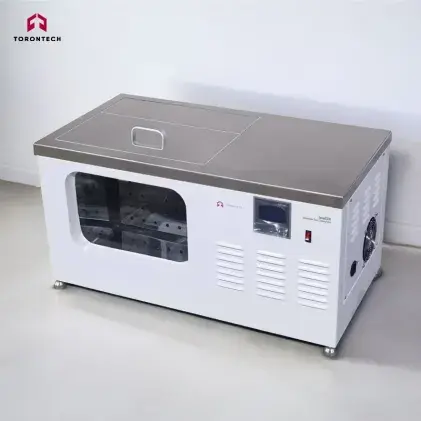
At Torontech, we believe that making products that last starts with having accurate data. Our equipment, like our Environmental Stress Cracking Tester, is made to give you the straight truth by running these exact simulations.
It is built to meet established standards like ASTM D1693, allowing you to see precisely how your plastics will hold up when they are subjected to both physical and environmental pressures. An unexpected material failure can have a lasting impact on your product's reputation.
We invite you to look at our line of cost-effective testers or to contact our team to identify the right solution for your application.
References
- Xu, S., Tahon, J., De-Waele, I., Stoclet, G., & Gaucher, V. (2020). Brittle-to-ductile transition of PLA induced by macromolecular orientation. Express Polymer Letters, 14, 1034-1047. doi.org/10.3144/expresspolymlett.2020.84
- Choo, J., & Sun, W. (2018). Coupled phase-field and plasticity modeling of geological materials: From brittle fracture to ductile flow. Computer Methods in Applied Mechanics and Engineering, 330, 1-32. doi.org/10.1016/j.cma.2017.10.009
- You, T., Waisman, H., & Zhu, Q. (2021). Brittle-ductile failure transition in geomaterials modeled by a modified phase-field method with a varying damage-driving energy coefficient. International Journal of Plasticity, 136, 102836. doi.org/10.1016/j.ijplas.2020.102836
- Miehé, C., Hofacker, M., Schänzel, L., & Aldakheel, F. (2015). Phase Field Modeling of Fracture in Multi-Physics Problems. Part II. Coupled Brittle-to-Ductile Failure Criteria and Crack Propagation in Thermo-Elastic-Plastic Solids. Computer Methods in Applied Mechanics and Engineering, 294, 486-522. doi.org/10.1016/j.cma.2014.11.017
- Zhang, T., Jiang, F., Huang, H., Lu, J., Wu, Y., Jiang, Z., & Xu, X. (2021). Towards understanding the brittle–ductile transition in the extreme manufacturing. International Journal of Extreme Manufacturing, 3. doi.org/10.1088/2631-7990/abdfd7
- Pineau, A., Benzerga, A., & Pardoen, T. (2016). Failure of metals I: Brittle and ductile fracture. Acta Materialia, 107, 424-483. doi.org/10.1016/j.actamat.2015.12.034
- Brumblay, H., Thompson, G., & Weinberger, C. (2025). Insights into the soft brittle-to-ductile transition from discrete dislocation dynamics. Computational Materials Science. doi.org/10.1016/j.commatsci.2024.113503