A Guide to Choosing the Right ESCR Tester
It’s a scenario no one in manufacturing wants to face: plastic components failing unexpectedly in the field. There's an unseen culprit that's often responsible, an issue called Environmental Stress Cracking (ESC).
According to the Encyclopedia of Polymer Science and Technology, this single problem accounts for 15-30% of all plastic component failures. That's a significant figure, and frankly, it's a risk that can and should be managed with the right testing protocols.
The defense against this is what we call Environmental Stress Cracking Resistance (ESCR). This is simply a measure of a plastic's capacity to hold up when it's under load and exposed to chemicals, temperature shifts, and other real-world conditions. We view ESCR testing as a fundamental step in quality assurance—one that’s critical for guaranteeing a product’s long-term performance.
The Clear Advantages of ESCR Testing
Integrating a formal ESCR testing process isn't just a defensive move; it provides tangible benefits that directly impact product quality and your bottom line. The primary ESCR advantages are rooted in risk prevention and quality assurance. This process is a direct investment in your product's long-term success by helping you:
- Prevent Costly Field Failures: By identifying a material's vulnerability before mass production, you can better predict its service life and prevent unexpected failures in critical applications like industrial piping and containers (Thuy et al., 2022; Qin et al., 2022; Contino et al., 2020).
- Protect Your Brand Reputation: A reliable product builds customer trust. ESRC testing demonstrates a commitment to quality and protects your company’s hard-won reputation by developing safer, more reliable products (Thuy et al., 2022; Zhang et al., 2024).
- Ensure Product Safety and Reliability: Testing confirms your product will perform safely under real-world conditions. It provides crucial insights into the interplay between material structure, environmental factors, and mechanical stress (Qin et al., 2022; Zhang et al., 2024).
- Make Smarter Material Choices: ESRC testing allows for a detailed assessment of how different environmental agents (like surfactants or solvents) and even manufacturing processes affect a material's performance, enabling targeted improvements in material selection (Thuy et al., 2022; Contino et al., 2020; Shi & Lin, 2023).
Related article: How to Perform an ESC Test Using ASTM D1693
Key Materials Prone to This Weakness
Certain plastics, due to their internal structure, are notoriously susceptible to this kind of failure. We’ve found that a proactive approach means knowing which materials demand a closer look, such as high-density polyethylene and polycarbonate (Shi & Lin, 2023; Thuy et al., 2022). If you work with these, you know exactly what we're talking about:
Polyolefins (HDPE & LDPE)
They are the workhorses for things like containers and industrial pipes. Yet, their reliability can be compromised when they come into contact with common detergents, soaps, or alcohols.
Polycarbonate (PC)
Valued for its high impact strength and clarity. However, its renowned toughness can become a liability when exposed to certain cleaning agents or industrial lubricants, leading to unforeseen cracks.
ABS
A staple in consumer electronics and automotive interiors. It’s a solid performer, but particular solvents can initiate cracking, undermining the product's structural integrity.
Polystyrene (PS)
Commonly used in food packaging, it’s already known for its rigidity. This characteristic makes it especially vulnerable to cracking when in contact with fats and oils.
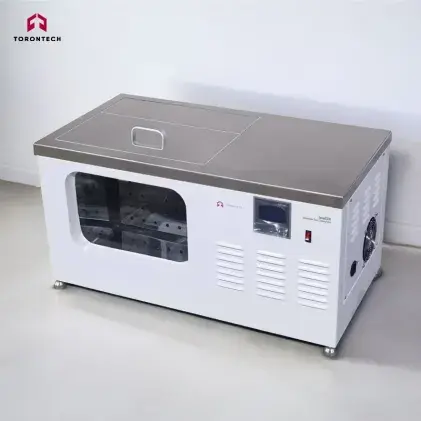
Validating these materials with a reliable device like our ToronESCR Environmental Stress Cracking Tester before they go into production is a strategic move that prevents substantial costs down the road.
Related article: Ductile vs Brittle: Is Your Plastic Reliable?
Industries Where ESCR is Non-Negotiable

For some sectors, a component failure goes beyond inconvenience and presents serious financial and safety implications. In these fields, we feel that thorough ESCR testing is simply a non-negotiable part of doing business responsibly.
1. Packaging and Containers
When a container is holding industrial chemicals or cleaning agents, its integrity is paramount. Think of a detergent bottle that splits and leaks on a retail shelf, creating a safety hazard and a costly clean-up. ESCR testing is the critical checkpoint that prevents this.
2. Automotive
Modern vehicles depend on a multitude of plastic components. Imagine a fluid reservoir under the hood cracking from exposure to lubricants, leading to a vehicle failure. Given the stakes, every material's performance must be verified.
3. Medical Devices
In the medical field, the stakes are considerably higher. Consider a critical housing for a diagnostic tool cracking after being wiped down with a standard hospital disinfectant. There is simply no room for this kind of material compromise when patient safety is on the line.
4. Consumer Goods
Products from appliances to toys are expected to be durable. Picture the outer casing of a popular kitchen appliance cracking after repeated exposure to common cleaning sprays. ESCR testing ensures products stand up to daily use, protecting both the consumer and the company's reputation.
How to Choose an ESCR Tester: What Really Matters
Choosing a tester isn't just about buying a piece of hardware; it’s about investing in certainty. If you're wondering how to choose an ESCR machine, remember that bad data is arguably worse than no data at all, as it can lead you to make poor decisions. When we developed the ToronESCR tester, we engineered it to address the core requirements that truly matter for a quality control team.
Adherence to Official Standards
Any serious tester must conform to industry benchmarks like ASTM D1693. Using standardized methods is the baseline, and advancements such as modified bent strip tests or automated notching can further enhance the reproducibility and accuracy of your evaluations (Zhang et al., 2024; Shi & Lin, 2023).
Consistency and Precision in Your Data
The value of a tester lies in its ability to deliver repeatable, accurate results. This requires precise control over environmental parameters like temperature and chemical exposure. The ability to provide detailed analysis or real-time monitoring is also a significant advantage for modern labs (Zhang et al., 2024; Rihan et al., 2020; Fan et al., 2025).
Operational Simplicity
A machine with a complicated interface creates a bottleneck and invites operator error. An effective tester should be straightforward to operate, reducing training time and minimizing the risk of mistakes that can skew results.
Durability for a Demanding Environment
This equipment is a long-term investment that has to survive in a real-world work setting. A tester needs to be built with materials that can handle continuous use without constant recalibration or repair.
Torontech: A Practical, Cost-Effective Solution
At Torontech, our experience in the field has shown us what companies need. We've applied that insight to develop our ToronESCR Environmental Stress Cracking Tester. It is engineered to precisely meet and exceed the requirements of ASTM D1693, providing data you can depend on.
The ToronESCR delivers precision control and customizable parameters in a user-friendly and resilient package. We're confident it's the right choice for quality control departments and manufacturers focused on verifying the long-term performance of their plastic materials.
Don't let a preventable issue like Environmental Stress Cracking impact your products and your reputation. Contact Torontech today. Let’s have a conversation about how our cost-effective ESCR tester can help you deliver on your promise of quality and durability.
References:
- Thuy, M., Pedragosa-Rincón, M., Niebergall, U., Oehler, H., Alig, I., & Böhning, M. (2022). Environmental Stress Cracking of High-Density Polyethylene Applying Linear Elastic Fracture Mechanics. Polymers, 14. doi.org/10.3390/polym14122415
- Qin, Y., Litvinov, V., Chassé, W., Sun, J., & Men, Y. (2022). Environmental stress cracking of polyethylene pipe: Changes in physical structures leading to failure. Polymer. doi.org/10.1016/j.polymer.2022.124938
- Contino, M., Andena, L., & Rink, M. (2020). Environmental stress cracking of high-density polyethylene under plane stress conditions. Engineering Fracture Mechanics. doi.org/10.1016/j.engfracmech.2020.107422
- Zhang, Y., Wu, L., Jar, B., & Xing, X. (2024). Characterization of Environmental Stress Cracking in Polymers Through a Modified Bent Strip Test Method. Experimental Mechanics. doi.org/10.1007/s11340-024-01129-y
- Shi, S., & Lin, L. (2023). On the environmental stress cracking of a vibration-welded polycarbonate (PC)-based nanocomposite. Polymer. doi.org/10.1016/j.polymer.2023.126338
- Rihan, R., Al-Wakaa, B., & Tanoli, N. (2020). A novel approach for investigating the effect of flowing fluid on the susceptibility of alloys to environmental stress cracking. Journal of Petroleum Science and Engineering, 192, 107212. doi.org/10.1016/j.petrol.2020.107212
- Fan, Y., Lu, Y., Wang, F., Hong, C., & Shoji, T. (2025). Development of a methodology to study the stress corrosion cracking behavior in high-temperature and high-pressure water environment based on small punch test. Nuclear Engineering and Design. doi.org/10.1016/j.nucengdes.2025.113830