Choosing the Best Floor or Benchtop Ultracentrifuge
The ultracentrifuge is the heavy-lifting heart of any high-stakes lab, and picking the wrong one is a headache nobody wants. The choice between a floor-standing beast and a countertop sidekick is enough to trigger a cold sweat if big budgets are on the line.
We’ve stripped back the fluff in this guide to settle the floor standing vs benchtop ultracentrifuges debate so you can find the exact muscle your research deserves. We’ve named the must have features ultracentrifuges require to stay alive under pressure.
Key Takeaways
- Size Dictates Function: Floor-standing models provide massive capacity for high-volume industrial work, whereas benchtop units fit best in clinical settings for quick, low-volume batches.
- Look Past the Sticker Price: Smart procurement requires evaluating the total cost of ownership, sample throughput, and your specific facility requirements rather than just the initial quote.
- Demand Essential Tech: Mandatory specifications for any new spinner include pin-point temperature control, intelligent vacuum setups, and automated rotor identification.
- Scale Without Draining the Budget: Torontech offers high-capacity, cost-effective solutions like the TT-UltraC30 to help laboratories expand their operations responsibly.
Evaluating Benchtop vs Floor Standing Ultracentrifuges
Before you drop a pile of cash, you have to get a handle on how these two types of hardware actually behave. While both use massive G-force to separate tiny biological blobs, they are built for totally different lives.
Selecting the right unit depends on balancing performance demands with practical constraints such as laboratory space and budget.
Comparative Specifications Overview
| Feature / Characteristic | Floor-Standing Units | Benchtop Units |
|---|---|---|
| Sample Space | Enormous (6-liter jugs) | Small to Middle-of-the-road |
| Footprint | Dedicated floor space | Standard lab counters |
| Workload Capacity | High-volume industrial work | Quick, one-off batches |
| Rotor Options | Diverse & heavy-duty | Specialized & lightweight |
| Upfront Cost | Significant initial investment | Lower entry point |
| Best Suited For | Vaccine factories & proteomics | Clinical settings & gene look-ups |
Benchtop Ultracentrifuges: Compact and Specialized
These units are meant to sit right where you do your daily prep.
- The Upside: They are great for saving room. They don’t take much effort to get running, and they are perfect for a researcher who just needs to spin a few tiny vials without walking across the building. Benchtop units have demonstrated serious utility in clinical settings, such as reducing lipaemia in samples while maintaining clinically reliable results.
- The Downside: Because they are so petite, they just can’t hold much. They are fine for little projects, but they lack the muscle needed for 24/7 heavy-duty work or processing buckets of liquid.
Our Two Cents: We think these counter-huggers are great as "supplementary" machines for specific, repetitive tasks. However, we have noticed that labs relying solely on these small units usually hit a brick wall the second their research volume starts to grow.
Floor Standing Ultracentrifuges: High-Capacity Workhorses
These are the big, standalone cabinets that mean business.
- The Upside: These machines are in a class of their own for sheer guts. Floor-standing ultracentrifuges typically offer higher maximum speeds, hitting up to 100,000 rpm or 802,400 x g, and greater rotor versatility. You can throw 6 liters (using a massive 6 x 1000ml setup) of sample in there at once and the machine won't even flinch. Their AC Inverter Motors are built to run until the cows come home.
- The Downside: You have to find a spot for them to live, and they definitely cost more on day one. However, they often feature advanced temperature control and energy-efficient designs that save money over time.
Our Two Cents: Regarding the floor standing vs benchtop ultracentrifuges debate, the choice is really about the volume of samples you are planning to spin. From a long-term strategic perspective, we see the floor units as a much smarter way to spend your budget if you think your lab is going to get even a little bit busier.
How to Choose Ultracentrifuges
Figuring out how to choose ultracentrifuges means taking a long, hard look at what your lab actually does all day. We suggest you look at these five things before you ask for a price:
- Sample Throughput: If you are constantly harvesting giant batches of cell soup, a floor unit that holds liters of liquid is going to save you an insane amount of time compared to running a small benchtop ten times in a row.
- Required Spin Velocity: Different tasks need different levels of "oomph." Make sure the machine can hit the exact G-force you need for your specific science. For instance, units like the Torontech TT-UltraC30 hit exactly 31,200 RPM (110,000 x g) to handle those highly intensive separations.
- Application Environment: Do you have samples that will fall apart if they get even a tiny bit warm? Make sure the machine's specs are a perfect match for the physical reality of your samples. A flexible temperature range from -20°C to +40°C gives you serious breathing room for tricky protocols.
- Facility Infrastructure: The big floor units usually need a special 220V plug and their own dedicated space. Environmental factors like cooling systems (air-cooled vs. liquid-cooled) and power consumption can also influence the choice.
- Total Cost of Ownership (TCO): Buying equipment isn't just about the first check you write. You have to think about repairs, the warranty, and maintenance requirements.
Our Two Cents: We really think it is a mistake to go for the absolute cheapest price you can find. In our view, spending a little more for a heavy-duty AC Inverter Motor that won't quit is going to save you a massive headache on repair bills and electricity costs later on.
Essential Specifications: Must Have Features Ultracentrifuges Require
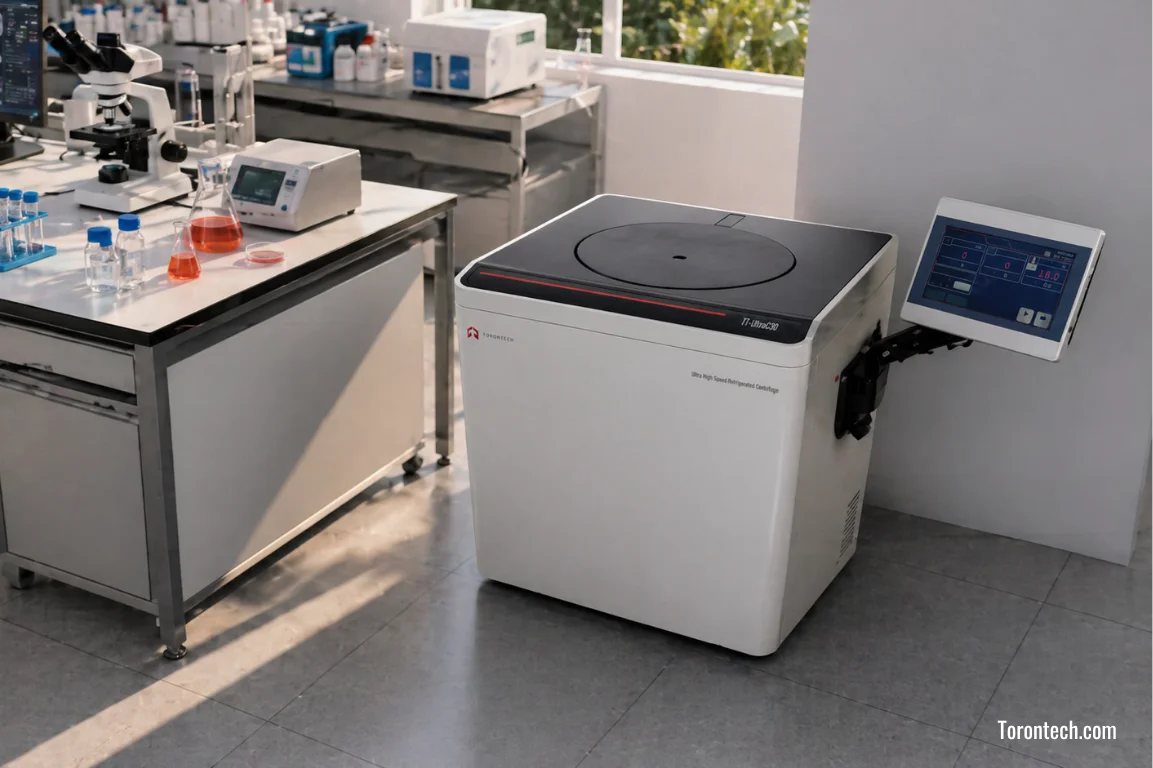
No matter the size, if you are buying a new machine, there are some must have features ultracentrifuges should have if you want to stay sane:
High-Accuracy Refrigeration
Spinning fast creates a ton of heat from the air rubbing against the rotor. You need a rock-solid cooling system that stays exactly at 4°C even when it is going full tilt to prevent sample damage. An Inverter compressor that maintains ±1°C accuracy ensures you don't fry a highly sensitive enzyme batch.
Customizable Control Screens
You shouldn't need an engineering degree just to program a basic spin cycle. Having a massive 10-inch color LCD touch screen that stores up to 1000 custom programs means your team can load their exact protocol in seconds with intuitive controls.
Noise Mitigation & Ergonomics
The old-school machines sounded like a jet taking off. These days, you want a unit that is whisper-quiet, like the TT-UltraC30 staying strictly under 56 dB (A). It makes the lab a much better place to spend eight hours a day.
Intelligent Vacuum Systems
A high-end vacuum setup is what lets the machine hit those crazy speeds without catching fire from the friction. Pulling a deep vacuum removes the air resistance, which is the only way a heavy metal rotor spins at 110,000 x g without turning into a space heater.
Rotor Identification Logic
The machine should be smart enough to know which spinning head is inside it. If it tries to spin a heavy rotor too fast, it is a total disaster. Smart safety tech like Auto rotor recognition hits the brakes before things fly apart.
Operational Energy Efficiency
Some of these machines eat electricity like crazy. Look for newer ones with a standby cooling function that can cut your electricity use by over 45% when they are just sitting there waiting for the next batch.
The Torontech Advantage: Innovation Meets Value
Beefing up your lab’s spinning strength is a huge move. In our honest opinion, high-speed labs that are actually getting things done almost always lean on the massive capacity and rotor versatility of floor-standing models.
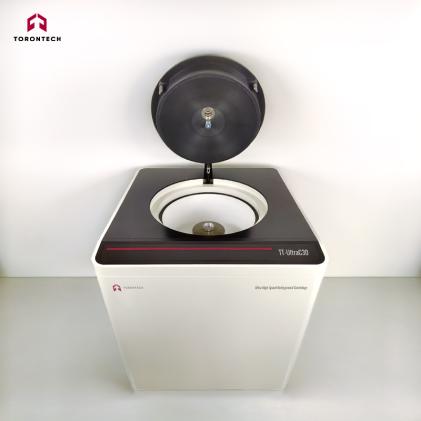
If you are done messing around and want a real-deal solution, our Torontech TT-UltraC30 Ultra-High Speed Refrigerated Centrifuge is basically the gold standard for floor units. It has everything you actually need:
- Maximum Velocity and Volume: Hits a wild 31,200 RPM and can hold 6 liters of sample at once.
- Automated Safety: It recognizes its own rotors, features an intelligent vacuum, and utilizes an AC Inverter Motor so it won't skyrocket your electric bill.
- Sample Flexibility: It works with a huge list of leak-proof rotors, from the No. 1 Angle Rotor for 24 x 1.5ml microtubes up to the No. 5 Angle Rotor for 6 x 50ml conical tubes.
At Torontech, we have been helping North American labs for more than two decades. We truly believe that great science shouldn't be blocked just because equipment costs are through the roof. We focus on providing cost-effective options and fresh tech ideas that actually work.
Ready to give your lab some serious muscle without draining the bank? Take a look at the TT-UltraC30 specs now, or get in touch with our team to talk about how we can help your research move a whole lot faster.
References
- Science. (1995). PRODUCTS & MATERIALS. Science, 269(5226), 996–997.
- Hall, J., Carlton, H., & Shipman, K. (2024). Benchtop centrifugation: An effective method for reducing lipaemia associated interference in grossly lipaemic samples?. Annals of Clinical Biochemistry, 62, 287–292.