ASTM C231 vs ASTM C173: Concrete Air Entrainment Guide
Getting entrained air right separates durable concrete from premature structural failure. Missing your target percentage triggers immediate financial fallout, from heavy pay penalties to rejected ready-mix trucks.
Selecting the best concrete air entrainment meter means matching your testing hardware to your specific aggregate, site weather, and agency specs. Below is our direct guide to governing standards, field data, and dependable equipment.
Key Takeaways
- Aggregate geology governs testing protocol: dense, normal-weight stone requires ASTM C231 (Type B), while lightweight or highly porous aggregates strictly mandate ASTM C173 (Volumetric).
- Published field data confirms that Type B pressure meters systematically indicate approximately 0.6% to 0.75% higher air content than volumetric meters on the identical concrete batch.
- That 0.7% inter-method spread carries serious financial consequences inside tight state DOT and Canadian provincial acceptance windows.
- Type B pressure testing offers substantial cycle-time efficiency, finishing in 5 to 8 minutes compared to 15 to 20 minutes for volumetric testing.
- Hardware selection should solve operational challenges directly, including sub-zero batch temperatures, high mountain elevations, and digital inspection records.
Aggregate Compatibility: ASTM C231 vs ASTM C173
The primary factor dictating whether you select a Type B pressure meter or a volumetric unit is how dense or porous your coarse and fine aggregates happen to be.
ASTM C231: Type B Pressure Method
The Type B air meter operates via Boyle's Law: a predetermined volume of air at a calibrated initial pressure discharges from an upper chamber into a sealed sample bowl filled with fresh mix. The drop in pressure displayed on the gauge correlates directly with the volume of air compressed within the paste. Standard ready-mix production across the US Midwest and the Canadian Prairies relies heavily on dense crushed dolomite, limestone, or glacial gravel, establishing the Type B pressure meter as the universal daily choice throughout these areas.
However, the pressure approach is built specifically for concrete containing dense aggregates and is unsuited for lightweight or highly porous aggregates. The core physics assumes stone particles will not compress under standard test pressure. When porous aggregates are introduced, air pressure forces water into internal rock cavities, compressing air pockets hidden deep inside the stone itself.
This produces a falsely elevated air reading on the gauge face, even after applying aggregate correction factor calculations. In our view, attempting to force ASTM C231 onto porous aggregate batches while relying on theoretical correction math introduces unnecessary risk; we believe specifying ASTM C173 from project inception is simply sound engineering practice.
ASTM C173: Volumetric Method
The volumetric approach (commonly designated the Roll-a-Meter method) determines air volume by physically washing air free from a concrete sample using tap water and 70% isopropyl alcohol. Once the vessel is clamped, an operator inverts, shakes, and rolls the apparatus through repeated cycles to liberate air bubbles from the mortar paste.
Under ASTM C173, rolling cycles must continue until two consecutive readings agree within 0.25% air, and the liquid column is considered stable only when the fluid level shifts by no more than 0.25% air over a 2-minute period. This standardized stabilization criterion explains why volumetric field testing requires a 15 to 20 minute cycle.
This procedure functions on any concrete batch, but it is explicitly recommended and widely enforced for lightweight aggregate concrete where the pressure method is inapplicable. For instance, across major urban regions like New York, Chicago, Toronto, and Vancouver, structural lightweight concrete incorporating expanded shale, slate, or clay is regularly specified for suspended high-rise floor slabs and bridge decks to reduce dead load, turning ASTM C173 (or its Canadian counterpart CSA A23.2-7C) into a strict contractual requirement.
Likewise, for heavy industrial paving around the Great Lakes basin and southern Ontario, mixes manufactured with blast-furnace slag carry elevated water absorption that distorts pressure readings, requiring volumetric verification instead. Because it depends on physical rinsing and liquid displacement rather than air pressure, internal stone porosity cannot alter your final percentage.
Given these differing operating mechanisms, academic and field evaluations confirm that these two procedures cannot simply substitute for one another on a single concrete batch, with aggregate geology being the governing criterion.
Operational Performance and Empirical Research
In fast-paced quality control environments, testing speed, procedural nuances, and technician repeatability must be evaluated against strict inspector acceptance limits.
Systematic Offsets and Agency Tolerances
Over 15 consecutive years of parallel field checks conducted from 1990 to 2008 within the FHWA Highway Materials Engineering Course, Type B pressure meters consistently recorded higher air percentages than volumetric units, averaging readings approximately 0.6% to 0.75% higher on the identical batch of fresh concrete.
Complementary field investigations corroborate this exact pattern, observing that true air content almost invariably settles in the intermediate space: sitting below the pressure meter readout and resting above the volumetric figure, with both displaying comparable precision and accuracy on normal-weight concrete. Both meter styles demonstrated a standard deviation of about 0.75% air across simultaneous trials, translating to an operational spread of plus or minus 1.5% at a 95% confidence level.
That variance carries major contractual consequences when evaluated against standard North American mix requirements. Under ACI 318, target air content is inversely proportional to aggregate size, meaning larger coarse aggregates require lower total air volumes:
Target Air Content by Aggregate Size and Exposure Class (General Industry Standard: ACI 318)
| Nominal Maximum Aggregate Size | Moderate Exposure (F1) | Severe / Deicer Exposure (F2, F3) |
|---|---|---|
| 3/8 in. (9.5 mm) | 6.0% | 7.5% |
| 1/2 in. (12.5 mm) | 5.5% | 7.0% |
| 3/4 in. (19.0 mm) | 5.0% | 6.0% |
| 1.0 in. (25.0 mm) | 4.5% | 6.0% |
| 1-1/2 in. (37.5 mm) | 4.5% | 5.5% |
| 2.0 in. (50.0 mm) | 4.0% | 5.0% |
| 3.0 in. (75.0 mm)* | 3.5% | 4.5% |
Note: ACI 318 permits air content targets to be reduced by 1.0 percentage point for specified compressive strengths at or above 5,000 psi (35 MPa). Aggregates exceeding 2.0 in. (50.0 mm) require wet-sieving over a 1.5 in. (37.5 mm) screen prior to testing in standard 7,000 mL Type B bowls.
These ACI parameters represent design mix targets, not equipment measurement limits. While mix targets decline with larger stone sizes, testing hardware must cover much wider operational bands; for instance, our ToronCAM units measure up to 10%, 14%, or 100% air content to capture batching over-doses and non-compliant mixes.
The practical conflict emerges when comparing these targets against agency acceptance windows. State transportation agencies (such as PennDOT, MnDOT, and NYSDOT) and Canadian provincial authorities (such as the Ontario Ministry of Transportation / MTO and Alberta Transportation under CSA A23.1) enforce strict acceptance windows, often set at target plus or minus 1.5%.
On a standard 3/4-inch mix requiring 5.0% air (acceptable range: 3.5% to 6.5%), a 0.6% to 0.75% systematic offset between a Type B pressure meter and a volumetric meter consumes up to half of your entire contractual tolerance window before factoring in sampling variation or batch stiffening.
In light of this documented spread, contract documents must explicitly define which test method governs rather than treating them as interchangeable. In our view, penalizing concrete suppliers over natural method-to-method variance runs counter to equitable quality assurance.
Correlation with Hardened Air Content
When comparing fresh air test results against microscopic air void analysis on hardened concrete (ASTM C457), published research demonstrates how testing environments influence correlation rankings. In field-placed concrete, researchers observed that Type B pressure meter readouts on fresh mix align closely with hardened air content for practical inspection purposes, whereas field-operated volumetric units generally report lower values than subsequent polished-section microscopic counts.
However, evaluating relative mathematical deviation under controlled laboratory conditions produced a different ranking. Across experimental batches, fresh air exceeded hardened air by 0.5% to 1.5% (particularly past 4% air), with the pressure meter showing an average relative discrepancy of 22% compared to 13% for the roller unit and 19% for the mini meter.
Rather than a direct contradiction, these findings demonstrate that correlation between fresh test methods and hardened air void structure is mix-dependent and varies between active jobsite placements and controlled laboratory trials. Note that these third-party studies evaluated baseline ASTM C231 and ASTM C173 methodologies across generic concrete batches, rather than commercial instrument tolerances.
Field Variables and Time-Dependent Loss
A significant portion of jobsite test scatter stems from concrete handling practices. Even though ASTM C172 advises technicians against sampling the initial or final discharge from a mixer drum because it is less representative, field staff routinely take material directly from the chute to make prompt placement decisions, introducing additional variance into test data. W
hile taking early discharge directly from the chute is a standard compromise for quick site decisions, we believe specification tolerances should realistically account for this field habit rather than presuming pristine laboratory procedures during placement.
Furthermore, volumetric air readings decline more quickly over elapsed time than pressure readings. That reduction is largely attributed to concrete stiffening, which increases the physical difficulty of washing air bubbles out of the paste during manual rolling cycles, compounded by technician fatigue.
Workflow Comparison: Type B Air Meter vs Volumetric
| Feature / Parameter | ASTM C231 (Type B Pressure Meter) | ASTM C173 (Volumetric Air Meter) |
|---|---|---|
| Standard Testing Equipment | Type B Pressure Meter (e.g., ToronCAM Series) | Volumetric Air Meter ("Roll-a-Meter") |
| Governing Specifications | ASTM C231, AASHTO T152, EN 12350-7, CSA A23.2-4C | ASTM C173, AASHTO T196 |
| Aggregate Compatibility | Dense, normal-weight stone only | All aggregates; mandatory for lightweight |
| Typical Testing Duration | 5 to 8 minutes | 15 to 20 minutes (requires extended rolling and settling) |
| Consumables / Liquids | Potable water (or dry-method on digital units) | Potable water plus 70% Isopropyl Alcohol (to dissipate foam) |
| Comparative Reading | Measures ~0.6% to 0.75% higher on average | Measures ~0.6% to 0.75% lower on average |
| Aggregate Correction Factor | Required; introduces an extra calibration step | Not required (direct neck reading minus alcohol correction) |
| Physical Effort | Simple, repeatable valve operation | Laborious inversion, shaking, and rolling |
| Standard Base Volume | 7,000 mL (7 Liters / 0.25 cu. ft.) | Minimum 2,100 mL (2.1 Liters / 0.075 cu. ft.) base bowl |
For commercial ready-mix concrete made with natural sand and crushed stone, the Type B pressure meter remains the preferred industry choice due to its rapid testing cycle, single-operator efficiency, and heavy-gauge metal construction.
Field Tooling and Verification Protocols
Even with established engineering principles, modern commercial meters require routine verification so that worn hardware does not introduce secondary errors into field testing. We frequently emphasize that even the sturdiest testing apparatus is only as dependable as pre-shift maintenance. In our assessment, skipping the daily initial pressure check or allowing abrasive cement paste to accumulate around brass petcocks accounts for most disputed site readings.
Required Testing Accessories
- Tamping Rod: A 5/8 in. (16 mm) diameter steel rod with a smooth hemispherical tip, required to consolidate fresh concrete in three equal layers (25 strokes each) without scratching the base bowl.
- Strike-Off Bar or Plate: A flat, rigid metal straightedge or thick acrylic plate used to level excess concrete flush with the rim of the 7,000 mL base.
- Rubber Mallet: Used to strike the exterior of the bowl 10 to 15 times per lift to close insertion voids and liberate coarse pockets of entrapped air.
- Bulb Syringe: Used to inject clean water through petcock valves to displace air above the struck concrete without disturbing the finished surface.
- Calibration Vessel and Tubes: Machined accessories required to verify upper pressure chamber accuracy against known air volumes.
Daily Verification Procedures
- Initial Pressure Line Check: Prior to testing on site, pressurize the upper air vessel to the initial calibration line. Tap the dial lightly; the needle must align precisely with the calibration mark.
- Water Fill Zero Verification: Regularly fill the 7,000 mL bottom bowl completely with water, secure the lid clamps, introduce water through the petcock valves until clean water flows bubble-free, and actuate the release valve to verify that the dial needle drops to zero percent air.
- Aggregate Correction Factor Determination: Subtract a predetermined correction factor from raw readings to offset stone compressibility, re-testing it whenever aggregate sources change. Note that under industry-wide ASTM C231 and AASHTO T152 standards for all pressure meters, complete recalibration must occur at intervals not exceeding three months.
- Seal Maintenance: Inspect the primary lid O-ring and valve seats consistently. Concrete slurry is abrasive; keeping petcock valves and mating surfaces free of build-up prevents pressure leakage during testing.
Equipment Selection Matrix: ToronCAM Series
Academic trials evaluate standardized methods in the abstract, but commercial testing agencies must deploy hardware capable of withstanding rough jobsite handling, wide temperature shifts, and heavy testing schedules.
Third-party research reflects baseline ASTM C231 and C173 performance across broad industry data rather than commercial brands. To address specific field challenges, our ToronCAM Series (standardized with a 7,000 mL base capacity) is structured to match diverse commercial requirements:
ToronCAM S: Standard Quality Control
Our cost-effective daily workhorse built for dependable compliance checks at ready-mix batch plants, municipal paving projects, and commercial testing facilities. It utilizes a direct-reading analog dial featuring 4 factory pre-calibrated initial pressure points, enclosed in a magnesium-aluminum-zinc alloy casting with copper operating valves.
- Key Specifications: Range: 0% to 10% | Accuracy: plus or minus 0.2% (0% to 4% range), plus or minus 0.25% (5% to 8% range), plus or minus 0.3% (9% to 10% range) | Capacity: 7,000 mL
- Standards Compliance: ASTM C231, AASHTO T152, EN 12350-7, CSA A23.2-4C
ToronCAM D: High-Volume Digital QC
Configured for commercial testing laboratories, precast yards, and fast-paced highway operations where rapid turnaround is vital. In our view, replacing an analog dial with an unmistakable digital screen represents a clear operational upgrade for high-throughput teams, largely because it eliminates subjective reading disputes between inspectors.
It utilizes an imported ceramic sensor and supports dry-method testing without water injection, reducing testing duration on every truckload. The package features a bilingual digital display, a leveling bubble, and a rechargeable lithium battery delivering up to 3 hours of continuous operation and 8 hours on standby.
- Key Specifications: Range: 0% to 10% (max less than or equal to 10%) | Test Error: Approx. plus or minus 0.0020% | Max Aggregate: less than or equal to 40 mm | Max Gauge Pressure: 0.2 MPa | Initial Pressure: 0.1000 plus or minus 0.0020 MPa (dry method: 0.1000 MPa) | Capacity: 7,000 mL
- Standards Compliance: ASTM C231, AASHTO T152, EN 12350-7, CSA A23.2-4C
ToronCAM UP: Extreme Temperature Operations
Specifically engineered for cold-weather placement under Canadian CSA A23.1 guidelines and winter road construction across northern US states (including Minnesota, Wisconsin, North Dakota, and Alaska). For cold-weather placement, we consider building temperature detection directly into the pressure vessel far more practical than requiring technicians to manage separate glass thermometers with cold hands.
The ToronCAM UP monitors concrete batch temperatures from -30 degrees C to 60 degrees C, while its precision pressure gauge is rated for operation between -20 degrees C and 40 degrees C (plus or minus 2 degrees C), meaning site teams facing ambient conditions below -20 degrees C should utilize a heated field shelter or enclosure to keep the gauge within its calibrated envelope. The gauge housing is dustproof, waterproof, and explosion-proof to handle challenging jobsite conditions.
- Key Specifications: Range: 0% to 10% working range (max scale up to 14%) | Accuracy: plus or minus 0.1% (0% to 4% range), plus or minus 0.12% (5% to 8% range), plus or minus 0.15% (9% to 10% range) | Temperature Detection: -30 degrees C to 60 degrees C | Gauge Rated Operating Temperature: -20 degrees C to 40 degrees C (plus or minus 2 degrees C) | Capacity: 7,000 mL | Materials: Magnesium alloy body with copper or stainless steel assemblies
- Standards Compliance: ASTM C231, AASHTO T152, EN 12350-7, CSA A23.2-4C
ToronCAM P: High-Altitude and Remote Sites
Configured for remote infrastructure and highway projects across the US Intermountain West (such as Colorado, Utah, and Wyoming) and the Canadian Rockies (Alberta and British Columbia).
Testing at 5,000 to 9,000+ feet introduces atmospheric pressure changes that typically demand continuous recalibration on traditional analog meters; the ToronCAM P features elevation-independent operation that remains unaffected by barometric shifts. Weighing approximately 10 kg, it incorporates a built-in manual hand pump and a quick-cover clamping system for easy transport across field locations, delivering accuracy of plus or minus 0.1% across the 1% to 5% range and plus or minus 0.2% across the 6% to 10% range.
- Key Specifications: Range: 0% to 100% | Accuracy: plus or minus 0.1% (1% to 5% range), plus or minus 0.2% (6% to 10% range) | Capacity: 7 liters (7,000 mL) | Weight: approximately 10 kg
- Standards Compliance: ASTM C231, AASHTO T152, EN 12350-7, CSA A23.2-4C
ToronCAM HP: High-Strength Mix Designs
Constructed for commercial testing laboratories and infrastructure projects evaluating high-performance structural designs, pre-stressed bridge girders, and heavily reinforced elements. Built with Japanese Sanyo sensing technology, this instrument is calibrated specifically to evaluate concrete strength classifications spanning C15 to C80 with high consistency, protected by an explosion-proof and dustproof gauge enclosure.
- Key Specifications: Range: 1% to 10% | Accuracy: plus or minus 0.1% | Strength Spectrum: C15 to C80 | Capacity: 7,000 mL | Materials: Magnesium alloy with copper or stainless steel components
- Standards Compliance: ASTM C231, AASHTO T152, EN 12350-7, CSA A23.2-4C
ToronCAM DM: Dual-Method Verification
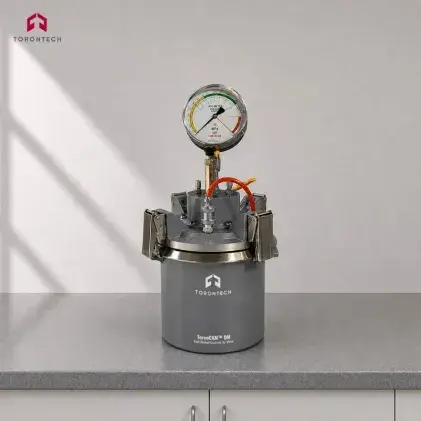
Engineered for commercial testing agencies and research facilities required to verify client concrete mixes against multiple procedural specifications. This versatile unit incorporates both Direct-Reading and Non-Direct Reading testing modes into a single instrument body, offering multi-method verification capability without requiring duplicate testing pots.
- Key Specifications: Range: 0% to 10% | Direct-Reading Accuracy: plus or minus 0.25% | Capacity: 7,000 mL | Materials: Magnesium alloy with copper or stainless steel hardware
- Standards Compliance: ASTM C231, AASHTO T152, EN 12350-7, CSA A23.2-4C
Mortar Air Testing: ToronMAM Series
When testing fine-aggregate mortars (Types S, N, and M), repair compounds, non-shrink grouts, or specialized calcium aluminate (CA) mortars, standard 7,000 mL concrete bowls are oversized. For these smaller batches, we manufacture the ToronMAM Series, featuring dedicated 1,000 mL (1-liter) vessels engineered specifically for the pressure-method procedures in ASTM C780 Annex A5 and EN 1015-7.
While ASTM C185 and AASHTO T137 define gravimetric protocols utilizing a 400 mL measure where air is calculated from mass and density, our ToronMAM pressure units deliver direct, on-site gauge readings for modern masonry and precast specifications:
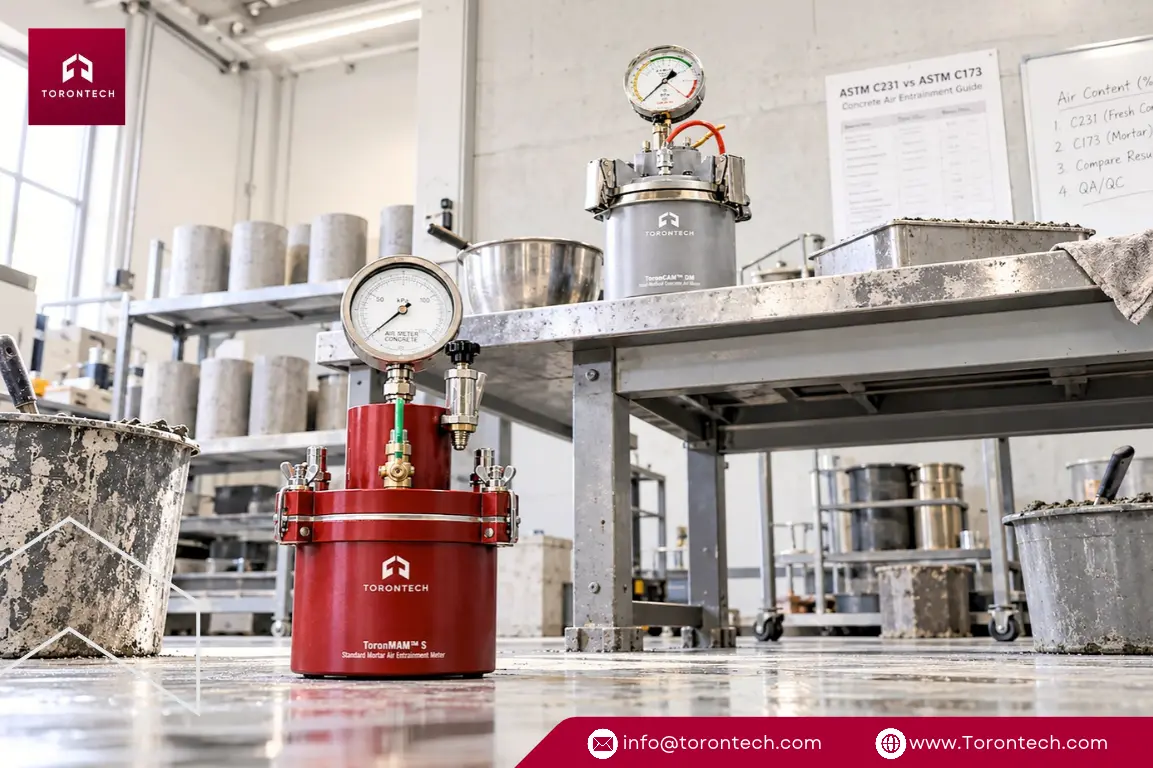
- ToronMAM S (Standard): Single direct-reading pressure unit featuring a 0% to 20% range, tiered accuracy of plus or minus 0.1% (0% to 6% range) and plus or minus 0.2% (7% to 20% range), and a sealed 1,000 mL bowl for standard mortar testing.
- ToronMAM P (Precision): Engineered for field durability featuring a pure 304 stainless steel pressure gauge, an integrated air pump, and a pressure gauge lock mechanism that stops pressure bleed. Delivers a 0% to 20% range (plus or minus 0.1% accuracy for 0% to 6%, plus or minus 0.2% for 7% to 20%) with a lightweight profile of approximately 3.2 kg.
- ToronMAM WR (Wide-Range): Uses German sensing technology and a heavy-duty press-type snap buckle. Features an explosion-proof, dustproof, and waterproof gauge covering an extended 0% to 100% range with an overall weight of approximately 6 kg.
- ToronMAM D (Digital): Digital direct-reading mortar meter built with German sensing technology, a digital display screen, and a press-type snap buckle. Delivers a 0% to 100% range with tiered accuracy of plus or minus 0.1% (0% to 5% range), plus or minus 0.15% (6% to 20% range), and plus or minus 0.2% (21% to 100% range), weighing approximately 6.2 kg.
Upgrade Testing Precision with Torontech
Aggregate physics dictates your test method: run ASTM C173 volumetric units for lightweight or porous stone, and deploy ASTM C231 Type B pressure meters for normal gravel and sand. As a US and Canadian manufacturer, Torontech supplies cost-effective testing equipment built for harsh field conditions and strict agency compliance.
Contact our engineering team today to review your specifications and receive a formal quote.
References (Click to expand)
- Crouch, L. K., Honeycutt, K., Dunn, T., Maxwell, R., Huo, S., & Goodwin, W. A. (2002). Comparison of AASHTO Plastic PCC Air Determination Techniques.
- Hover, K. (2013). Observed Variability in Tests of Fresh Concrete Properties from the FHWA Highway Materials Engineering Course. Transportation Research Record, 2342, 61-75.
- Kett, I. (2009). Air Content of Freshly Mixed Concrete by the Pressure Method (C 231). In Concrete Design and Technology (pp. 109-114).
- Khayat, K., & Nasser, K. (1991). Comparison of Air Contents in Fresh and Hardened Concretes Using Different Airmeters. Cement Concrete and Aggregates, 13(1), 18-24.
- Ozyildirim, C. (1991). Comparison of the Air Contents of Freshly Mixed and Hardened Concretes. Cement Concrete and Aggregates, 13(1), 11-17.