
Zorba Scrap Recycling Line
The Zorba Scrap Recycling Line upgrades zorba (the shredded aluminum-dominant non-ferrous scrap grade produced by ASR and metal recycling operations) into high-purity aluminum ingot feedstock and segregated heavy-metal byproducts. The system serves aluminum smelters, secondary aluminum ingot manufacturers, and non-ferrous concentrate processors that buy zorba as raw material and sell alloy-graded aluminum downstream.
The Zorba Scrap Recycling Line is built around a polishing drum that removes the surface oxide layer from every particle before sorting. Zorba arriving at the plant is dull, oxidized, and often coated with paint or dirt, so visual sorting quality drops as operators struggle to distinguish aluminum from brass, copper, and mixed alloys. The polishing drum abrades each piece against the others under controlled tumbling action, exposing bright metallic surfaces that both operators and optical sensors can classify reliably. A trommel screen then sizes the polished material for optimal sorting, and multi-lane manual stations upgrade the aluminum concentrate to alloy-graded purity.
The line handles typical throughput from 3 to 12 t/h and can be extended with sensor-based sorting modules (X-ray transmission for heavy-metal ejection, LIBS for alloy grading, optical for color-based fine sorting) when the customer's purity target requires it. Standard configuration matches the ISRI zorba grade specification and typical secondary aluminum smelter feedstock requirements.
Applications
The Zorba Scrap Recycling Line targets aluminum-heavy non-ferrous scrap streams that require upgrade into smelter-grade or alloy-grade concentrate.
- Zorba Upgrading to Ingot Feedstock: converts ISRI zorba into aluminum concentrate ready for secondary smelting into ingot
- Twitch Sorting and Upgrading: refines twitch (higher-aluminum-content zorba variant) into alloy-graded aluminum
- Secondary Aluminum Smelter Preparation: delivers polished, sized, sorted aluminum concentrate for remelt operations
- ASR Downstream Refinement: upgrades the non-ferrous concentrate output from ASR pre-sorting plants
- Non-Ferrous Scrap Concentrator Operations: refines mixed non-ferrous concentrates into aluminum, brass, copper, and stainless fractions
- Aluminum Ingot Manufacturing: prepares alloy-graded aluminum for closed-loop ingot production
- Heavy-Metal Byproduct Recovery: isolates brass, copper, zinc, and lead-bearing fractions for separate downstream sale
Theory and Method
Zorba is defined by ISRI as shredded non-ferrous scrap dominated by aluminum but containing brass, copper, zinc, magnesium, stainless steel, and other non-ferrous metals. The material arrives from ASR pre-sorting or eddy current concentrate streams already reduced in size and largely stripped of ferrous content. Upgrading zorba to a marketable aluminum concentrate requires two things: exposing the true metallic surface of each particle so it can be identified visually or by sensor, and separating the particles into aluminum and non-aluminum fractions.
Surface polishing comes first. Zorba particles arrive coated with oxide layers, paint residue, rubber marks, and shredder dirt that mask their true color and reflectivity. Inside the polishing drum, particles tumble against each other under controlled rotation. Particle-to-particle friction abrades the oxidized surface layer, so each piece emerges with bright, distinguishable metallic finish. Aluminum shows its characteristic silver-white color, brass shows yellow, and copper shows red-orange, making visual and optical sorting far more accurate than before polishing.
The polished material then passes through a rotary trommel screen that splits it into size fractions for optimal downstream sorting. Multi-lane manual sorting stations follow, with operators standing at picking conveyors to identify and remove non-aluminum particles from each fraction. Bright aluminum passes through to the finished product bin, while brass, copper, stainless, and mixed alloys are hand-picked into separate byproduct bins. The final aluminum concentrate meets purity levels required by secondary smelters, typically 95 to 99 percent depending on operator skill and staffing density. Sensor-based sorting stages (X-ray transmission, LIBS, or optical color sorters) can be added downstream when higher throughput or automated purity control is required.
Key Features
The line integrates polishing, screening, and manual sorting under a single PLC control system, with sensor-based sorting available as an add-on module.
Apron Feeder
The heavy-duty apron feeder receives zorba from a wheel loader or storage bunker and meters it onto the infeed conveyor at a controlled rate. Its self-scraping chain-plate design handles mixed particle sizes and moderate contamination without bridging or manual intervention.
- Function: primary bunker discharge and metering feed
- Design: heavy-gauge steel chain plates with self-cleaning scraper
- Feed handling: not limited by particle size, density, or moisture
Polishing Drum
The polishing drum removes the surface oxide layer from every particle in the zorba stream. A large rotating drum tumbles particles against each other under controlled speed and residence time, and the resulting particle-to-particle friction abrades the oxidized surface, exposing bright metallic finish. The drum interior is lined with wear-resistant material to withstand the continuous abrasive action.
- Function: surface oxide removal and metallic finish exposure
- Operating principle: particle-to-particle friction under controlled tumbling
- Interior: wear-resistant lining for continuous abrasive service
- Output: bright, distinguishable particles ready for visual and optical sorting
- Benefit: dramatically improves accuracy of both manual and sensor-based sorting downstream
Trommel Screen
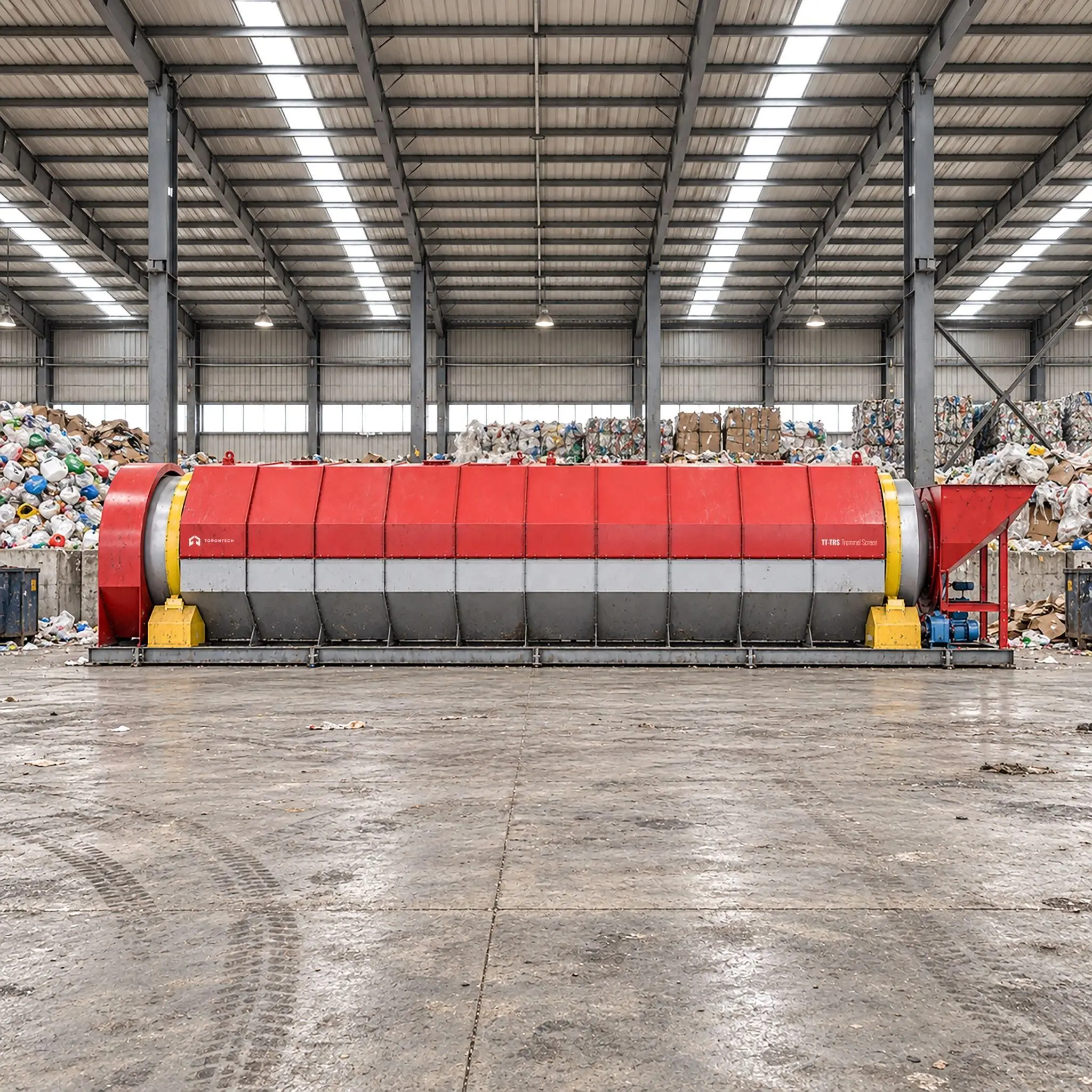
The rotary trommel screen classifies the polished material into size fractions for optimal downstream sorting. Wear-resistant screen panels and a shaft-less drive extend service life on the mixed non-ferrous stream.
- Screen material: wear-resistant alloy panels
- Drum options: hexagonal or cylindrical, custom aperture sizes
- Drive: polyurethane driving system, low noise, no-shaft design
Trommel Screen Specifications:
| Model | Power (kW) | Drum Diameter (mm) | Drum Length (mm) | Capacity (m³/h) | Speed (r/min) | Inclination (%) |
|---|---|---|---|---|---|---|
| TT-TRS-1220 | 4.0 | Ø1200 | 2000 | 12 | 5 to 25 | 0 to 6 |
| TT-TRS-1240 | 5.5 | 4000 | 18 | |||
| TT-TRS-1260 | 5.5 | 6000 | 20 | |||
| TT-TRS-1290 | 7.5 | 9000 | 35 | |||
| TT-TRS-1560 | 7.5 | Ø1500 | 6000 | 35 | ||
| TT-TRS-1590 | 11 | 9000 | 50 | |||
| TT-TRS-15120 | 18.5 | 12000 | 65 | |||
| TT-TRS-1860 | 11 | Ø1800 | 6000 | 50 | ||
| TT-TRS-1890 | 18.5 | 9000 | 65 | |||
| TT-TRS-18120 | 22 | 12000 | 75 | |||
| TT-TRS-2060 | 18.5 | Ø2000 | 6000 | 65 | ||
| TT-TRS-2090 | 22 | 9000 | 75 | |||
| TT-TRS-20120 | 30 | 12000 | 85 |
Manual Sorting Station
Multi-lane manual sorting stations provide the primary upgrade stage in a standard zorba line. Operators standing at picking conveyors identify each particle by color and shape (aluminum white, brass yellow, copper red-orange, stainless dull grey) and remove non-aluminum particles into designated bins. The bright metallic finish produced by the polishing drum makes this identification accurate and repeatable.
- Function: manual upgrade of aluminum concentrate by visual classification
- Configuration: multi-lane picking conveyors with side-discharge bins
- Operator positions: adjustable for one to twelve operators per line depending on throughput target
- Byproducts recovered: brass, copper, stainless steel, mixed alloys (each to separate bin)
- Aluminum concentrate purity: typically 95 to 99% depending on operator skill and staffing
Optional Sensor-Based Sorting Add-Ons
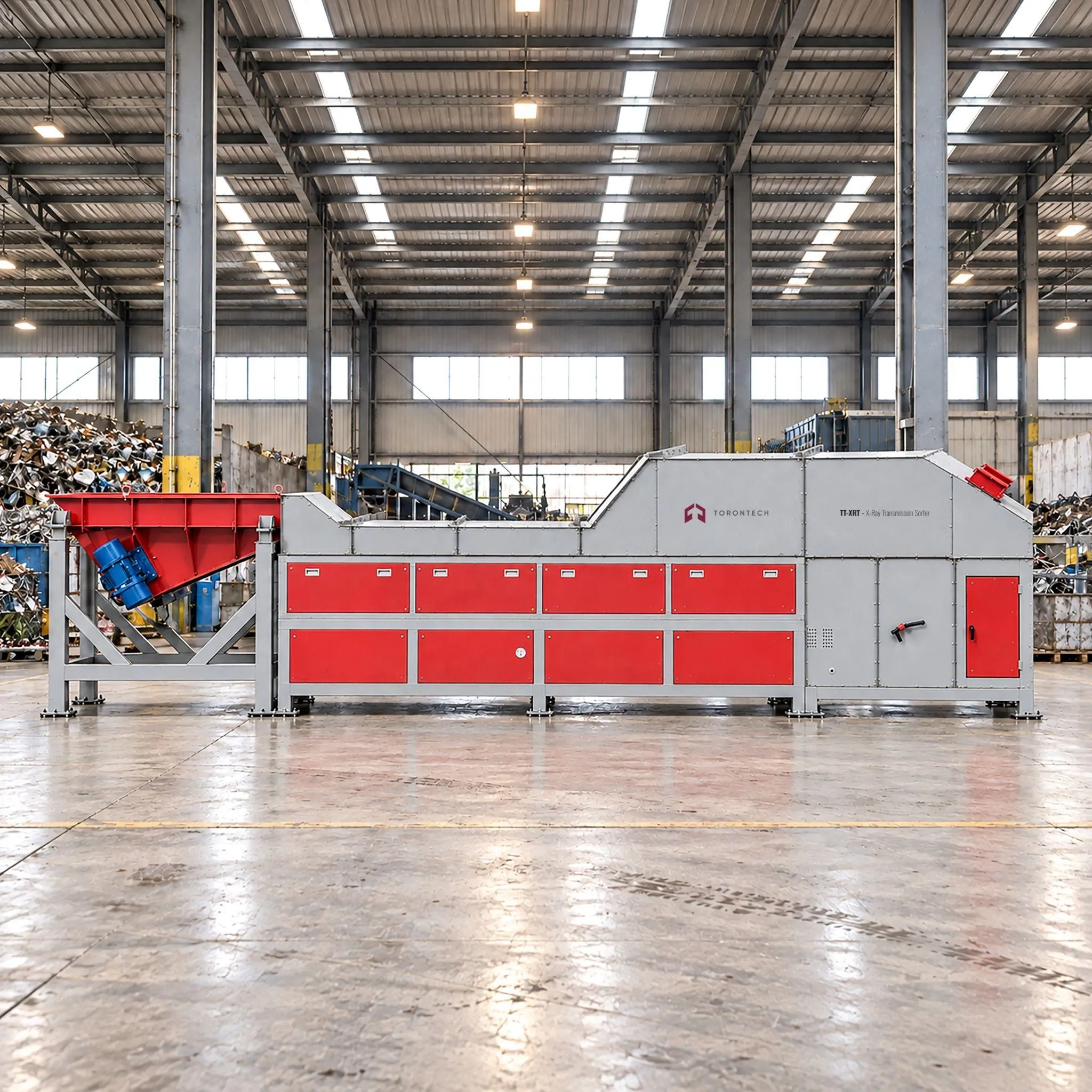
For higher throughput or automated purity control, sensor-based sorting modules can replace or supplement the manual stations.
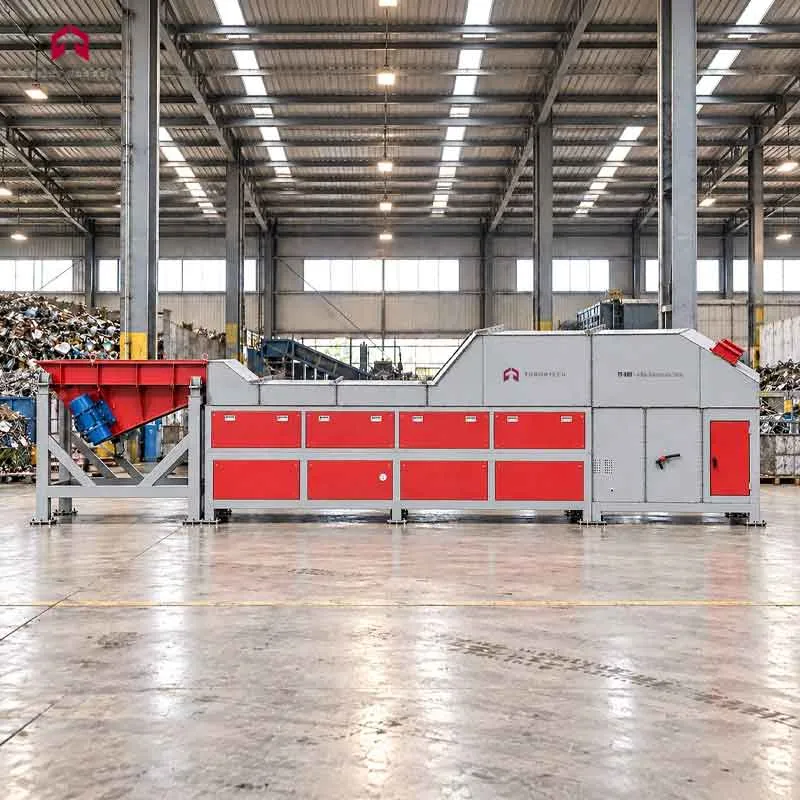
- X-Ray Transmission Sorter (TT-XRT Series): ejects heavy metals (copper, lead, brass) by atomic-density detection
- LIBS Sorter: classifies aluminum alloys by elemental composition, enabling cast-vs-wrought and series-specific separation
- Optical Color Sorter (AI-Powered): uses high-resolution cameras and machine-learning classifiers for color-based separation of polished particles
Discharge and Collection Bins
Dedicated collection bins receive each output fraction at designated discharge points: finished aluminum concentrate, brass byproduct, copper byproduct, stainless fraction, mixed tailing, and any oversize or undersize splits from the trommel. Bin size and position are configured to match the site layout and downstream handling equipment.
- Function: fraction collection at each discharge point
- Configuration: multiple bins per output fraction as needed for throughput
- Handling: sized for forklift, skid steer, or wheel-loader offload
Chain Apron Conveyor and Belt Conveyors
Chain apron conveyors handle post-polishing transfer where residual abrasive fines can wear belt covers, while belt conveyors handle the lighter-duty transfers between screen, manual stations, and sensor sorters. All conveyors are integrated into the central PLC control system.
- Chain apron function: high-abrasion post-polishing transfer
- Belt conveyor function: light-duty inter-stage transfer
- Integration: full PLC coordination and safety interlocks
Electrical Control System
The line runs under a single PLC control system with automatic overload reverse control, interlock logic, and an operator HMI. All motors, drums, sensors, and pneumatic actuators are wired to the central cabinet for coordinated operation and remote diagnostics.
- Controller: PLC-based programmable control
- Protection: automatic overload reverse, safety interlocks across the full line
- Interface: HMI touchscreen with process-status visualization
Technical Specifications
The Zorba Scrap Recycling Line is engineered around the customer's zorba composition, throughput target, and output purity requirement. Optional sensor-based sorting modules extend the line for higher-purity or higher-throughput operation.
| Parameter | Specification |
|---|---|
| Line Focus | Zorba upgrading to aluminum concentrate and segregated heavy-metal byproducts |
| Typical Throughput Range | 3 to 12 t/h (customer-specific) |
| Input Material | ISRI zorba, twitch, mixed non-ferrous concentrate from ASR or ECS output |
| Aluminum Concentrate Purity | 95 to 99% (manual station configuration, sensor-assisted higher) |
| Surface Preparation Stage | Polishing drum with particle-to-particle friction abrasion |
| Size Classification | Rotary trommel screen |
| Primary Sorting Stage | Multi-lane manual picking station |
| Optional Sensor Sorting | X-ray transmission, LIBS, optical color (add-on modules) |
| Output Fractions | Aluminum concentrate, brass, copper, stainless, mixed tailing, size fractions |
| Control System | PLC with HMI touchscreen, full-line interlocks |
| Installation Options | Skid-mounted modules or civil-work integrated |
| Power Supply | 380 V / 50 Hz (customer voltage available on request) |
Each line is configured to the customer's specific zorba profile and downstream smelter requirements. Contact the Torontech application engineering team for a site-specific process flow diagram and quotation.