
Automotive Shredder Residue (ASR) Pre-Sorting Line
The Automotive Shredder Residue (ASR) Pre-Sorting Line recovers valuable ferrous, non-ferrous, and stainless-steel fractions from the residual output of automotive shredders serving end-of-life vehicle (ELV) recyclers, scrap yards, and metal recovery facilities. The system processes damp, mixed shredder tailings that typically contain iron fines, copper wire, aluminum shreds, glass, foam, dust, and plastic fragments left behind after the main heavy metal separation stage.
The Pre-Sorting Line combines coarse-fraction screening, fine-fraction screening, air classification, magnetic separation, and sensor-based sorting into one integrated flow. This layered approach lifts overall recovery yield on the residual stream, so operators can send cleaner metal concentrate to downstream buyers and reduce the volume of material sent to landfill or thermal disposal.
The line supports both online (in-line with the shredder) and offline (standalone batch) configurations. Customer-specific throughput ranges from roughly 1 t/h for small operators up to over 20 t/h for large-scale ELV processors, with each configuration engineered around the specific input material characteristics.
Applications
The Pre-Sorting Line targets the residual output stream from automotive and industrial shredders, delivering clean metal concentrates for downstream smelting and reprocessing.
- End-of-Life Vehicle (ELV) Recycling: recovers residual copper, aluminum, brass, and stainless steel from car shredder fluff after primary ferrous separation
- Auto Shredder Residue (ASR) Reclamation: converts landfill-bound shredder tailings into salable non-ferrous metal fractions and cleaned light residue
- Metal Recycling Facilities: upgrades scrap yard residue streams to recover fine and mid-fraction metals missed by primary sorting
- Waste Electrical and Electronic Equipment (WEEE) Processing: separates copper wire, aluminum housings, and mixed circuit-board fragments from shredded e-waste
- Municipal Solid Waste (MSW) Bottom Ash: recovers metals from incinerator bottom ash and mixed residual waste streams
- Non-Ferrous Metal Concentrators: delivers high-purity copper, aluminum, and stainless-steel fractions to smelters and refiners
- Refuse-Derived Fuel (RDF) Preparation: removes metal contamination from mixed waste destined for RDF production
Theory and Method
ASR pre-sorting relies on the fact that automotive shredder residue is a heterogeneous mix in which each component has a different combination of size, density, magnetic susceptibility, electrical conductivity, and spectral signature. No single separation principle recovers all valuable material, so the line applies several physical and sensor-based methods in sequence, with each stage targeting one property.
Mechanical screening comes first. A rotary trommel splits the raw feed into coarse and fine fractions by particle size, and a flip-flow screen handles the small, damp, and sticky fraction that would blind conventional screens. The sized material then enters air classification, where a rising airstream lifts low-density light fractions (foam, film, textile fibers) away from heavier valuable material by exploiting differences in terminal settling velocity.
Ferromagnetic material is removed next by overband and drum magnets, since iron and steel respond strongly to a magnetic field while all other components do not. The non-ferrous concentrate then passes through an eccentric eddy current separator, which generates a high-frequency alternating magnetic field. Conductive non-ferrous metals such as aluminum, copper, and brass have induced eddy currents that produce a repulsive Lorentz force, throwing them off the belt trajectory while non-conductive material falls straight down. Finer or more difficult fractions are then upgraded by sensor-based sorters (electromagnetic induction, X-ray transmission, LIBS, and optical/color) that identify individual particles by conductivity, atomic density, elemental composition, or color and eject them with compressed-air valves.
Key Features
The line integrates all sorting stages under a single PLC control system, with each module optimized for the specific fraction it handles.
Apron Feeder
The heavy-duty apron feeder receives raw ASR material from a wheel loader or storage bunker and meters it onto the line at a controlled rate. Its self-scraping chain-plate design handles wet, oversized, and awkwardly shaped input without bridging or manual intervention.
- Function: primary bunker discharge and metering feed
- Design: heavy-gauge steel chain plates with self-cleaning scraper
- Feed handling: not limited by particle size, density, or moisture
Trommel Screen
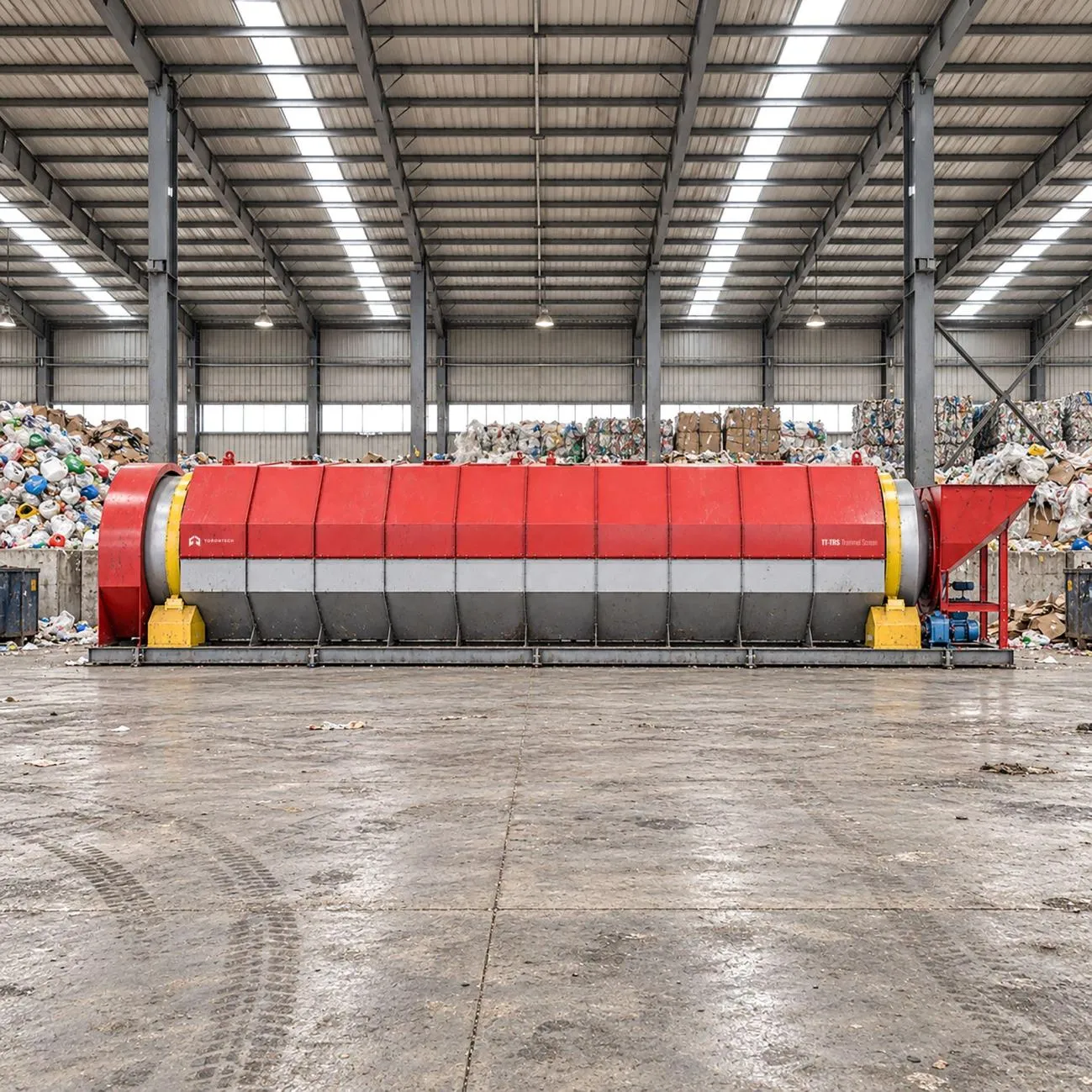
The rotary trommel screen provides the first size classification, splitting the raw feed into oversize (returned for re-shredding or hand-picking) and undersize (sent to fine-sorting stages). Wear-resistant screen panels and a shaft-less drive extend service life on abrasive shredder residue.
- Screen material: wear-resistant alloy panels
- Drum options: hexagonal or cylindrical, custom aperture sizes
- Drive: polyurethane driving system, low noise, no-shaft design for complex waste
Trommel Screen Specifications:
| Model | Power (kW) | Drum Diameter (mm) | Drum Length (mm) | Capacity (m³/h) | Speed (r/min) | Inclination (%) |
|---|---|---|---|---|---|---|
| TT-TRS-1220 | 4.0 | Ø1200 | 2000 | 12 | 5 to 25 | 0 to 6 |
| TT-TRS-1240 | 5.5 | 4000 | 18 | |||
| TT-TRS-1260 | 5.5 | 6000 | 20 | |||
| TT-TRS-1290 | 7.5 | 9000 | 35 | |||
| TT-TRS-1560 | 7.5 | Ø1500 | 6000 | 35 | ||
| TT-TRS-1590 | 11 | Ø1500 | 9000 | 50 | ||
| TT-TRS-15120 | 18.5 | 12000 | 65 | |||
| TT-TRS-1860 | 11 | Ø1800 | 6000 | 50 | ||
| TT-TRS-1890 | 18.5 | 9000 | 65 | |||
| TT-TRS-18120 | 22 | 12000 | 75 | |||
| TT-TRS-2060 | 18.5 | Ø2000 | 6000 | 65 | ||
| TT-TRS-2090 | 22 | Ø2000 | 9000 | 75 | ||
| TT-TRS-20120 | 30 | Ø2000 | 12000 | 85 |
Flip-Flow Screen
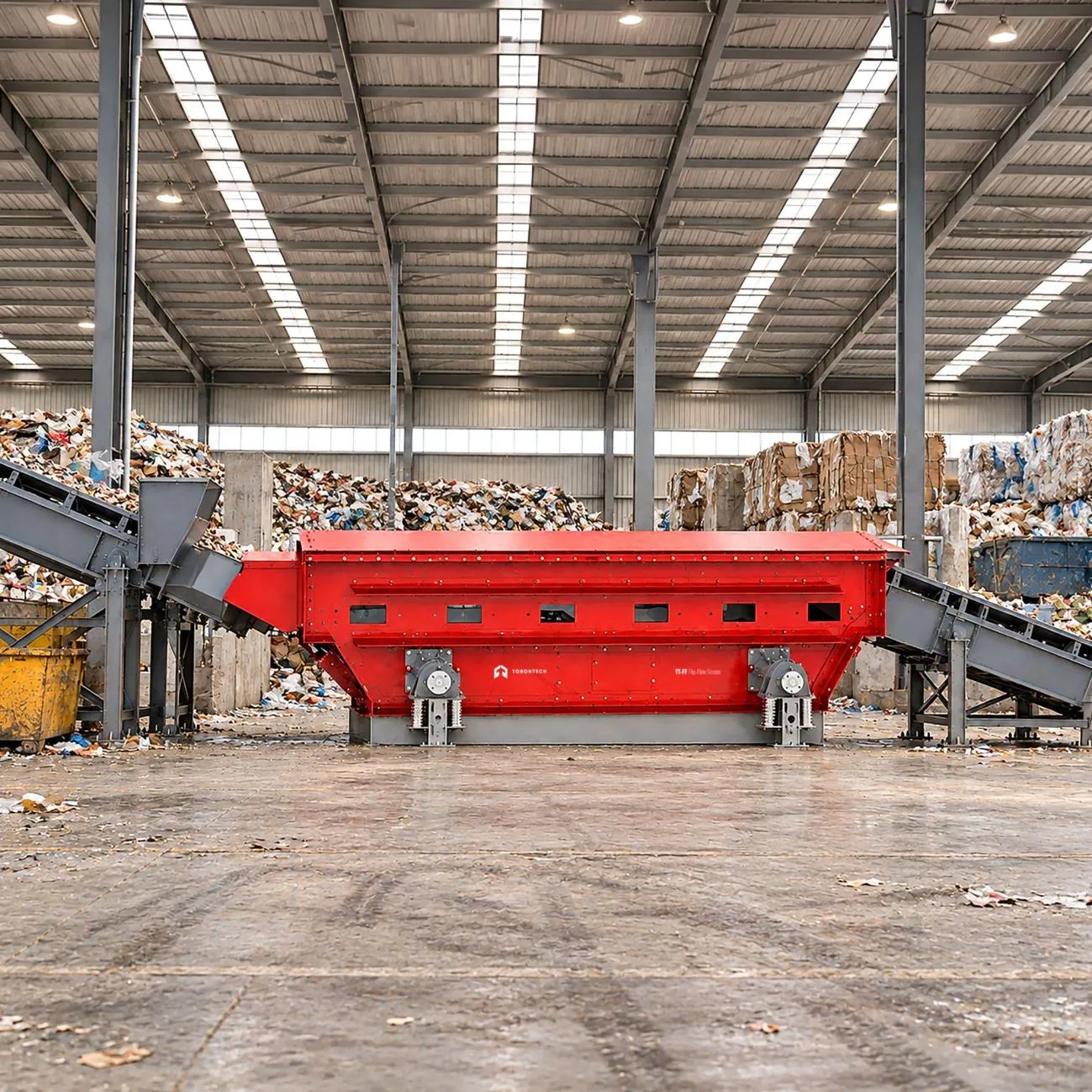
The flip-flow screen handles the damp, sticky, and film-heavy fine fraction that blinds conventional screens. Flexible polyurethane screen panels are stretched and released ("flip-flow" action) by the vibrating drive, which throws material clear at high acceleration and prevents mesh blinding.
- Application: fines separation on wet, sticky, or fibrous material
- Screen deck: elastic polyurethane panels
- Anti-blinding: dynamic stretch-release action across the deck
Vertical Air Separator
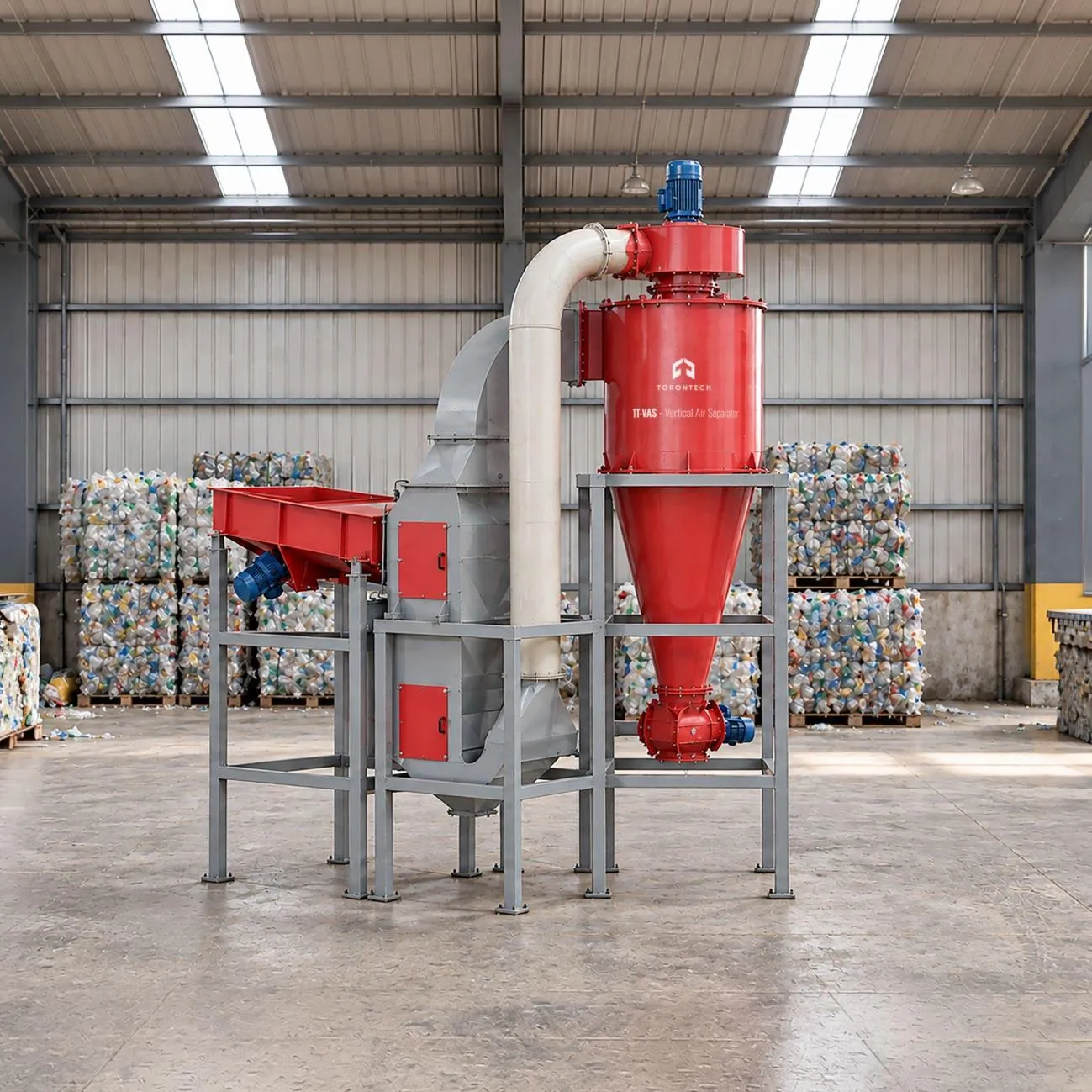
The vertical air separator removes light fractions (film, foam, dust, textile fibers) from the sized material by suspending them in a rising airstream while heavier valuable material falls through a Z-shaped chute. A vibratory feeder distributes material evenly into the Z-hopper, a centrifugal fan draws the light and dusty particles upward into a cyclone dust collector, and the heavier fraction drops by gravity into the discharge for downstream metal sorting.
Vertical Air Separator Specifications:
| Model | Air Blower | Feed Valve | Light Material Valve | Dust Valve | Capacity (t/h) |
|---|---|---|---|---|---|
| TT-VAS-43 | 20 to 30 HP | 2 HP | 2 HP | 2 HP | 4 to 5 |
| TT-VAS-86 | 40 HP | 3 HP | 1.5 HP | 3 HP | 8 to 10 |
- Function: light-fraction removal and dust extraction
- Design: Z-hopper vibratory feed, centrifugal fan, cyclone dust collector
- Output: clean, densified fraction ready for downstream metal sorting
Permanent Overband Magnet (Self-Cleaning)
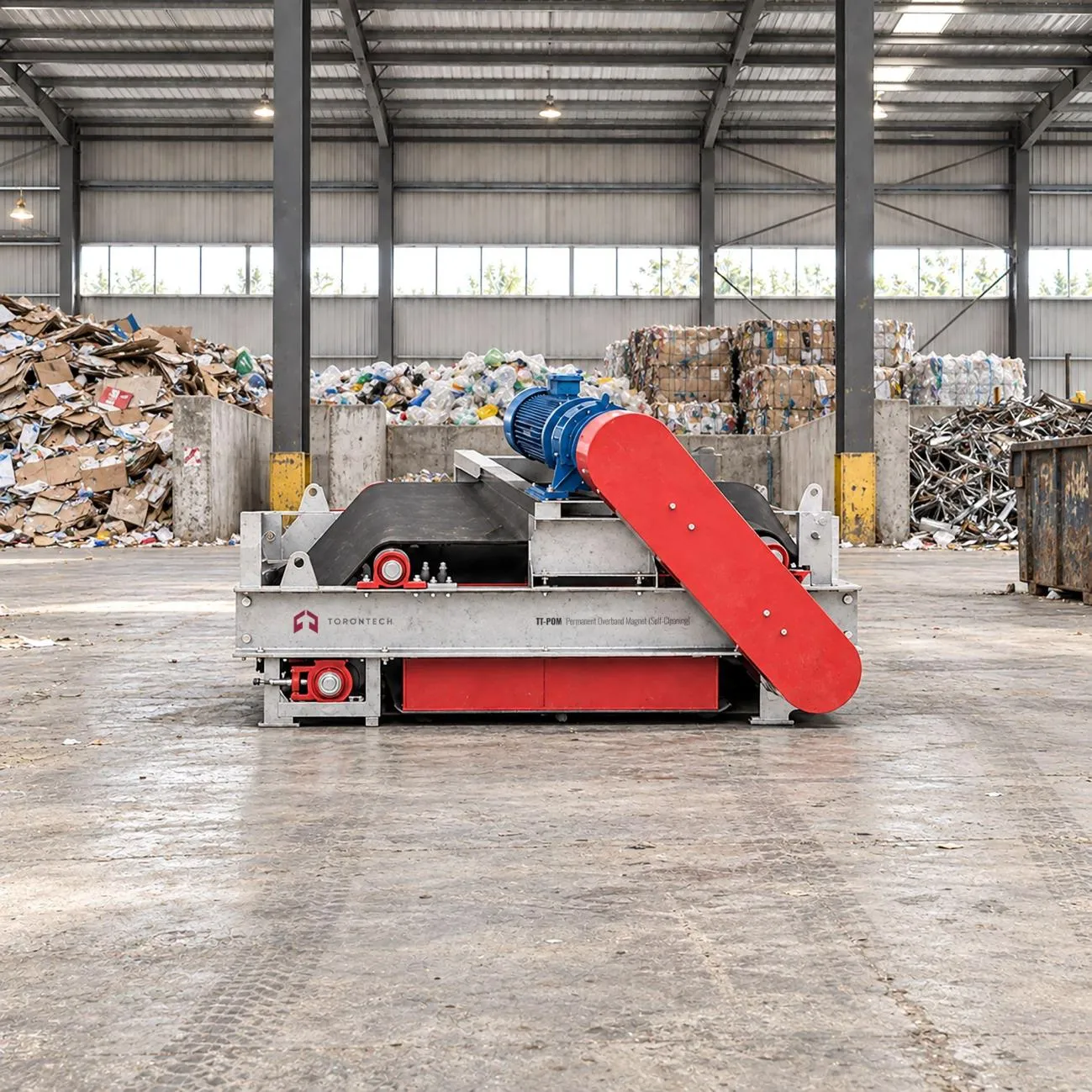
The self-cleaning permanent overband magnet suspends above the conveyor belt and removes ferrous metals from the material stream continuously. Rare-earth NdFeB magnets deliver strong, stable field intensity without coil power or cooling, and a dedicated self-cleaning belt discharges captured iron to a side chute so operators never need to shut down for magnet cleaning.
- Function: continuous ferrous removal from mixed stream
- Magnet type: high-performance NdFeB (rare earth), no external excitation power required
- Structure: double-pole magnetic circuit, waist drum-shaped frame with automatic belt tracking
- Sealing: fully sealed bearings adapt to dusty, wet, or corrosive environments
- Operation: self-cleaning belt for continuous, unattended iron discharge
Permanent Overband Magnet Specifications:
| Model | Suitable Belt Width (mm) | Material Thickness (mm) | Suspended Height (mm) | Magnet Intensity | Power (kW) | Belt Speed | Overall Dimensions L×W×H (mm) | Ring Center Distance (mm) | Weight (kg) |
|---|---|---|---|---|---|---|---|---|---|
| TT-POM-5 | 500 | 80 | 150 | 63 mT | 1.5 | ≤2.5 m/s | 1650 × 835 × 940 | 1100 × 635 | 580 |
| TT-POM-6 | 600 | 125 | 200 | 1700 × 835 × 940 | 1150 × 735 | 700 | |||
| TT-POM-6.5 | 650 | 150 | 200 | 1750 × 985 × 940 | 1200 × 785 | 700 | |||
| TT-POM-8 | 800 | 200 | 250 | 70 mT | 2.2 | 1900 × 1140 × 960 | 1350 × 935 | 820 | |
| TT-POM-10 | 1000 | 250 | 300 | 70 mT | 3.0 | 2140 × 1350 × 1010 | 1590 × 1135 | 1220 | |
| TT-POM-12 | 1200 | 300 | 350 | 70 mT | 4.0 | 2340 × 1550 × 1060 | 1790 × 1335 | 1420 | |
| TT-POM-14 | 1400 | 350 | 400 | 70 mT | 5.5 | 2540 × 1750 × 1060 | 1990 × 1535 | 1730 | |
| TT-POM-16 | 1600 | 400 | 450 | 70 mT | 7.5 | 3040 × 1550 × 860 | 2190 × 1335 | 2140 |
Magnetic Drum Separator
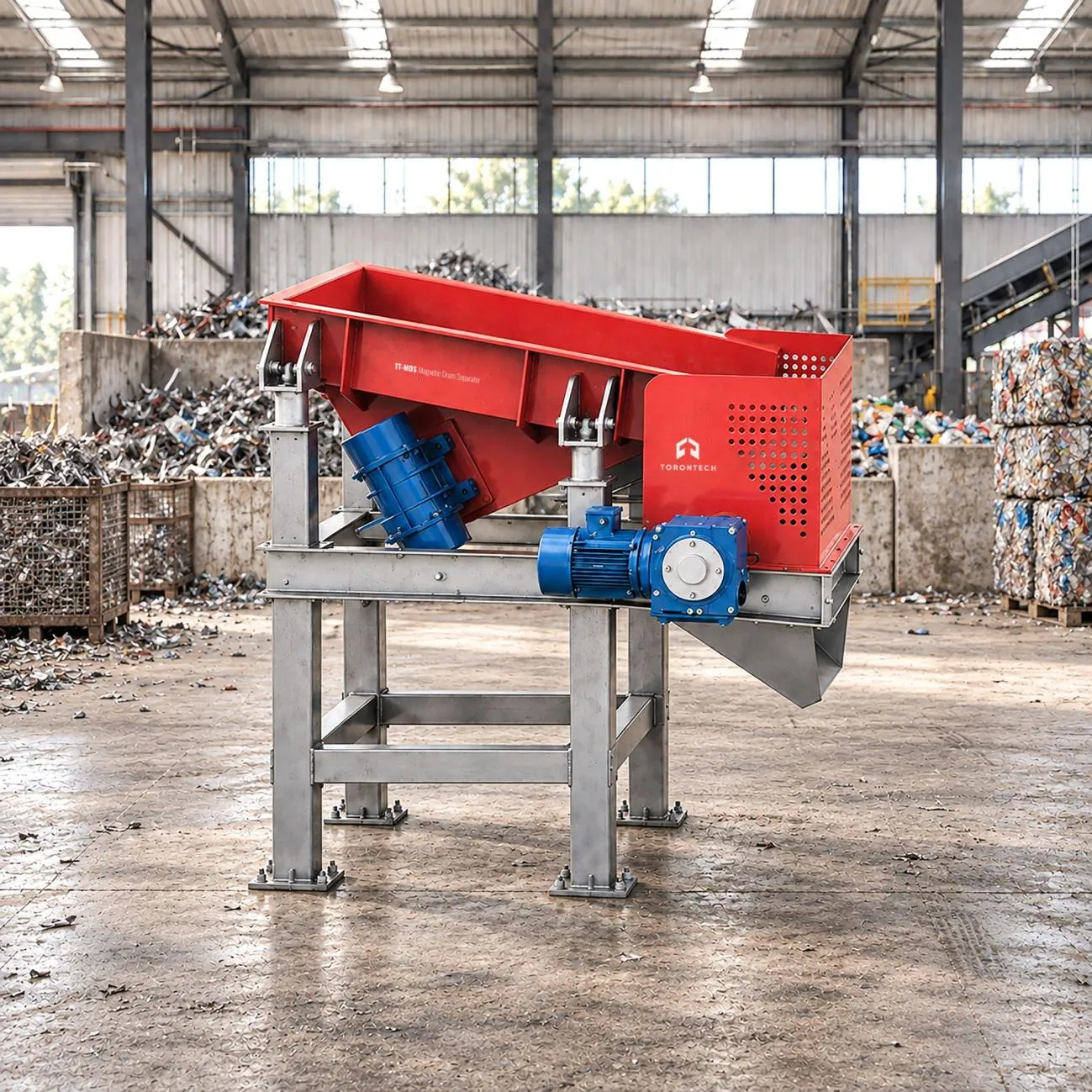
The top-feed magnetic drum separator is a semi-enclosed, vibratory-fed magnetic drum for high-throughput fine ferrous recovery. Adjustable magnetic field strength allows tuning to the specific fraction being processed.
- Magnetic field strength: 1,800 to 8,000 Gauss (selectable)
- Operation: continuous, high recovery rate
- Design: simple structure, reliable operation, straightforward maintenance
Magnetic Drum Separator Specifications:
| Model | Drum Length (mm) | Drum Diameter (mm) | Magnet Intensity (Gs) | Driving Power (kW) | Vibrating Motor Power (kW) |
|---|---|---|---|---|---|
| TT-MDS-32/50 | 500 | Ø320 | 1,800 to 8,000 | 1.1 | 0.4 |
| TT-MDS-32/60 | 600 | Ø320 | |||
| TT-MDS-32/80 | 800 | Ø320 | 1.5 | 0.8 | |
| TT-MDS-32/100 | 1000 | Ø320 | 0.8 | ||
| TT-MDS-32/120 | 1200 | Ø320 | 1.1 | ||
| TT-MDS-32/140 | 1400 | Ø320 | 1.5 |
Permanent Magnetic Drum Separator
The permanent-magnet drum separator handles ferrous concentration on the fine fraction, using a rare-earth NdFeB magnetic circuit. The permanent design eliminates coil power consumption and provides consistent field strength.
- Magnet type: high-performance NdFeB (rare earth)
- Field decay: less than 5% over 8 years
- Structure: waist-drum shape, fully sealed bearing, automatic belt tracking
Permanent Magnetic Drum Separator Specifications:
| Model | Suitable Belt Width (mm) | Roller Size (mm) | Motor Power (kW) | Weight(kg) |
|---|---|---|---|---|
| TT-PMD-6 | 600 | Ø500 × 600 | 1.5 | 1520 |
| TT-PMD-6.5 | 650 | Ø500 × 650 | 1.5 | 1550 |
| TT-PMD-8 | 800 | Ø600 × 800 | 2.2 | 2720 |
| TT-PMD-10 | 1000 | Ø800 × 1000 | 3.0 | 3920 |
| TT-PMD-12 | 1200 | Ø800 × 1200 | 4.0 | 5280 |
| TT-PMD-14 | 1400 | Ø1000 × 1400 | 4.0 | 7500 |
| TT-PMD-16 | 1600 | Ø1200 × 1600 | 5.5 | 8800 |
Eccentric Eddy Current Separator
The eccentric eddy current separator recovers non-ferrous metals (copper, aluminum, brass, zinc) from the non-magnetic stream. An eccentric rotor design places the magnetic pole close to the belt surface, giving a wider throw angle for small particles than a concentric rotor design, and a vibrating feeder plus adjustable baffle allows fine-tuning to the fraction being processed.
- Rotor type: eccentric high-speed magnetic rotor
- Particle size range: ≥1 mm²
- Magnet material: NdFeB with anti-fall spray-plastic protection
- Recovery target: aluminum, copper, brass, zinc, and other non-ferrous metals
Eccentric Eddy Current Separator Specifications:
| Model | Feed Width (mm) | Feed Length (mm) | Particle Size | Capacity (m³/h) | Power (kW) | Weight (kg) | Length (mm) | Width (mm) | Height (mm) |
|---|---|---|---|---|---|---|---|---|---|
| TT-ECS-5 | 300 | 1500 | ≥1 mm² | 6 | 5.9 | 730 | 4600 | 1123 | 1200 |
| TT-ECS-6 | 400 | ≥1 mm² | 10 | 5.9 | 895 | 1223 | |||
| TT-ECS-8 | 600 | ≥1 mm² | 20 | 5.9 | 1225 | 1623 | |||
| TT-ECS-10 | 800 | ≥1 mm² | 25 | 6.3 | 1555 | 1823 | |||
| TT-ECS-12 | 1000 | ≥1 mm² | 30 | 7.0 | 1875 | 2023 | |||
| TT-ECS-14 | 1200 | ≥1 mm² | 35 | 8.8 | 2275 | 2223 | |||
| TT-ECS-16 | 1400 | ≥1 mm² | 40 | 10 | 2850 | 2423 | |||
| TT-ECS-20 | 1800 | ≥1 mm² | 50 | 10.7 | 3650 | 5000 | 2823 | ||
| TT-ECS-22 | 2000 | ≥1 mm² | 55 | 13 | 4500 | 5000 | 3023 |
Induction Metal Sorter (Sensor-Based)
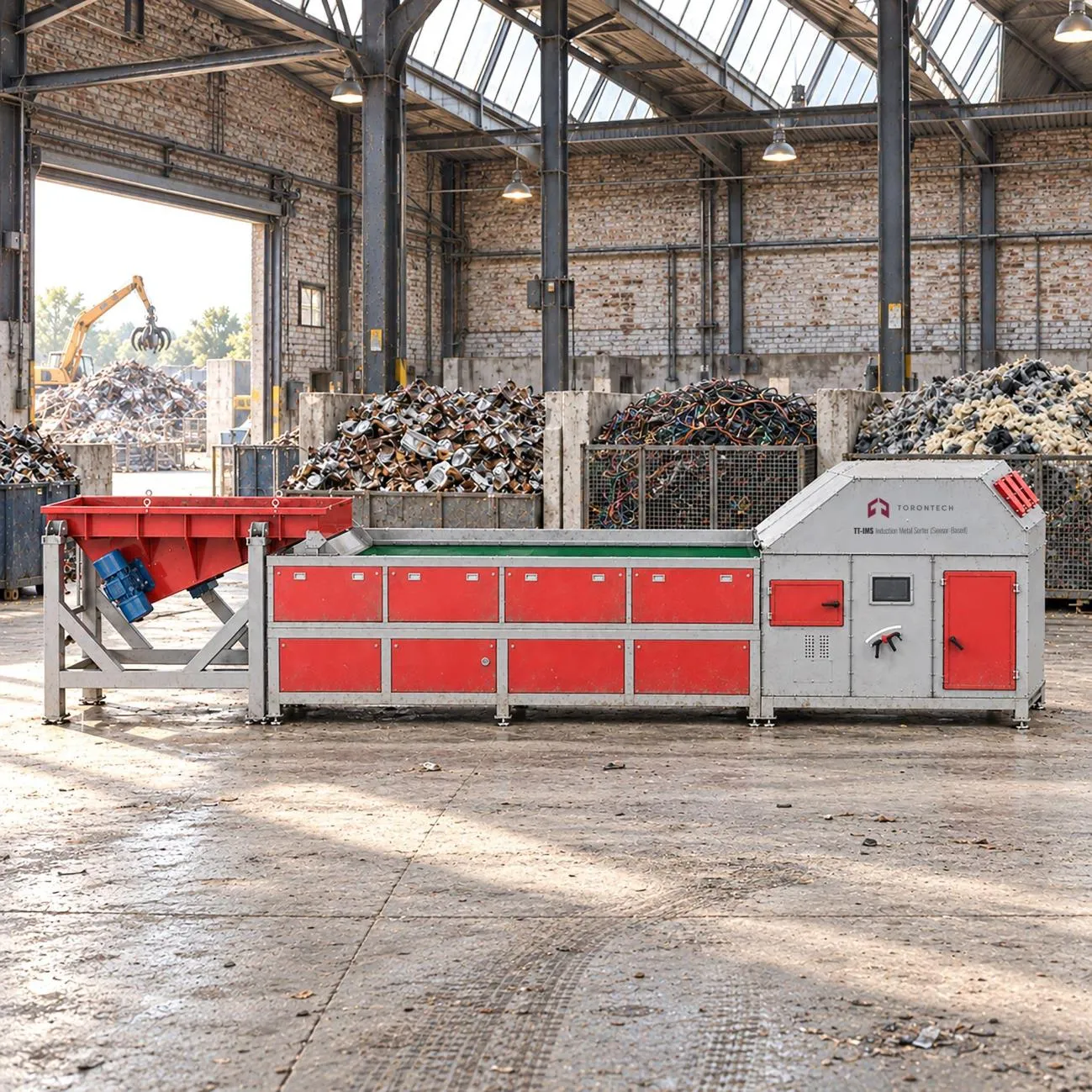
The induction metal sorter identifies conductive particles (both ferrous and non-ferrous) on the conveyor using high-sensitivity electromagnetic (EM) sensors, then ejects them from the stream through an array of compressed-air valves. It is used to upgrade non-ferrous concentrate purity, recover stainless steel, and recover the smallest metal fragments that eddy current separators cannot reach.
- Sensor: high-sensitivity electromagnetic (EM) with image-processing algorithm
- Detectable metal size: 1 to 2 mm minimum
- Resolution options: 25 mm or 12.5 mm scan resolution
- Valve options: 48 to 240 valves (belt width dependent)
- Optional integration: EM + NIR sensor fusion for "poly" separation
Induction Metal Sorter Valve Configurations:
| Belt Width | 6-Valve Bank | 12-Valve Bank | 18-Valve Bank | 24-Valve Bank | 30-Valve Bank |
|---|---|---|---|---|---|
| Ts1500 / 6.25 mm | 48 valves | 96 valves | 144 valves | 192 valves | 240 valves |
| Ts400 / 6.25 mm | 96 valves | 192 valves | 288 valves | 384 valves | 480 valves |
| Ts200 / 6.25 mm | 96 valves | 192 valves | 288 valves | 384 valves | 480 valves |
LIBS Sorter (Laser-Induced Breakdown Spectroscopy)
The LIBS sorter identifies aluminum alloy grades and other non-ferrous metals by their elemental composition. A pulsed laser vaporizes a microscopic amount of material from each particle, and a spectrometer analyzes the emitted light to identify the alloy in real time. Particles are then ejected by compressed-air valves. LIBS enables cast-vs-wrought aluminum separation and alloy-specific sorting (e.g., 5000-series from 6000-series) that no other sensor technology can deliver.
- Function: alloy-specific non-ferrous sorting by elemental composition
- Typical application: cast/wrought aluminum separation, brass and copper alloy sorting
- Ejection: high-speed compressed-air valve array
X-Ray Transmission Sorter
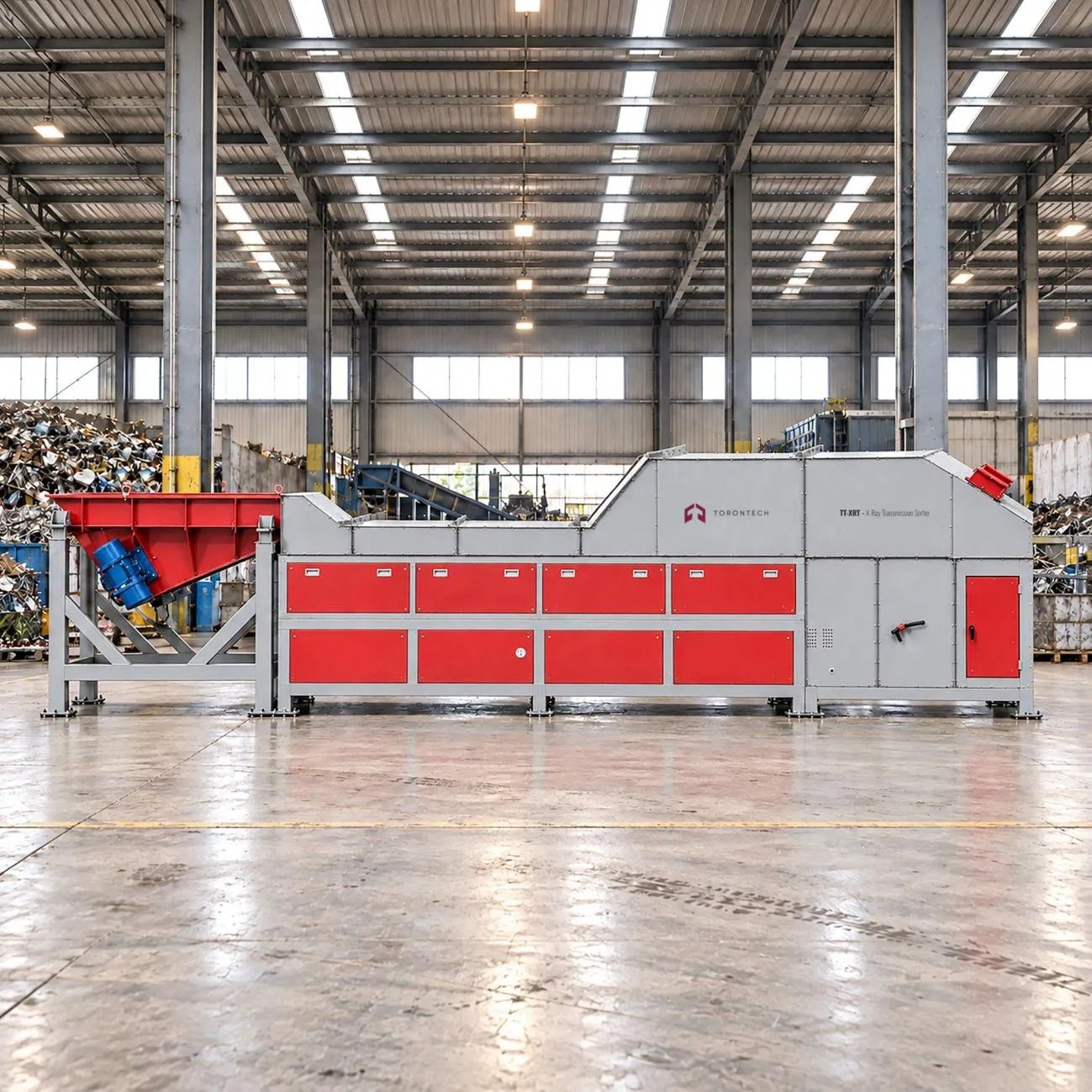
The X-Ray Transmission (XRT) sorter distinguishes particles by atomic density rather than surface appearance. Material passes on a conveyor belt between an X-ray emitter above and a set of LDA dual-energy receivers below, which measure how much energy each particle absorbs. A self-learning classifier reads the signal and triggers a compressed-air jet valve at the belt head pulley to eject targeted particles. XRT uniquely separates heavy metals from light metals regardless of color, coating, or geometry, recovering small copper wire from aluminum shred, isolating lead-bearing fractions, and separating stainless steel from mixed non-ferrous streams.
- Detection method: dual-energy X-ray transmission with LDA receivers
- Classifier: self-learning system that continuously accumulates material characteristic samples
- Typical applications: zorba sorting (aluminum from copper, zinc, lead, magnesium), cast-vs-wrought aluminum separation, chlorinated/brominated flame-retardant plastic removal, reclaimed aluminum quality upgrade
- Ejection: compressed-air jet valve array
X-Ray Transmission Sorter Specifications:
| Model | Belt Width (mm) | Raw Material Size (mm) | Capacity (t/h) | Power (kW) | Weight (t) | Machine Size L×W×H (mm) |
|---|---|---|---|---|---|---|
| TT-XRT-1200 | 1200 | 10 to 100 | 4 to 6 | 6.6 | 3 | 6000 × 1490 × 1780 |
| TT-XRT-1800 | 1800 | 6 to 8 | 4 | 6000 × 2090 × 1780 | ||
| TT-XRT-2400 | 2400 | 8 to 10 | 5 | 6000 × 2690 × 1780 |
Optical Color Sorter (AI-Powered)
The AI-powered optical color sorter uses high-resolution cameras and machine-learning classifiers to identify materials by color, texture, and shape. It handles final upgrade steps such as separating copper from brass, sorting plastic flakes by color for downstream reuse, and removing residual contamination from cleaned metal fractions.
- Function: sorting by color, shape, and surface texture
- Detection: high-resolution RGB cameras with AI classification
- Typical application: copper/brass separation, colored plastic flake sorting, contaminant removal
Single-Shaft Shredder
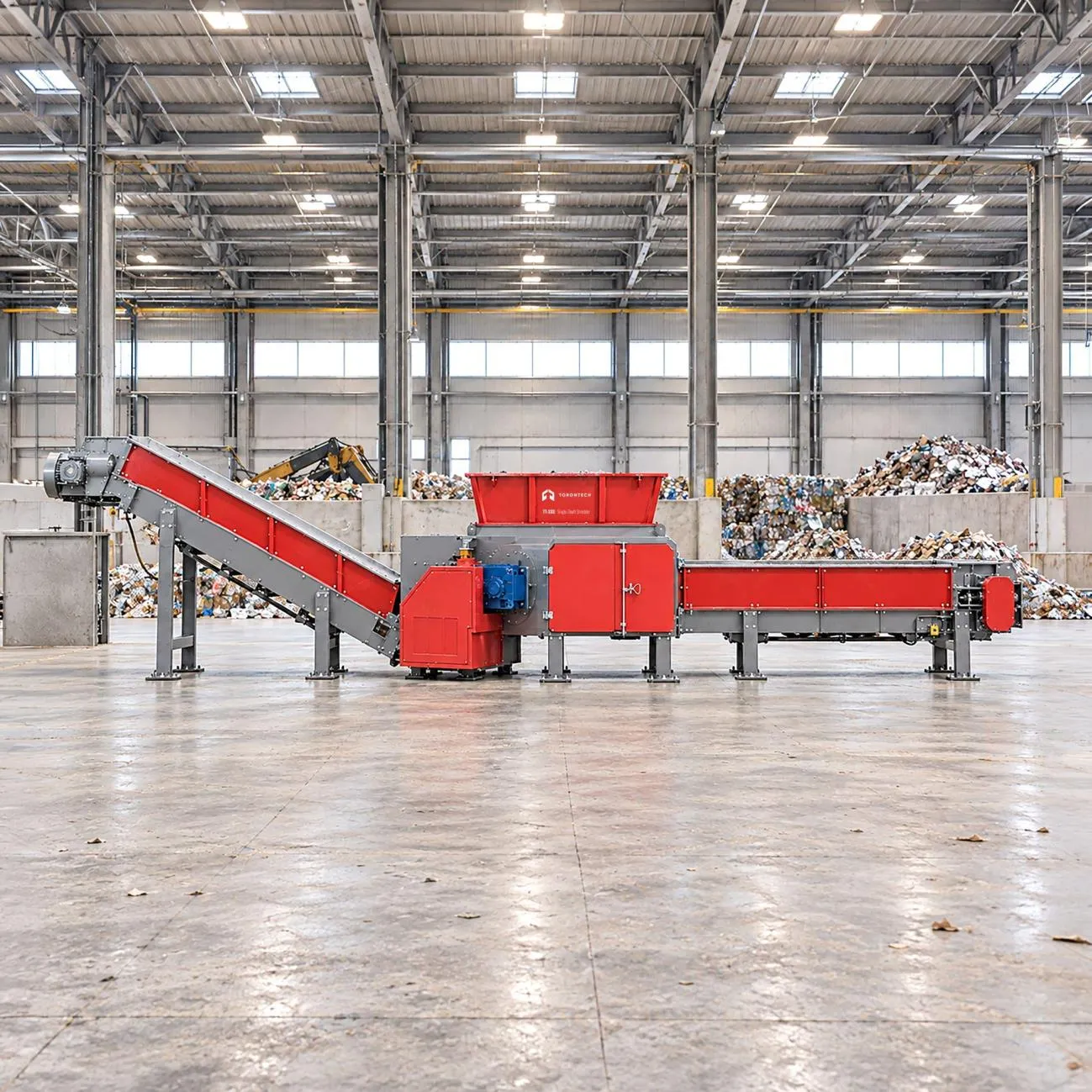
The single-shaft shredder performs secondary size reduction to the target flake dimension. A single rotor carries interchangeable knives that shear the material against a stationary comb, and output size is controlled by a bottom screen with user-defined aperture. The machine delivers uniform particle geometry required for downstream eddy current separation and X-ray sorting.
- Function: secondary size reduction to target flake size
- Design: single-shaft rotor with interchangeable knives and screen-controlled output
- Advantage: uniform particle size for sensor-based sorting
Single-Shaft Shredder Specifications:
| Model | Power (kW) | Shredder Width (mm) | RPM | Total Weight (t) |
|---|---|---|---|---|
| TT-SSS-800 | 37 | 800 | 80 | 4.04 |
| TT-SSS-1200 | 55 | 1200 | 5 | |
| TT-SSS-1500P | 55 + 55 | 1500 | 11 | |
| TT-SSS-2200P | 90 + 90 | 2200 | 19 | |
| TT-SSS-3000P | 160 + 160 | 3000 | 25 |
Chain Apron Conveyor
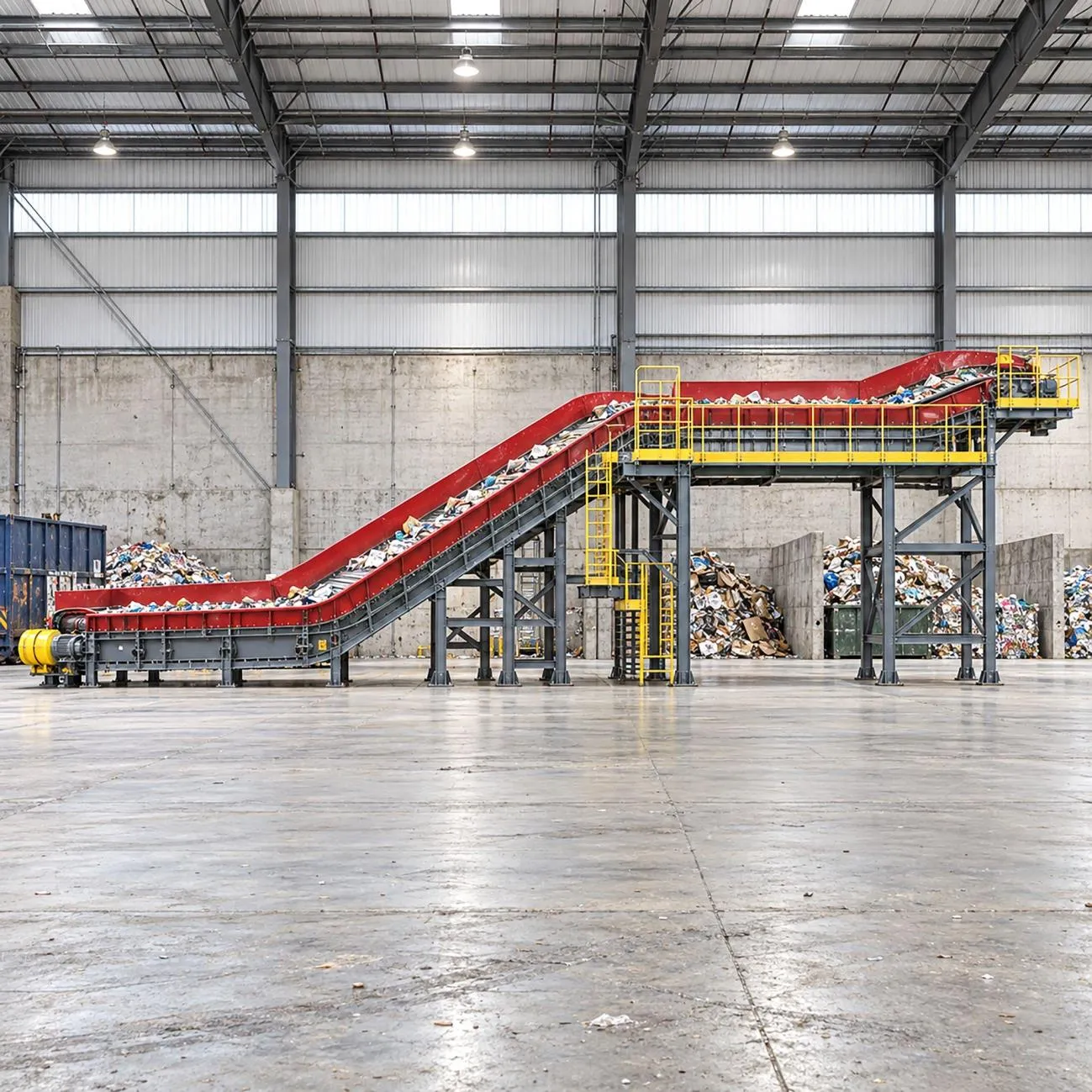
The heavy-duty chain apron conveyor connects the process stages and handles the highest-abrasion transfers where belt conveyors would be damaged. Wide, overlapping steel apron plates ride on a chain drive with high torque and low maintenance requirements.
- Function: high-abrasion inter-stage transfer
- Design: hinged steel apron plates on driven chain
- Advantages: high torque, low noise, high durability, wide feed range
Electrical Control System
The line runs under a single PLC control system with automatic overload reverse control, interlock logic, and an operator HMI. All motors, sensors, and pneumatic actuators are wired to the central cabinet for coordinated operation and remote diagnostics.
- Controller: PLC-based programmable control
- Protection: automatic overload reverse, safety interlocks across the full line
- Interface: HMI touchscreen with process-status visualization
Technical Specifications
The Pre-Sorting Line is engineered around the customer's throughput target, input material composition, and required output purity. The line is available in offline (batch) and online (in-line with shredder) configurations.
| Parameter | Specification |
|---|---|
| Line Configuration | Offline (batch) or online (in-line with shredder) |
| Typical Throughput Range | 1 to 20+ t/h (customer-specific) |
| Input Material | Automotive shredder residue (ASR) / shredder fluff / mixed residual |
| Input Moisture | Handles damp and wet material via flip-flow screening |
| Ferrous Recovery Stages | Permanent overband magnet, magnetic drum, permanent magnetic drum |
| Non-Ferrous Recovery Stages | Eccentric eddy current separator, induction metal sorter |
| Sensor-Based Sorting | LIBS, X-ray transmission, optical color, induction |
| Size Classification | Rotary trommel + flip-flow screen |
| Light-Fraction Removal | Vertical air separator with cyclone dust collector |
| Control System | PLC with HMI touchscreen, full-line interlocks |
| Installation Options | Skid-mounted modules or civil-work integrated |
| Power Supply | 380 V / 50 Hz (customer voltage available on request) |
Each line is engineered to the customer's specific input stream and output purity targets. Contact the Torontech application engineering team for a site-specific process flow diagram and quotation.