
ASR Plastics Washing & Recycling Line
Plastic Cleaning & Separation System for the Scrap Metal Industry | Post-Shredder
The ASR Plastics Washing & Recycling Line cleans and reclaims the plastic fraction recovered from automotive shredder residue (ASR) and other scrap-metal tailings streams. The system handles the complex contamination profile of post-shredder plastic waste: embedded metal fragments, rubber pieces, glass fibers, foam, dirt, oils, and mixed polymer types.
This line up combines upstream metal contamination removal with a multi-stage wet washing process. Ferrous and non-ferrous metal fragments are removed by magnetic and eddy current separators before the plastic enters the water bath, sink-float separation isolates floatables (PP, PE) from heavy contaminants (metals, rubber, glass), and a high-speed friction washer scrubs residual glue, oil, and surface soil off the flakes. The output is a clean, sized, contamination-free plastic flake stream ready for downstream extrusion, pelletization, or downcycling.
The line runs configurable throughput and is engineered around the customer's input composition and target output purity. Typical capacities range from 500 kg/h for boutique reclaimers up to 3000+ kg/h for large-scale ASR processors and scrap yard operators.
Applications
The ASR Plastics Washing & Recycling Line targets plastic waste streams contaminated with metal, glass, rubber, and organic material from scrap and recycling operations.
- Automotive Shredder Residue (ASR) Plastic Recovery: reclaims polypropylene, ABS, PVC, and mixed polymer fragments from ELV shredder tailings
- Scrap Metal Industry Plastic Cleaning: processes the plastic byproduct fraction from ferrous and non-ferrous metal recycling yards
- Waste Electrical and Electronic Equipment (WEEE) Plastic Reclamation: separates and cleans housing plastics from shredded e-waste
- Cable and Wire Recycling Plastic Byproduct: cleans the insulation and jacket plastic fraction after copper recovery
- Mixed Polymer Downcycling: prepares contaminated mixed plastic for extrusion into secondary applications (pallets, boards, drainage components)
- Post-Industrial Contaminated Plastic: reclaims plastic from manufacturing scrap contaminated with metal or fluids
- Municipal Solid Waste (MSW) Bottom Ash Plastic: recovers plastic fragments from incinerator bottom ash residue
Theory and Method
Post-shredder plastic waste is heterogeneous by design: it contains multiple polymer types, mixed with metal fragments, mineral fillers, rubber, foam, and adhered organic material. No single separation method can produce clean plastic flakes from this feed, so the line applies mechanical, magnetic, sensor-based, and density-based methods in sequence.
Metal contamination is removed first. A permanent overband magnet extracts ferrous fragments, an eddy current separator throws off non-ferrous conductive particles (aluminum, copper, brass), and an induction metal sorter catches the finest metal fragments. Removing metal before the water bath protects downstream cutting knives, extends pump life, and prevents cross-contamination of the plastic output.
The size-reduced material then enters the wet separation stages. Sink-float separation exploits density differences: a freshwater tank first lets polymers with density less than 1.0 g/cm³ (PP, PE, PS foam) float and skims them off the surface, while heavier particles sink. A second brine tank at controlled specific gravity splits the remaining fraction again to isolate the target plastic from heavier contaminants (dense polymers, mineral filler, residual metal, glass fiber, rubber). A high-speed friction washer then scrubs the flake surface against a rotating rotor and shear ribs, dislodging adhered glue, oil, and dirt. The washed flakes are dewatered in a centrifugal dryer at high G-forces and finished in a vibration dryer that removes residual surface moisture, producing dry, flowable, sortable flake ready for baling or extrusion.
Key Features
The line integrates metal removal, sink-float separation, friction washing, and drying under a single PLC control system.
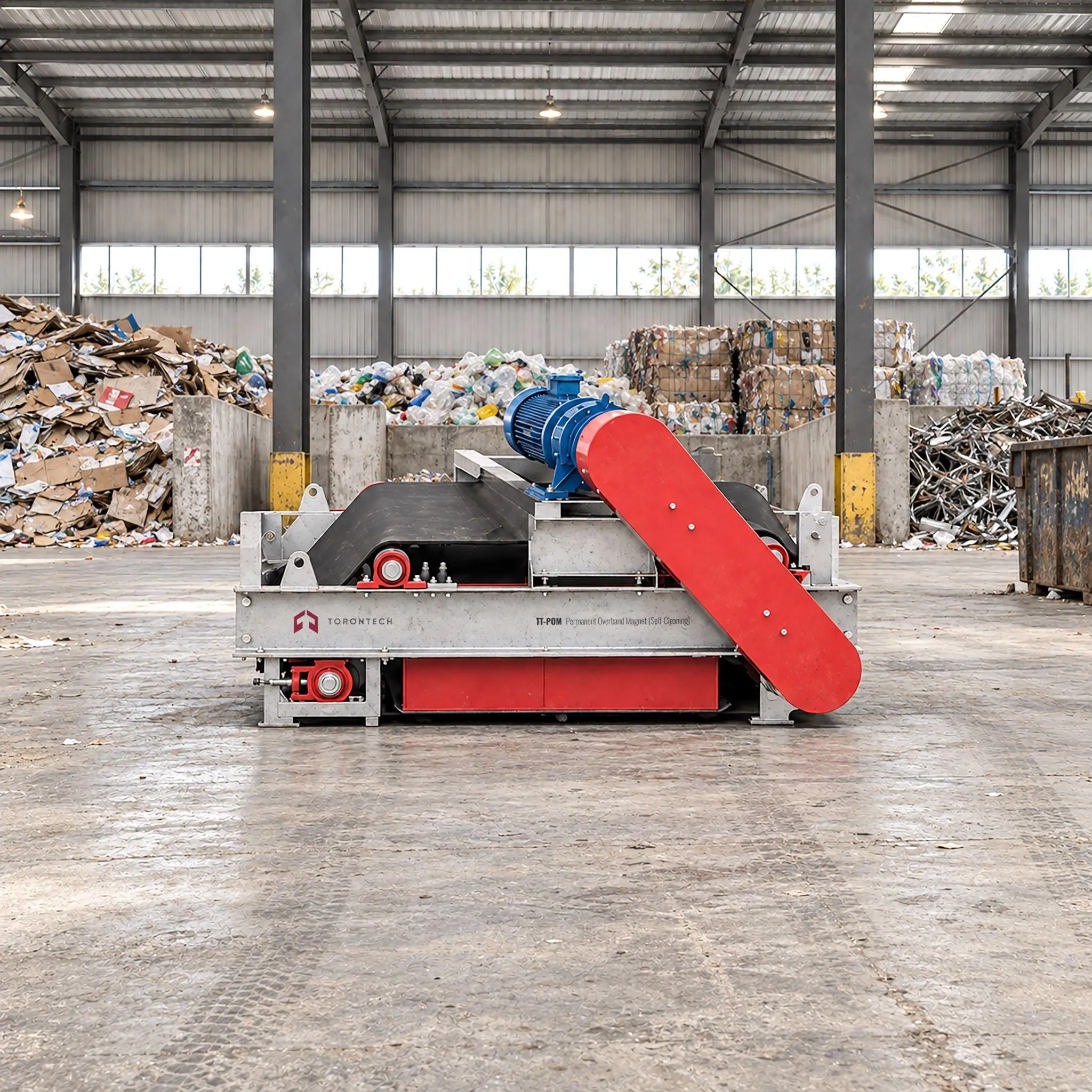
Permanent Overband Magnet (Self-Cleaning)
The self-cleaning permanent overband magnet suspends above the infeed conveyor and removes ferrous metals before the plastic reaches the shredder. Rare-earth NdFeB magnets deliver strong, stable field intensity without coil power or cooling, and a dedicated self-cleaning belt discharges captured iron continuously.
- Function: pre-shredder ferrous removal to protect cutting knives
- Magnet type: high-performance NdFeB (rare earth), no external excitation power required
- Structure: double-pole magnetic circuit, waist drum-shaped frame with automatic belt tracking
Permanent Overband Magnet Specifications:
| Model | Suitable Belt Width (mm) | Material Thickness (mm) | Suspended Height (mm) | Magnet Intensity | Power (kW) | Belt Speed | Overall Dimensions L×W×H (mm) | Ring Center Distance (mm) | Weight (kg) |
|---|---|---|---|---|---|---|---|---|---|
| TT-POM-5 | 500 | 80 | 150 | 63 mT | 1.5 | ≤2.5 m/s | 1650 × 835 × 940 | 1100 × 635 | 580 |
| TT-POM-6 | 600 | 125 | 200 | 1700 × 835 × 940 | 1150 × 735 | 700 | |||
| TT-POM-6.5 | 650 | 150 | 1750 × 985 × 940 | 1200 × 785 | 700 | ||||
| TT-POM-8 | 800 | 200 | 250 | 70 mT | 2.2 | 1900 × 1140 × 960 | 1350 × 935 | 820 | |
| TT-POM-10 | 1000 | 250 | 300 | 3.0 | 2140 × 1350 × 1010 | 1590 × 1135 | 1220 | ||
| TT-POM-12 | 1200 | 300 | 350 | 4.0 | 2340 × 1550 × 1060 | 1790 × 1335 | 1420 | ||
| TT-POM-14 | 1400 | 350 | 400 | 5.5 | 2540 × 1750 × 1060 | 1990 × 1535 | 1730 | ||
| TT-POM-16 | 1600 | 400 | 450 | 7.5 | 3040 × 1550 × 860 | 2190 × 1335 | 2140 |
Single-Shaft Shredder
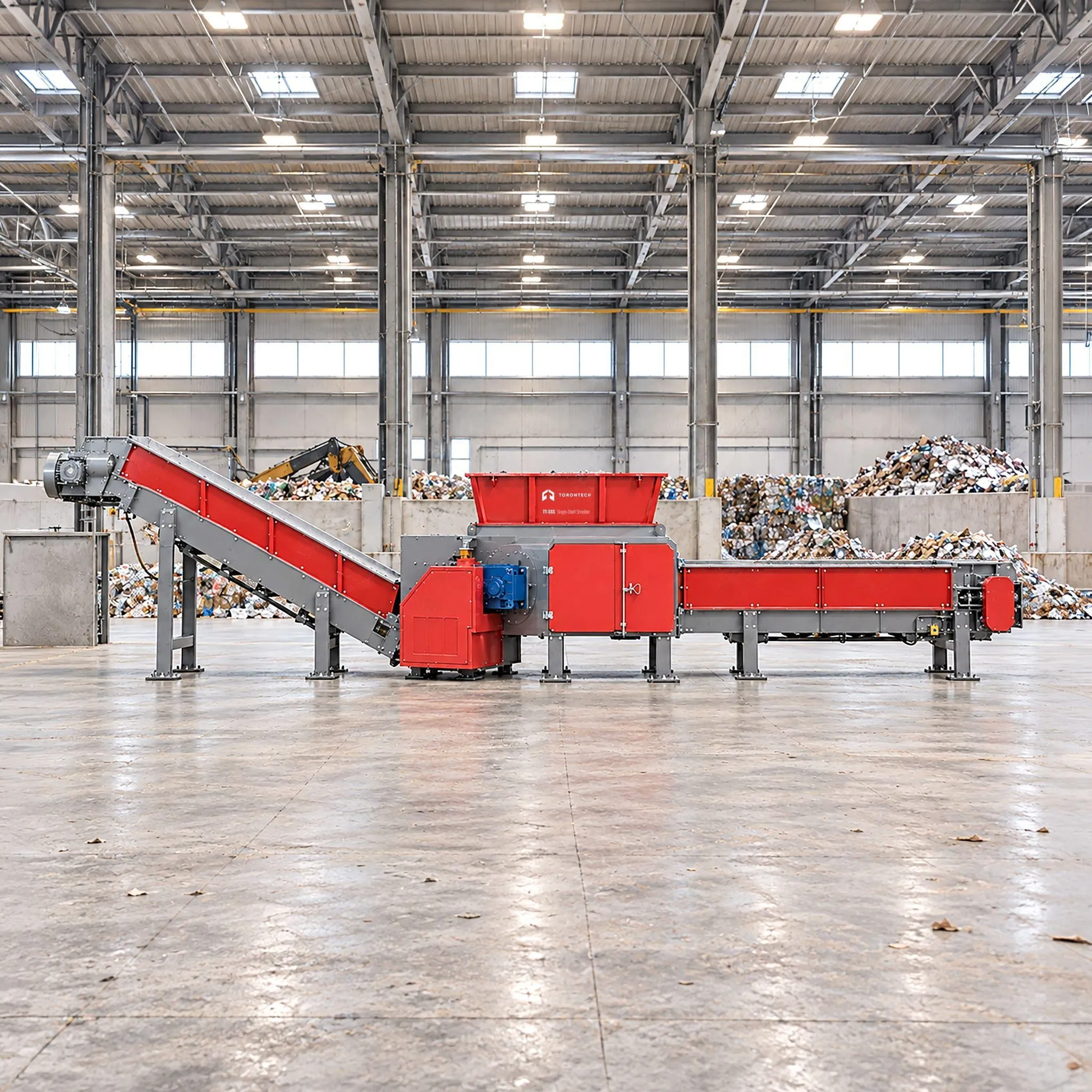
The single-shaft shredder performs secondary size reduction to the target flake dimension. A single rotor carries interchangeable knives that shear the material against a stationary comb, and output size is controlled by a bottom screen with user-defined aperture. The machine delivers uniform particle geometry required for downstream eddy current separation and X-ray sorting.
- Function: secondary size reduction to target flake size
- Design: single-shaft rotor with interchangeable knives and screen-controlled output
- Advantage: uniform particle size for sensor-based sorting
Single-Shaft Shredder Specifications:
| Model | Power (kW) | Rotary Diameter (mm) | Shredder Width (mm) | RPM | Total Weight (t) |
|---|---|---|---|---|---|
| TT-SSS-800 | 37 | Ø400 | 800 | 80 | 4.04 |
| TT-SSS-1200 | 55 | Ø400 | 1200 | 5 | |
| TT-SSS-1500P | 55 + 55 | Ø460 | 1500 | 11 | |
| TT-SSS-2200P | 90 + 90 | Ø800 | 2200 | 19 | |
| TT-SSS-3000P | 160 + 160 | Ø800 | 3000 | 25 |
Concentric Eddy Current Separator
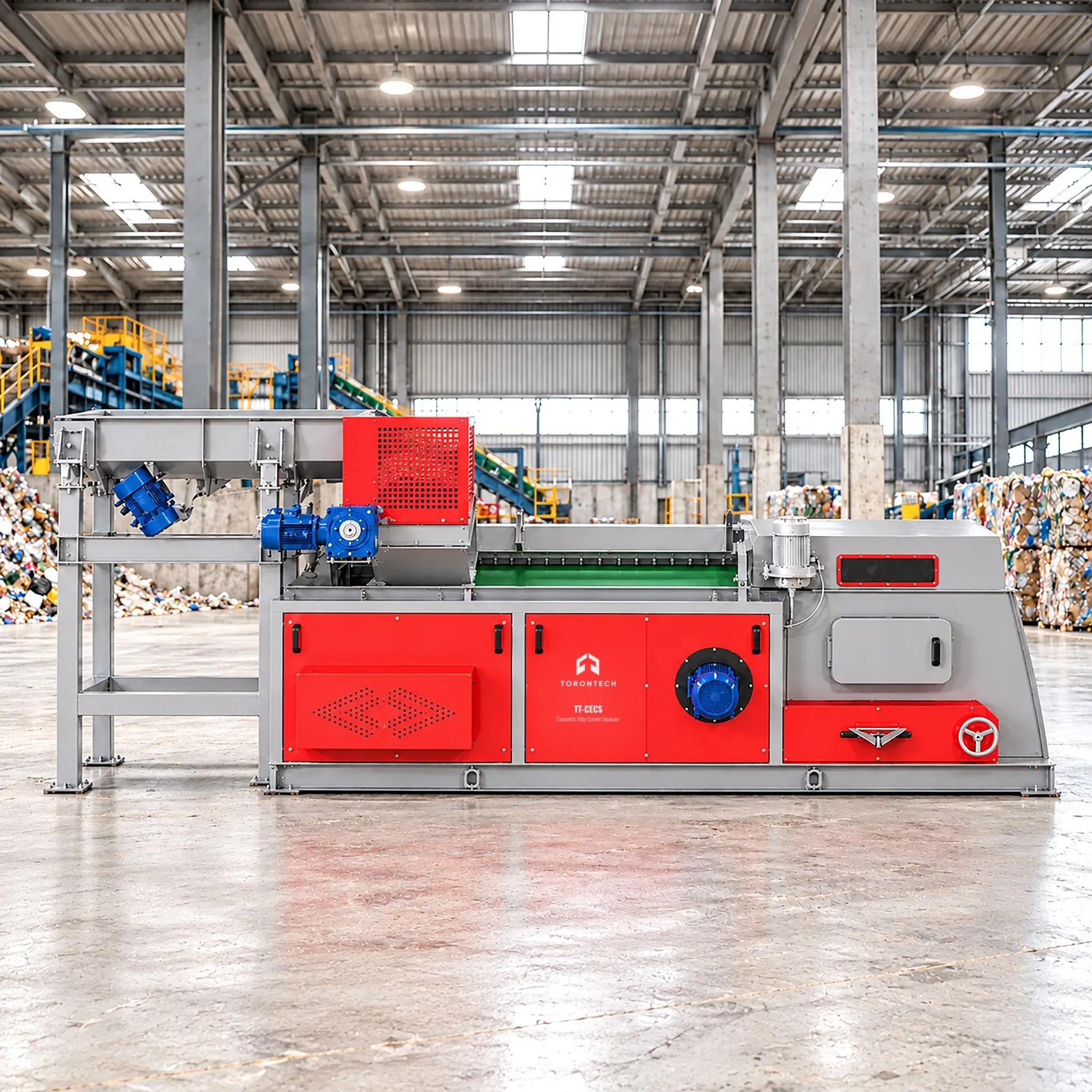
The concentric eddy current separator recovers residual non-ferrous metal fragments (aluminum, copper, brass) from the shredded plastic feed before it enters the water bath. A concentric magnetic rotor design generates a high-frequency alternating field that produces Lorentz repulsion on conductive particles while non-conductive plastic falls straight down. The concentric design is optimized for coarser, mid-fraction material typical of shredder residue plastic.
- Rotor type: concentric high-speed magnetic rotor
- Particle size range: ≥25 mm² (coarse to mid-fraction)
- Function: non-ferrous metal removal from plastic stream
- Feed length: 1500 mm across all models
Concentric Eddy Current Separator Specifications:
| Model | Feed Width (mm) | Feed Length (mm) | Feed Size | Capacity (m³/h) | Power (kW) | Weight (kg) | Length (mm) | Width (mm) | Height (mm) |
|---|---|---|---|---|---|---|---|---|---|
| TT-CECS-5 | 300 | 1500 | ≥25 mm² | 8 | 5.9 | 630 | 4600 | 1123 | 1200 |
| TT-CECS-6 | 400 | 12 | 5.9 | 795 | 4600 | 1223 | 1200 | ||
| TT-CECS-6.5 | 400 | 15 | 5.9 | 850 | 4600 | 1423 | 1200 | ||
| TT-CECS-8 | 600 | 22 | 5.9 | 1120 | 4600 | 1623 | 1200 | ||
| TT-CECS-10 | 800 | 27 | 6.3 | 1450 | 4600 | 1823 | 1200 | ||
| TT-CECS-12 | 1000 | 32 | 7.0 | 1750 | 4600 | 2023 | 1200 | ||
| TT-CECS-14 | 1200 | 37 | 8.8 | 2150 | 4600 | 2223 | 1200 | ||
| TT-CECS-16 | 1400 | 42 | 10 | 2750 | 4600 | 2423 | 1200 | ||
| TT-CECS-17 | 1500 | 47 | 10 | 3000 | 4600 | 2523 | 1200 | ||
| TT-CECS-20 | 1800 | 52 | 10.7 | 3550 | 5000 | 2823 | 1200 |
Induction Metal Sorter (Sensor-Based)
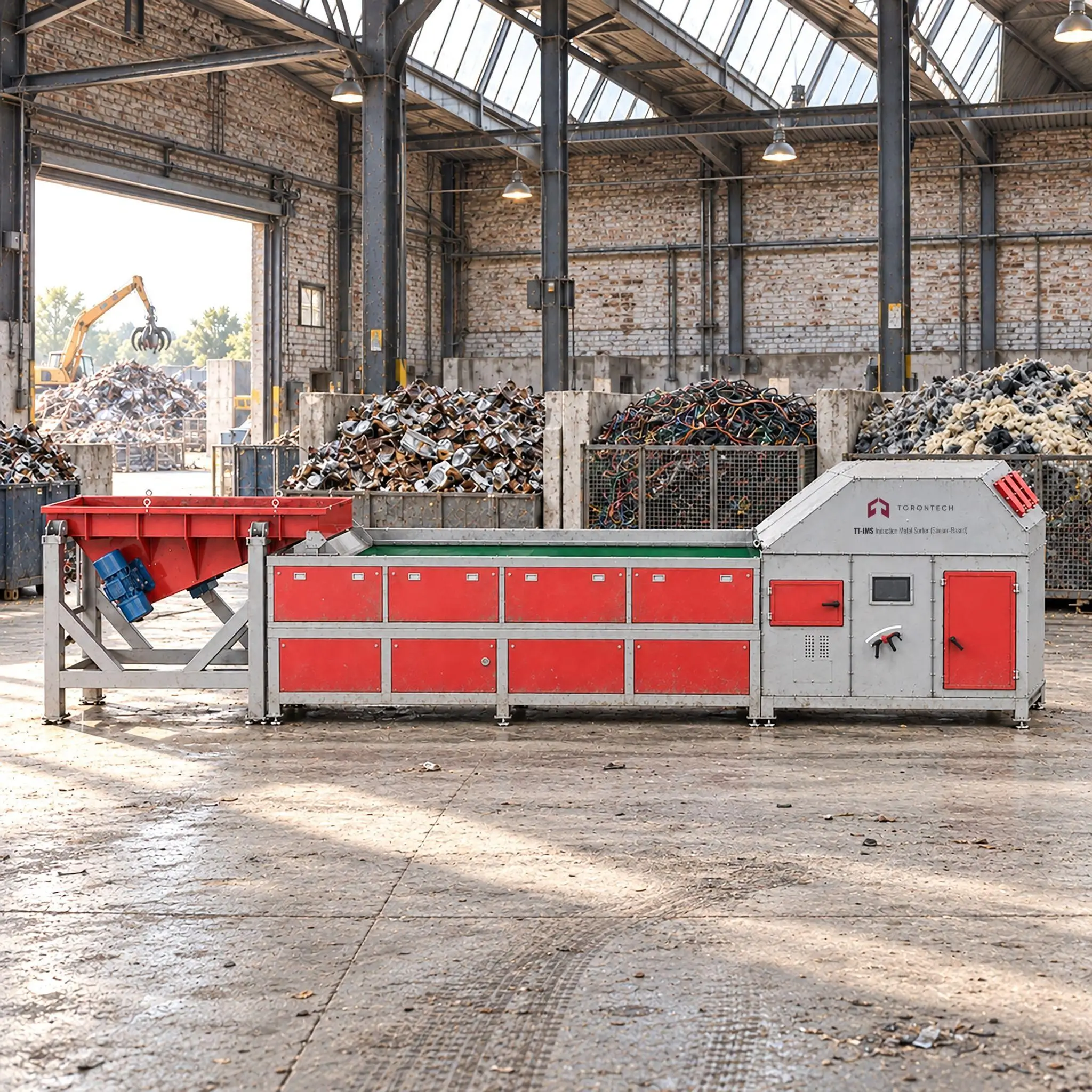
The induction metal sorter catches conductive fragments too small for the eddy current separator to throw. High-sensitivity electromagnetic sensors identify each metal particle on the conveyor and eject it through compressed-air valves before the plastic enters the water bath.
- Sensor: high-sensitivity electromagnetic (EM) with image-processing algorithm
- Detectable metal size: 1 to 2 mm minimum
- Resolution options: 25 mm or 12.5 mm scan resolution
- Valve options: 48 to 240 valves (belt width dependent)
Freshwater Pre-Washing Tank
The freshwater pre-washing tank uses gravity separation to remove the lightest contaminants from the shredded plastic. Materials less dense than water (PP, PE, foam, some films) float to the surface and are skimmed to a dedicated collection point, while target plastic and heavier contaminants sink and continue downstream.
- Function: floating-fraction removal (PP, PE, foam skim)
- Medium: freshwater at controlled level and flow
- Discharge: overflow skimmer for floatables, submerged conveyor for sinkers
Brine Density Separation Tank
The brine density separation tank uses a controlled-specific-gravity salt solution to make a second density split. The brine density is tuned to the target polymer, so target flakes float while denser contaminants (dense polymers, mineral filler, residual metal fragments, rubber, glass fiber) sink to the bottom and are removed by a submerged screw or scraper.
- Function: heavy-contaminant removal by controlled-density brine
- Sinkers removed: residual metal, rubber, glass fiber, mineral-filled composites
- Brine concentration: adjustable to match target polymer density
High-Speed Friction Washer
The high-speed friction washer scrubs plastic flakes against a rotating rotor and shear ribs to dislodge adhered glue, oil, and organic soil. Water is introduced continuously and drains out through a screen, carrying the removed contamination to the wastewater system. This is the most aggressive washing stage in the line.
- Function: mechanical surface cleaning by shear and friction
- Rotor: high-speed (typically 1,000 to 1,500 rpm)
- Wetting: continuous water spray, screen drainage
- Product contact: stainless steel surfaces
Centrifugal Dryer
The centrifugal dryer removes the bulk of the water from the flakes by high-G spinning. A vertical rotor throws the flakes against a perforated cage, and water is driven off through the perforations while the dried flakes exit at the top. Target output moisture is typically 2% or less.
- Function: high-G mechanical dewatering
- Rotor speed: typically 1,500 to 2,500 rpm
- Output moisture: approximately 2%
- Product contact: stainless steel
Vibration Dryer
The vibration dryer is the final finishing stage. A vibratory screen deck removes residual surface moisture beads and any fines, delivering dry, flowable, and clean flakes to the packaging or downstream extrusion stage.
- Function: final surface-moisture removal and fines classification
- Design: vibratory screen deck
- Output: dry, flowable flakes ready for baling or extrusion
Optical Color Sorter (AI-Powered)
The AI-powered optical color sorter provides a final upgrade of the washed flakes by color. High-resolution cameras and machine-learning classifiers separate clear from colored flakes, remove residual off-color contamination, and can be configured to produce color-specific fractions for higher-value downstream markets.
- Function: color-based flake sorting and contaminant removal
- Detection: high-resolution RGB cameras with AI classification
- Typical application: clear/colored PET flake separation, residual contamination ejection
Chain Apron and Belt Conveyors
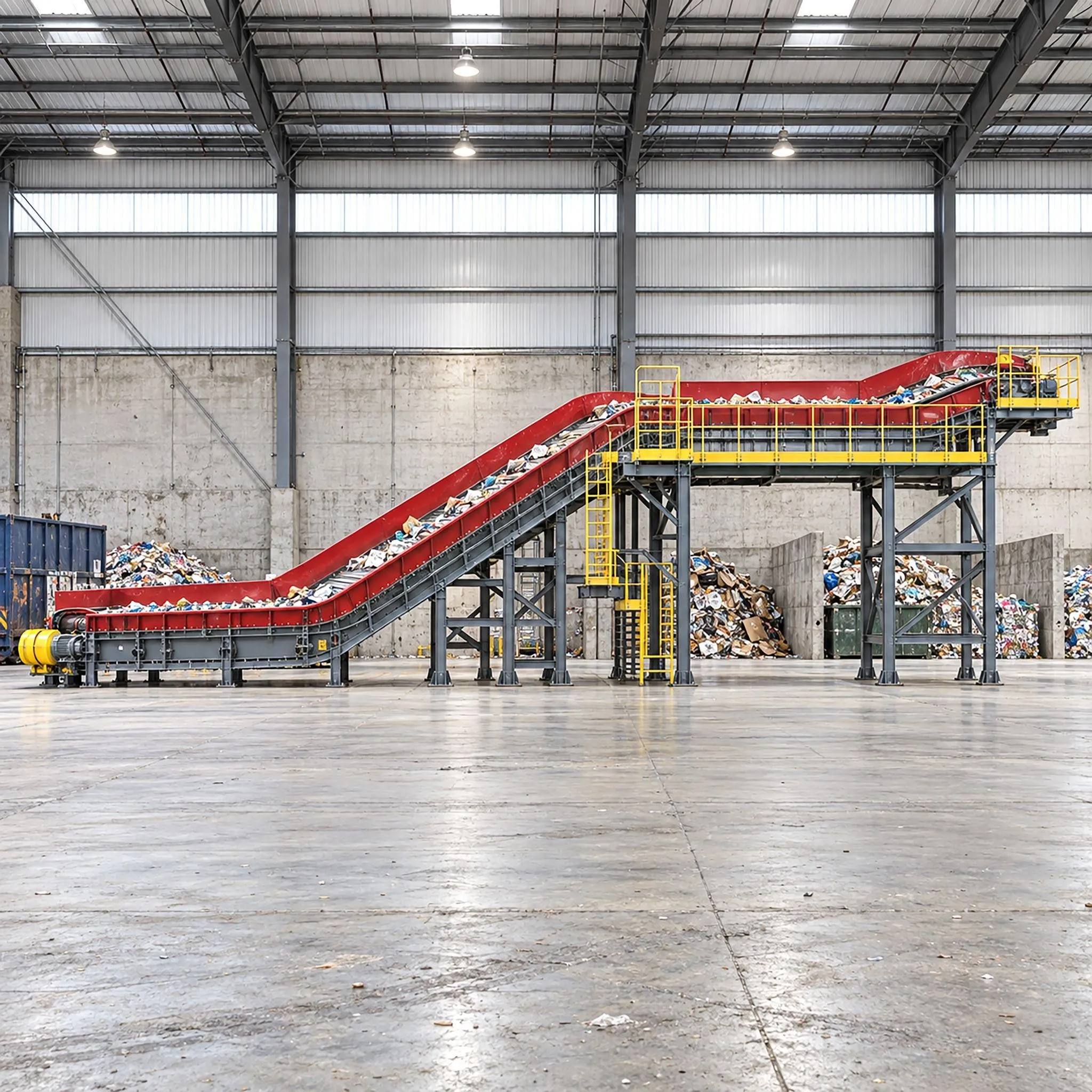
Heavy-duty chain apron conveyors handle the highest-abrasion transfers (raw input, pre-shredder feed), while belt conveyors carry clean shredded and washed material between the lighter-duty stages. All conveyors are integrated into the central control system for coordinated line operation.
- Chain apron function: high-abrasion inter-stage transfer
- Belt conveyor function: light-duty transfer between clean stages
- Integration: full PLC coordination and interlock
Electrical Control System
The line runs under a single PLC control system with automatic overload reverse control, interlock logic, and an operator HMI. Motors, water pumps, brine density controls, and pneumatic actuators are wired to the central cabinet for coordinated operation and remote diagnostics.
- Controller: PLC-based programmable control
- Protection: automatic overload reverse, safety interlocks across the full line
- Interface: HMI touchscreen with process-status visualization
Technical Specifications
This line up is engineered around the customer's input composition, throughput target, and target output purity. Water and brine consumption depend on the specific contamination profile of the input material.
| Parameter | Specification |
|---|---|
| Line Focus | Post-shredder plastic cleaning and reclamation from scrap metal industry residue |
| Typical Throughput Range | 500 kg/h to 3000+ kg/h (customer-specific) |
| Input Material | ASR plastic fraction, scrap yard plastic byproduct, contaminated mixed plastic |
| Input Contamination Tolerance | Metal fragments, rubber, glass fiber, foam, oils, adhered soil |
| Metal Removal Stages | Permanent overband magnet, concentric eddy current separator, induction metal sorter |
| Sink-Float Separation | Freshwater tank (floatables removal) + brine density tank (heavy contaminant removal) |
| Washing Stage | High-speed friction washer with continuous water spray |
| Drying Stages | Centrifugal dryer (mechanical dewatering) + vibration dryer (final surface drying) |
| Output Moisture | ≤2% at centrifugal stage, further reduced by vibration dryer |
| Final Sorting (Optional) | AI-powered optical color sorter |
| Control System | PLC with HMI touchscreen, full-line interlocks |
| Product-Contact Surfaces | Stainless steel throughout wet section |
| Installation Options | Skid-mounted modules or civil-work integrated |
| Power Supply | 380 V / 50 Hz (customer voltage available on request) |
Each line up is engineered to the customer's specific plastic waste stream and output requirements. Contact the Torontech application engineering team for a site-specific process flow diagram and quotation.