
UBC Recycling Line
The UBC Recycling Line shreds and sorts used beverage cans (UBC) into clean aluminum, ferrous, and non-metal fractions ready for smelter feedstock or downstream re-melting. The system serves aluminum recyclers, remelters, and closed-loop beverage packaging programs that process baled or loose UBC input at industrial scale.
The UBC Recycling Line pairs dual-stage shredding with layered separation. A twin-shaft shredder opens compacted bales and reduces cans to intermediate size, a single-shaft shredder refines to target flake dimension, and downstream stages (trommel screening, air classification, magnetic separation, eddy current separation, and X-ray transmission sorting) recover each material fraction cleanly. The result is high-purity aluminum flake at yields typically reaching 95 to 98 percent under normal input conditions.
The line supports customer-specific throughput from 2 to 15+ t/h and adapts to varying input formats (baled UBC, loose collection, mixed light-gauge aluminum). Primary shredding can be configured as twin-shaft plus single-shaft (standard UBC config) or hammer mill (higher-abrasion tolerance) depending on the input profile and capacity target.
Applications
The UBC Recycling Line targets used beverage can streams and other light-gauge aluminum feedstocks that require size reduction plus material separation.
- Used Beverage Can (UBC) Reclamation: converts baled aluminum can feed into clean flake for closed-loop remelting into rolling stock
- Aluminum Beverage Packaging Recycling: processes aluminum bottles, caps, and mixed container aluminum for smelter charge
- Aluminum Foil and Light-Gauge Recovery: handles thin-gauge aluminum foil, tray, and packaging scrap
- Municipal Collection UBC Processing: sorts co-mingled aluminum recovered from municipal recycling streams
- Remelter Feedstock Preparation: delivers sized, cleaned aluminum flake to secondary aluminum smelters and remelt operations
- Closed-Loop Beverage Programs: supports "can-to-can" recycling initiatives with contamination-controlled output
- Scrap Yard Aluminum Upgrading: refines mixed aluminum scrap into segmented ferrous, non-ferrous, and non-metal fractions
Theory and Method
Used beverage cans arrive in compacted bales or loose form and must be opened, sized, and separated before entering a remelt furnace. Contamination in the aluminum output directly reduces the value of the metal and damages the melting process, so the line applies a sequence of mechanical, magnetic, air-based, and sensor-based separations, each targeting one property of the input mix.
Size reduction comes first. A twin-shaft shredder tears open bales at low rpm and high torque, exploiting the shear action of two counter-rotating shafts to handle the packed input without stalling. A single-shaft shredder then reduces the intermediate output to the target flake size against a stationary comb screen, giving controlled particle geometry for downstream separators. For higher throughput or when input contains harder inclusions, a hammer mill is used instead: hinged hammers on a high-speed rotor impact the material against a breaker plate, producing a densified, cleaned flake.
The sized material then passes through classification and separation stages. A trommel screen splits the material into size fractions for optimal downstream sorting. A vertical air separator lifts light contaminants (film, labels, dust) into a cyclone dust collector. A permanent overband magnet removes ferrous fragments (steel closures, bimetal composite pieces). Eddy current separation recovers the aluminum: a high-frequency eccentric rotor generates a rapidly alternating magnetic field, inducing eddy currents in each aluminum particle that produce a repulsive Lorentz force, throwing aluminum off the belt trajectory while non-conductive material falls straight down. A second eddy current stage catches undersize aluminum missed by the primary. Finally, an X-ray transmission sorter distinguishes any remaining metal by atomic density, cleaning heavy metal (copper wire from tabs, lead-bearing contamination) out of the aluminum concentrate.
Key Features
The line integrates dual-stage shredding, classification, and multi-stage separation under a single PLC control system, with each module optimized for the specific fraction it handles.
Apron Feeder
The heavy-duty apron feeder receives baled or loose UBC from the tipping floor and meters it onto the inclined infeed conveyor. Its self-scraping chain-plate design handles compacted bales and mixed loose input without bridging or manual intervention.
- Function: primary bunker discharge and metering feed
- Design: heavy-gauge steel chain plates with self-cleaning scraper
- Feed handling: not limited by bale density, particle size, or moisture
High-Angle Belt Conveyor
The high-angle belt conveyor lifts UBC from the feeder to the shredder inlet with corrugated sidewalls and cross cleats that hold material on steep inclines. Its compact footprint fits sites where floor-level space is limited.
- Function: steep-incline transfer to shredder inlet
- Design: corrugated sidewall belt with cross cleats
- Advantage: high throughput in a small footprint, simple maintenance
Twin-Shaft Shredder
The twin-shaft shredder opens compacted UBC bales and performs primary size reduction. Two counter-rotating shafts carry interchangeable cutter discs that shear the material at low rpm and high torque, so the machine handles baled input, mixed contamination, and dense pack without stalling. Output particle size is set by cutter geometry and shaft speed.
- Function: primary bale opening and size reduction
- Design: two counter-rotating shafts with interchangeable cutter discs
- Operating principle: low-rpm, high-torque shear action
- Advantage: handles baled and mixed input without pre-treatment
Twin-Shaft Shredder Specifications:
The single-shaft shredder performs secondary size reduction to the target flake dimensi
| Model | Power (kW) | Rotary Diameter (mm) | Center Distance (mm) | Shredder Width (mm) | RPM | Total Weight (t) |
|---|---|---|---|---|---|---|
| TT-TSS-1300 | 37 + 37 | Ø520 | 400 | 1300 | 3 to 15 | 8 |
| TT-TSS-1500 | 55 + 55 | Ø630 | 520 | 1500 | 17 | |
| TT-TSS-1600 | 75 + 75 | Ø510 | 400 | 1600 | 14 | |
| TT-TSS-1800 | 110 + 110 | Ø740 | 610 | 1800 | 33 | |
| TT-TSS-2200 | 75 + 75 | Ø650 | 520 | 2200 | 30 |
Single-Shaft Shredder
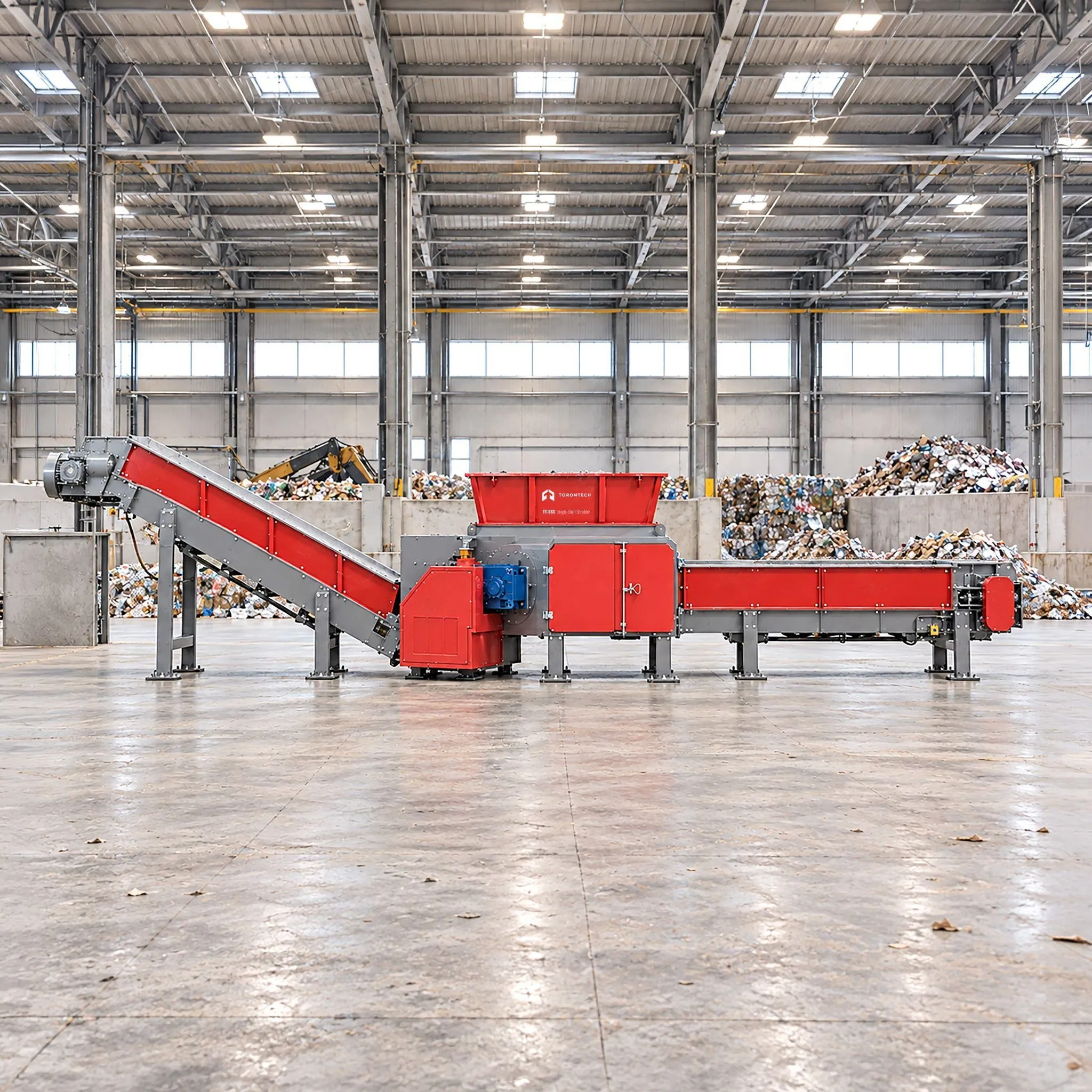
A single rotor carries interchangeable knives that shear the material against a stationary comb, and output size is controlled by a bottom screen with user-defined aperture. The machine delivers uniform particle geometry required for downstream eddy current separation and X-ray sorting.
- Function: secondary size reduction to target flake size
- Design: single-shaft rotor with interchangeable knives and screen-controlled output
- Advantage: uniform particle size for sensor-based sorting
Single-Shaft Shredder Specifications:
| Model | Power (kW) | Rotary Diameter (mm) | Shredder Width (mm) | RPM | Total Weight (t) |
|---|---|---|---|---|---|
| TT-SSS-800 | 37 | Ø400 | 800 | 80 | 4.04 |
| TT-SSS-1200 | 55 | Ø400 | 1200 | 5 | |
| TT-SSS-1500P | 55 + 55 | Ø460 | 1500 | 11 | |
| TT-SSS-2200P | 90 + 90 | Ø800 | 2200 | 19 | |
| TT-SSS-3000P | 160 + 160 | Ø800 | 3000 | 25 |
Hammer Mill Shredder (Alternative Primary Option)
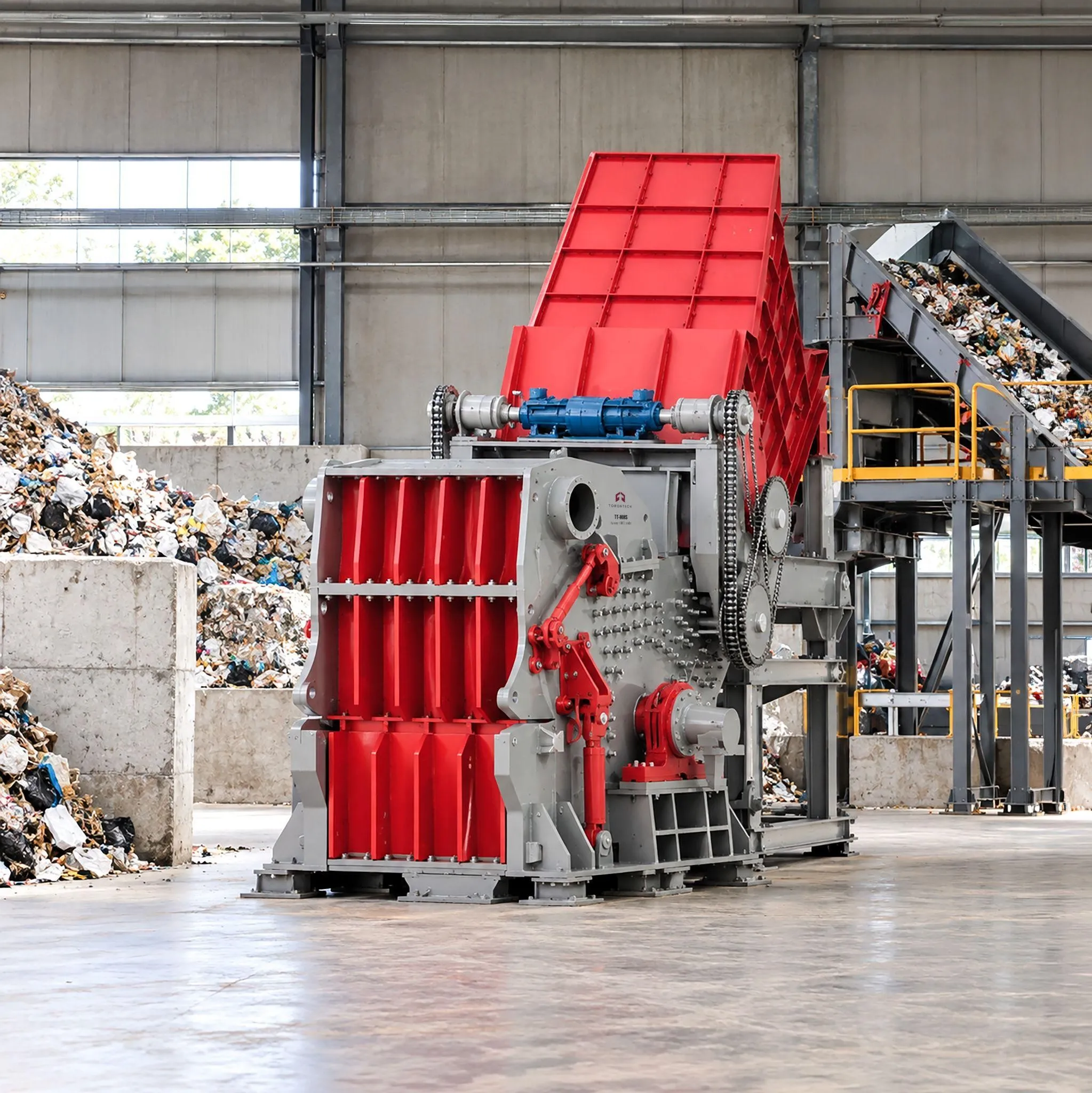
The hammer mill shredder is an alternative to the twin-shaft plus single-shaft configuration for customers with higher throughput requirements or input containing harder inclusions. Hinged hammers on a high-speed rotor impact the material against a breaker plate, producing a densified, cleaned flake in a single pass. Hydraulic feed rollers meter the input against the rotor at controlled speed.
- Function: single-pass primary size reduction with densification
- Design: hinged hammers on high-speed rotor, hydraulic feed rollers, breaker plate
- Advantage: high throughput, tolerant of hard inclusions, densifies output
Hammer Mill Shredder Specifications:
| Model | Main Motor / Pressure Roller / Hydraulic (kW) | Rotary Diameter (mm) | RPM | Shredder Width (mm) | Total Weight (t) |
|---|---|---|---|---|---|
| TT-HMS-315 | 315 / 11 + 11 / 15 | Ø1300 | 600 | 1400 | 51 |
| TT-HMS-450 | 450 / 15 + 15 / 15 | Ø1300 | 1600 | 68 | |
| TT-HMS-630 | 630 / 18.5 + 18.5 / 18.5 | Ø1500 | 1800 | 98 | |
| TT-HMS-900 | 900 / 18.5 + 18.5 / 18.5 | Ø1500 | 2200 | 110 |
Vertical Hammer Mill (Alternative Primary Option)
The vertical hammer mill delivers primary size reduction in a vertical rotor configuration, well suited to aluminum profile scrap and other geometrically consistent input. Material falls into the chamber by gravity, meets the high-speed rotor, and exits through a bottom discharge. The vertical layout gives a compact footprint compared to horizontal hammer mills at similar capacity.
- Function: vertical-axis primary size reduction
- Design: high-speed vertical rotor with chamber-based impact reduction
- Advantage: compact footprint, ideal for aluminum profile and geometric scrap
Vertical Hammer Mill Specifications:
| Model | Power (kW) | Rotary Diameter (mm) | RPM | Shredder Chamber Diameter (mm) | Shredder Chamber Height (mm) | Total Weight (t) |
|---|---|---|---|---|---|---|
| TT-VHM-250 | 110 to 160 | Ø1100 | 520 / 630 | 1280 | 1660 | 18 |
| TT-VHM-450 | 160 to 250 | Ø1500 | 520 / 630 | 1600 | 1800 | 24 |
Trommel Screen
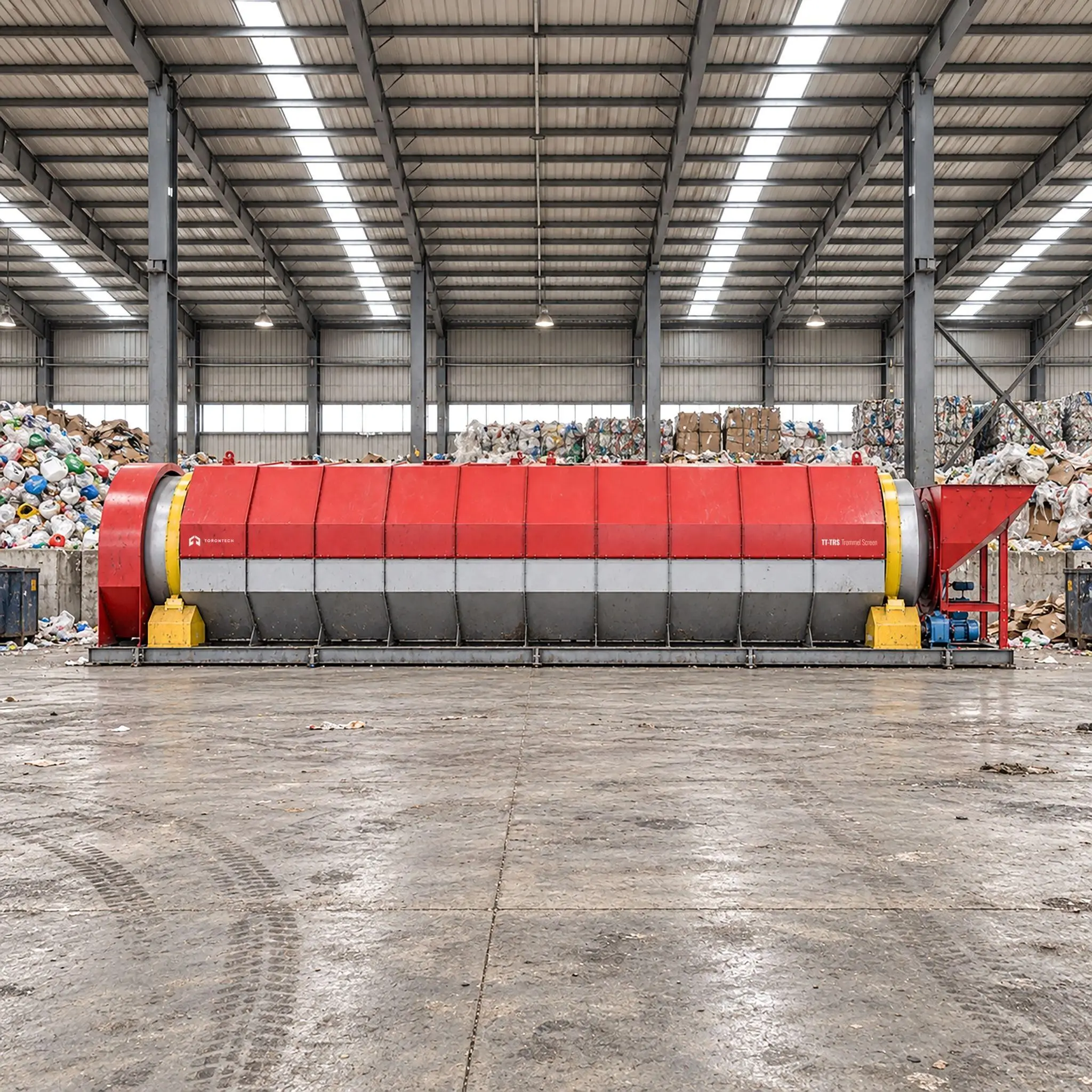
The rotary trommel screen classifies the shredded material into size fractions for optimal downstream sorting. Wear-resistant screen panels and a shaft-less drive extend service life on abrasive aluminum shred.
- Screen material: wear-resistant alloy panels
- Drum options: hexagonal or cylindrical, custom aperture sizes
- Drive: polyurethane driving system, low noise, no-shaft design
Trommel Screen Specifications:
| Model | Power (kW) | Drum Diameter (mm) | Drum Length (mm) | Capacity (m³/h) | Speed (r/min) | Inclination (%) |
|---|---|---|---|---|---|---|
| TT-TRS-1220 | 4.0 | Ø1200 | 2000 | 12 | 5 to 25 | 0 to 6 |
| TT-TRS-1240 | 5.5 | Ø1200 | 4000 | 18 | ||
| TT-TRS-1260 | 5.5 | Ø1200 | 6000 | 20 | ||
| TT-TRS-1290 | 7.5 | Ø1200 | 9000 | 35 | ||
| TT-TRS-1560 | 7.5 | Ø1500 | 6000 | 35 | ||
| TT-TRS-1590 | 11 | Ø1500 | 9000 | 50 | ||
| TT-TRS-15120 | 18.5 | Ø1500 | 12000 | 65 | ||
| TT-TRS-1860 | 11 | Ø1800 | 6000 | 50 | ||
| TT-TRS-1890 | 18.5 | Ø1800 | 9000 | 65 | ||
| TT-TRS-18120 | 22 | Ø1800 | 12000 | 75 | ||
| TT-TRS-2060 | 18.5 | Ø2000 | 6000 | 65 | ||
| TT-TRS-2090 | 22 | Ø2000 | 9000 | 75 | ||
| TT-TRS-20120 | 30 | Ø2000 | 12000 | 85 |
Vertical Air Separator
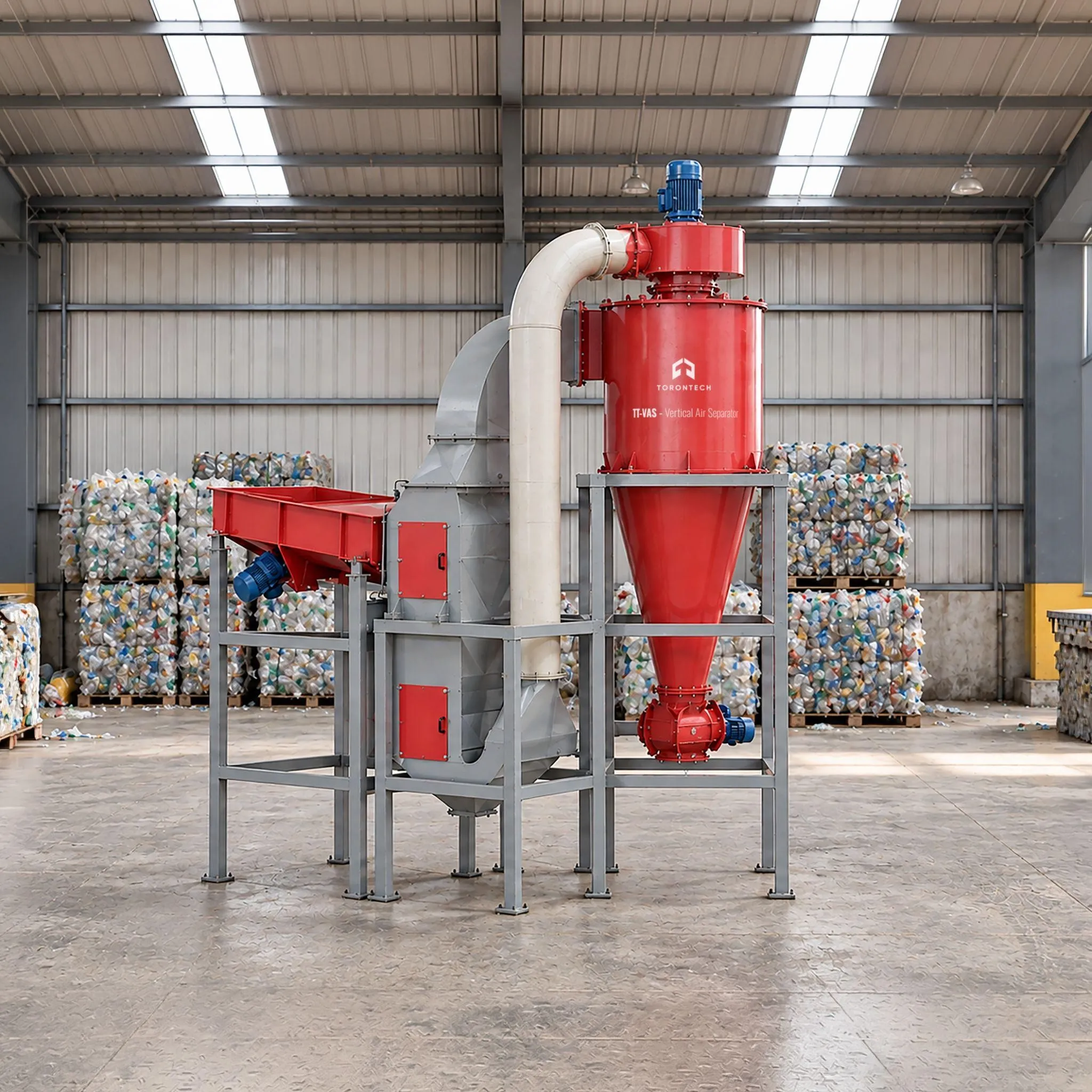
The vertical air separator lifts light contaminants (labels, film, dust) from the sized aluminum stream into a cyclone dust collector. A vibratory feeder distributes material into a Z-hopper, a centrifugal fan draws light particles upward, and heavy aluminum drops by gravity into the discharge.
- Function: light-fraction removal and dust extraction
- Design: Z-hopper vibratory feed, centrifugal fan, cyclone dust collector
Vertical Air Separator Specifications:
| Model | Air Blower | Feed Valve | Light Material Valve | Dust Valve | Capacity (t/h) |
|---|---|---|---|---|---|
| TT-VAS-43 | 20 to 30 HP | 2 HP | 2 HP | 2 HP | 4 to 5 |
| TT-VAS-86 | 40 HP | 3 HP | 1.5 HP | 3 HP | 8 to 10 |
Permanent Overband Magnet (Self-Cleaning)
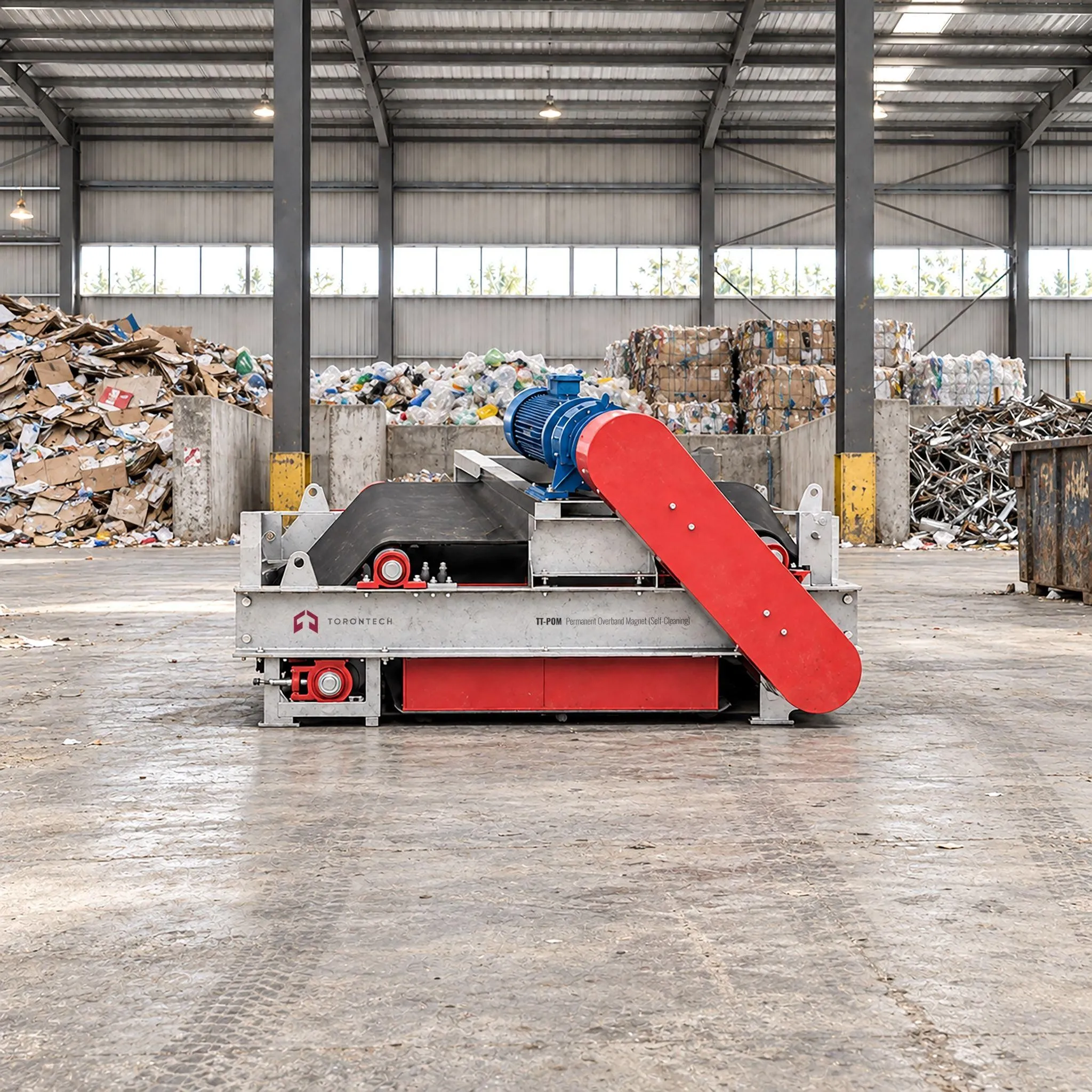
The self-cleaning permanent overband magnet removes ferrous fragments (steel closures, bimetal composites) from the aluminum stream continuously. Rare-earth NdFeB magnets deliver strong, stable field intensity without coil power or cooling, and a dedicated self-cleaning belt discharges captured iron to a side chute.
- Function: continuous ferrous removal from aluminum stream
- Magnet type: high-performance NdFeB (rare earth), no external excitation power required
- Structure: double-pole magnetic circuit, waist drum-shaped frame with automatic belt tracking
Permanent Overband Magnet Specifications:
| Model | Suitable Belt Width (mm) | Material Thickness (mm) | Suspended Height (mm) | Magnet Intensity | Power (kW) | Belt Speed | Overall Dimensions L×W×H (mm) | Ring Center Distance (mm) | Weight (kg) |
|---|---|---|---|---|---|---|---|---|---|
| TT-POM-5 | 500 | 80 | 150 | 63 mT | 1.5 | ≤2.5 m/s | 1650 × 835 × 940 | 1100 × 635 | 580 |
| TT-POM-6 | 600 | 125 | 200 | 1700 × 835 × 940 | 1150 × 735 | 700 | |||
| TT-POM-6.5 | 650 | 150 | 200 | 1750 × 985 × 940 | 1200 × 785 | 700 | |||
| TT-POM-8 | 800 | 200 | 250 | 70 mT | 2.2 | 1900 × 1140 × 960 | 1350 × 935 | 820 | |
| TT-POM-10 | 1000 | 250 | 300 | 3.0 | 2140 × 1350 × 1010 | 1590 × 1135 | 1220 | ||
| TT-POM-12 | 1200 | 300 | 350 | 4.0 | 2340 × 1550 × 1060 | 1790 × 1335 | 1420 | ||
| TT-POM-14 | 1400 | 350 | 400 | 5.5 | 2540 × 1750 × 1060 | 1990 × 1535 | 1730 | ||
| TT-POM-16 | 1600 | 400 | 450 | 7.5 | 3040 × 1550 × 860 | 2190 × 1335 | 2140 |
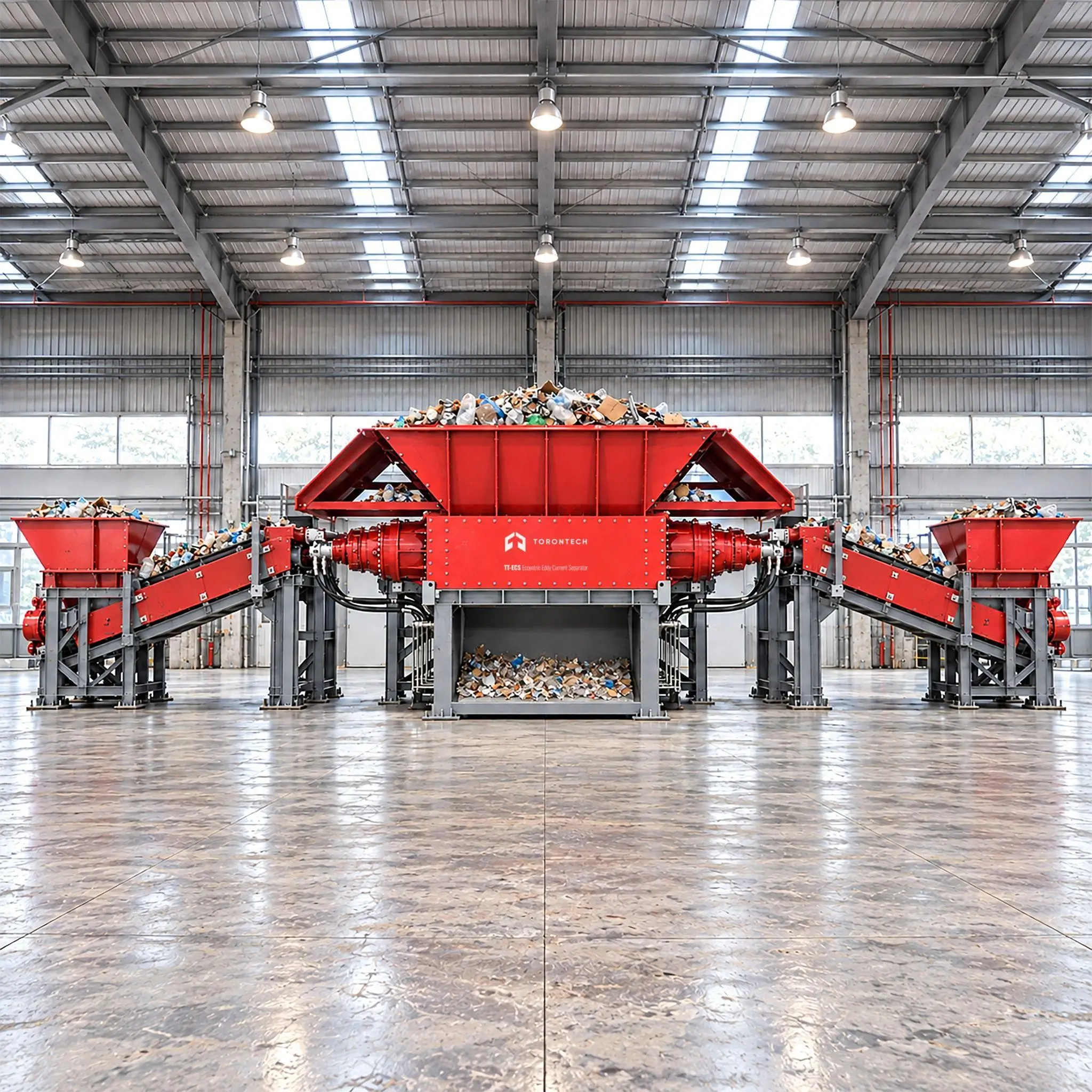
Eccentric Eddy Current Separator
The eccentric eddy current separator recovers aluminum from the non-magnetic stream. An eccentric rotor design places the magnetic pole close to the belt surface, giving a wider throw angle for small aluminum flakes than a concentric rotor design. A vibrating feeder plus adjustable baffle allows fine-tuning to the specific flake profile. For UBC applications, the high-frequency (H) rotor variant handles the finer aluminum fraction while the standard rotor handles coarse material.
- Rotor type: eccentric high-speed magnetic rotor
- Particle size range: ≥1 mm²
- Magnet material: NdFeB with anti-fall spray-plastic protection
- Recovery target: aluminum flakes and other non-ferrous metals
Eccentric Eddy Current Separator Specifications:
| Model | Feed Width (mm) | Feed Length (mm) | Particle Size | Capacity (m³/h) | Power (kW) | Weight (kg) | Length (mm) | Width (mm) | Height (mm) |
|---|---|---|---|---|---|---|---|---|---|
| TT-ECS-5 | 300 | 1500 | ≥1 mm² | 6 | 5.9 | 730 | 4600 | 1123 | 1200 |
| TT-ECS-6 | 400 | 10 | 5.9 | 895 | 1223 | ||||
| TT-ECS-8 | 600 | 20 | 5.9 | 1225 | 1623 | ||||
| TT-ECS-10 | 800 | 25 | 6.3 | 1555 | 1823 | ||||
| TT-ECS-12 | 1000 | 30 | 7.0 | 1875 | 2023 | ||||
| TT-ECS-14 | 1200 | 35 | 8.8 | 2275 | 2223 | ||||
| TT-ECS-16 | 1400 | 40 | 10 | 2850 | 2423 | ||||
| TT-ECS-20 | 1800 | 50 | 10.7 | 3650 | 5000 | 2823 | |||
| TT-ECS-22 | 2000 | 55 | 13 | 4500 | 3023 |
X-Ray Transmission Sorter
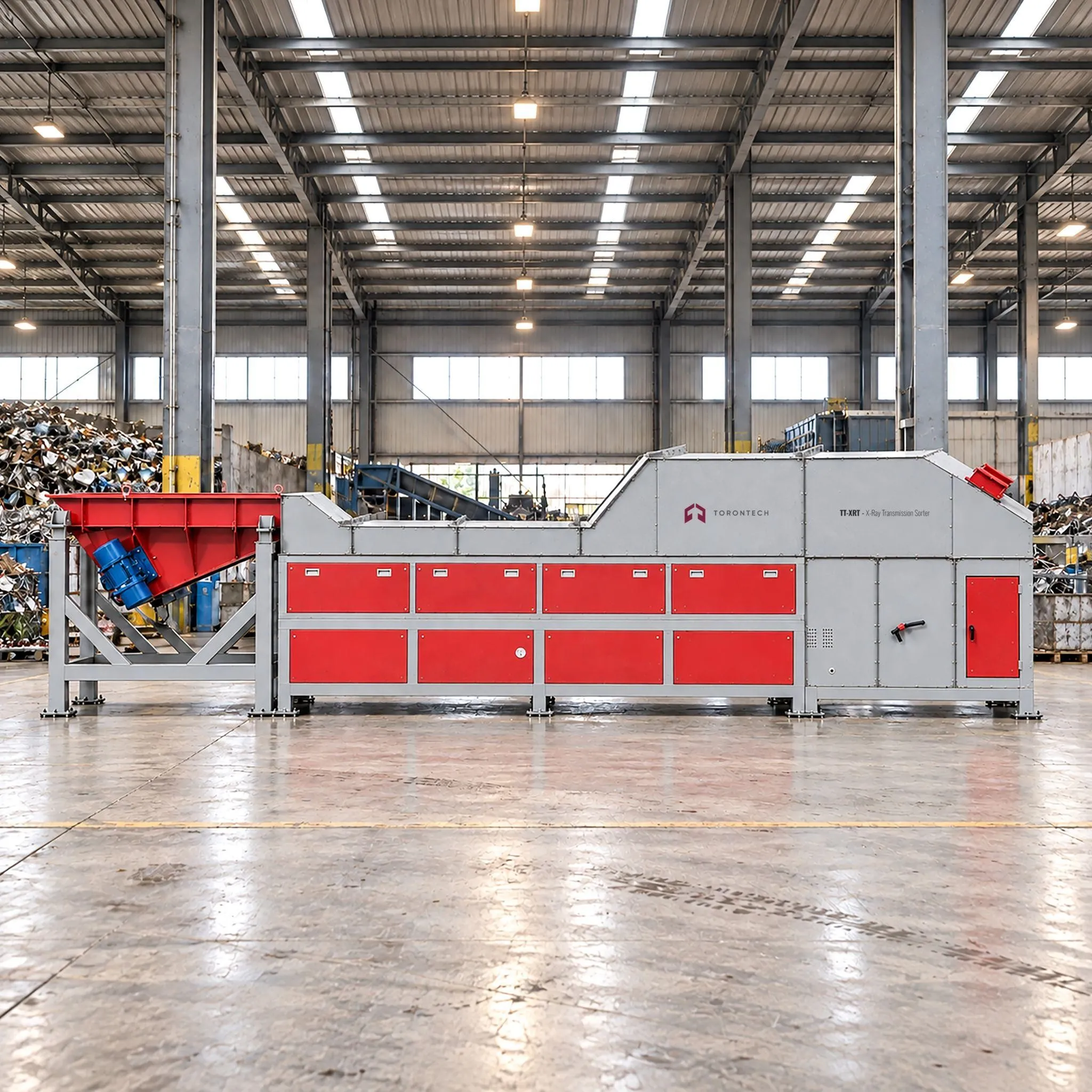
The X-Ray Transmission sorter provides final quality upgrade of the aluminum concentrate by rejecting any residual heavy metal contamination (copper wire from can tabs, lead-bearing fragments, bimetal composite pieces). Material passes on a conveyor belt between an X-ray emitter above and a set of LDA dual-energy receivers below, and a self-learning classifier reads the atomic-density signal and triggers a compressed-air jet valve at the belt head pulley to eject targeted particles.
- Detection method: dual-energy X-ray transmission with LDA receivers
- Classifier: self-learning system that accumulates material characteristic samples
- Typical UBC application: heavy metal contamination removal from aluminum concentrate
- Ejection: compressed-air jet valve array
X-Ray Transmission Sorter Specifications:
| Model | Belt Width (mm) | Raw Material Size (mm) | Capacity (t/h) | Power (kW) | Weight (t) | Machine Size L×W×H (mm) |
|---|---|---|---|---|---|---|
| TT-XRT-1200 | 1200 | 10 to 100 | 4 to 6 | 6.6 | 3 | 6000 × 1490 × 1780 |
| TT-XRT-1800 | 1800 | 6 to 8 | 6.6 | 4 | 6000 × 2090 × 1780 | |
| TT-XRT-2400 | 2400 | 8 to 10 | 6.6 | 5 | 6000 × 2690 × 1780 |
Chain Apron Conveyor and Belt Conveyors
Heavy-duty chain apron conveyors handle high-abrasion transfers (post-shredder discharge, ferrous byproduct), while belt conveyors handle the lighter-duty inter-stage transfers between sensor sorting modules. All conveyors are integrated into the central PLC control system for coordinated line operation.
- Chain apron function: high-abrasion transfer
- Belt conveyor function: light-duty inter-stage transfer
- Integration: full PLC coordination and safety interlocks
Electrical Control System
The line runs under a single PLC control system with automatic overload reverse control, interlock logic, and an operator HMI. All motors, sensors, and pneumatic actuators are wired to the central cabinet for coordinated operation and remote diagnostics.
- Controller: PLC-based programmable control
- Protection: automatic overload reverse, safety interlocks across the full line
- Interface: HMI touchscreen with process-status visualization
Technical Specifications
The UBC Recycling Line is engineered around the customer's input format (baled or loose UBC), throughput target, and output purity requirement. Primary shredding can be configured as twin-shaft plus single-shaft (standard UBC) or hammer mill (higher throughput or harder input).
| Parameter | Specification |
|---|---|
| Line Focus | Used beverage can shredding, sorting, and aluminum flake recovery |
| Typical Throughput Range | 2 to 15+ t/h (customer-specific) |
| Input Material | Baled or loose UBC, aluminum can scrap, light-gauge aluminum |
| Aluminum Recovery Yield | 95 to 98% under normal input conditions |
| Primary Shredding Options | Twin-shaft + single-shaft (standard) or hammer mill / vertical hammer mill |
| Ferrous Recovery Stage | Permanent overband magnet |
| Non-Ferrous Recovery Stages | Eccentric eddy current separator (with high-frequency variant for fine fraction) |
| Sensor-Based Sorting | X-ray transmission (dual-energy) for final quality upgrade |
| Size Classification | Rotary trommel screen |
| Light-Fraction Removal | Vertical air separator with cyclone dust collector |
| Control System | PLC with HMI touchscreen, full-line interlocks |
| Installation Options | Skid-mounted modules or civil-work integrated |
| Power Supply | 380 V / 50 Hz (customer voltage available on request) |
Each ToronUBC™ line is engineered to the customer's specific input profile and output purity targets. Contact the Torontech application engineering team for a site-specific process flow diagram and quotation.