
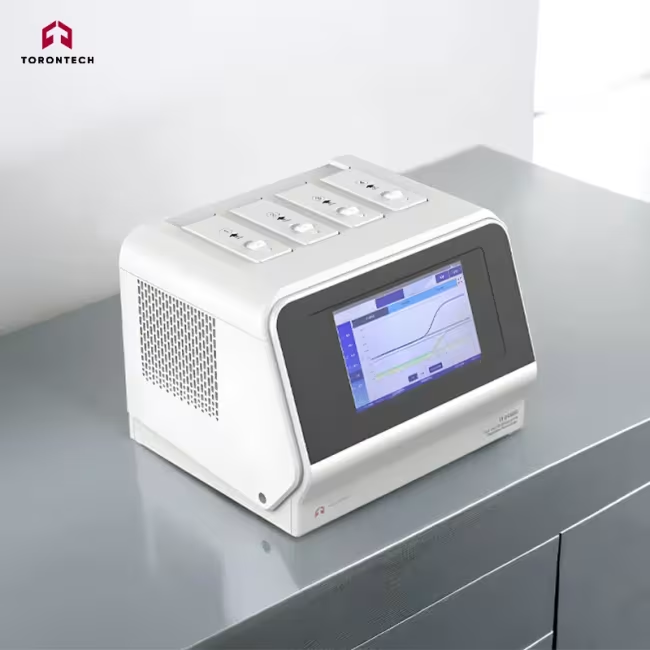
Real-Time PCR System (qPCR) – Quantitative Thermal Cycler TT-Q4505T
Real-Time PCR System (qPCR) – Quantitative Thermal Cycler TT-Q4505T is equipped with 4 independent wells and a 5-channel configuration, making it a versatile and efficient choice for quantitative PCR analysis.
Its innovative optical fiber detection system ensures faster imaging and reduces overall cycling time, delivering reliable results with exceptional speed and accuracy.
- Nucleic acid target detection and quantification
- Gene expression analysis
- Genotyping
- Agri-food safety testing
- Veterinary diagnostics
- Random access for flexible sample processing
- Exceptional sensitivity for low-concentration targets
- Rapid results with reduced cycling time
- Advanced optical system for enhanced detection
- Multiple fluorescent channels for diverse assays
- Accurate and consistent temperature control
- Cost-effective solution for laboratories
- User-friendly software interface
- Multiple data analysis modes for research needs
- Broad application range across various fields
- Collaboration-ready for research projects
- Comprehensive customer support
Core qPCR Quantification Theory
Instead of putting up with shaky baselines and messy readouts, the TT-Q4505T Real-Time PCR System blends the process of copying DNA strands with capturing high-speed snapshots of the glowing tracers while the reaction is still running.
Relying on an advanced optical fiber detection setup to speed up the imaging, this qPCR machine doesn’t just wait until the finish line to show you what occurred. It tracks the exact figures cycle-by-cycle right on a slick 7-inch touchscreen, removing the heavy math from the equation and handing you a stack of perfectly clear data.
Monitoring the Exponential Phase
The core strategy relies on tracking those fluorescent chemicals that shine brighter every time a fresh DNA sequence appears. Powered by a brilliant LED excitation source and sensitive photodiodes, our Real-Time PCR System records that light during the exact window where the signal is climbing fastest. This results in noticeably sharper and more distinct peaks for your analysis.
Quantification Cycle (Cq/Ct) Methodology
We are looking for that precise instant where the fluorescence finally jumps up from the background static. It is a lot like spotting a bright flashlight in a pitch-black room. That specific cycle number tells you exactly how much starting material you dropped into the tube at the very beginning, providing enough precision to spot concentration differences as small as 1.5-fold.
Sensitivity and Measurement Range
When everything is dialed in just right, you can spot even a single, solitary copy of a target gene. It stays incredibly accurate across a huge spread of sample amounts. To be specific, we are talking about 10 solid logs of linear dynamic range without the usual headaches often found in lesser systems.
Thermal Cycling Engineering and Performance
The way the TT-Q4505T Quantitative Thermal Cycler handles the temperature is something else entirely. Most of those standard benchtop blocks take ages to warm up or cool off, but this compact 7.5 kg unit is built to move fast and deliver honest, predictable results the entire way through.
Hitting maximum heating rates of 7.0°C per second and cooling at 6.5°C per second, it zips between the hot, medium, and cool stages so quickly it might make your head spin. While other models use basic metal chunks that hold onto warmth for far too long, our 45-well, 0.2mL block utilizes zippy thermal-pump components that make sure every single reaction stays at the exact same heat level simultaneously.
With a temperature uniformity of ±0.25°C and an accuracy of ±0.15°C, there is zero chance of one tube being warmer than the other. It is totally even, keeping the whole 20–120 µL reaction volume moving along without a single glitch so you aren't left guessing.
Fluorescence Readout Modes and Detection Channels
You have multiple ways to see what is occurring inside the tubes, and our 5-channel configuration keeps an eye on the fluorescence in a way that is spot on. It is sensitive enough to catch every detail but not so loud that it washes out the fine data.
- Non-Specific Intercalating Dyes: These little chemical markers grab onto any double-stranded DNA they come across. It is affordable, it is straightforward, and it works like a charm. You will just want to look at the final "melt curve" on your screen to verify you didn’t accidentally multiply some genetic junk.
- Sequence-Specific Probes: These act like heat-seeking missiles for your specific gene. They only light up when they find a flawless match. Because the TT-Q4505T is loaded with 5 distinct dye channel filters, you can look for multiple different targets at once in the exact same tube without the optical signals getting all tangled up. It is snappy, it is incredibly smart, and it gets you from a tiny drop of sample to a mountain of crystal-clear data.
| Model | TT-Q4505T |
|---|---|
| Product description | 4-well Real-Time PCR instrument with 5 dye channel filters & 7-inch touchscreen |
| Sample capacity | 4-well, 0.2mL block |
| Compatible plates/tubes | Single tube |
| Reaction volume | 20–120 µL |
| Excitation source | LED |
| Excitation range | 475–670 nm |
| Detection method | Photodiodes |
| Detection range | 515–680 nm |
| Detection channels | 5 |
| Temperature range | 4–100°C |
| Average heating/cooling rate | 5.0°C/sec / 5.5°C/sec |
| Maximum heating/cooling rate | 7.0°C/sec / 6.5°C/sec |
| Temperature uniformity | ±0.25°C |
| Temperature accuracy | ±0.15°C |
| Detection sensitivity | 1 copy |
| Sensitivity | Detect differences as small as 1.5-fold in target quantities in singleplex reactions |
| Dynamic range | 10 logs of linear dynamic range |
| Footprint (W × D × H) | 30.0 × 26.5 × 25.0 cm |
| Weight | 7.5 kg |
