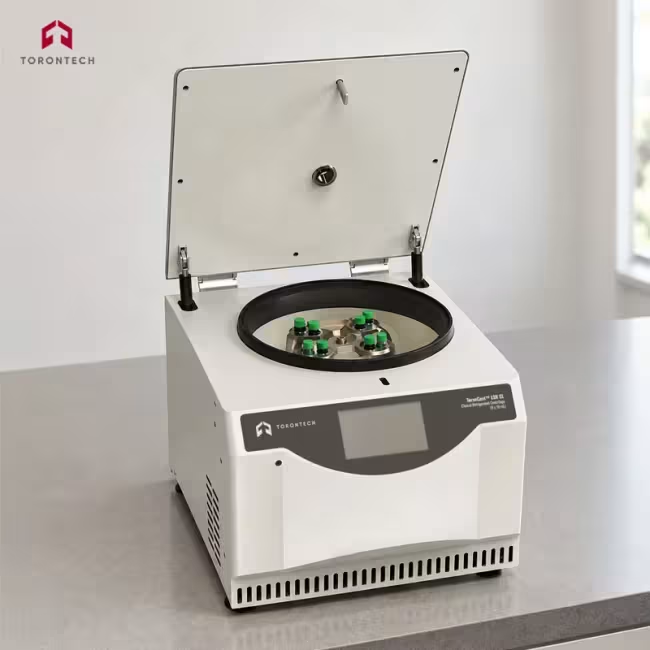
Low Speed Refrigerated Centrifuges
Temperature-controlled separation, from 10 mL clinical tubes to 4 x 750 mL bottles.
Low speed refrigerated centrifuges separate blood, cell suspensions, and other temperature-sensitive samples while holding the chamber at a set temperature through the whole run. Clinical laboratories, blood collection programs, and molecular diagnostics teams use them because several analytes shift within an hour at ambient temperature. This range spans 8 x 10 mL clinical tubes up to 4 x 750 mL bottles.
Rotor choice sets what each unit does. Swing-out rotors give a flat pellet and a level plasma interface for component work, while angle rotors trade that for higher speed and a shorter run. Every model here covers a -20°C to 40°C setting range, so a 4°C protocol transfers across the lineup.
Why Choose Torontech for Your Low Speed Refrigerated Centrifuge
Torontech supplies testing and measurement equipment to laboratories, quality teams, and manufacturers, backed by responsive technical support and calibration service. The Low Speed Refrigerated Centrifuge range is built for reliable, standards-driven results, so you can source confidently from a single partner. Our team helps you match the right configuration to your samples, applicable standards, and throughput, then supports you through installation and beyond.
Request a Quote
Tell us your sample volumes, the tube formats you run most, and the temperature your protocol calls for, and we will point you to the right model and rotor combination. Contact the Torontech team for pricing, configuration, and lead times.
Applications
Low speed refrigerated centrifugation supports sample preparation wherever the separation has to happen cold, from a hospital laboratory to a collection vehicle parked at a blood drive.
- Clinical Diagnostics: serum and plasma separation from vacuum blood collection tubes before analyzer loading
- Blood Banking and Component Preparation: separating plasma, platelets, and packed cells from large-volume collections
- Molecular Diagnostics: nucleic acid tube processing for extraction and PCR sample preparation
- Cell Culture: harvesting suspension cells from media without exposing them to ambient warming
- Hormone and Labile Analyte Testing: chilled separation for analytes that degrade at room temperature
- Cytology and Urinalysis: low-speed sedimentation of body fluids ahead of slide preparation
- Mobile Collection Programs: on-vehicle processing at blood drives and outreach sites
- Pharmaceutical and Biotech QC: clarification of in-process samples under documented temperature conditions
Low Speed Refrigerated Centrifuge Range
Four models cover the range, separated mainly by sample volume and by how tight the temperature control needs to be. Speed and RCF figures are listed by rotor, since the maximum speed and the maximum capacity usually belong to different rotors on the same machine.
| Model | Max Capacity | Speed and RCF by Rotor | Description |
|---|---|---|---|
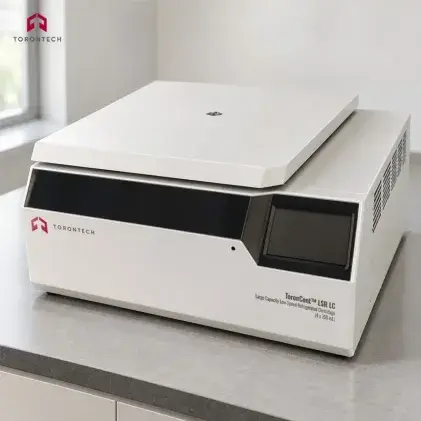
| Large Capacity Low Speed Refrigerated Centrifuge (ToronCent™ LSR LC) | 4 x 750 mL | Swing rotor 4,000 rpm / 3,500 x g; angle rotor 5,500 rpm / 4,904 x g | The high-volume unit in the range, taking 3 liters per cycle across four 750 mL buckets. A 7-inch touchscreen, 100-program memory, and ±0.5°C control suit blood component preparation and large-batch clinical work. Aerosol-tight buckets are available for biohazardous samples. |
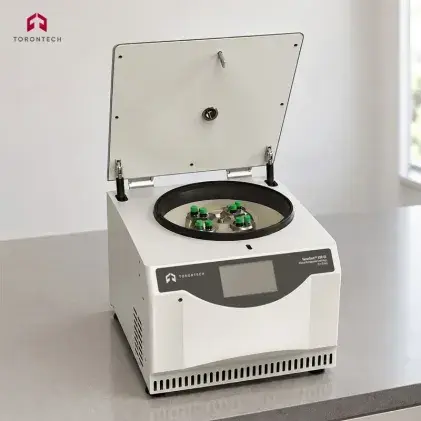
| Low Speed Refrigerated Centrifuge (ToronCent™ LSR) | 4 x 250 mL | Swing rotor 4,500 rpm / 4,080 x g; 4 x 100 mL rotor 5,300 rpm / 5,010 x g | A four-rotor platform covering tubes, bottles, and microplates on one drive, including a rotor that holds twelve 96-well ELISA plates. Suits general laboratory work where sample formats change from run to run. |
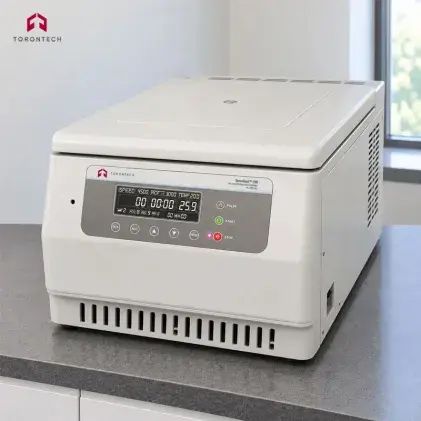
| Clinical Refrigerated Centrifuge (ToronCent™ LSR CL) | 8 x 10 mL | Swing rotor 5,000 rpm / 3,354 x g | The compact model at 30 kg and 400 x 470 mm, with suction-cup feet and a sealed rotary compressor for mobile collection vehicles. Holds 12 vacuum tubes in 5 mL or 7 mL format, or 8 tubes at 10 mL. |
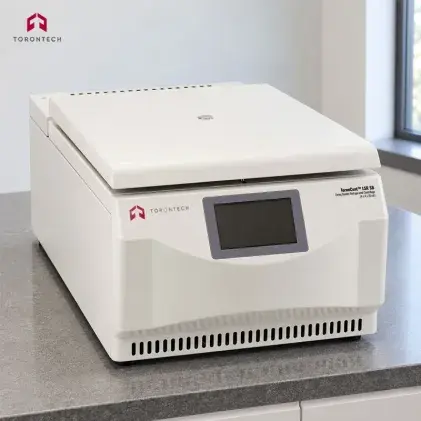
| Swing Bucket Refrigerated Centrifuge (ToronCent™ LSR SB) | 4 x 4 x 15 mL | Swing rotor 4,200 rpm / 2,958 x g; angle rotor 5,000 rpm / 3,555 x g | A stainless-chamber unit that accepts both a swing rotor (16 x 15 mL) and an angle rotor (12 x 15 mL). Nested brackets and adapters cover 0.5 mL through 50 mL, including nucleic acid centrifuge tubes. |
How to Choose the Right Low Speed Refrigerated Centrifuge
- For blood component preparation and large batches: choose the 4 x 750 mL model, the only unit in the range that takes blood-bag-scale buckets.
- For mixed tube, bottle, and microplate work: choose the 4 x 250 mL model, which carries a dedicated microplate rotor alongside three tube rotors.
- For mobile blood drives and collection vehicles: choose the 8 x 10 mL clinical model, built at 30 kg with suction-cup mounting for a moving platform.
- For molecular diagnostics and nucleic acid tubes: choose the 4 x 4 x 15 mL swing bucket model, with brackets sized for nucleic acid centrifuge tubes.
- For the tightest temperature control: choose the 4 x 750 mL model at ±0.5°C, ahead of ±1°C on the 250 mL and 15 mL units and ±2°C on the clinical unit.
- For the highest g-force in a compact footprint: choose the 4 x 250 mL model, which reaches 5,010 x g on its 4 x 100 mL rotor.
- For a clean plasma interface: choose any model with a swing rotor, since horizontal buckets pack a flat pellet under a level boundary.