
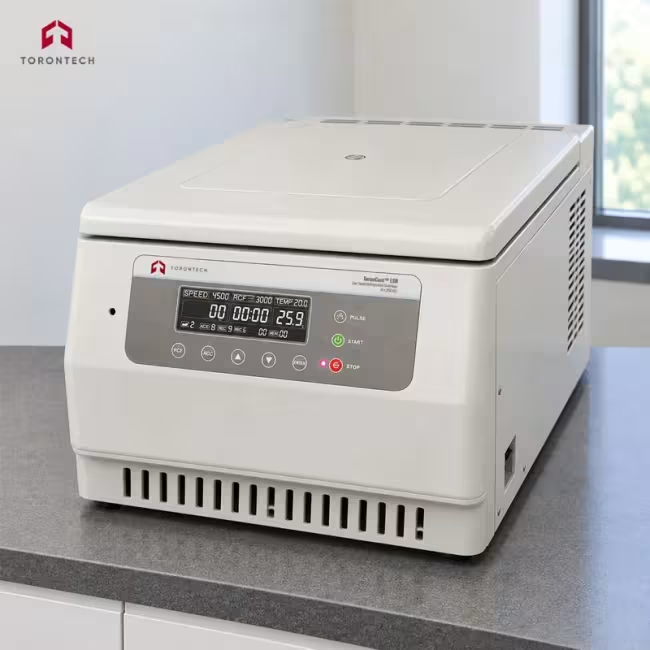
Low Speed Refrigerated Centrifuge (4 x 250 mL)
Low Speed Refrigerated Centrifuge (4 x 250 mL) - ToronCent™ LSR
ToronCent™ LSR is a low speed refrigerated centrifuge for clinical, genetics, and cytology laboratories that separate temperature-sensitive samples at moderate speeds. Rotor choice sets the working envelope: the 4 x 100 mL rotor reaches 5,300 rpm and 5,010 x g, while the swing-out rotor carries 4 x 250 mL at 4,500 rpm. Chamber temperature holds from -20°C to 40°C, and the machine stays below -4°C with the rotor at top speed. Brackets and adapters cover 1.5 mL microtubes through 250 mL bottles, plus ELISA and deep-well plates.
Refrigeration performance is where low speed centrifuges separate from one another. The unit uses a non-CFC refrigerant and a convertible-frequency refrigeration system under PID control, a patented arrangement that trims compressor output to the actual thermal load rather than cycling on and off. Temperature accuracy reaches ±0.5°C at a 4°C setpoint, the condition most clinical protocols run at. The compressor also keeps acoustic output at or below 65 dB(A), quiet enough for an open bench.
Microprocessor control drives a high-torque frequency-conversion motor directly, with no belt and no carbon brushes to replace. Operators store multiple user-defined programs, and the controller calculates RCF automatically so protocols written in x g need no manual conversion. Nine acceleration and ten deceleration rates let the operator match ramp rates to sample fragility. Self-diagnostics monitor door interlock status, over-speed conditions, and motor temperature, and stop the run when any of the three falls outside limits.
Low Speed Refrigerated Centrifuge (4 x 250 mL) - ToronCent™ LSR Applications
The ToronCent™ LSR handles the routine separations that clinical and life science laboratories run every day, from single tubes to full plate batches. Four interchangeable rotors let one instrument cover tube, bottle, and microplate formats.
- Clinical Diagnostics: serum and plasma separation from vacuum blood collection tubes, with adapters for 5 mL, 7 mL, and 10 mL formats under temperature control
- Plasma and Blood Component Preparation: swing-out buckets settle a flat cell layer with a clean plasma boundary, which raises recovery volume and cuts cell carryover
- Genetics and Molecular Biology: pelleting of nucleic acid and protein precipitates in microtubes and conical tubes, cooled to limit degradation across long spins
- Cytology: low-speed sedimentation of body fluid and urine samples ahead of slide preparation and microscopic review
- Cell Culture Work: gentle harvesting of suspension cells from media in 15 mL through 250 mL formats without exposing them to ambient warming
- ELISA and Plate-Based Assays: the microplate rotor spins up to twelve 96-well ELISA plates, four deep-well plates, or filter plate reagent kits per run
- Microbiology: concentration of cell suspensions and culture supernatants in bracket-mounted tubes before staining or plating
- Pharmaceutical and Biotech Quality Control: clarification of in-process samples and reagent preparations under documented temperature conditions
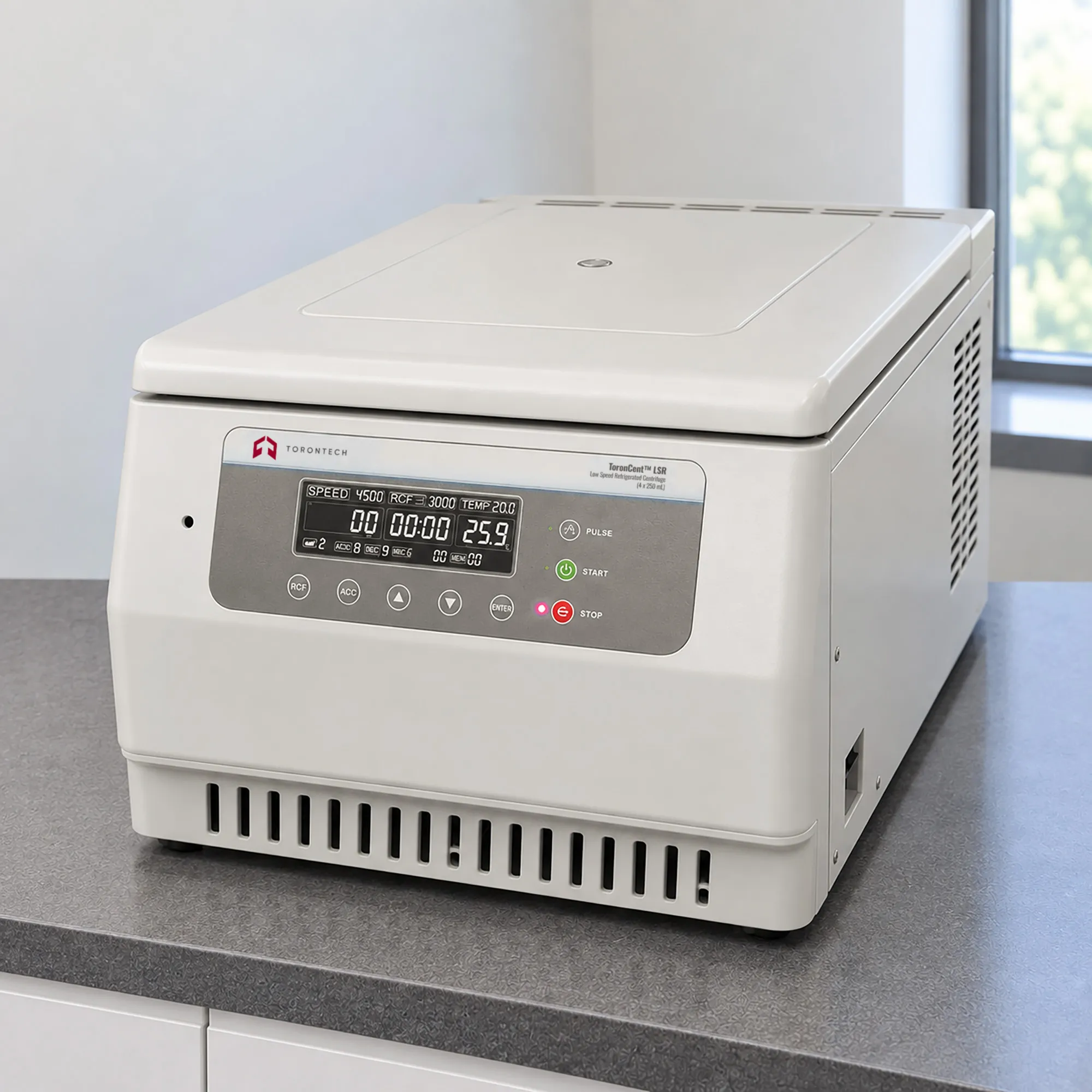
Low Speed Refrigerated Centrifuge (4 x 250 mL) - ToronCent™ LSR Key Features
The ToronCent™ LSR pairs a patented refrigeration circuit with direct-drive control and layered fault protection. The feature set below reflects the standard configuration.
- Non-CFC Refrigerant System: refrigeration built around a non-ozone-depleting refrigerant, meeting current environmental requirements without giving up cooling capacity
- Patented PID Compressor Control: dynamic intelligent temperature regulation holds ±0.5°C at a 4°C setpoint, the range most clinical and biological protocols call for
- Cooling Held at Maximum Speed: chamber temperature stays below -4°C with the rotor at 5,300 rpm, so long runs do not warm the sample
- Direct-Drive Frequency-Conversion Motor: the high-torque brushless drive uses no belt and no carbon brushes, removing brush dust and a scheduled wear part from the maintenance list
- Microprocessor Control with Program Storage: multiple user-defined programs save and recall, so repeat protocols run the same way across operators and shifts
- Automatic RCF Calculation: the controller converts between rpm and x g using the installed rotor radius, removing a manual conversion step and the arithmetic errors that come with it
- 9 Acceleration and 10 Deceleration Rates: ramp control lets the operator slow the stop for layered separations, or speed it up for routine pelleting
- Multi-Point Self-Diagnostic Protection: interlocks watch door status, over-speed conditions, and motor overheating, and halt the run before a fault reaches the sample or the operator
- Low Acoustic Output: the refrigeration compressor runs at or below 65 dB(A), quiet enough for an open bench in a shared laboratory
- Four Interchangeable Rotors: a 4 x 100 mL rotor, a 4 x 200 mL bracket rotor, a microplate rotor, and a 4 x 250 mL swing-out rotor all run on the same drive
- Broad Bracket and Adapter Range: covers 1.5 mL microtubes, 5 mL and 7 mL vacuum tubes, accretion tubes, 15 mL to 50 mL conical tubes, 100 mL and 250 mL bottles, and 96-well plates
- Benchtop Footprint: 470 × 730 × 380 mm at 70 kg, sized for standard laboratory bench depth
Theory and Method
Speed and force are not the same number, which is why the controller converts between them. Relative centrifugal force is the acceleration a sample experiences as a multiple of gravity, scaling with rotating radius and the square of rotational speed: RCF = 1.118 x 10⁻⁵ x r x N². The 4 x 100 mL rotor produces 5,010 x g at 5,300 rpm, while the swing-out rotor reaches 4,080 x g at only 4,500 rpm because its buckets swing out to a longer working radius.
Every centrifuge run puts heat into the chamber. Air trapped between the spinning rotor and the chamber wall shears against both surfaces, and that viscous drag converts motor work into heat at a rate climbing steeply with speed. Bearing friction adds to the load. A refrigeration system rated only at low speed drifts once the rotor is at maximum, so the number that matters is the temperature held at top speed, below -4°C here.
Rotor geometry changes both the distance a particle travels and the shape of the pellet. Tubes held at a slant give particles a short path to the outer wall, where they slide into an angled pellet, which shortens run time. Swing-out buckets rotate to horizontal under load, giving particles the full tube length to travel and producing a flat, evenly packed pellet with a sharp interface. Plasma and buffy coat recovery depends on that interface, which is why the swing-out configuration suits component preparation.
Low Speed Refrigerated Centrifuge (4 x 250 mL) - ToronCent™ LSR Technical Specifications
| Parameter | Specification |
|---|---|
| Max Speed | 5,300 rpm |
| Max RCF | 5,010 x g |
| Max Capacity | 4 x 250 mL |
| Speed Accuracy | ±30 rpm |
| Time Setting Range | 1 min to 99 min |
| Temperature Setting Range | -20°C to 40°C |
| Temperature Accuracy | ±1°C (±0.5°C at a 4°C setpoint) |
| Temperature at Maximum Speed | Below -4°C |
| Compressor Unit | Convertible frequency refrigeration system, non-CFC refrigerant |
| Drive | Direct-drive high-torque frequency-conversion motor |
| Control | Microprocessor, programmable with multiple user-defined programs |
| RCF Calculation | Automatic |
| Acceleration / Deceleration | 9 acceleration rates / 10 deceleration rates |
| Safety Protection | Door interlock, over-speed, motor overheating self-diagnostics |
| Noise | ≤65 dB(A) |
| Voltage | AC 220 V ±22 V, 50/60 Hz (110V is also available) |
| Power Consumption | 1,200 W |
| Dimensions (W x D x H) | 470 × 730 × 380 mm |
| Packing Dimensions (W x D x H) | 547 × 960 × 422 mm |
| Net Weight | 70 kg |
Rotor Options
| Rotor | Type | Max Speed | Max RCF | Max Capacity |
|---|---|---|---|---|
| Rotor 1 | Bracket rotor | 5,300 rpm | 5,010 x g | 4 x 100 mL |
| Rotor 2 | Bracket rotor | 4,500 rpm | 3,560 x g | 4 x 200 mL |
| Rotor 3 | Microplate rotor | 4,000 rpm | 2,200 x g | 2 x 2 x 96-well |
| Rotor 4 | Swing-out rotor | 4,500 rpm | 4,080 x g | 4 x 250 mL |
Rotor 1 Brackets and Adapters
| Bracket | Adapter Capacity |
|---|---|
| 4 x 100 mL bracket | 4 x 50 mL |
| 4 x 100 mL bracket | 4 x 50 mL (conical) |
| 4 x 100 mL bracket | 4 x 30 mL |
| 4 x 100 mL bracket | 4 x 20 mL |
| 4 x 100 mL bracket | 4 x 15 mL |
| 4 x 100 mL bracket | 4 x 15 mL (conical) |
| 4 x 100 mL bracket | 4 x 2 x 10 mL |
| 4 x 100 mL bracket | 4 x 3 x 5 mL vacuum tube |
| 4 x 100 mL bracket | 4 x 4 accretion tube |
| 4 x 100 mL bracket | 4 x 3 x 1.5 mL |
Rotor 2 Brackets and Adapters
| Bracket | Adapter Capacity |
|---|---|
| 4 x 2 x 100 mL bracket | 4 x 2 x 50 mL |
| 4 x 2 x 100 mL bracket | 4 x 2 x 50 mL (conical) |
| 4 x 2 x 100 mL bracket | 4 x 2 x 30 mL |
| 4 x 2 x 100 mL bracket | 4 x 2 x 20 mL |
| 4 x 2 x 100 mL bracket | 4 x 2 x 15 mL |
| 4 x 2 x 100 mL bracket | 4 x 2 x 15 mL (conical) |
| 4 x 2 x 100 mL bracket | 4 x 4 x 10 mL |
| 4 x 2 x 100 mL bracket | 4 x 6 x 5 mL vacuum tube |
| 4 x 2 x 100 mL bracket | 8 x 4 accretion tube |
| 4 x 2 x 100 mL bracket | 8 x 3 x 1.5 mL |
| 4 x 8 x 15 mL bracket | 10 mL adapter |
| 4 x 8 x 15 mL bracket | 7 mL adapter |
| 4 x 8 x 15 mL bracket | 5 mL adapter |
| 4 x 2 x 50 mL bracket | Customized on request |
Rotor 3 Microplate Carriers
| Carrier | Capacity |
|---|---|
| ELISA microplate | 2 x 6 x 96-well (12 plates per run) |
| Deep-well plate | 2 x 2 x 96-well (4 plates per run) |
| Filter plate reagent kit | 2 x 1 x 96-well (2 plates per run) |
Rotor 4 Buckets and Adapters
| Bucket | Adapter Capacity |
|---|---|
| Round bucket | 4 x 1 x 100 mL |
| Round bucket | 4 x 1 x 50 mL (conical or round) |
| Round bucket | 4 x 4 x 20 mL |
| Round bucket | 4 x 4 x 15 mL (conical) |
| Round bucket | 4 x 6 x 15 mL |
| Round bucket | 4 x 7 x 10 mL |
| Round bucket | 4 x 10 x 5 mL |
| Round bucket | 4 x 8 x 1.5 mL |
| Rectangular bucket | 4 x 1 x 250 mL |
| Rectangular bucket | 4 x 4 x 50 mL (conical) |
| Rectangular bucket | 4 x 7 x 15 mL (conical) |
| Rectangular bucket | 4 x 9 x 10 mL |
| Rectangular bucket | 4 x 9 x 5 mL |
| Rectangular bucket | 4 x 15 x 1.5 mL |
Additional rotor, bracket, and adapter configurations can be customized on request.