Coefficient of Friction Tester
Coefficient of Friction Tester
Three COF testers, two methods: static and kinetic friction for films, foils, paper, and board.
A coefficient of friction tester measures how easily two surfaces slide against each other, reported as the coefficient of friction (COF). It matters for films, foils, paper, and board, where surface slip affects how materials feed, stack, open, and stay stable on a pallet. The ToronCOF™ range covers static and kinetic COF across two measurement methods.
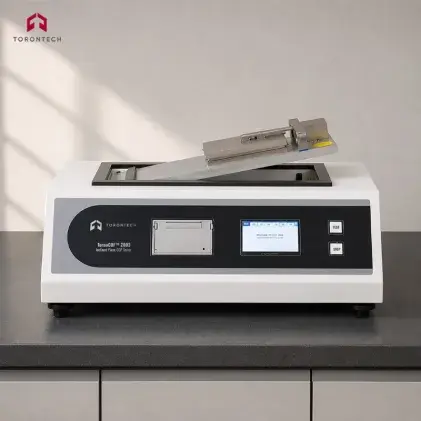
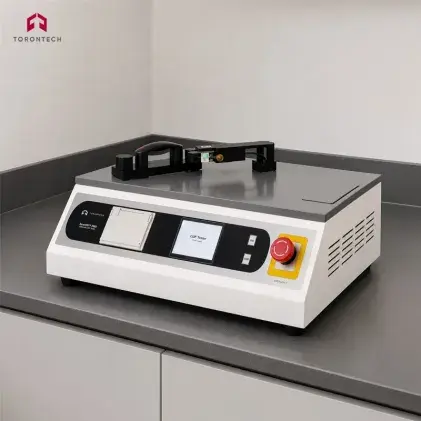
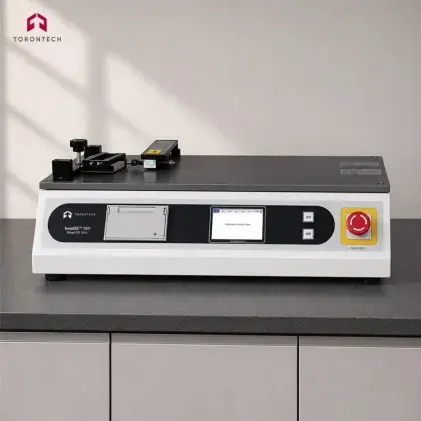
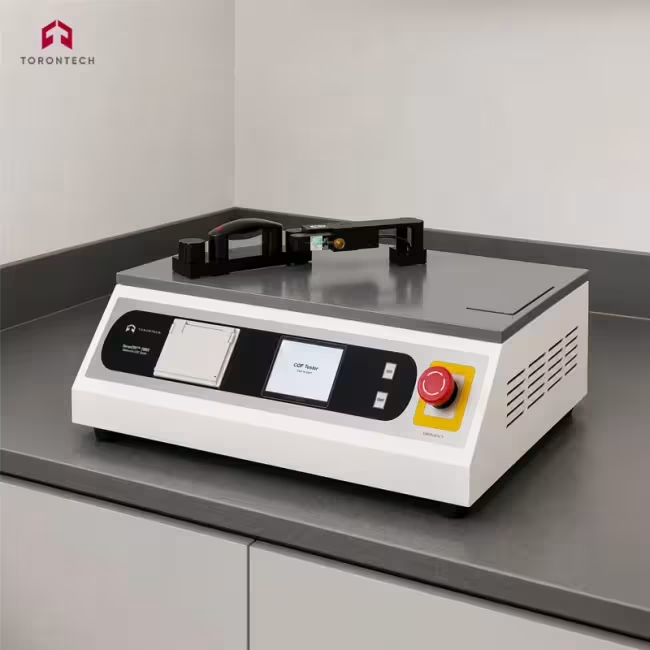
Horizontal sled models pull a weighted sled across the specimen and report both static and kinetic COF per ASTM D1894 and ISO 8295. The inclined plane model reads the static coefficient from the slip angle. Choose the model by the method your standard calls for and the level of automation you need.
Why Choose Torontech for Your Coefficient of Friction Tester
Torontech supplies testing and measurement equipment to laboratories and manufacturers across North America and worldwide, backed by responsive technical support and calibration service. The coefficient of friction tester range is built for reliable, standards-driven results, so you can standardize on one supplier as your testing needs grow. Our team helps you match the right configuration to your samples, applicable standards, and throughput, then supports you through installation and beyond.
Request a Quote
Tell us your material, the standard you test to, and whether you need static or kinetic values, and we will recommend the right coefficient of friction tester for your lab. Contact the Torontech team for pricing and lead times.
Applications
Coefficient of friction testing supports quality control and product development wherever surface slip affects handling and performance.
- Plastic Films and Flexible Packaging: measures the slip of films that must feed, stack, and open consistently on packaging lines.
- Paper, Board, and Corrugated: tests friction for stacking, conveying, and pallet stability.
- Foils and Metallized Films: measures the surface slip of foils and metallized structures.
- Films with Slip Additives: verifies the effect of slip and anti-block additives on surface friction.
- Converting and Printing Lines: supports process control where sheet slip affects feeding.
- Research and Quality Control: quantifies surface friction for material development and incoming inspection.
Coefficient of Friction Tester Range
The ToronCOF™ range spans three models across two measurement methods. Use the table to match a model to your method, standard, and level of automation.
| Model | Method | Coefficients | Highlights | Best For |
|---|---|---|---|---|
| ToronCOF™ 2001 | Horizontal sled | Static and kinetic | Preset speeds (100 / 150 mm/min), 5 N load cell | Entry-level, routine QC |
| ToronCOF™ 2002 | Horizontal sled | Static and kinetic | Variable speed 1 to 500 mm/min, four built-in standards | Automatic, multi-standard testing |
| ToronCOF™ 2003 | Inclined plane | Static only | Slip-angle measurement, no pulling force | Static COF by the slip-angle method |
How to Choose the Right Coefficient of Friction Tester
- For routine, single-standard COF testing: choose the ToronCOF™ 2001, with preset ASTM and ISO speeds and a 5N load cell.
- For variable-speed, multi-standard testing: choose the ToronCOF™ 2002, which runs 1 to 500 mm/min with four built-in test-standard modes.
- For static COF by the slip-angle method: choose the ToronCOF™ 2003, which reads the static coefficient from the angle at which the specimen slips.
- For both static and kinetic values: choose a horizontal sled model, the 2001 or the 2002.
- For higher automation and reporting: step up to the 2002 and add the optional analysis software.