
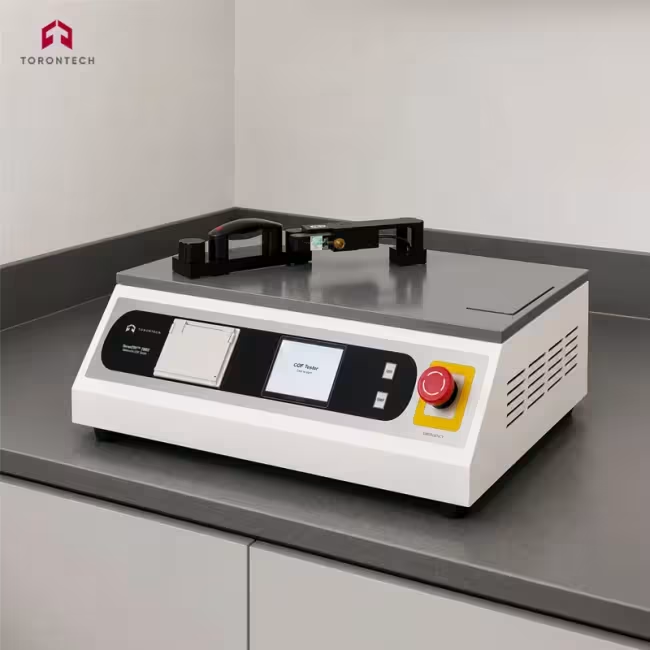
Automatic COF Tester
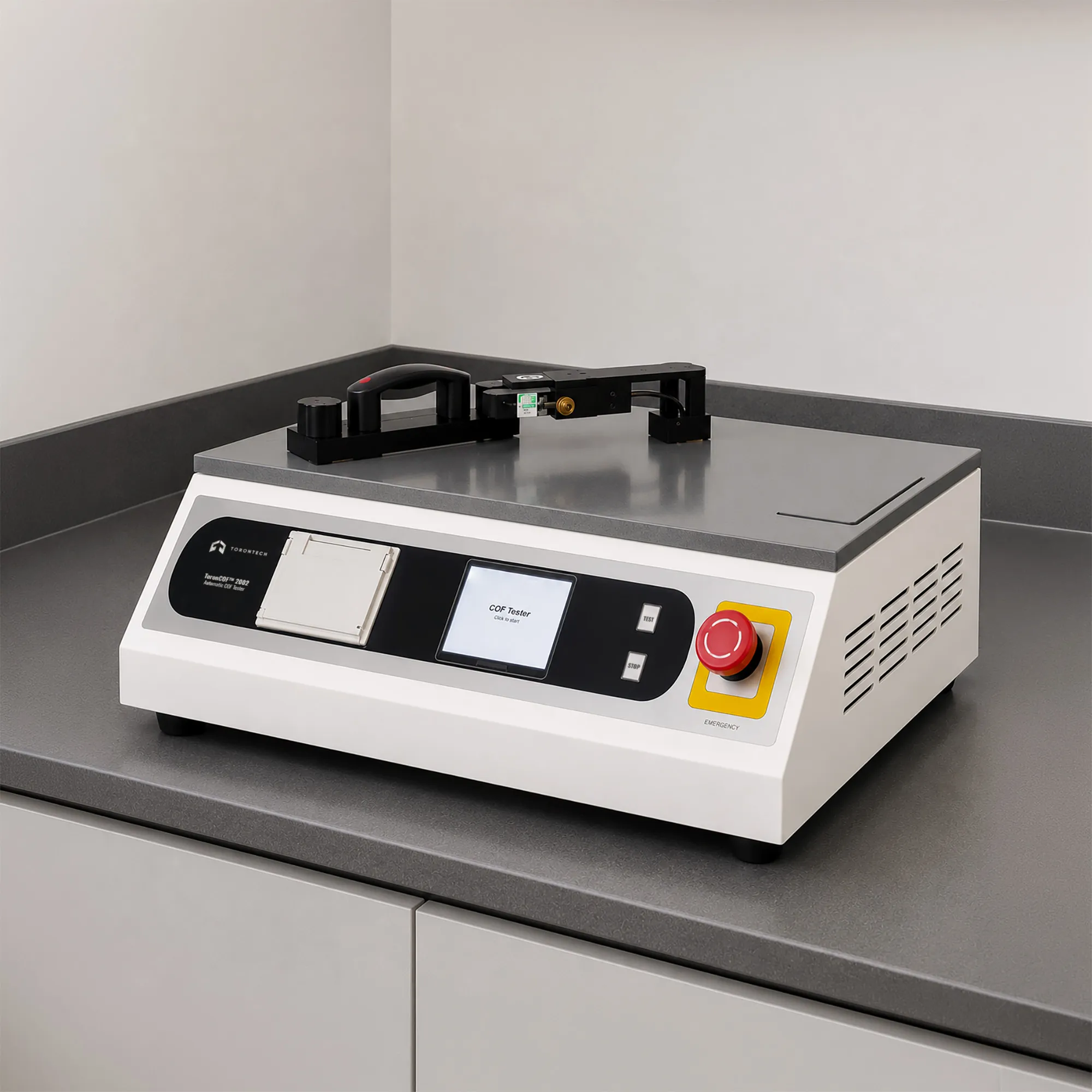
Automatic COF Tester - ToronCOF™ 2002
Static and Kinetic COF Tester with Four Built-In Test Standards
The ToronCOF™ 2002 is an automatic coefficient of friction tester that measures the static and kinetic coefficients of friction of plastic films, laminated films, foils, paper, paperboard, and many other materials. The instrument uses the horizontal sled method, pulling a weighted sled across the specimen while a load cell reads the drag force. An AC-servo drive and a high-accuracy load cell give steady speed and precise force measurement. Built around methods such as ASTM D1894 and ISO 8295, it serves packaging, film, and materials labs.
Four built-in test-standard modes let the ToronCOF™ 2002 start a standard or custom test quickly, and both static and kinetic friction are measured in one run. A color touchscreen sets test parameters, a 5N standard load cell covers light films with 10N to 30N options, and test speed sets over 1 to 500 mm/min. The adjustable moving beam accepts specimens of different thickness.
Built-in statistical analysis and a micro-printer handle results at the bench, and compatibility with standard and non-standard sleds matches different methods and materials. Optional computer software adds curve display, group testing, and reporting. The ToronCOF™ 2002 (Static and Kinetic COF Tester) suits packaging, food, pharmaceutical, and materials QC and R&D labs.
Automatic COF Tester - ToronCOF™ 2002 Applications
The ToronCOF™ 2002 measures surface friction across films, packaging, paper, and related materials.
- Plastic Films and Sheets: measures static and kinetic COF of mono and multilayer films that must feed and slip consistently.
- Laminates and Flexible Packaging: checks the slip behavior of laminated and coated packaging films.
- Paper and Paperboard: measures the friction of papers, board, and corrugated for stacking and conveying.
- Foils and Metallized Films: tests the surface slip of foils and metallized structures.
- Films with Slip Additives: verifies the effect of slip and anti-block additives on surface friction.
- Converting and Bag-Making Lines: supports process control where film slip affects feeding and forming.
- Rubber, Coatings, and Sheets: measures the friction of rubber, coated surfaces, and sheet materials.
- Research and Quality Control: quantifies surface friction for material development and incoming inspection.
Standards
The ToronCOF™ 2002 is designed to align with internationally recognized standards for coefficient of friction testing by the horizontal sled method.
- ASTM D1894 - Standard Test Method for Static and Kinetic Coefficients of Friction of Plastic Film and Sheeting
- ISO 8295 - Plastics: Film and Sheeting: Determination of the Coefficients of Friction
- TAPPI T816 - Coefficient of Static Friction of Corrugated and Solid Fiberboard (Horizontal Plane Method)
Automatic COF Tester - ToronCOF™ 2002 Key Features
The ToronCOF™ 2002 pairs a servo-driven sled drive with four built-in standard modes for automatic static and kinetic friction testing.
- Static and Kinetic COF: measures both the static and kinetic coefficients of friction in one automatic run.
- Four Built-In Test-Standard Modes: preloaded standard modes, including ISO and ASTM methods, plus a custom mode, so standard or non-standard tests start quickly.
- Horizontal Sled Method: pulls a weighted sled across the specimen while a load cell reads the drag force.
- AC-Servo Drive: a servo drive holds a steady, accurate pull speed for repeatable friction values.
- High-Accuracy Load Cell: force measurement to 0.05% of full scale resolves the small drag forces of smooth films.
- Selectable Load Cells: a 5N standard load cell with 10N, 20N, and 30N options suits light films alongside higher-friction materials.
- Wide Speed Range: test speed sets freely over 1 to 500 mm/min for different standards.
- Touchscreen Operation: a color TFT touchscreen sets test parameters and runs the test without a connected PC.
- Adjustable Moving Beam: the beam height adjusts so specimens of different thickness can be tested.
- Standard and Non-Standard Sleds: works with standard sleds and custom sled mass and area for different methods.
- Built-In Statistics and Data Query: onboard statistical analysis and record recall handle results at the bench.
- Built-In Micro-Printer: prints statistics and reports directly, with programmed printing.
- Safety Protections: an emergency-stop button, overload protection, and travel-limit protection guard the instrument.
- Quiet Operation: the drive runs quietly with low power consumption.
- RS232 Communication: a serial port connects the instrument to a PC.
- Optional Analysis Software: optional computer software adds curves, group testing, and reporting.
- Laboratory Data Management Integration: optional lab data management software centralizes test records.
Theory and Method
A coefficient of friction test measures how easily two surfaces slide against each other. A sled of known weight rests on the specimen, and the instrument pulls the sled horizontally across the surface at a steady speed while a load cell records the drag force. The coefficient of friction is that drag force divided by the sled's normal force.
The test gives two values. The static coefficient comes from the higher force needed to start the sled moving from rest, and the kinetic coefficient comes from the lower, steadier force that keeps it sliding. A lower coefficient means a more slippery surface, which affects how films feed, stack, and open on packaging lines.
An AC-servo drive holds the pull speed steady, which matters because friction values depend on speed, and a high-accuracy load cell resolves the small drag forces of smooth films. The instrument runs recognized methods such as ASTM D1894 and ISO 8295, reports static and kinetic values, and calculates statistics across a group of specimens.
Automatic COF Tester - ToronCOF™ 2002 Technical Specifications
| Parameter | Specification |
|---|---|
| Coefficient Measured | Static and kinetic coefficient of friction |
| Load Cell Range | 5 N (standard); 10 N, 20 N, 30 N (optional) |
| Load Accuracy | 0.05% of full scale (max) |
| Maximum Travel Distance | 400 mm |
| Displacement Accuracy | Better than 0.1 mm |
| Sled Mass | 200 g (customization available) |
| Sled Area | 63 mm × 63 mm (customization available) |
| Test Speed | 1 to 500 mm/min |
| Sample Thickness | 30 mm (optional) |
| Voltage | AC 220 V, 50 Hz (110V is also available) |
| Power Consumption | 25 W |
| Dimensions | 650 mm (L) × 340 mm (W) × 210 mm (H) |
| Net Weight | 42 kg |
Standard Delivery
| Item | Description |
|---|---|
| Main Unit | Horizontal-sled COF test instrument with touchscreen |
| Micro-Printer | Built-in printer for test reports and statistics |
| Sled (200 g) | Standard friction sled |
| Sample Cutter | Prepares specimens to the required size |
Optional Accessories
| Item | Description |
|---|---|
| Computer | Dedicated control PC |
| Control Software | Computer software for curves, group testing, and reporting |
| Sample Presser | Fixture to condition and flatten specimens before testing |
| Communication Cable | Connects the instrument to the control PC |
| Non-Standard Sled | Custom sled mass and area for specific methods |
| Calibration Assemblies | Reference assemblies for force calibration |
| Laboratory Data Management System | Centralized data management and reporting software |