
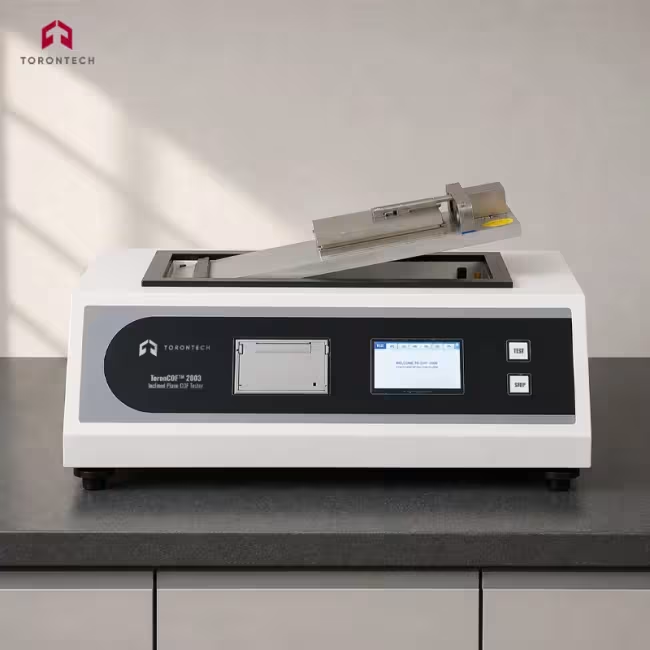
Inclined Plane COF Tester - ToronCOF™ 2003
Static Coefficient of Friction Tester (Inclined Plane Method)
ToronCOF™ 2003 is an inclined plane coefficient of friction tester that measures the static coefficient of friction of packaging films, paper, paperboard, and related materials. The instrument uses the inclined plane method: a weighted sled rests on the specimen while the plane tilts steadily until the sled begins to slip. The static coefficient of friction is read from the slip angle, giving a direct measure of surface slip.
The ToronCOF™ 2003 suits materials where surface slip affects stacking, feeding, and stability, such as films, coated papers, and corrugated board. A touchscreen sets the test, and a built-in micro-printer and statistical analysis handle results at the bench. Adjustable sled mass and area let the instrument match different materials and test conditions.
The bed and controlled tilt keep the specimen flat and the slip angle repeatable, and safety protections guard the instrument during operation. Optional computer software adds data storage and reporting. The ToronCOF™ 2003 (Static Coefficient of Friction Tester, Inclined Plane Method) suits packaging, paper, and materials QC and R&D labs.
Inclined Plane COF Tester - ToronCOF™ 2003 Applications
The ToronCOF™ 2003 measures static surface friction where slip affects handling, stacking, and stability.
- Packaging Films: measures the static slip of films that must stack and feed without sliding.
- Paper and Paperboard: tests the slip of papers and board for stacking and palletizing.
- Corrugated Board and Cartons: measures the slip angle of corrugated for stable stacking and unit loads.
- Coated and Laminated Papers: checks the surface slip of coated and laminated paper.
- Films with Slip Additives: verifies the effect of slip and anti-block additives on static friction.
- Pallet and Unit-Load Stability: assesses slip between stacked layers for load stability.
- Printing and Converting: supports process control where sheet slip affects feeding.
- Research and Quality Control: quantifies static surface friction for material development and inspection.
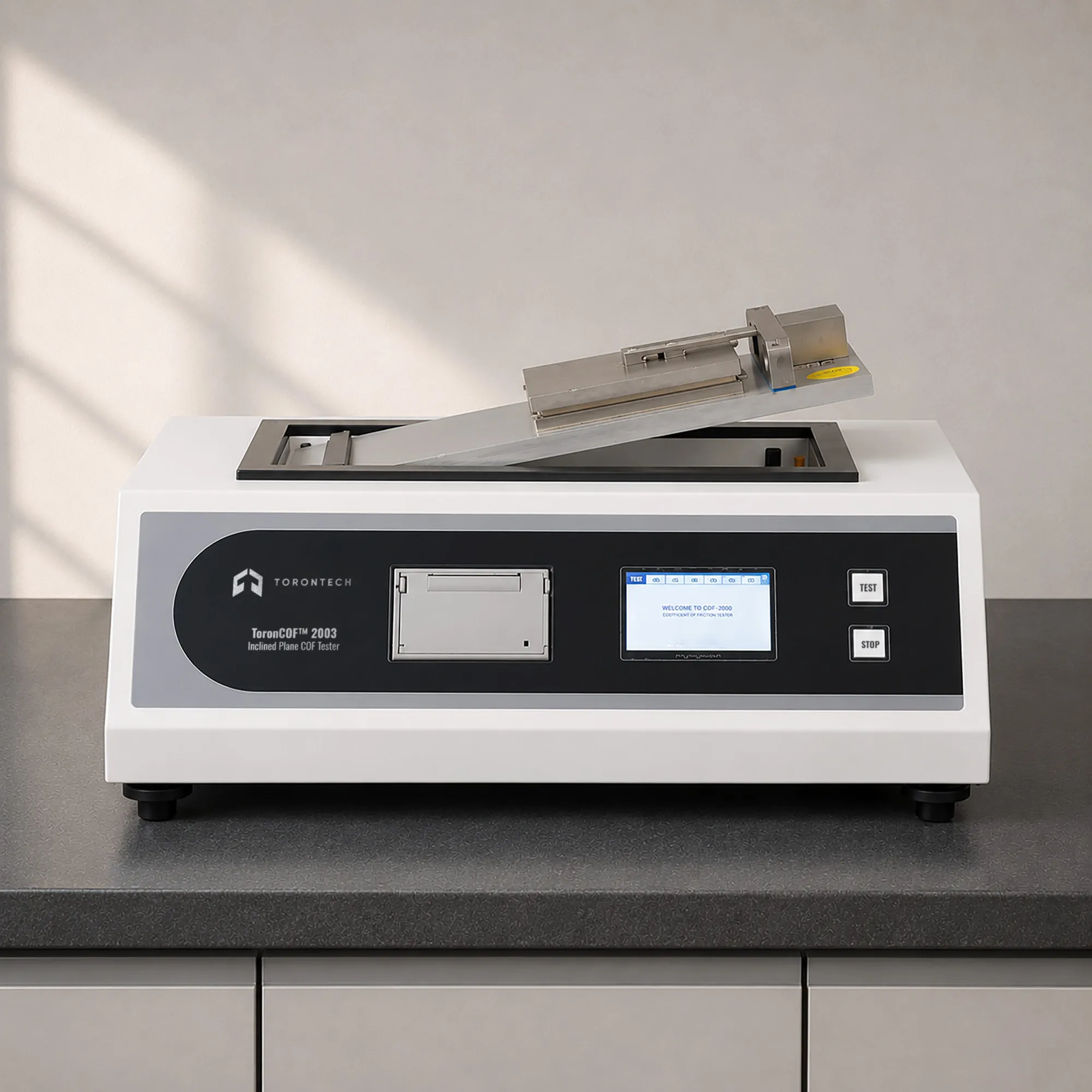
Inclined Plane COF Tester - ToronCOF™ 2003 Key Features
The ToronCOF™ 2003 measures static friction by the inclined plane method with touchscreen control and onboard reporting.
- Inclined Plane Method: measures the static coefficient of friction from the angle at which the specimen slips.
- Direct Static COF Reading: reports the static coefficient of friction from the slip angle, with no pulling force needed.
- Touchscreen Operation: a color TFT touchscreen sets test parameters and runs the test without a connected PC.
- Adjustable Sled: sled mass and area adjust to match different materials and test conditions.
- Standard and Non-Standard Sleds: works with standard sleds and custom sled mass and area for different methods.
- Built-In Statistics: onboard statistical analysis and a data query function handle results at the bench.
- Built-In Micro-Printer: prints statistics and reports directly, with programmed printing.
- Safety Protections: an emergency-stop button and overload and limit-position protection guard the instrument.
- Quiet Operation: the instrument runs quietly with low power consumption.
- RS232 Communication: a serial port connects the instrument to a PC.
- Optional Analysis Software: optional computer software adds data storage, curves, and reporting.
- Laboratory Data Management Integration: optional lab data management software centralizes test records.
Theory and Method
The inclined plane method measures the static coefficient of friction from the angle at which a specimen begins to slide. A sled of known weight sits on a specimen fixed to a flat plane. The plane tilts slowly and steadily, raising one end, until the sled overcomes static friction and starts to slip.
At the moment of slipping, the plane's angle is recorded. The static coefficient of friction equals the tangent of that slip angle, so a steeper slip angle means a higher-friction, less slippery surface. The measurement needs no pulling force, since gravity supplies the driving component along the incline.
Because the slip angle depends only on the surface pair and the tilt, the inclined plane method gives a direct, simple reading of static friction. A smooth, controlled tilt and a clean sled release matter for repeatable slip-angle values. The method suits packaging films, papers, and boards where surface slip affects stacking, feeding, and pallet stability.
Inclined Plane COF Tester - ToronCOF™ 2003 Technical Specifications
| Parameter | Specification |
|---|---|
| Measurement | Static coefficient of friction (inclined plane, slip-angle method) |
| Sled Mass | 200 g (customization available) |
| Sled Area | 63 mm × 63 mm (customization available) |
| Sample Thickness | 30 mm (optional) |
| Voltage | AC 220 V, 50 Hz (110V is also available) |
| Power Consumption | 25 W |
| Dimensions | 650 mm (L) × 340 mm (W) × 210 mm (H) |
| Net Weight | 42 kg |
Standard Delivery
| Item | Description |
|---|---|
| Main Unit | Inclined plane COF test instrument with touchscreen |
| Micro-Printer | Built-in printer for test reports and statistics |
| Sled (200 g) | Standard friction sled |
| Sample Cutter | Prepares specimens to the required size |
Optional Accessories
| Item | Description |
|---|---|
| Computer | Dedicated control PC |
| Control Software | Computer software for data storage, curves, and reporting |
| Sample Presser | Fixture to condition and flatten specimens before testing |
| Communication Cable | Connects the instrument to the control PC |
| Non-Standard Sled | Custom sled mass and area for specific methods |
| Calibration Assemblies | Reference assemblies for calibration |
| Laboratory Data Management System | Centralized data management and reporting software |