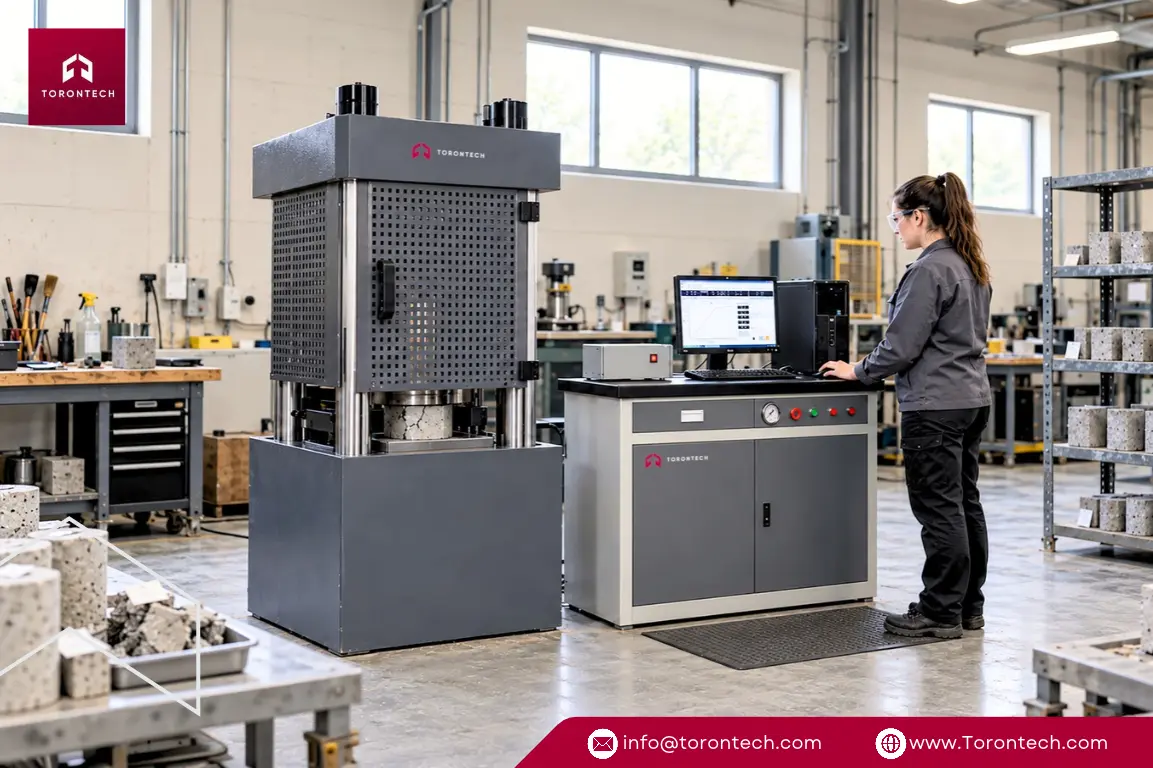
Autoclaved Aerated Concrete (AAC) Panel Structural Testing Machine
Autoclaved Aerated Concrete (AAC) Panel Structural Testing Machine - ToronAAC™ 30
ToronAAC™ 30 is a purpose-built structural performance test bench for autoclaved aerated concrete (AAC) panels, slabs, and lintels used in civil and industrial buildings. The machine performs four-point bending tests on full-size AAC panels up to 6,000 mm long, 600 mm wide, and 75 to 275 mm thick, applying a concentrated load of up to 30 kN through a servo-controlled ball screw and synchronous belt drive. The system determines flexural capacity, cracking load, ultimate load, mid-span deflection, and load-deflection behavior to verify that autoclaved aerated concrete panels meet the structural performance requirements of the applicable product and design standards.
A three-closed-loop (force, deformation, and displacement) digital servo control system based on a neuron-adaptive PID algorithm provides stable, continuous loading with multi-level force hold capability. The operator can select constant-rate force loading, constant-rate displacement loading, force hold, or displacement hold, and switch between control modes at any point during the test without interrupting the data stream. Two high-precision load sensors on the lower supports weigh the specimen before testing, eliminating the need to transport the panel to a separate scale. A deformation measurement device positioned beneath the panel records mid-span deflection with 0.01 mm resolution.
The test bench frame consists of a rigid base, an adjustable lower support platform with motorized span adjustment (1,700 to 5,900 mm), and a C-shaped loading beam. Four railway light rails installed along the lower support frame guide the support rollers to the correct span position. The lower supports provide one roller (fulcrum) and one hinge to satisfy the simply-supported boundary condition required by the test standard. The upper loading span is adjustable from 900 to 3,000 mm via a suspension beam system. The entire machine operates on three-phase 380 V AC at a total power of 1.3 kW, with the test platform standing 500 mm above floor level.
Autoclaved Aerated Concrete (AAC) Panel Structural Testing Machine - ToronAAC™ 30 Applications
The ToronAAC™ 30 supports structural performance testing of autoclaved aerated concrete products for manufacturers, third-party laboratories, and building inspection authorities.
- AAC Wall and Floor Panel Qualification: verifies the flexural capacity, cracking load, and deflection limits of reinforced and unreinforced AAC wall panels and floor slabs per EN 12602 and ASTM C1694 before the product is released for construction use.
- AAC Lintel and Beam Testing: applies four-point bending loads to reinforced AAC lintels and beams to confirm that span, reinforcement placement, and concrete density meet the design requirements.
- Production Quality Control: performs routine sampling tests on AAC panels from each production batch, comparing cracking load and ultimate load to the manufacturer’s declared values and the product certification corridor.
- Third-Party Certification and Type Approval: equips accredited testing laboratories with a standardized, servo-controlled bending rig for AAC product certification programs administered under the Construction Products Regulation (CPR) and CE marking.
- Research and Development: allows AAC manufacturers and university research groups to evaluate new mix designs, reinforcement configurations, fiber additions, and curing regimes by testing full-size panels under controlled loading conditions.
- Building Inspection and Forensic Testing: tests panels extracted from existing structures to assess residual structural capacity after fire exposure, moisture damage, or prolonged service loading.
- Precast Concrete Panel Comparison: the adjustable span and loading geometry accommodate non-AAC precast panels, lightweight concrete slabs, and sandwich panels for comparative structural studies.

Standards
The ToronAAC™ 30 supports the structural test requirements of the following international standards for autoclaved aerated concrete products and building panel testing.
- EN 12602 - Prefabricated Reinforced Components of Autoclaved Aerated Concrete (structural performance, flexural strength, and deflection requirements)
- ASTM C1693 - Standard Specification for Autoclaved Aerated Concrete (AAC) (material properties and classification)
- ASTM C1694 - Standard Specification for Reinforced Autoclaved Aerated Concrete (AAC) Elements (dimensional tolerances, reinforcement, and structural verification)
- ASTM E575 - Standard Practice for Reporting Data from Structural Tests of Building Constructions, Elements, Connections, and Assemblies
- EN 1351 - Determination of Flexural Strength of Autoclaved Aerated Concrete
- EN 772-6 - Methods of Test for Masonry Units, Part 6: Determination of Bending Tensile Strength of Aggregate Concrete Masonry Units
- ACI 523.5R - Guide for Using Autoclaved Aerated Concrete Panels
Autoclaved Aerated Concrete (AAC) Panel Structural Testing Machine - ToronAAC™ 30 Key Features
The ToronAAC™ 30 combines full-size panel accommodation with servo-controlled loading and integrated specimen weighing in a dedicated AAC structural test platform.
- Full-Size Panel Accommodation: tests AAC panels up to 6,000 mm long, 600 mm wide, and 75 to 275 mm thick, covering the full range of standard AAC wall, floor, and roof panel dimensions.
- Servo-Controlled Ball Screw Loading: a high-precision ball screw driven by a servo motor and synchronous toothed belt delivers smooth, vibration-free loading up to 30 kN, with the ability to hold load at multiple levels for crack observation.
- Three-Closed-Loop Control (Force, Deformation, Displacement): a neuron-adaptive PID algorithm switches seamlessly between constant-rate force, constant-rate displacement, force hold, and displacement hold modes during a running test.
- Motorized Lower Span Adjustment (1,700 to 5,900 mm): a servo motor and synchronous belt drive adjust both lower supports simultaneously along four railway light rails, enabling fast, repeatable span changes between panel sizes.
- Adjustable Upper Loading Span (900 to 3,000 mm): upper loading points slide along a 3,200 mm steel beam and lock at the required inner span, accommodating different standard loading geometries.
- Simply-Supported Boundary Condition: the lower support provides one roller (fulcrum) and one hinge, satisfying the simply-supported condition required by EN 12602 and eliminating parasitic end moments.
- Built-In Specimen Weighing: two high-precision load sensors on the lower supports measure the panel’s mass before testing, eliminating the need for a separate scale and reducing handling of the fragile AAC panel.
- Mid-Span Deformation Measurement: a self-resetting lifting device positions a deformation sensor (0.01 mm resolution) at the panel’s underside to record mid-span deflection without interfering with specimen handling.
- Thickness-Adjustable Upper Deformation Sensors: two additional deformation sensors on the upper side adjust to the panel thickness and measurement position, providing supplementary deflection data.
- Pin-Connected Load Transfer: the upper loading beam and support connect to the load sensor via pin joints, reducing the dead-weight pre-load transferred to the panel before the test begins.
- Machine Accuracy Grade 0.5: force measurement across 1% to 100% of the 30 kN range meets Class 0.5 accuracy (±0.5% relative error), providing reliable data for both low-load cracking tests and high-load ultimate tests.
- Real-Time Multi-Curve Display: the software switches between force-time, force-displacement, and displacement-time curves during the test, with zoom and pan for detailed observation of cracking and post-peak behavior.
- Automatic Data Storage and Reporting: database-managed test records, automatic curve saving, customizable report templates, and a data interface for integration with laboratory information management systems (LIMS).
- Overload and Safety Protection: overload protection, travel limit protection, and emergency stop safeguard the machine, the specimen, and the operator during testing.
Theory and Method
The four-point bending test subjects an AAC panel to a uniform bending moment between two symmetrically placed loading points while the panel rests on two lower supports. Unlike the three-point test, which concentrates the load at a single center point, the four-point configuration creates a constant-moment zone between the inner loading points where the shear force is zero. The flexural stress in this zone is uniform across the panel’s full width, making the test sensitive to the weakest cross-section rather than to local conditions at a single contact point.
The operator places the full-size AAC panel on the lower supports (one roller, one hinge) at the specified span and positions the upper loading points symmetrically at the required inner span. The servo system ramps the force at a constant rate while the software records force, mid-span deflection, and time. The first visible crack defines the cracking load. Loading continues until the panel reaches its ultimate capacity, at which point the load drops and the software records the peak force. The load-deflection curve reveals the panel’s stiffness (initial slope), the onset of cracking (change in slope), and the ductility or brittleness of the failure mode.
The flexural capacity of the panel is calculated from the peak bending moment and the panel’s cross-sectional geometry. For reinforced AAC panels, the cracking load verifies that the concrete matrix carries the service-level stresses without cracking, while the ultimate load confirms that the internal reinforcement provides adequate reserve strength. The built-in weighing function measures the panel’s mass before testing, which the software uses to calculate self-weight bending moment and to determine the panel’s dry density class per ASTM C1693 or EN 12602.
Autoclaved Aerated Concrete (AAC) Panel Structural Testing Machine - ToronAAC™ 30 Technical Specifications
| Parameter | Description |
|---|---|
| Maximum Test Force | 30 kN |
| Machine Accuracy Grade | Class 0.5 |
| Force Measurement Range | 1% to 100% F.S. |
| Relative Error of Force | ±0.5% |
| Quick Displacement Speed (No-Load) | 50 to 100 mm/min |
| Slow Displacement Speed | 5 to 50 mm/min |
| Displacement Measurement Range | 0 to 280 mm |
| Relative Error of Displacement | ±0.5% |
| Displacement Resolution | 0.01 mm |
| Maximum Loading Point Center Distance | 350 mm |
| Test Space (Vertical) | 0 to 280 mm |
| Test Platform Height (Above Floor) | 500 mm |
| Lower Support Span (Adjustable) | 1,700 to 5,900 mm (motorized) |
| Lower Support Type | One roller (fulcrum) + one hinge |
| Upper Loading Beam Length | 3,200 mm |
| Upper Loading Span (Adjustable) | 900 to 3,000 mm (manual) |
| Maximum Sample Size (L × W × T) | 1,800–6,000 × 600 × 75–275 mm |
| Mid-Span Deformation Sensor | 30 mm stroke, 0.01 mm resolution |
| Upper Deformation Sensors | 10 mm stroke (x2), thickness-adjustable |
| Specimen Weighing | Two high-precision load sensors on lower supports |
| Control System | Three-closed-loop servo (force, deformation, displacement), neuron-adaptive PID |
| Loading Drive | Ball screw + servo motor + synchronous toothed belt |
| Voltage | Three-phase 380 V, 50 Hz |
| Total Power | 1.3 kW |
The standard configuration consists of one main frame (complete with a base, adjustable lower support, and C-beam), two 30 kN high-precision load sensors, and one high-precision displacement sensor.
For tracking movement, it includes one mid-span deformation device with a 30 mm stroke and two upper deformation devices with a 10 mm stroke.
The mechanical setup features one loading system (powered by a ball screw and servo motor), one adjustable lower support with rail guides, one set of lower support rollers (one fulcrum and one hinge), and one upper steel beam with an upper loading support.
Finally, the operation is managed by one servo control system and one computer equipped with control and analysis software.