
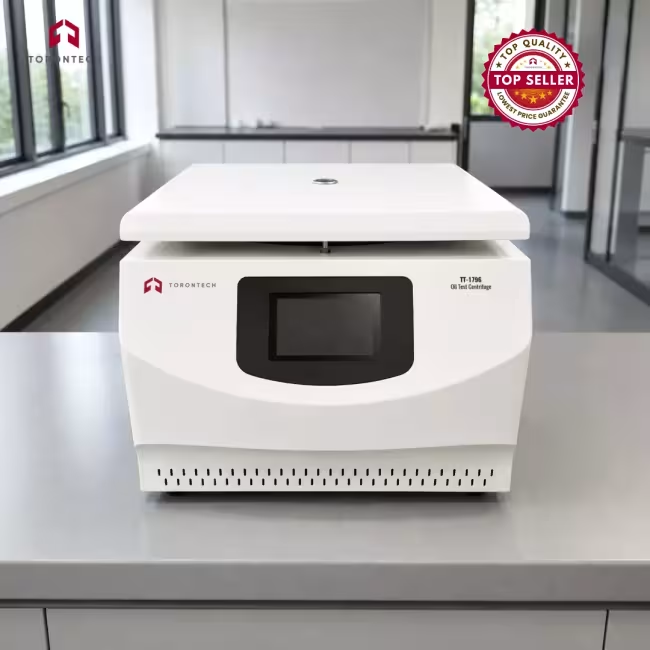
Oil Test Centrifuge
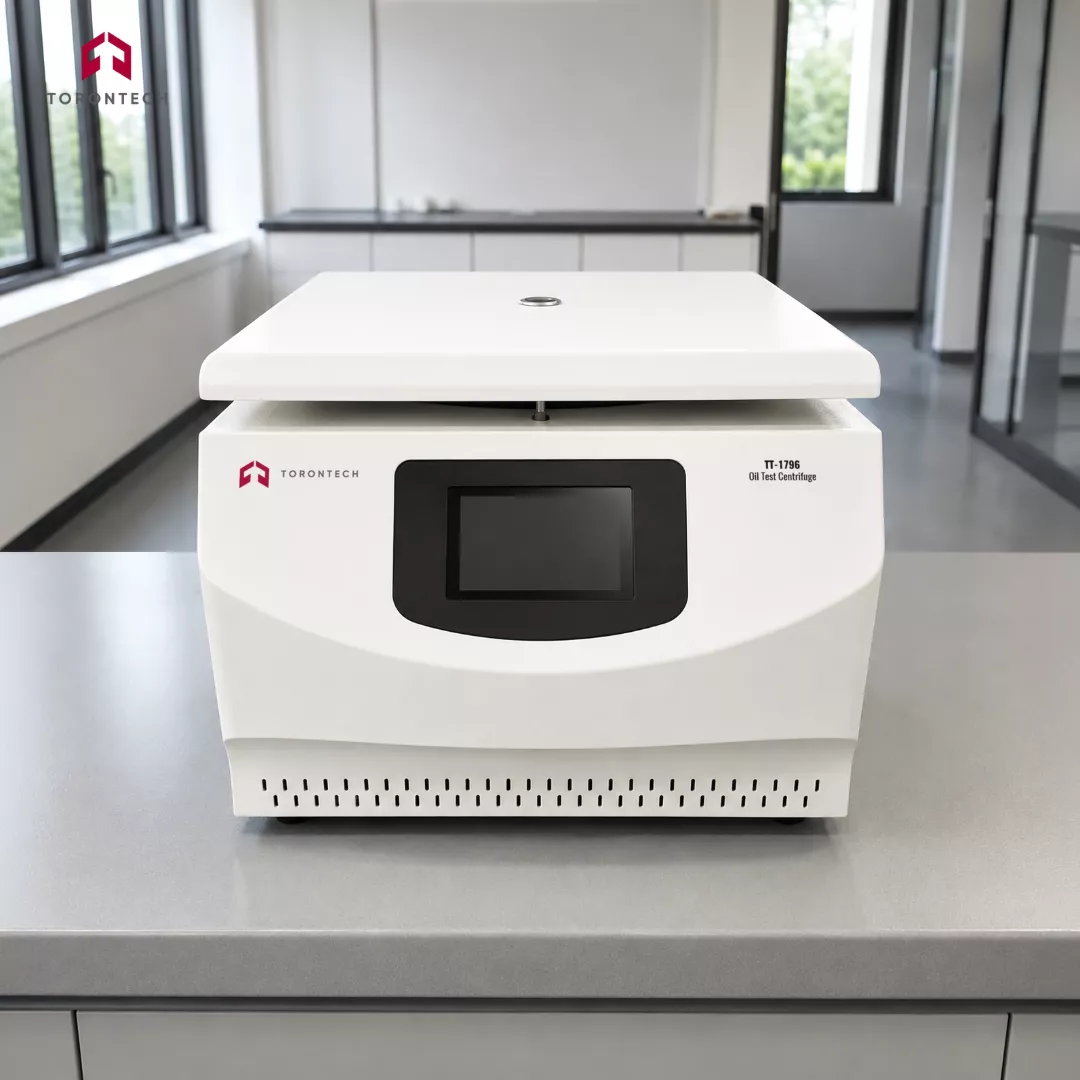
Oil Test Centrifuge TT-1796
The TT-1796 Oil Test Centrifuge is a fully programmable laboratory centrifuge designed for the determination of water and sediment content in fuel oils, crude petroleum, and middle distillate fuels. Petroleum laboratories, refineries, and quality-control facilities use this instrument to run ASTM D1796, D2709, and D4007 test procedures with repeatable precision. The centrifuge applies controlled centrifugal force to separate water and sediment from oil samples, providing volumetric readings that directly support product acceptance testing, custody transfer measurements, and blend quality verification.
The TT-1796 features a brushless motor with PID speed control, holding rotational speed within ±10 r/min of the set point across the full operating range. A touch-panel interface with LCD display allows operators to configure and store up to 12 test programs, each with independently adjustable speed, run time, and 19 selectable acceleration/deceleration ramp levels. The built-in temperature control system maintains the chamber at user-defined temperatures from +10°C to +70°C with ±2°C accuracy, accommodating the elevated-temperature procedures specified in ASTM D1796 and related methods. Automatic RCF calculation converts speed settings to centrifugal force values on screen, eliminating manual conversion errors.
A four-place swing-out rotor accepts universal bucket assemblies fitted with low-cost adapters and cushions suitable for the borosilicate glass centrifuge tubes specified across the applicable ASTM oil test methods. Seven rotor configurations are available, covering capacities from 4 × 15 ml to 4 × 800 ml, giving the same instrument a broad range of sample volumes and tube formats. An electronic door interlock prevents operation unless the lid is fully closed, and a short-run (point start) function supports quick centrifugation without setting a full test cycle.
Oil test centrifuges serve a range of petroleum laboratory and industrial testing environments where water and sediment content directly affects product quality, equipment performance, or commercial transactions. The TT-1796 is used across these contexts:
- Fuel Oil Quality Control: quantifying water and sediment in residual and distillate fuel oils per ASTM D1796 to verify compliance with product specifications and fuel quality standards before delivery or use
- Crude Oil Production and Processing: determining basic sediment and water (BS&W) content in crude oil by centrifuge per ASTM D4007, supporting oilfield production monitoring and refinery feedstock evaluation
- Custody Transfer Measurement: measuring net volumes of actual fuel oil free of water and sediment in sales, taxation, exchange, and custody transfer transactions as required by API and ASTM guidelines
- Middle Distillate Fuel Testing: detecting free water and sediment in diesel fuel, heating oil, and gas turbine fuels per ASTM D2709 to identify contamination that can foul fuel systems and burner equipment
- Biodiesel and Blended Fuel Verification: testing B100 biodiesel and biodiesel-diesel blends for water and sediment content per ASTM D2709, supporting biofuel blend quality programs
- Marine Fuel Testing: assessing water and sediment in bunker fuels and marine gas oils to meet international maritime fuel quality requirements and prevent contamination-related engine damage
- Lubricating Oil Analysis: running precipitation number tests per ASTM D91 to evaluate asphaltene content and stability in lubricating oils used in engines and industrial equipment
- Pipeline and Storage Operations: screening fuel oil and crude oil at storage terminals and pipeline transfer points to identify water ingress and sediment accumulation before product movement
Standards
The TT-1796 Oil Test Centrifuge is designed and built to align with internationally recognized test methods for the centrifugal determination of water and sediment in petroleum products. The following ASTM and ISO standards define the test procedures this instrument is configured to support:
ASTM D1290: This test method determines the volume of sediment that settles out of water-emulsion floor polishes when centrifuged, helping evaluate product stability.
ASTM D1796: It outlines the standard procedure for determining both water and sediment in fuel oils by centrifuging them with a solvent.
ASTM D2709: This standard measures the volume of free water and sediment in middle distillate fuels (like diesel) via centrifugation to ensure fuel cleanliness.
ASTM D4007: It provides the specific laboratory method for determining the water and sediment content of crude oils using the centrifuge procedure.
ASTM D91: This test method determines the "precipitation number" of lubricating oils, which measures the amount of steam-refined cylinder stocks or sediment present.
ASTM D96: This is a historically foundational standard that provides general, overarching guidelines for using centrifuge methods to determine water and sediment in crude oils.
Oil Test Centrifuge TT-1796 Key Features
The TT-1796 is configured for a broad range of petroleum centrifuge test methods, with programmable controls and a versatile rotor system that accommodate a wide variety of tube formats and sample volumes.
- Fully Programmable Test Configuration: stores up to 12 user-defined test programs with independent speed, time, and ramp settings, allowing rapid recall of method-specific parameters and reducing operator setup time between sample runs
- PID Brushless Motor Control: maintains set speed within ±10 r/min using a brushless motor and closed-loop PID algorithm, eliminating carbon-brush wear, reducing dust contamination, and delivering stable, quiet operation
- Automatic RCF Display: calculates and displays Relative Centrifugal Force (×g) in real time based on set speed and rotor, removing the need for manual conversion and ensuring the applied centrifugal force matches the method requirement
- Integrated Temperature Control: heats the centrifuge chamber from +10°C to +70°C with ±2°C accuracy, supporting the elevated-temperature procedures required by ASTM D1796 and comparable methods for viscous fuel oils
- Touch Panel with LCD Interface: provides clear, menu-driven operation for setting speed, time, temperature, and ramp profiles, with all parameters visible on screen during the run
- 19 Acceleration/Deceleration Ramp Levels: delivers fine control over spin-up and coast-down speed profiles, preventing sample remixing after centrifugation and preserving the separated water-sediment layer for accurate reading
- Point Start (Inching) Function: enables short-duration centrifugation without a full timed cycle, useful for tube positioning or preliminary observations
- Electronic Door Interlock: prevents rotor engagement unless the lid is fully and properly closed, protecting the operator and the instrument against accidental exposure during high-speed operation
- Vibration-Dampened Housing: incorporates a shock-absorber system that minimizes vibration transmission to the bench and surrounding equipment, supporting stable operation even at maximum speed
- Seven Interchangeable Rotor Options: seven swing-out rotor configurations cover capacities from 4 × 15 ml to 4 × 800 ml and max speeds from 2500 to 5000 r/min, giving the same instrument flexibility across multiple ASTM oil tube formats
- Universal Bucket Assembly: accepts low-cost adapters and cushions compatible with the borosilicate glass centrifuge tube types (conical, pear-shaped, long, and short) specified across the applicable ASTM and ISO petroleum test methods
- Low Noise Output: operates below 60 dB(A), meeting the noise requirements of laboratory environments and supporting continuous operation without acoustic disruption
Theory and Method
Centrifugal separation exploits the density difference between oil and the contaminants mixed within it. Water, inorganic sediment, and mineral particles are denser than petroleum fractions, so when a mixture rotates at high speed, centrifugal force displaces heavier phases radially outward toward the tube bottom. The degree of separation depends on the Relative Centrifugal Force (RCF), expressed as a multiple of gravitational acceleration (×g), the duration of the run, and the physical properties of the sample. The TT-1796 calculates RCF automatically from the set speed and selected rotor radius, allowing operators to match the centrifugal force precisely to the method specification.
Under ASTM D1796, equal volumes of fuel oil and water-saturated toluene are combined in a graduated conical centrifuge tube and conditioned at a defined temperature (typically 60°C) before centrifugation. The toluene dilutes the heavy fuel oil, reducing its viscosity so that water droplets and sediment particles are free to migrate under centrifugal force rather than remaining trapped in a viscous matrix. After the specified run time at the prescribed RCF, the operator reads the graduated scale at the base of the cone-shaped tube to obtain the combined volume of water and sediment as a percentage of sample volume. The procedure is run in duplicate, and readings are averaged to report the final result.
The PID speed control system in the TT-1796 maintains rotor speed within ±10 r/min of the target throughout the run, preventing velocity drift that would alter the applied RCF and compromise test reproducibility. The 19 selectable acceleration and deceleration ramp rates allow slow, controlled spin-up and coast-down, which prevents sample remixing during the deceleration phase and preserves the stratified water-sediment layer at the tube bottom. Once the run completes, the separated phases remain stable for immediate reading, giving the analyst an accurate volumetric measurement without redistribution artifacts from abrupt mechanical braking.
Technical Specifications
Main Specifications
Parameter | Specification |
Maximum Speed | 5,000 r/min |
Maximum RCF | 4,750 × g |
Speed Accuracy | ±10 r/min |
Temperature Range | +10°C to +70°C |
Temperature Control Accuracy | ±2°C |
Time Control Range | 1 min to 99 min; inching (point start) mode |
Stored Programs | 12 user-defined programs |
Acceleration/Deceleration Levels | 19 selectable ramp levels |
Motor Type | Brushless motor with PID speed control |
Speed Control Method | PWM (Pulse Width Modulation) |
RCF Calculation | Automatic, displayed on screen |
Display | LCD with touch panel |
Door Safety | Electronic interlock (door must be closed to operate) |
Power Supply | AC 220V, 50Hz, 15A |
Noise Level | < 60 dB(A) |
Ambient Operating Temperature | +10°C to +35°C |
Relative Humidity | ≤85% (non-condensing) |
Rotor Configurations
Rotor No. | Type | Capacity | Max Speed | Max RCF |
No. 1 | Swing-out | 4 × 50 ml | 5,000 r/min | 4,750 × g |
No. 2 | Swing-out | 4 × 100 ml | 5,000 r/min | 4,750 × g |
No. 3 | Swing-out | 4 × 2 × 50 ml | 4,000 r/min | 3,280 × g |
No. 4 | Swing-out | 4 × 8 × 15 ml | 4,000 r/min | 3,280 × g |
No. 5 | Swing-out | 4 × 2 × 100 ml | 4,000 r/min | 3,050 × g |
No. 6 | Swing-out | 4 × 100 ml (glass) | 2,500 r/min | 1,500 × g |
No. 7 | Swing-out | 4 × 800 ml | 4,000 r/min | 3,530 × g |