
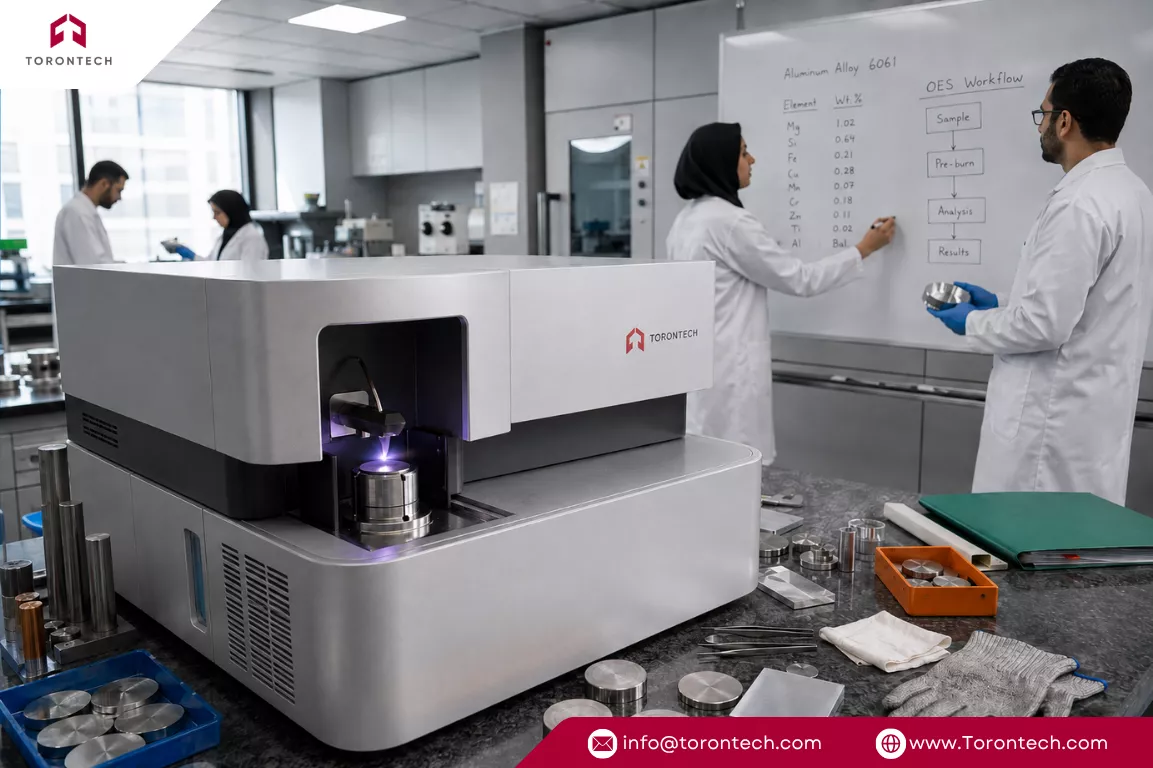
GCC Lab Supplier Boosts Metal Testing with Our Optical Emission Spectrometer
Getting spot-on chemical breakdowns on solid metal should never cost a king's ransom or hold up a busy workshop floor. A prominent scientific equipment and laboratory solutions supplier in the GCC proved that achieving atomic-scale accuracy and fast turnaround times is entirely possible while keeping operating budgets healthy.
By bringing in the Torontech TT-OES9000 Optical Emission Spectrometer, their technical team unlocked quick readouts, lowered argon gas bills, and handled diverse alloy batches with ease. Here is how focusing on smart, cost-effective engineering delivered outstanding results and led to plans for a second machine.
GCC Metallurgical Standards and Quality Demands
Across the Gulf Cooperation Council (GCC), heavy manufacturing, foundry casting, and structural fabrication operate around the clock. When a furnace holds liquid metal, every single minute counts.
If laboratory results take too long, furnace fuel burns away and production schedules grind to a halt. More critically, misreading trace elements like carbon, phosphorus, or sulfur by even a tiny sliver can cause a complete batch of finished steel or aluminum to fail strict international quality checks.
Our partner, an established laboratory equipment and testing solutions supplier in the GCC, supports industrial facilities with equipment demonstrations and certified material checks. To maintain their strong reputation, they require testing hardware that produces rock-solid data every single time.
Operational Challenges in Regional Elemental Testing
Supporting regional foundries and fabrication facilities revealed serious day-to-day operational hurdles. Spark spectrometers rely on a continuous flow of high-purity argon gas to shield the burn area during testing. In hot industrial zones, constantly replacing gas cylinders adds significant ongoing operating expenses.
At the same time, older testing benches with rigid hardware setups made switching between structural steel, brass components, and casting aluminums a slow, cumbersome chore that created testing backlogs.
These technical headaches were compounded by legacy commercial practices. Heritage equipment brands attach substantial price premiums to older hardware designs and lock buyers into expensive, rigid maintenance agreements.
For an agile regional supplier, absorbing those inflated markups or passing them along to local foundries was unsustainable. The team needed an instrument that could chew through high sample volumes smoothly while keeping running costs thoroughly manageable.
Technical Advantages of the Torontech TT-OES9000
Evaluating instruments strictly on build quality, optical physics, and practical economics led the supplier directly to Torontech. The TT-OES9000 stood out across two core technical areas:
Full-Spectrum Optical Detection
Built with an automated vacuum chamber and a 400 mm Rowland circle, the optical system spans from 130 nm to 800 nm. This provides accurate, simultaneous detection of light elements such as carbon, phosphorus, and sulfur right alongside heavy alloying metals. Instead of older fixed sensor channels, the high-density multi-CCD array captures up to thirty-one elements simultaneously across iron, aluminum, copper, zinc, titanium, and nickel bases on a single bench.
Efficient Gas Consumption and High-Speed Processing
The instrument features an engineered spray discharge electrode assembly that uses just five liters of argon per minute during active sparks, keeping gas consumption exceptionally low across long testing shifts. Paired with the internal DM9000A electronics package, the system reads and converts raw spectral data up to five times faster than traditional units, displaying verified chemical percentages in seconds.
Measurable Operational and Financial Results
Putting the TT-OES9000 to work in their regional facility delivered immediate operational gains. Technicians simply position a sample, pull the clamp tight, and initiate the spark. Complete chemical breakdowns appear on the display in seconds flat, allowing the team to generate verified certificates of analysis without keeping clients waiting.
Financially, the system delivered immediate relief. Between the low electrical draw on standby and the thrifty argon usage, the cost per test dropped significantly, protecting healthy margins on contract testing and client demonstrations.
Furthermore, the open software framework allowed technicians to shift between testing carbon steels, bronze components, and casting aluminums without mechanical teardowns or hardware downtime.
Scaling Up: Planning for an Additional OES Machine
The success of the TT-OES9000 created a steady increase in testing requests from industrial clients across the GCC. The initial unit proved so dependable, accurate, and cost-effective that the facility began running at full capacity.
Because of this positive operational experience and rising workload, the GCC supplier is now planning to purchase an additional Torontech Optical Emission Spectrometer. Adding a second unit will allow them to double their analytical throughput, support parallel testing lines, and continue meeting the growing quality needs of regional industries.
Why Not Scale Your Lab Throughput with Torontech?
Torontech combines North American engineering with cost-effective pricing, giving industrial laboratories, foundries, and testing providers high-precision elemental analysis without unnecessary brand markups.
You can review detailed optical setups and limits on the Torontech TT-OES9000 Optical Emission Spectrometer page, or contact the Torontech technical team directly to review your application requirements, arrange a consultation, or request a competitive quotation.