Oil Particle Counter in UAE for Offshore, Aviation, and Marine Fleets
A single contaminated hydraulic line can ground an aircraft, stall an offshore rig, or shut down a crane at Jebel Ali Port. In the UAE's high-value industrial fleets, invisible particles suspended in oil are often the real cause of unscheduled downtime and premature component wear.
A dependable Oil Particle Counter in UAE facilities turns that invisible risk into a measurable number. Torontech's ToronOPC™ Liquid and Oil Particle Counter series gives maintenance teams a fast, repeatable read on fluid cleanliness before wear becomes failure.
Where UAE Industries Rely on Fluid Cleanliness Data
Abu Dhabi's offshore fields anchor the country's energy output, and hydraulic systems power the walking rigs deployed across projects such as ADNOC's Ghasha sour gas development. Every hydraulic circuit on those platforms depends on clean fluid to avoid valve wear and seal failure.
Dubai's aviation sector adds another layer of demand. Accredited labs in the emirate already test aircraft hydraulic fluid against SAE AS4059 Class 9 limits. That practice confirms regional MRO providers treat particle counting as a routine airworthiness check, not an afterthought.
Jebel Ali Port, the world's largest man-made harbor, runs a dense fleet of cranes, tugs, and terminal equipment on hydraulic and turbine lubricants. DP World's terminal operations depend on that equipment running without unplanned hydraulic downtime.
Power generation and desalination plants across Abu Dhabi and Dubai add a fourth demand driver. Turbine and gear oil condition monitoring helps these facilities avoid unplanned outages in infrastructure that the wider grid depends on.
How the ToronOPC™ Series Measures Contamination
ToronOPC™ instruments use optical light-blocking detection. A laser beam crosses a sensing zone, and each particle that passes interrupts the beam long enough for the instrument to calculate its size and count.
The result is a cleanliness code, not a guess. Engineers compare that code against ISO 4406 or NAS 1638 limits to decide whether a system needs filtration, flushing, or continued monitoring.
Across the ToronOPC™ platform, detection covers particle sizes from roughly 1 micron to 500 microns across 32 counting channels. That range is wide enough to catch both the fine silt that erodes servo valves and the larger debris that signals a failing pump or bearing.
Selecting an Oil Particle Counter in UAE Operations
Field teams, labs, and continuous-monitoring programs need different hardware, and matching the wrong instrument to the application wastes both budget and technician time. The table below maps common UAE use cases to the right configuration within the ToronOPC™ lineup.
| Configuration | Best Suited For | Example Model |
|---|---|---|
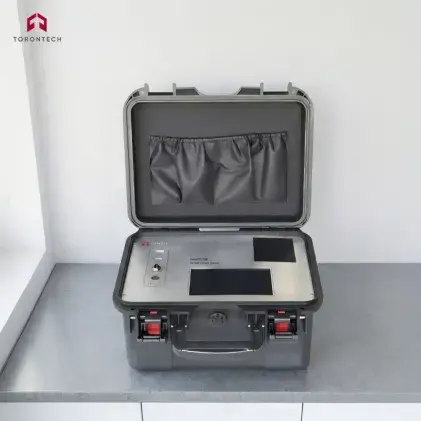
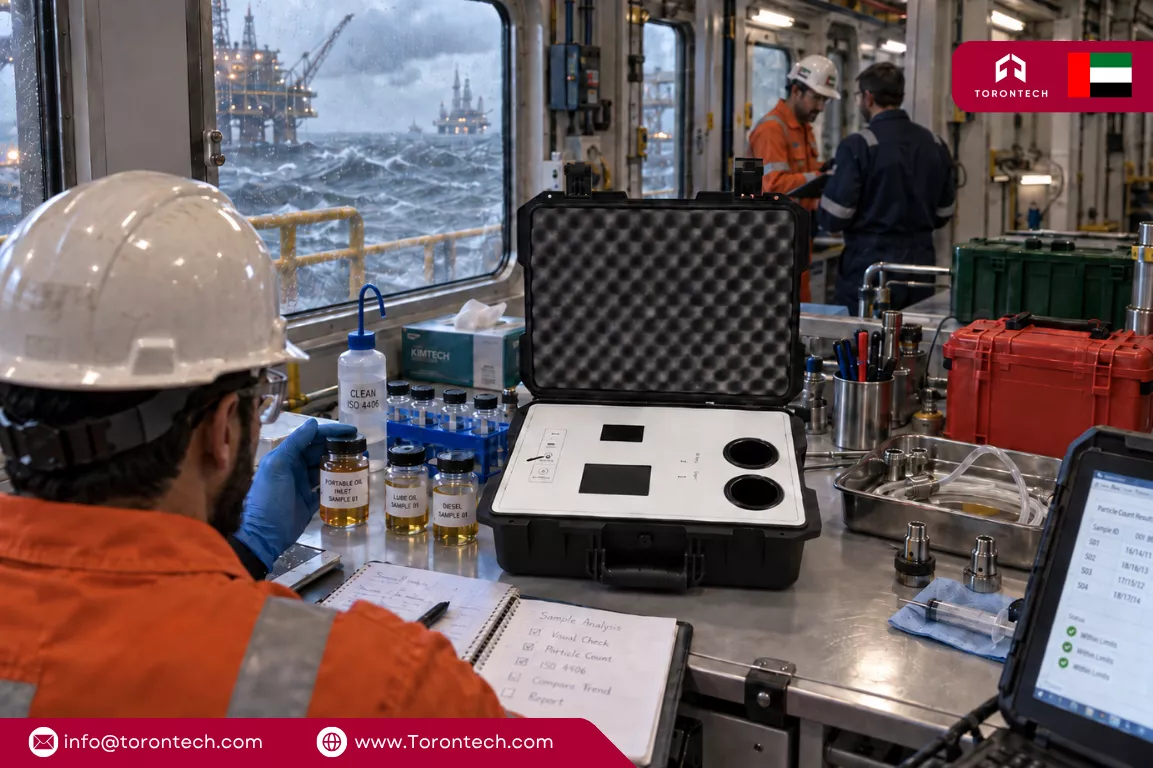
| Portable / Field | Rig inspections, MRO bays, site audits | ToronOPC™ 300W |
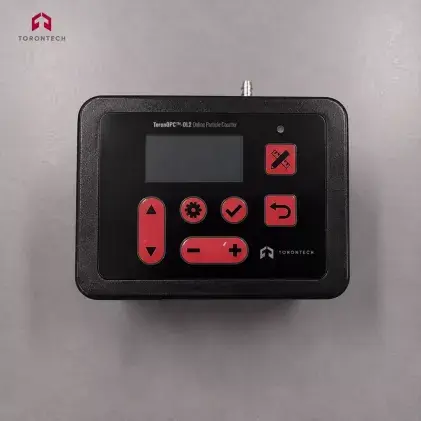
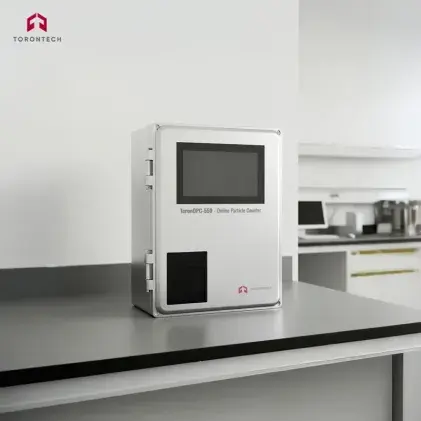
| Online / Continuous | Hydraulic power units, turbines in service | ToronOPC™ 550 |
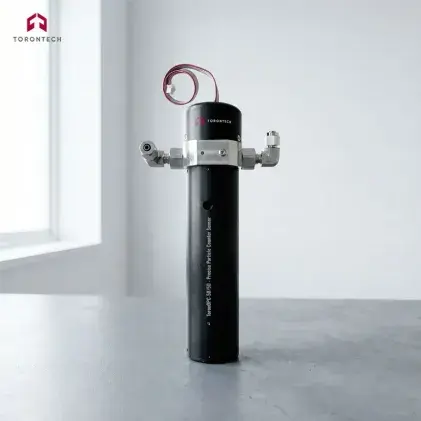
| Sensor-Based | OEM integration, compact machinery | ToronOPC™-50/50 |
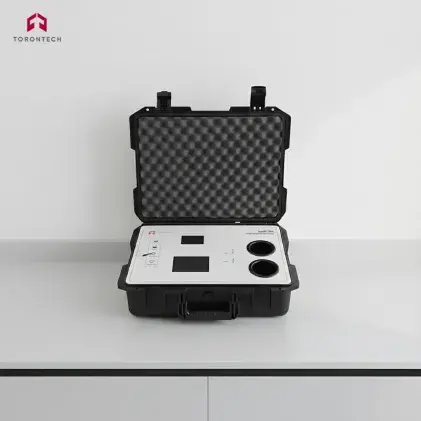
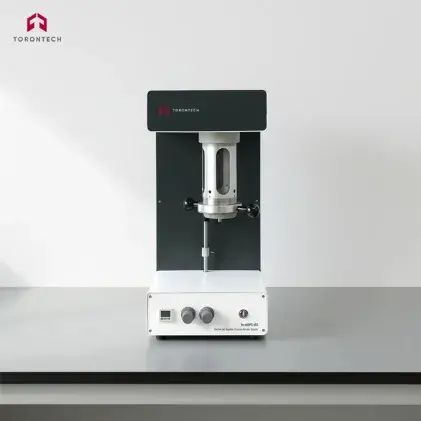
| Laboratory | High-volume sample throughput | ToronOPC™ series |
- Portable units run on battery power and store results for offline review, useful for technicians moving between offshore support vessels and hangar bays. A built-in printer and USB export keep field data audit-ready.
- Online systems stay connected to a hydraulic line and report cleanliness continuously, suited to power and process plants that cannot pause for manual sampling. Threshold alarms flag a developing problem before it reaches critical levels.
- Sensor-based modules integrate into existing equipment, giving OEMs a path to build condition monitoring into new machinery without redesigning the fluid circuit around a standalone instrument.
Standards That Matter for UAE Operators
Contamination reporting in the UAE generally follows the same international frameworks used across the GCC and the wider Middle East market. Torontech's Oil Particle Counter in UAE deployments typically report against the following:
- ISO 4406: cleanliness coding based on particle counts at multiple micron thresholds, the standard most widely referenced for hydraulic and lubricating oils.
- NAS 1638: an aerospace-origin classification still used across UAE aviation and defense maintenance programs.
- SAE AS4059: the current fluid cleanliness standard for aerospace hydraulic systems, aligned with modern particle counting methods.
- ISO 4402 and ISO 11171: calibration and particle-sizing references that support traceable, repeatable results.
Local labs and maintenance programs set their own acceptance limits within these frameworks, and Torontech configures each ToronOPC™ unit to report in that format. This flexibility matters for contractors serving multiple sectors, since an offshore platform and an aircraft hangar rarely share the same cleanliness target.
Partner With Torontech's GCC Team in Dubai
UAE operators managing offshore platforms, aircraft fleets, or port equipment need contamination data they can act on quickly, not weeks after a sample ships overseas. Local support shortens that loop considerably.
Torontech ME FZE operates from Meydan Grandstand in Dubai, giving UAE and wider GCC customers a regional point of contact for configuration guidance, calibration questions, and spare parts support. That regional presence matters when a rig or aircraft is waiting on a cleanliness result before it returns to service.
Reach the Dubai team directly at me@torontech.com or +971 4 881 9252, or contact Torontech to discuss which ToronOPC™ configuration fits your fleet and reporting requirements.