How a Bandage Elasticity Tester Works & Why It Matters
A bandage without the right amount of elasticity fails to perform its essential function.
When it comes to medical fabrics, achieving that perfect springiness is the entire point. We are talking about that critical property that allows a bandage to conform to a joint, providing continuous support without impeding circulation.
For the patient, this means the difference between effective recovery and a poor experience. It's why a deep familiarity with what is a bandage elasticity tester is so crucial in this field. For us, as suppliers and manufacturers, that perfect stretch is our proof of a well-engineered and reliable product.
What is a Bandage Elasticity Tester & How Does It Work?
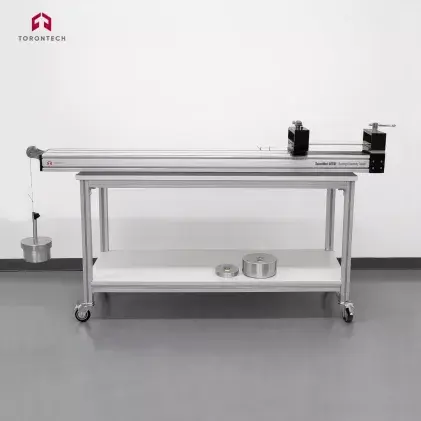
So, let's answer the core question: what is a bandage elasticity tester? It is a purpose-built machine focused on a single objective: to determine how far a bandage can stretch and, critically, how effectively it recovers its original shape.
The mechanics are refreshingly straightforward. Our ToronMed-BET01 utilizes a horizontal track where a bandage sample is secured in clamps at both ends. Then, a series of precisely calibrated weights are used to apply a pulling force. At Torontech, we designed our tester around this direct method because we believe simplicity and mechanical certainty are the most reliable ways to get honest, repeatable data.
To ensure the results are meaningful and consistent, the entire procedure is run according to official standards like ISO 13934-1. This reliable process is the clearest answer to how does a bandage elasticity tester work to deliver meaningful results. By replicating these forces, you get data that you can truly count on.
Why is a Bandage Elasticity Tester Essential?
From our professional standpoint, having a dependable method for testing stretch is not optional. It supports the two most important pillars of the medical textile industry: guaranteeing the quality of every product and creating the innovations of the future.
Ensuring Quality and Compliance
In an industry where patient safety is the highest priority, we feel that rigorous quality control forms the bedrock of a reputable operation.
For a QC team, understanding how does a bandage elasticity tester work on a practical, day-to-day basis is key to confirming that every batch leaving their facility meets the exact required specifications. If it has too little give, the bandage is ineffective. If it has too much, it could create other problems. It is that clear-cut.
Read more: A Guide to Medical Bandage Compliance Testing Success
Driving Innovation and Product Development
Beyond just confirming quality, this is where significant progress happens.
The information gathered from these tests is pure fuel for research and development teams. The demand for more advanced healthcare materials is constant, and we advise our partners that with reliable data on how to test bandage elasticity for their new textiles, their creative teams can confidently explore new materials.
This is why we focus on making our high-precision equipment accessible—to empower that innovation without an excessive capital investment.
The Business Impact of Inaccurate Testing
We feel it is our duty to be frank about the consequences of inadequate testing. Viewing proper equipment as an expense is a miscalculation, especially when the consequences of not knowing how to test bandage elasticity correctly can be so severe. From our perspective, the impact can include:
- Product Recalls & Reputation Damage: A single subpar batch reaching the market can force a costly recall and cause serious damage to your company's reputation.
- Significant Material Waste: Inconsistent testing can lead to entire production runs being rejected. That is a direct financial loss that we believe is entirely preventable.
- Failure to Secure Contracts: We have seen companies disqualified from bidding on major contracts because they could not provide certified documentation of compliance. It's a significant and unnecessary business obstacle.
- Stalled Innovation: If your development teams are working with inaccurate information, their progress will be hampered, allowing competitors to move ahead.
How to Test a Bandage Correctly
For teams that need a clear, repeatable method for how to test bandage elasticity, the process is methodical with the right equipment. This is the straightforward process we guide our clients to follow for repeatable results.
- Sample Preparation: First, a sample of the bandage is cut to a standardized size, as defined by industry protocols. This precision is the first step toward a reliable measurement.
- Securing the Sample: The sample is carefully positioned and locked into the machine's high-grip clamps. We cannot overstate the importance of a secure hold for an accurate test.
- Applying the Load: The operator selects and applies the appropriate calibrated weights, which exert a specific, controlled pulling force on the sample.
- Measuring Elongation: As the bandage stretches, its new length is accurately read from the integrated scale on the device's frame.
- Calculating Recovery: After the force is removed, the bandage's final length is measured to calculate its recovery percentage. We see this metric as a true indicator of its performance over time.
Key Features to Look for in a Bandage Elasticity Tester
When clients ask us about the specifics of how to test bandage elasticity effectively, we tell them it begins with the instrument itself. We engineered our ToronMed-BET01 to include the components we consider non-negotiable, as compromising on testing quality is a risk we don't believe our clients should ever have to take.
- Broad Compatibility: Versatility is a practical necessity, so our design accommodates a full range of bandage widths, from 7.5 cm to 20 cm, to maximize its value in your lab.
- Precise, Calibrated Weights: We provide a set of combinable weights because applying specific, variable forces is required for comprehensive analysis.
- Clamps That Offer a Secure Grip: A test is compromised if the clamp fails. This is one area where we at Torontech refuse to cut corners, using 304 stainless steel to ensure the sample remains fixed every time.
- Smooth and Uniform Operation: We chose a dual linear guide rail system because it is the superior method for ensuring an even application of force, leading to results you can depend on.
- Adherence to Standards: Any professional-grade instrument must align with international standards like ISO 13934-1. We view this as a fundamental requirement for market acceptance.
Your Bandage Tester Solution by Torontech
Ultimately, we believe success in this industry is built on product confidence and forward progress.
A deep appreciation for what is a bandage elasticity tester and how does a bandage elasticity tester work leads to this confidence. It's an investment in your company’s quality standards and its future, providing the means to meet today's strict requirements while developing the superior products of tomorrow.
At Torontech, we are focused on providing our partners with cost-effective medical device testing equipment that deliver uncompromising quality. Our ToronMed-BET01 is engineered with the features we know are critical for precision and dependability.
If you are looking to improve your testing capabilities, we invite you to speak with one of our specialists. Let us help you find the right, cost-effective solution to support your business objectives.