
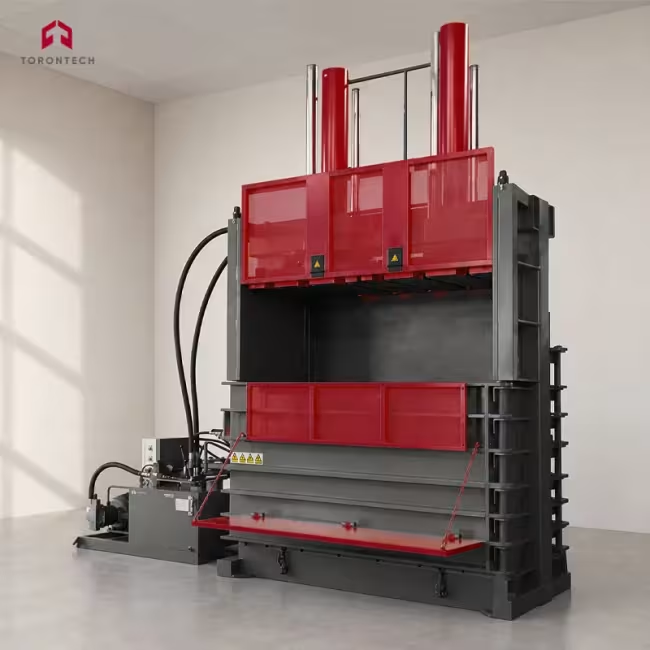
Vertical Tire Baler - ToronBale™ VT
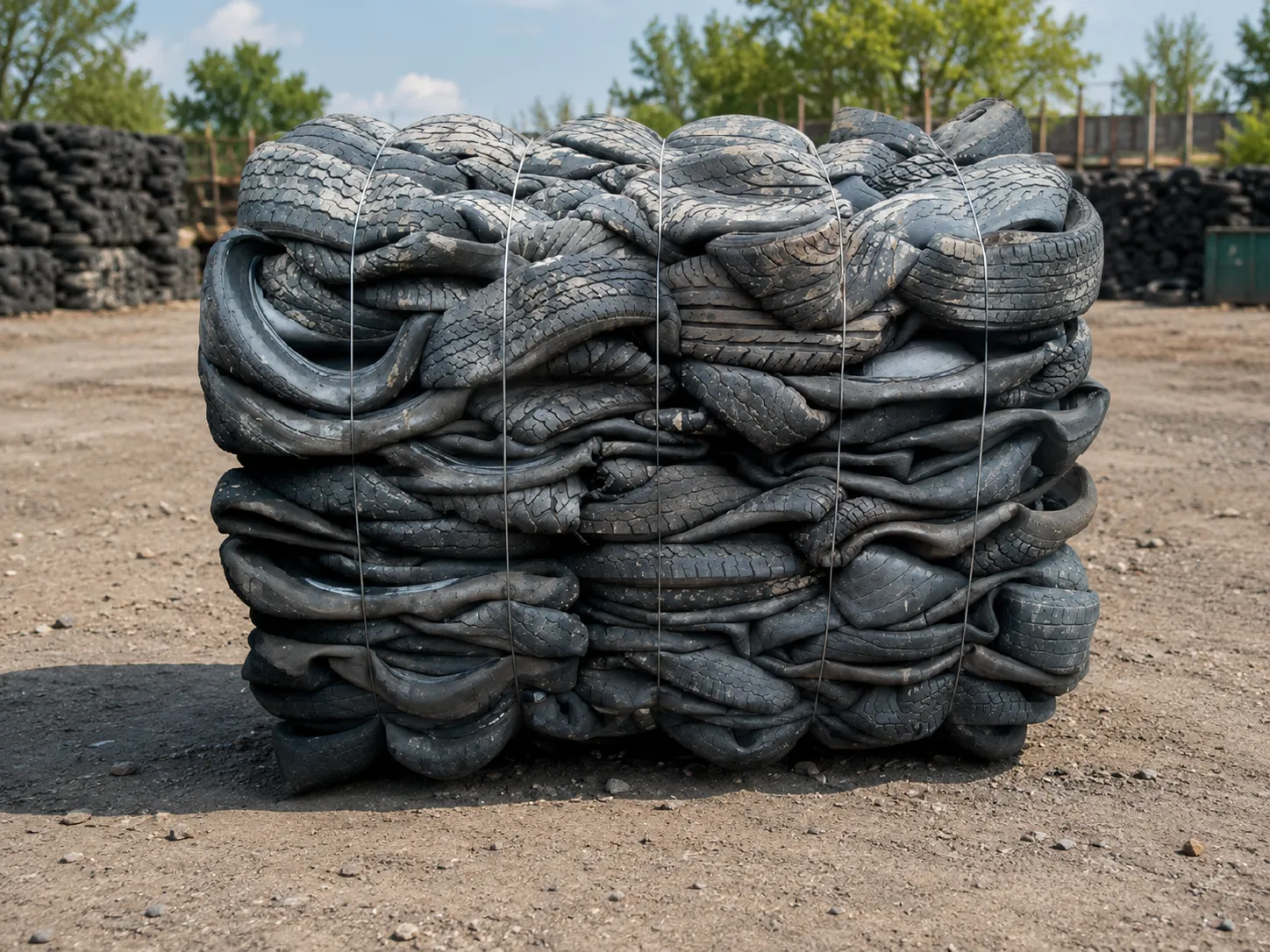
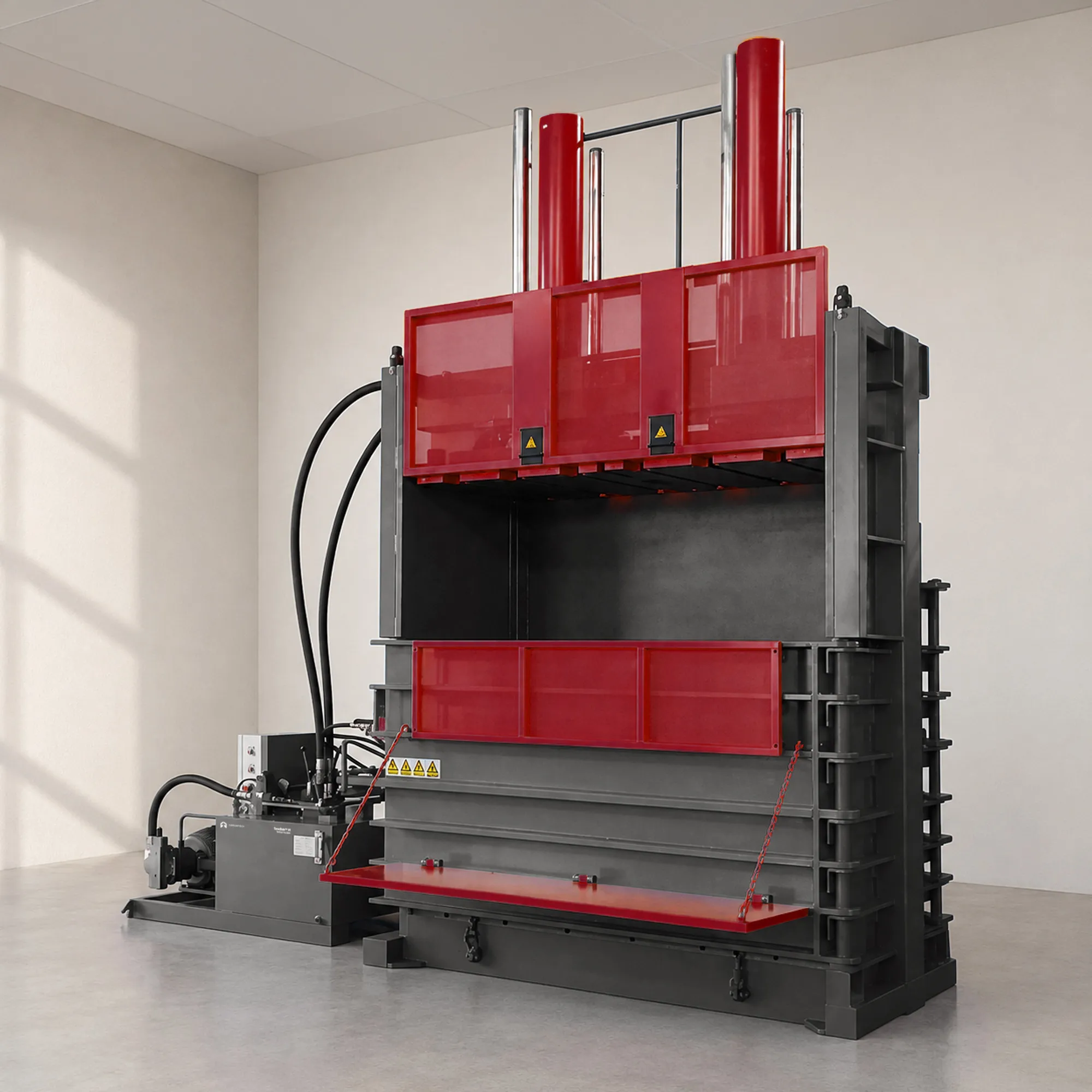
Vertical tire baler compresses car, truck, and bus tires into strapped bales weighing 1 to 1.9 tonnes. Torontech offers the ToronBale™ VT in two chamber sizes, both rated at 120 tons of press force, drawing 15 kW and 22 kW. Loose tires defeat ordinary handling because they nest badly, roll, and take up enormous space for very little weight. Machine weights of 7 and 12 tonnes reflect what containing baled rubber demands.
Rubber gives back nearly everything it absorbs. A tire bale pushes outward the moment platen pressure lifts. The machine answers with retractable retainer claws that hold each compressed layer mechanically, rather than relying on the material to stay put. The published specifications include a separate bale dimension after expansion, which is the size operators should plan storage and container loading around.
Both models use two split platens joined by movable links. Tires never lie flat, so the platen meets a wildly uneven surface, and a rigid single plate would twist under that loading. The linked halves follow the material instead. An oil cooling system, available as air-cooled or water-cooled, handles the heat that sustained rubber compression puts into the hydraulics.
Vertical Tire Baler - ToronBale™ VT Applications
The ToronBale™ VT serves operations that collect, store, or move scrap tires in volume.
- Tire Collection and Recycling Centers: bales incoming casings to cut the storage footprint of a stockpile before processing or resale
- Tire Retailers and Service Chains: consolidates part-worn and scrap casings accumulating across multiple service bays
- Municipal and Regional Collection Programs: reduces the volume of tires gathered from amnesty days, illegal dumping cleanups, and drop-off sites
- Transfer Stations and Landfill Operations: compacts tires that regulations exclude from whole-tire burial
- Tire-Derived Fuel Suppliers: prepares casings into consistent units for transport to cement kilns and energy recovery plants
- Pyrolysis and Crumb Rubber Plants: bales feedstock at collection points so inbound freight carries useful mass
- Fleet and Transport Depots: handles the truck and bus casing volumes generated by scheduled tire replacement
- Scrap Tire Export Operations: produces uniform bales that load predictably into shipping containers
- Civil Engineering Fill Projects: supplies baled tires for embankment and erosion control work where local regulations permit the practice
Standards
Torontech has no published standards compliance for the ToronBale™ VT at this time. The design uses a hydraulically driven chamber door and retractable retainer claws that hold compressed material against rebound. The supplier specification does not list an emergency stop or a feed-gate interlock for this model, so buyers should confirm the delivered safety configuration with Torontech before ordering, along with any certification or documentation their jurisdiction requires.
Vertical Tire Baler - ToronBale™ VT Key Features
The ToronBale™ VT is engineered around the single hardest property of scrap tires, their refusal to stay compressed.
- Retractable Retainer Claws: engage each compacted layer to hold rubber against rebound, then withdraw to release the finished bale
- Two Split Platens with Movable Links: the platen halves follow uneven tire surfaces independently, preventing the distortion a rigid plate suffers under irregular loading
- Twin Cylinders at Differing Frequencies: the paired cylinders can work at different rates when material sits unevenly, protecting the platen from damage
- 1 to 1.9 Tonne Bale Output: two chamber sizes cover collection depots through high-volume processing sites
- Published Bale Size After Expansion: expanded dimensions are stated alongside compressed ones, so storage and container planning uses real figures
- Oil Cooling System: available air-cooled or water-cooled, managing the heat that continuous rubber compression puts into the hydraulic circuit
- Hydraulically Driven Chamber Door: powered opening and closing removes the manual effort and pinch risk of moving a heavy door by hand
- Front and Rear Opening Doors: strapping passes through the chamber from both faces, and the bale discharges without awkward maneuvering
- Automatic Chain Bale Ejector: lifting chains discharge bales weighing up to 1.9 tonnes without manual handling
- Manual Control System: direct operator control keeps the machine serviceable in yard conditions where electronic complexity becomes a liability
- Taiwanese Hydraulic Package: a complete matched hydraulic system rather than assembled components of mixed origin
- Schneider Electrical Components: recognized electrical parts with spares available through established distribution
- A.M.C. Oil Pipe Joints: Japanese-made fittings hold hydraulic connections leak-free across thermal cycling and vibration
- Heavy Structural Frame: 7 and 12 tonne build weights carry the sustained outward load a restrained rubber bale applies to the chamber
Theory and Method
Vulcanized rubber behaves unlike any other baled material. Cross-linked polymer chains store deformation energy elastically and return almost all of it, so a compressed tire never takes a permanent set the way aluminum or corrugated board does. Steel belts and the bead ring add stiffness that resists folding. Compaction therefore holds only as long as something physically restrains it, which is why retractable claws engage each layer and why the finished bale still expands measurably once released.
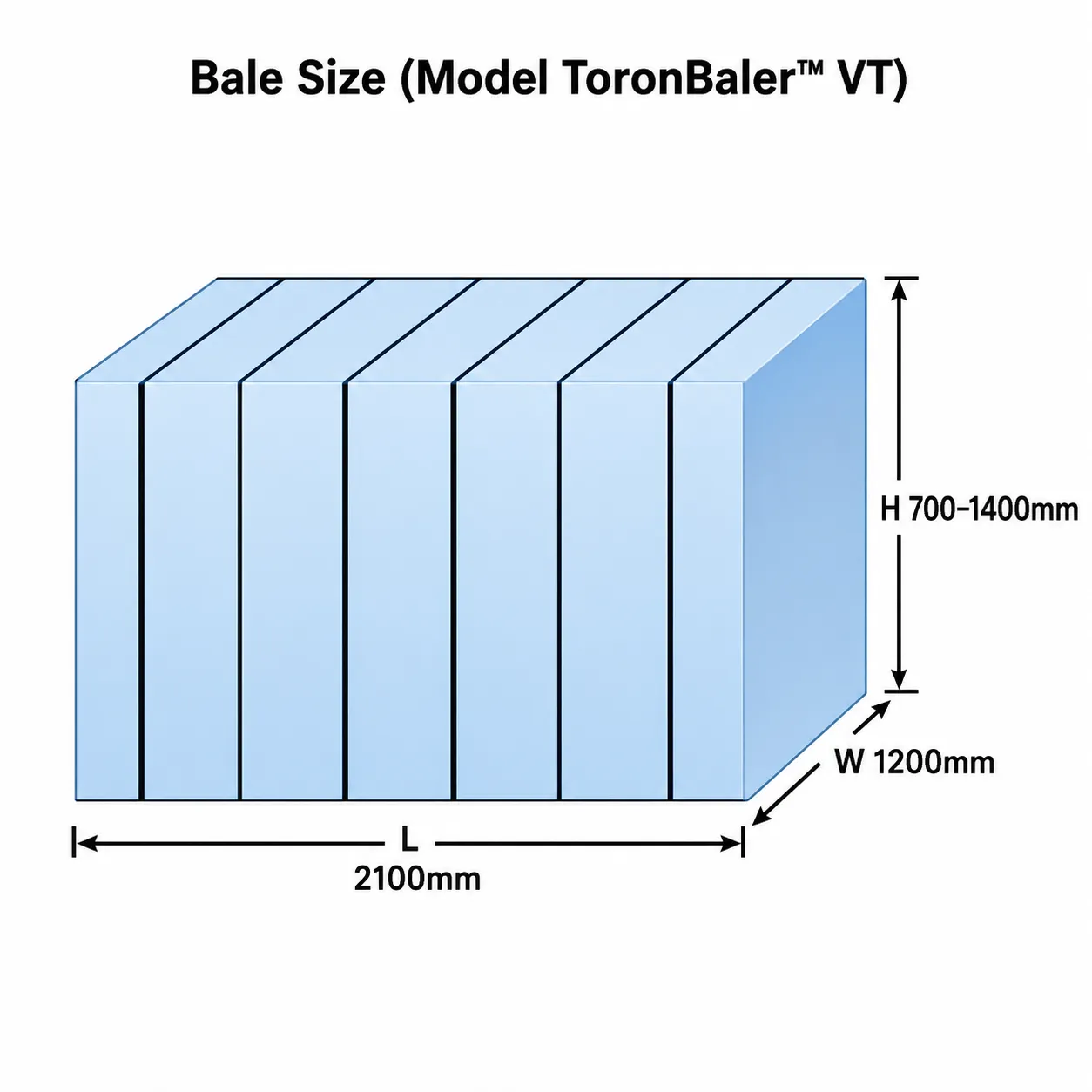
Bale expansion is a specification, not a defect. The smaller model produces a bale measuring 1,530 by 790 mm under compression that settles at 1,600 by 850 mm afterward, and the larger model grows from 2,100 by 1,200 mm to 2,200 by 1,300 mm. Container loading plans and rack spacing have to use the expanded figures. Strapping carries continuous tension for the life of the bale rather than simply holding a shape.
Chamber size changes what the same 120 tons achieves. The smaller chamber concentrates that force across roughly 1.2 square meters and reaches close to 690 kg per cubic meter of bale. The larger chamber spreads the same force over 2.5 square meters, producing a bigger bale at around 540 kg per cubic meter. Operators choosing between the two are trading bale density against bale size, not buying more press capacity.
Vertical Tire Baler - ToronBale™ VT Technical Specifications
| Parameter | ToronBale™ VT-120S | ToronBale™ VT-120L |
|---|---|---|
| Press Force | 120 tons (approx. 1,177 kN) | 120 tons (approx. 1,177 kN) |
| Motor Power | 15 kW | 22 kW |
| Baling Chamber Size (L × W × H) | 1,530 × 790 × 1,800 mm | 2,100 × 1,200 × 2,100 mm |
| Bale Size (L × W × H, H adjustable) | 1,530 × 790 × (500 to 1,200) mm | 2,100 × 1,200 × (700 to 1,400) mm |
| Bale Size After Expansion (L × W × H) | 1,600 × 850 × 1,200 mm | 2,200 × 1,300 × 1,400 mm |
| Bale Weight | 1 tonne | 1.9 tonnes |
| Cooling System | Air cooler or water cooler | Air cooler or water cooler |
| Machine Weight | 7 tonnes | 12 tonnes |
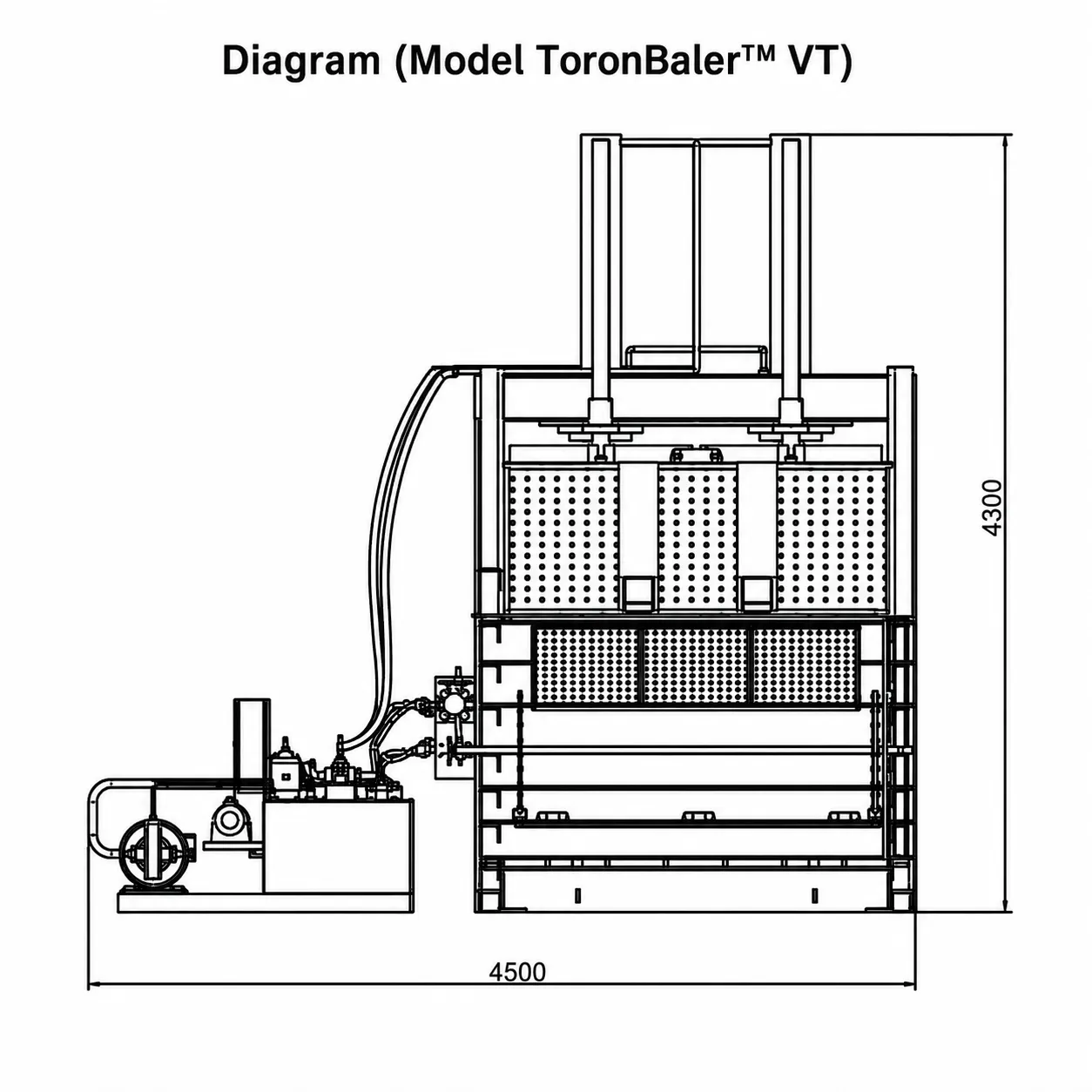
| Machine Size (L × W × H) | 3,734 × 1,098 × 3,700 mm | 4,231 × 1,510 × 4,300 mm |
| Control System | Manual | Manual |
| Bale Ejection | Automatic chain ejector | Automatic chain ejector |
| Chamber Access | Front and rear opening doors, hydraulically driven | Front and rear opening doors, hydraulically driven |
| Materials Handled | Car, truck, and bus tires, rubber products | Car, truck, and bus tires, rubber products |