
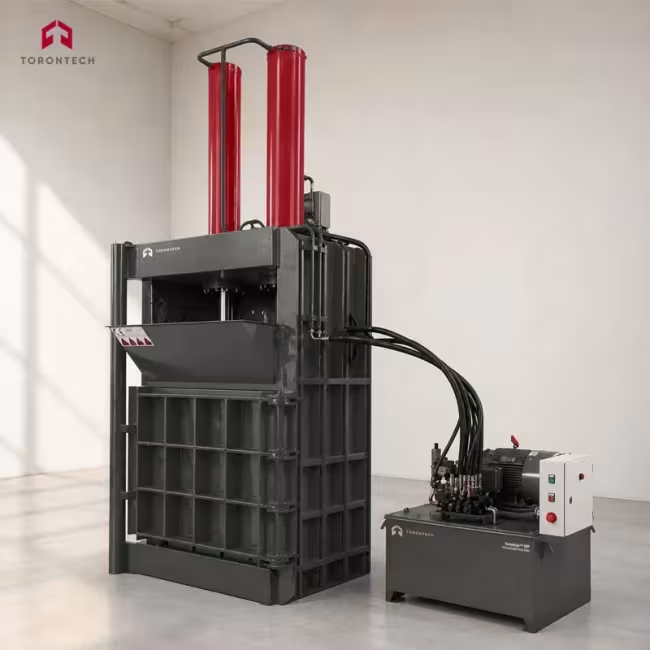
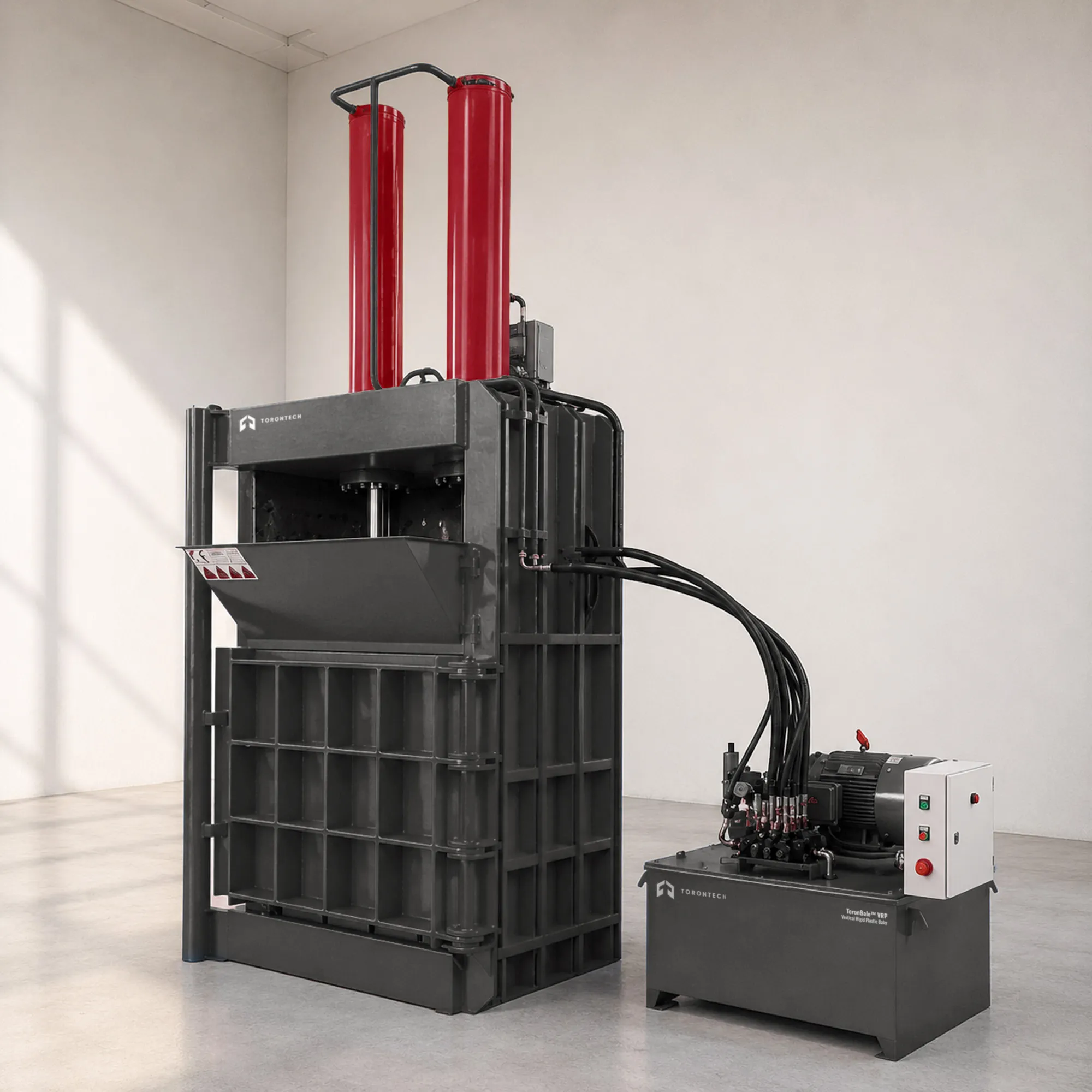
Vertical Rigid Plastic Baler - ToronBale™ VRP
Vertical rigid plastic baler compacts car bumpers, plastic pallets, crates, and similar bulky hard plastics that ordinary balers cannot take. Torontech offers the ToronBale™ VRP at 150 tons and 200 tons, producing bales measuring 1,250 by 1,100 mm at 200 kg to 600 kg. The feed opening measures 1,250 by 700 mm, wide enough to accept a whole automotive bumper without cutting it down first. Machine weights reach 6,000 kg and 8,000 kg.
Rigid plastics are engineered to resist exactly what a baler does to them. A bumper absorbs impact and springs back. A pallet carries tonnes across its ribbed deck. Compacting either one means exceeding the load the part was designed to survive, which is why these machines carry tonnages more often seen on scrap metal presses than on recycling equipment.
Chamber access reflects what comes out. Two adjacent faces open at a right angle. Operators gain room to pass strapping around a bale of interlocked fragments in both directions. A hydraulic cylinder ejector then pushes the finished bale clear rather than dragging it with a chain, which suits an irregular load with sharp broken edges.
Vertical Rigid Plastic Baler - ToronBale™ VRP Applications
The ToronBale™ VRP handles the bulky rigid plastic streams that resist size reduction by conventional means.
- Automotive Dismantling and ELV Processing: bales bumpers, fascias, wheel arch liners, and interior trim recovered during vehicle teardown
- Collision Repair and Body Shops: compacts replaced bumper covers and damaged panels accumulating in the yard
- Plastic Pallet and Crate Pooling: densifies damaged HDPE pallets, totes, and returnable crates at end of service life
- Injection Molding Plants: handles rejected large parts and startup scrap too bulky for a granulator infeed
- Plastics Recycling Facilities: prepares sorted rigid fractions for transport to reprocessors who buy by the container load
- Agricultural Plastics Recovery: bales crates, drums, and rigid containers collected from growers and packhouses
- Appliance and Electronics Recycling: compacts housings, casings, and molded structural parts after depollution
- Municipal Bulky Waste Programs: reduces rigid plastic items collected separately from household bulky waste
- Beverage and Distribution Logistics: handles retired crates and pallets from returnable transit packaging fleets
Standards
Torontech has no published standards compliance for the ToronBale™ VRP at this time. The design includes a feed-gate interlock that halts downward platen travel when the loading gate opens, along with an independent emergency stop mounted separately from the main controls. Buyers who require specific safety certification, marking, or documentation for their jurisdiction should raise this with Torontech before ordering, since available documentation varies by destination market and configuration.
Vertical Rigid Plastic Baler - ToronBale™ VRP Key Features
The ToronBale™ VRP is built around the two demands of bulky rigid plastic, force high enough to break the material and access wide enough to load and unload it.
- 150 or 200 Ton Press Force: delivers the pressure needed to buckle and fracture engineered rigid plastics rather than merely deflecting them
- Large-Volume Compression Chamber: sized to receive bulky items whole, removing the pre-cutting or shredding step that other balers require
- 1,250 mm Wide Feed Opening: takes a complete automotive bumper or a full-size plastic pallet without prior size reduction
- Right-Angle Opening Doors: two adjacent faces open, giving access for cross-pattern strapping around a bale of interlocked fragments
- Hydraulic Cylinder Bale Ejector: pushes the finished bale clear under positive control, better suited to irregular loads with sharp edges than a chain system
- Feed Gate Ram Interlock: stops downward platen travel the moment the loading gate opens, keeping hands clear of the compaction zone
- Independent Emergency Stop: a dedicated, prominently mounted circuit cuts hydraulic function apart from the main control system
- Reinforced Ram Guides: maintain a square platen face when rigid parts sit unevenly and load the platen off-center, protecting cylinder seals from side loading
- Direct-Coupled Motor and Pump: a cross-connected direct drive holds full concentricity between motor and pump, replacing conventional couplings and extending pump service life
- NOK Hydraulic Seals: Japanese-sourced sealing components extend service intervals and reduce seal replacement downtime
- A.M.C. Oil Pipe Joints: Japanese-made fittings hold hydraulic connections leak-free across thermal cycling and vibration
- Wide Bale Height Range: bale height sets between 200 and 1,000 mm, letting operators produce light trial bales or full-density units from the same machine
- Heavy Structural Frame: 6,000 kg and 8,000 kg build weights absorb the reaction loads generated when rigid parts fail suddenly under the platen
Theory and Method
Rigid plastic does not compress the way loose material does. A stack of bumpers is mostly empty space, but each individual part is stiff, and the platen meets that stiffness before it meets the void. Load builds against the ribs and curved shells until they buckle, and only then does the enclosed volume start to collapse. Compaction proceeds through a sequence of local failures rather than through steady densification.
Material design works against the machine. Bumper covers use polypropylene blends with impact modifiers precisely so they deform and recover rather than break, while pallet decks are ribbed to carry heavy static loads. A baler has to push both past the point their designers intended them to survive. The 200 ton model applies roughly 1.4 MPa across its 1,250 by 1,100 mm bale face, several times what a cardboard press delivers.
What follows the failure is the useful part. Fractured and folded rigid plastic nests together, with broken edges keying into neighboring fragments, and the deformation is largely permanent rather than elastic. A rigid plastic bale therefore holds its shape far better than a film or textile bale of comparable volume. Strapping still goes on in a cross pattern, since fragments near the surface can work loose under handling and transport vibration.
Vertical Rigid Plastic Baler - ToronBale™ VRP Technical Specifications
| Parameter | ToronBale™ VRP-150 | ToronBale™ VRP-200 |
|---|---|---|
| Press Force | 150 tons (approx. 1,472 kN) | 200 tons (approx. 1,962 kN) |
| Feed Opening Size (L × H) | 1,250 × 700 mm | 1,250 × 700 mm |
| Baling Chamber Height | 1,700 mm | 1,700 mm |
| Bale Size (L × W × H, H adjustable) | 1,250 × 1,100 × (200 to 1,000) mm | 1,250 × 1,100 × (200 to 1,000) mm |
| Bale Weight | 200 to 500 kg | 250 to 600 kg |
| Motor Power | 18.5 kW | 22 kW |
| Machine Weight | 6,000 kg | 8,000 kg |
| Overall Dimensions (L × W × H) | 1,700 × 2,800 × 4,000 mm | 1,800 × 3,000 × 4,200 mm |
| Bale Ejection | Hydraulic cylinder ejector | Hydraulic cylinder ejector |
| Chamber Access | Right-angle opening doors | Right-angle opening doors |
| Materials Handled | Car bumpers, plastic pallets, crates, rigid plastics | Car bumpers, plastic pallets, crates, rigid plastics |