
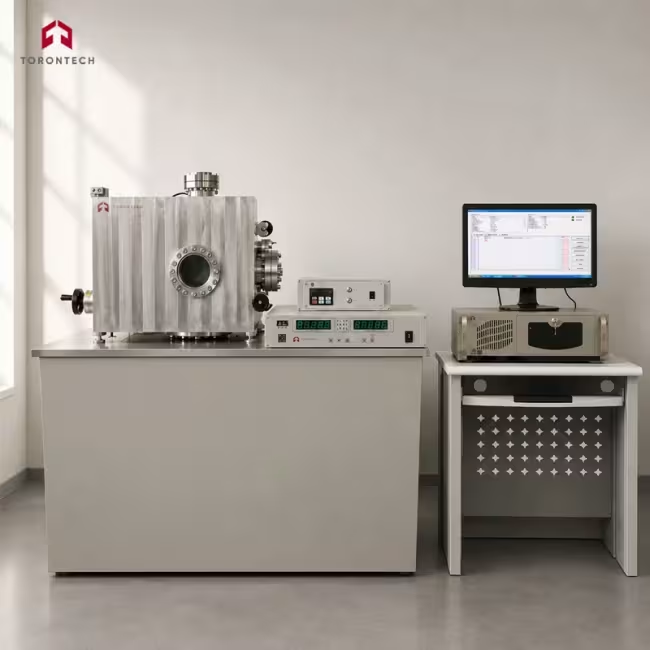
Vacuum Tribometer
Vacuum Tribometer - ToronTribo™ V
Vacuum Rotary Reciprocating Friction & Wear Tester
Vacuum tribometer measures friction and wear performance of materials and surface coatings under controlled vacuum conditions, serving aerospace, semiconductor, and materials-research laboratories. The ToronTribo™ V applies a low test force while the specimen moves through rotating or linear reciprocating motion inside a vacuum chamber, reproducing the near-absence of atmosphere that liquid lubricants and many coatings encounter in orbital and high-vacuum service. Operators track friction force and temperature in real time, with automatic shutdown or alarm protection when parameters exceed preset limits.
Because standard lubricants evaporate or break down in a vacuum environment, engineers rely on dedicated vacuum tribometers to validate how dry films, solid lubricants, and bare materials perform without atmospheric support. The ToronTribo™ V reaches a vacuum level of 10⁻³ Pa and a temperature range from ambient up to 600°C, allowing combined thermal and vacuum exposure during a single test. Test force, speed, frequency, and stroke length are all adjustable to match the low-load, precision contact conditions typical of aerospace mechanisms and small components.
Satellite component manufacturers, aerospace research institutions, and materials science laboratories use the ToronTribo™ V to screen coatings and dry lubricants before they reach flight hardware or vacuum-service equipment. Each test produces a continuous friction and temperature curve, giving engineers direct evidence of how a material pair behaves once atmospheric lubrication is no longer available.
Vacuum Tribometer - ToronTribo™ V Applications
The ToronTribo™ V supports friction and wear evaluation for components and materials destined for vacuum, high-altitude, or space service, where conventional lubrication behaves differently.
- Satellite and Spacecraft Mechanisms: evaluates friction and wear of bearings, gears, and sliding contacts used in solar array drives, gimbals, and deployment mechanisms exposed to space vacuum
- Solid Lubricant and Dry Film Development: screens self-lubricating coatings such as molybdenum disulfide and PTFE-based films that replace oils and greases in vacuum service
- Semiconductor Equipment Components: tests wear resistance of parts used in vacuum chambers and wafer-handling systems where outgassing and contamination control matter
- Aerospace Coating Qualification: assesses thermal-sprayed and hard coatings used on aerospace components exposed to combined vacuum and elevated temperature
- Cold Welding and Adhesive Wear Research: studies how metallic surfaces resist adhesive wear and cold welding when atmospheric oxide layers are absent
- Thin-Film and 2D Material Research: characterizes friction and wear behavior of thin films and low-dimensional materials under clean vacuum conditions
- Academic and Government Vacuum Tribology Research: supports fundamental studies of friction mechanisms in the absence of atmospheric moisture and oxygen
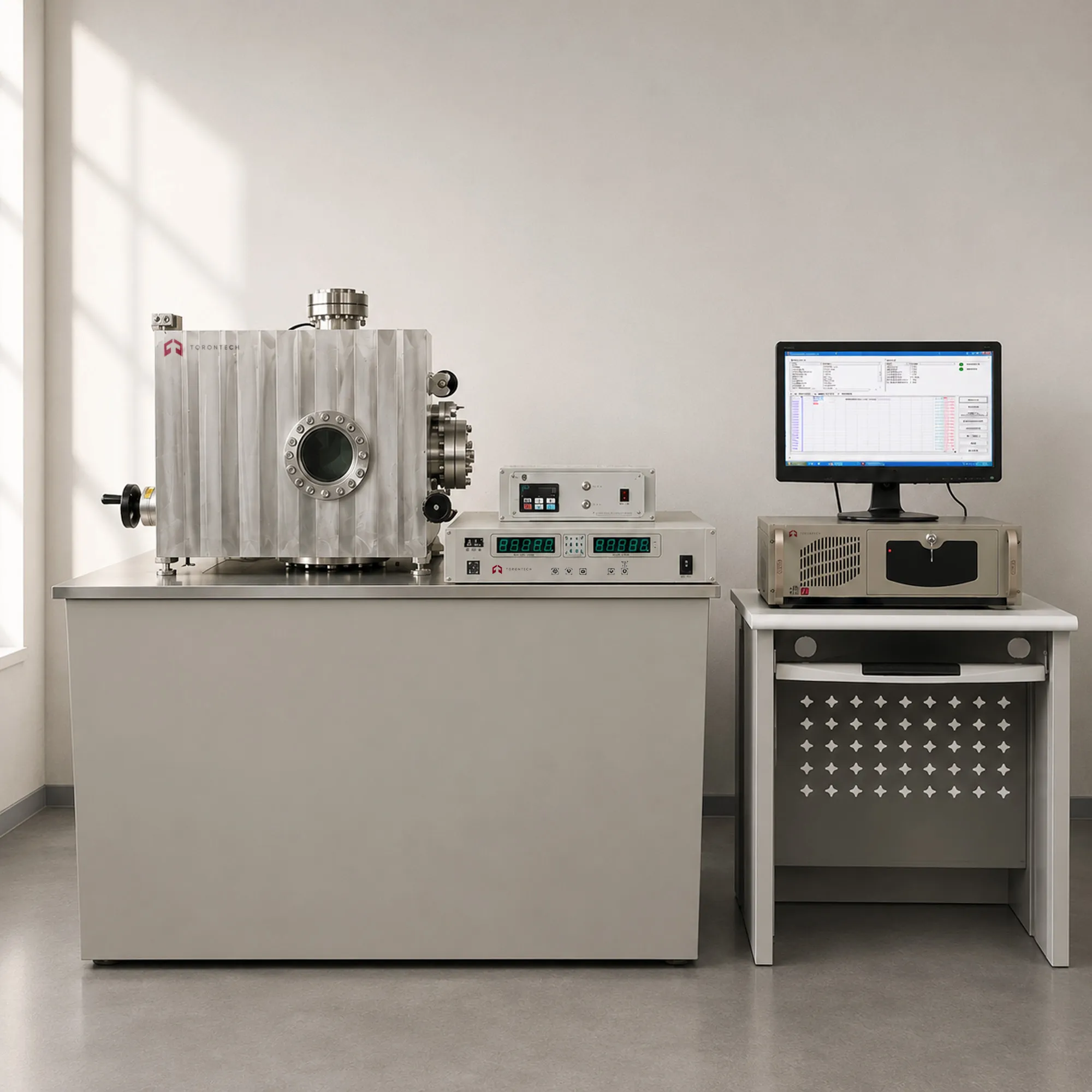
Vacuum Tribometer - ToronTribo™ V Key Features
The ToronTribo™ V combines rotating and reciprocating motion with vacuum and high-temperature control for testing materials outside normal atmospheric conditions.
- Vacuum Test Chamber: reaches a vacuum level of 10⁻³ Pa, reproducing the low-pressure conditions materials encounter in space and semiconductor vacuum equipment
- Dual Motion Testing: switches between rotating and linear reciprocating motion within the same vacuum chamber, covering two common contact geometries without breaking vacuum between setups
- Elevated Temperature Capability: operates from room temperature up to 600°C, allowing combined thermal and vacuum exposure in a single test
- Low-Force Precision Testing: applies test forces from 0.1 to 20 N, suited to delicate components, thin coatings, and small-scale contact studies
- Real-Time Friction and Temperature Monitoring: continuously records friction force and temperature and plots each parameter as a live curve during the test
- Automatic Protection Limits: shuts down or alarms automatically when key test parameters exceed preset thresholds, protecting samples and equipment during unattended runs
- Adjustable Motion Parameters: rotational speed, oscillation frequency, and stroke length are all user-configurable to match specific test protocols
Theory and Method
Friction and wear behave differently in vacuum than in ambient air, primarily because oxide films, adsorbed moisture, and airborne contaminants normally reduce adhesion between contacting surfaces. A vacuum environment removes or prevents these protective layers from reforming during sliding contact, so clean metal surfaces can adhere directly to one another, a phenomenon known as cold welding. This raises friction and accelerates wear compared to the same material pair tested in open air, which is why materials that perform well on the ground can fail unexpectedly once placed in vacuum service.
The ToronTribo™ V recreates this environment by enclosing the rotating or reciprocating test module inside a chamber pumped down to 10⁻³ Pa. As the specimen moves under a controlled test force, a sensor measures the resulting friction force while the vacuum system maintains the low-pressure environment throughout the test. Because liquid lubricants outgas and evaporate under vacuum, most tests performed on this platform evaluate solid lubricants, dry films, or bare material pairs rather than oil- or grease-lubricated contacts.
Combining vacuum with elevated temperature, up to 600°C on this platform, further stresses the test surfaces by accelerating diffusion, oxidation of any residual surface layers, and thermal softening effects. Running a candidate coating or material pair through this combined environment gives engineers a closer approximation of actual mission or process conditions than either a vacuum-only or a temperature-only test can provide on its own.
Vacuum Tribometer - ToronTribo™ V Technical Specifications
| Parameter | Specification |
|---|---|
| Test Force Range | 0.1 to 20 N |
| Maximum Friction Force | 20 N |
| Rotational Speed | 1 to 1,500 rpm |
| Maximum Rotational Radius | 30 mm |
| Oscillation Frequency | 0.1 to 10 Hz |
| Maximum Stroke Length | 30 mm |
| Reciprocating Friction Pair Forms | Ball-on-disc, pin-on-disc |
| Rotating Friction Pair Forms | Ball-on-disc, pin-on-disc |
| Temperature Range | Room temperature to 600°C |
| Vacuum Level | 10⁻³ Pa |