
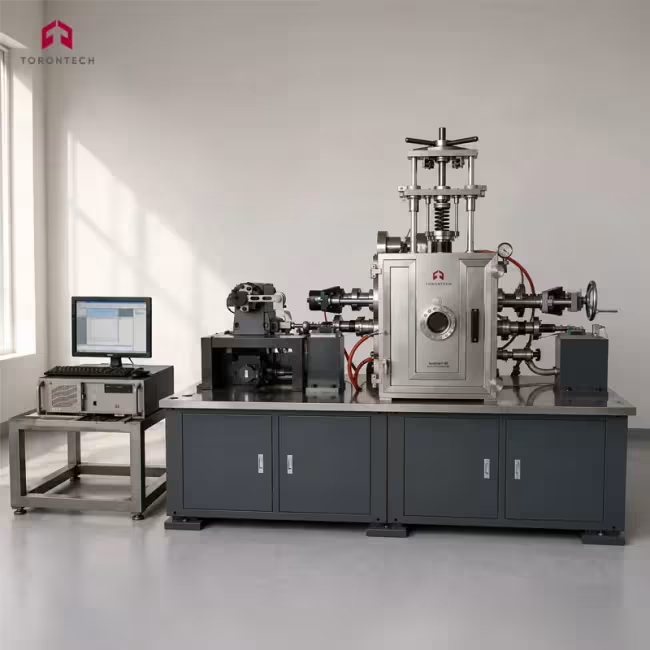
Vacuum Fretting Fatigue Tester
Vacuum Fretting Fatigue Tester - ToronTribo™ VFF
Fretting fatigue tester evaluates how small-amplitude oscillatory contact damages materials under sustained load, serving aerospace, power generation, and materials-research laboratories. The ToronTribo™ VFF applies a controlled contact force and drives a linear reciprocating motion across the specimen interface while operators vary load, frequency, stroke, temperature, and contact material to reproduce the micro-slip conditions found in bolted joints, dovetail attachments, and press-fit assemblies. The instrument runs tests in atmosphere, liquid, or vacuum, giving engineers a single platform for evaluating fretting behavior across different service environments.
Because fretting damage often nucleates fatigue cracks well before a component would fail from fatigue loading alone, engineers rely on dedicated testing to characterize this failure mode directly rather than inferring it from standard fatigue data. The ToronTribo™ VFF covers an amplitude range of 50 to 500 micrometers and a frequency range of 0.1 to 50 Hz, with temperature control up to 600°C for elevated-temperature fretting studies. Time control extends from single seconds to several days per test, supporting both short screening runs and extended fatigue-life evaluations.
Turbine and engine component manufacturers, aerospace research institutions, and materials science laboratories use the ToronTribo™ VFF to quantify how surface treatments, coatings, and lubricants reduce fretting damage before parts enter service. Manual or automatic stop control, triggered by time, speed, or friction force, protects the sample and instrument during unattended long-duration testing.
Vacuum Fretting Fatigue Tester - ToronTribo™ VFF Applications
The ToronTribo™ VFF supports fretting fatigue evaluation for components and materials where contact surfaces experience small oscillatory movement under sustained load.
- Turbine Blade and Disk Attachments: evaluates fretting fatigue at dovetail and fir-tree root contacts in gas turbine engines, where vibration-induced micro-slip drives crack initiation
- Bolted and Riveted Joint Assessment: characterizes fretting damage at structural joints in aircraft and machinery subjected to cyclic loading and vibration
- Wire Rope and Cable Fretting Studies: assesses wear and fatigue behavior at strand-to-strand contacts in wire ropes under tension and vibration
- Vacuum and Space Mechanism Components: tests fretting behavior of contacts operating in vacuum environments where atmospheric oxide films are absent
- Surface Treatment and Coating Qualification: measures how shot peening, coatings, and surface hardening treatments improve fretting fatigue resistance
- Bearing and Press-Fit Assembly Research: evaluates fretting corrosion and wear at interference-fit and bearing contact surfaces
- Power Generation Component Testing: assesses fretting fatigue life of steam and gas turbine components operating at elevated temperature
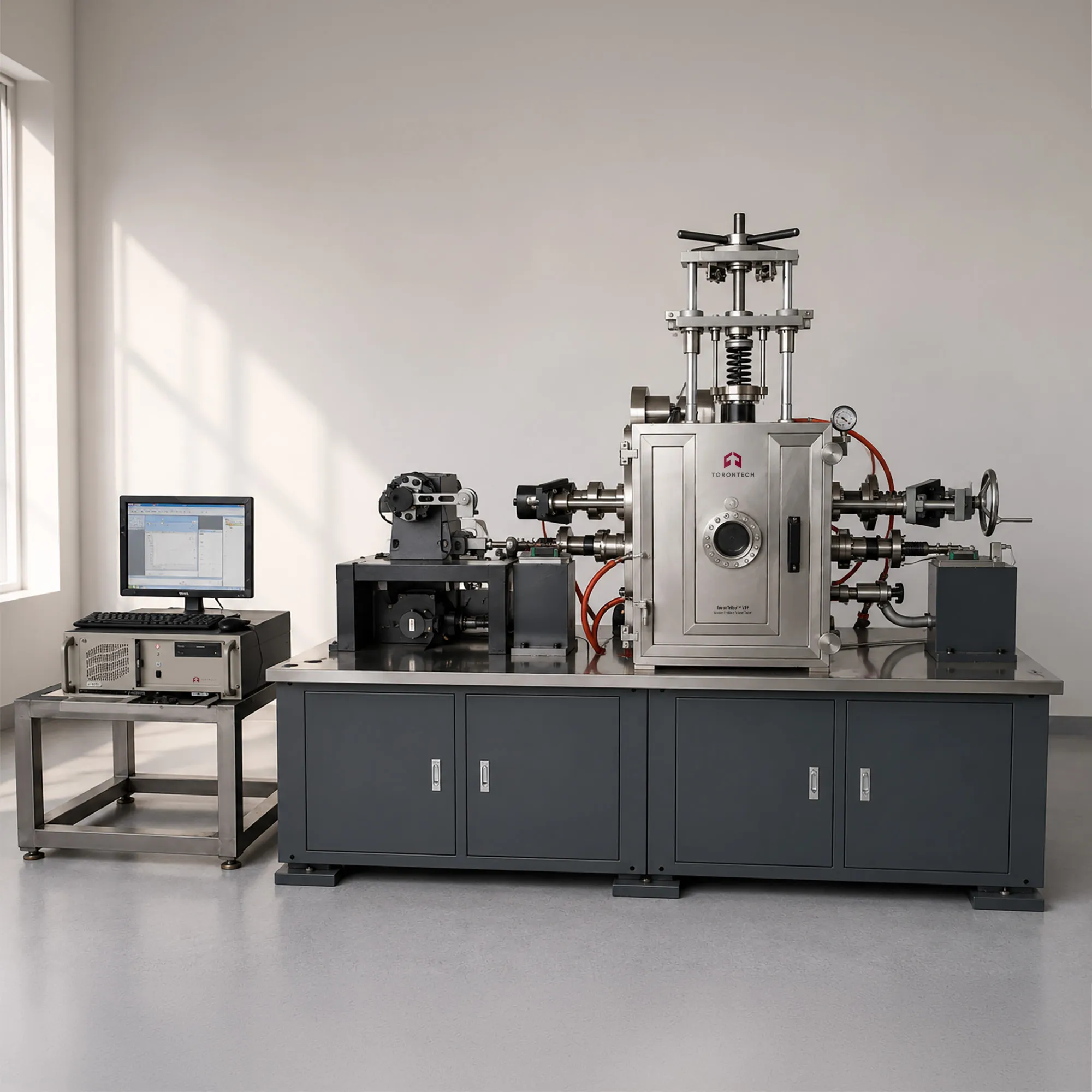
Vacuum Fretting Fatigue Tester - ToronTribo™ VFF Key Features
The ToronTribo™ VFF combines multi-environment testing with precise control over fretting motion and load.
- Multi-Environment Testing: runs fretting fatigue tests in atmosphere, liquid, or vacuum on the same platform, matching the test environment to actual service conditions
- High-Force Fretting Load: applies up to 2000 N of test force and 800 N of friction force for evaluating fretting behavior under demanding contact pressure
- Fine Amplitude Control: adjusts fretting amplitude from 50 to 500 micrometers to reproduce the small-scale micro-slip characteristic of real fretting contacts
- Wide Frequency Range: operates from 0.1 to 50 Hz, supporting both slow, detailed observation and accelerated fretting fatigue screening
- Elevated Temperature Testing: reaches up to 600°C, allowing fretting fatigue evaluation of components intended for high-temperature service such as turbine attachments
- Extended Time Control: sets test duration from 1 second to 9,999 minutes, accommodating both short screening tests and long-duration fatigue-life studies
- Automatic and Manual Stop Control: halts testing automatically based on time, speed, or friction force, or allows manual stop for operator-controlled test sequences
Theory and Method
Fretting occurs when two contacting surfaces experience repeated small-amplitude relative motion, typically in the range of tens to hundreds of micrometers, while under a sustained normal load. Unlike conventional sliding wear, this micro-slip is too small to fully separate the contact surfaces, so wear debris and oxide particles become trapped at the interface instead of clearing away. The trapped debris increases local stress concentration and abrasion at the contact edge, where the transition between stuck and slipping regions creates a zone of intense cyclic stress.
Fretting fatigue combines this micro-slip damage with a separately applied cyclic bulk stress on the specimen, replicating how a bolted joint, dovetail attachment, or press-fit assembly experiences both contact fretting and structural fatigue loading at the same time. The ToronTribo™ VFF applies a controlled normal force through the fretting contact while the reciprocating drive generates the oscillatory micro-slip at the set amplitude and frequency. Cracks typically nucleate at the edge of the fretting scar, where stress concentration is highest, and can propagate into the bulk material at fatigue stress levels well below the material's normal fatigue limit.
Testing environment strongly influences fretting fatigue life, since atmospheric oxygen and moisture affect oxide formation and debris behavior at the contact interface. Running the same material pair in atmosphere, liquid, and vacuum on the ToronTribo™ VFF lets engineers isolate the effect of environment from the effect of load and motion parameters, producing data that better predicts how a component will perform in its actual service condition.
Vacuum Fretting Fatigue Tester - ToronTribo™ VFF Technical Specifications
| Parameter | Specification |
|---|---|
| Maximum Friction Force | 800 N |
| Maximum Test Force | 2000 N |
| Amplitude Range | 50 to 500 μm, adjustable |
| Reciprocating Test Frequency | 0.1 to 50 Hz, adjustable |
| Temperature Range | Room temperature to 600°C |
| Time Control Range | 1 second to 9,999 minutes |
| Test Medium | Atmosphere, liquid, vacuum |
| Stop Control Mode | Manual or automatic (time, speed, friction force) |