
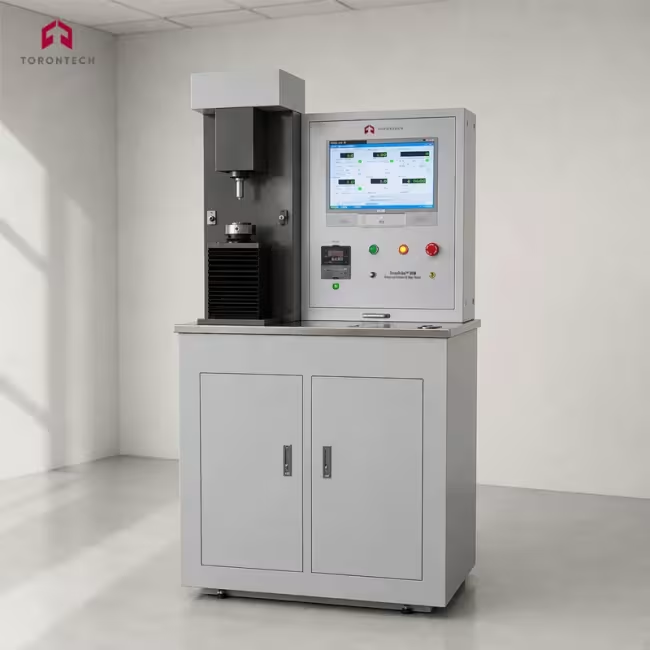
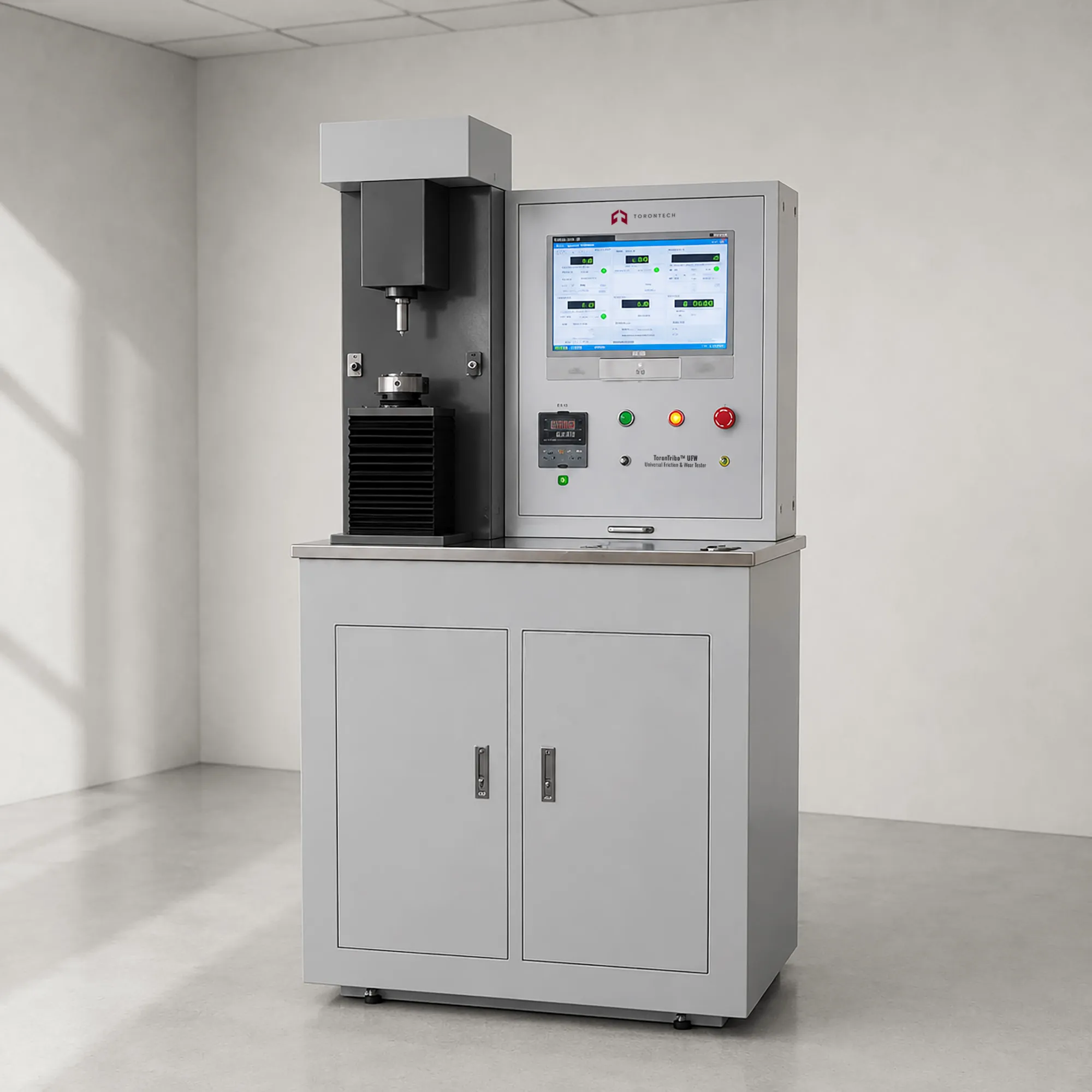
Universal Friction & Wear Tester
Universal Friction & Wear Tester - ToronTribo™ UFW
Universal friction and wear tester evaluates friction and wear performance across point, line, and surface contact configurations on a single platform, serving materials laboratories, bearing manufacturers, and lubricant developers. The instrument accepts pin-disc, ball-disc, thrust ring, and four-ball friction pairs, letting operators reproduce rolling, sliding, or combined rolling-sliding motion depending on the contact type under study. A servo motor drives the spindle with stepless speed control, giving precise, repeatable test conditions across a wide range of applied loads.
Operators adjust temperature, load, speed, friction pair material, surface roughness, and hardness, and select from no lubrication, drip lubrication, or oil-immersion lubrication to match real service conditions. The tester reaches up to 1000 N of normal force, spindle speeds up to 2000 rpm, and heating up to 260°C, with manual or automatic shutdown control for unattended operation. Test medium options extend beyond oil to include air, water, mud, and abrasive slurries for applications outside standard lubricated contact.
Materials researchers, bearing and bushing manufacturers, and lubricant formulators use this tester to screen candidate materials and lubricants across multiple contact geometries without switching to separate single-purpose machines. The combination of four friction pair types on one platform makes it a practical choice for laboratories that need broad tribological testing coverage.
Universal Friction & Wear Tester - ToronTribo™ UFW Applications
The universal friction and wear tester supports friction and wear evaluation across industries working with varied contact geometries and lubrication conditions.
- Self-Lubricating Bearing and Bushing Testing: measures wear rate and coefficient of friction of self-lubricated materials using the thrust washer configuration
- Plastic, Rubber, and Ceramic Materials Testing: evaluates wear resistance and fatigue performance of polymers, elastomers, and ceramics under varied contact conditions
- Metal and Metal Composite Materials Research: assesses wear resistance and fatigue properties of metals and metal matrix composites under rolling and sliding contact
- Lubricant and Grease Screening: compares friction and wear performance of oils and greases across pin-disc, ball-disc, and four-ball contact configurations
- Thrust Bearing and Ring Contact Testing: characterizes wear and friction behavior of thrust ring and washer components under axial load
- Multi-Material Comparative Testing: screens multiple candidate materials or coatings against a common reference material using consistent contact geometry
- Abrasive and Non-Lubricated Wear Research: studies material wear behavior under dry, water, mud, or abrasive slurry conditions beyond standard oil lubrication
Standards
The universal friction and wear tester supports test procedures aligned with internationally recognized ASTM standards for thrust washer and pin-on-disk or ball-on-disk friction and wear testing.
- ASTM D3702-94(2019) - Standard Test Method for Wear Rate and Coefficient of Friction of Materials in Self-Lubricated Rubbing Contact Using a Thrust Washer Testing Machine
- ASTM G99-23 - Standard Test Method for Wear and Friction Testing with a Pin-on-Disk or Ball-on-Disk Apparatus
Universal Friction & Wear Tester - ToronTribo™ UFW Key Features
The universal friction and wear tester combines multiple contact geometries with adjustable load, speed, and lubrication control.
- Four Friction Pair Configurations: supports pin-disc, ball-disc, thrust ring, and four-ball setups, covering point, line, and surface contact on one platform
- Servo-Controlled Spindle Drive: delivers stepless speed control up to 2000 rpm for precise, repeatable test conditions
- High-Capacity Loading: applies up to 1000 N of normal force for evaluating materials under demanding contact pressure
- Selectable Lubrication States: switches between no lubrication, drip lubrication, and oil-immersion lubrication to match real service conditions
- Broad Test Medium Compatibility: runs tests in air, oil, water, mud, or abrasive media beyond standard lubricated contact
- Elevated Temperature Testing: heats up to 260°C, allowing wear evaluation under combined thermal and mechanical stress
- Manual and Automatic Shutdown Control: stops testing manually or automatically, supporting both supervised and unattended operation
Theory and Method
Different contact geometries produce different friction and wear behavior even for the same material pair, because the shape of the contact area determines how stress distributes across the interface. A pin-disc or ball-disc setup concentrates contact at a point or small area, producing high local stress for a given load. A thrust ring or thrust washer configuration spreads the same load across an annular contact area, lowering local stress but introducing continuous circumferential sliding. A four-ball configuration adds multiple simultaneous point contacts, useful for evaluating lubricant film strength under combined rolling and sliding.
The universal friction and wear tester applies a servo-driven spindle to rotate the friction pair at a controlled speed while a normal force loading system holds the applied load constant. A sensor measures the resulting friction torque, and the ratio of friction torque to applied load, adjusted for contact geometry, yields the coefficient of friction. Because the spindle drive and load system remain constant across friction pair types, switching between pin-disc, ball-disc, thrust ring, and four-ball configurations lets engineers isolate the effect of contact geometry from the effect of material or lubricant choice.
Lubrication state further changes the friction and wear result, since a full oil-immersion condition maintains a continuous film at the interface while drip lubrication or dry operation allows more direct asperity contact. Running the same material pair across multiple lubrication states on this platform shows engineers how sensitive a given material or lubricant combination is to lubrication quality, information relevant to both component design and maintenance planning.
Universal Friction & Wear Tester - ToronTribo™ UFW Technical Specifications
| Parameter | Specification |
|---|---|
| Maximum Normal Force | 1000 N |
| Maximum Friction Torque | 2.5 N·m |
| Spindle Motor Type | Servo motor |
| Maximum Spindle Speed | 2,000 rpm, stepless adjustable |
| Test Medium | Air, oil, water, mud, abrasive, and others |
| Heater Heating Range | Room temperature to 260°C |
| Shutdown Control Mode | Manual or automatic |
| Friction Pair Forms | Four-ball, pin-disc, ball-on-disc, thrust ring |